To Whom Much is Given

For unto whomsoever much is given, of him shall much be required.

That’s a passage from Christian scripture, but it’s a precept that I’ve read, heard and seen in the texts and teachings of other religions, and it’s commonly enough reflected in social policy and proposals for humane and ethical action in all sorts of places that it deserves more general notice and attention, I think. There seems to be an underlying assumption amongst many people of all kinds and cultures that if one of us has more than another and that other is in need, one ought to take some responsibility for her neighbor’s well-being and share the resources. It’s arguably a foundational principle of civility and hospitality everywhere.

Yet it’s practiced so much less often than is possible. For all of my love of time with friends and family, I also crave quiet and reclusive time, shutting out the world and curling into my own self, and that applies to all parts of my life. And I think that’s probably more common than not. Who does not prefer the company of her own self or her very small circle of kin and kind, especially when the workaday world has seemed particularly demanding and rest and retreat as hard to come by as clear water in the swamp? Who doesn’t covet the privileges she feels she’s chosen and earned for herself?

I was reminded of this particularly when we were in Hungary this summer and I had the privilege of going with a number of the touring choir members and my husband to visit the ancestral home of a hereditary Count and his wife the Countess. The Count himself made only a brief appearance at the end of our visit, his wife having participated with staff and supporters in the greeting of our group, speechmaking about their work with orphans and special needs children in the family-sponsored home on the grounds of the residence, and a small but lovely reception in the main public-room of the place, a large parlor filled with art and artifacts passed down through the lineage. The Count was charming and rather cheery when he did appear, but I sensed that he preferred his privacy as well.

The Countess, on the other hand, had a rather regal bearing and while she was generous in hosting us and very willing to share her home and thoughts with the group, I heard some quiet comments aside that she seemed a touch condescending or even a bit put out by our visit. I had been at the back of the room during her parlor commentary about the family history and the work of the orphanage, not able to see her over the number of people in the room, and her tone was very subdued, so I got the gist of the story, but didn’t see any of the expressions that might have influenced the commenters.

What I did hear was probably a fairly common tale among the nobility in Europe during the previous centuries: a privileged kinship, whether by their own efforts or honors conferred upon them by royalty, this family had done as they were both able and expected to do with their wealth, which was to live quite elegantly and surround themselves with art and beautiful landscaping and magnificent homes. At the same time, they saw themselves very much as caretakers of the larger community, responsible for the well-being not only of the people who staffed their private holdings but those living in proximity as well. This is of course the story of noblesse oblige, a practice of good that may have been at its core a defensive move but served the purpose in any event. Like many noble families, the one we visited had essentially founded a town around themselves over the generations, supporting educational or healthcare or other needed resources and, in this instance, building a magnificent basilica where the town could worship and where, not coincidentally, the touring choir were performing on the evening of our visit in a benefit concert for the children’s home.

Also like so many other noble families, this one had gradually seen its fortunes decline in the years between the World Wars, and on advent of German action in the region in World War II, was ousted from their land and holdings and fled for safer places. Their palatial home first became military headquarters during that war (in which the Hungarians quickly and brutally learned that their alliance with Germany was a general pretext for annexation and Nazi rule), and then was used for Communist offices in the years after. It wasn’t until just a few decades ago that the Count and Countess were able to return to his family property and renew their residence in the place. The good news was that there had been no interest on the occupying military’s part in redesigning the buildings, nor any money for the Communists to do so, so the architecture remained for the most part intact. The bad news was born of the same circumstances, though: the military’s disinterest in redesign and the Communists’ lack of funds extended to any concern for maintenance. Naturally, the park in which the palace stood, the palace and outbuildings all fell into a state that even in their heyday the real owners could probably have scarce afforded to mend, and it all added to the sorrow that the art and fabulous book collections had been heavily looted.

This is a long way of saying so, but on the day we visited there, I stayed after the others had left that once-elegant parlor, pausing to thank the Countess and to ask her a couple of questions about what I understood were the Count’s and her attempts to resurrect some of the property, if only for the appreciation of the locals and the young wards and their caregivers now living in closer quarters with these two owners. Her tone, perhaps because she was no longer addressing a whole roomful of people, or maybe because she felt she didn’t have to represent her husband’s whole heritage anymore, not acting in any official capacity at the moment, softened greatly, and I sensed mostly melancholy. There was sorrow for what had been lost, yes, but after we spoke about that and the enormity of the restoration needs for a moment or two, I simply asked her in the middle of that once-glamorous hall if she had a personal favorite artwork in there.

It was almost as if she became for a moment the young bride who had come there with the Count before the war, a little in awe of his family and the wealth that surrounded them, the power and the weight of the name upon her shoulders seeming rather immense even in the midst of her happiness. I can’t say she became suddenly shy, though it seemed to me that there was the slightest hint of it as she walked across the room and, instead of choosing one of the showy ancestral treasures or superb museum-quality portraits but this moderate-sized, unrestored and slightly bleary, painting of peasant girls dancing around in an Impressionistic meadow, and said simply, “This one.” I asked her what made it so, and she did little more than offer a soft comment that it was pretty and it made her happy.

Digital artwork from a photo: The Countess's Favorite

This is my digitally painted version of the Countess’s beloved artwork, which besides being in great need of restoration was under glass and hard to see without much maneuvering. But even in its retouched state here, I think you can catch a glimpse of what filled her with such longing: a sense of sweetly carefree innocence that must seem now like a distant, faded dream.

And I thought that perhaps what had been asked of her, she who had had quite a lot at one time and might even be seen in town nowadays as a bit of a remnant of things past, was her innocence. It must have been a long, sorrowful journey from being a young lady inducted into the nobility by marriage and impressed, if not overwhelmed, by the lavish life and the heavy weight of what was expected of her in her new role, to the life she knows now. However she and her husband might work to regain a place in the community through their labor and largesse, the world has changed, and they with it.

What must it have been like, as she moved through the war and later years in exile, knowing that everything tangible she had known at home might well be gone? On returning long after, though she saw that it wasn’t demolished, her happy ease was clearly broken and irretrievably changed. Finally, settling into her new role as figurehead of a still somewhat nebulous but ambitious attempt to find a way to make all that was left have real meaning again, looking into that painting must have become rather like looking into a mirror at her past self, not as a dancing peasant girl but as a naïf who thought the world was simple and clean and kindly and that all she had to do was make the best of what had been given to her in order to be happy in it.
Giggling among the Snapdragons

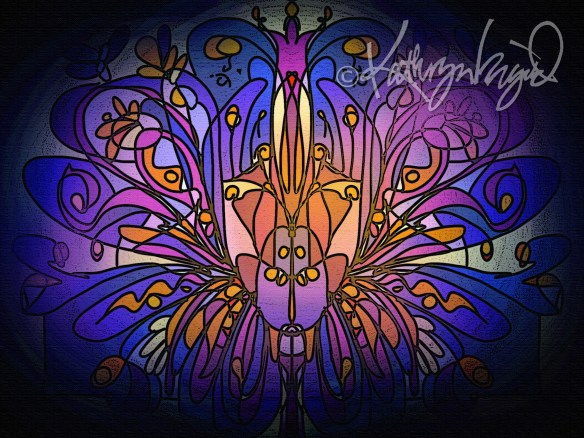
Digital illustration: Exploding SnapdragonSo many real-world things have such fanciful names that it’s a pity we really don’t pay much attention to them very often. Magical, rollicking words and names just roll off our tongues like music, yet we fail to pause and marvel at the wonderfulness of the sounds or ideas contained therein. If we must talk and listen and cogitate, why not relish, too, the sheer flavorful euphony of the language in which we do it?

I know, even as someone who barely manages a few words and phrases in various other languages (most of these, not surprisingly, food-related), that each language has its own elements of amusement, astonishment and alchemy embedded amid the ordinary terms and concepts of everyday use.

In the vestibule is one of the most wonderful of places one can be, in my estimation; it’s not for any innate fineness or elegance or appeal the room itself may well have or that being in it might confer upon me, but rather for the arcane and esoteric quality of the very word Vestibule, which leaps from lip to tongue to tooth with alacrity and verve long since arrested in lesser words that we use too commonly. For the same reason, one should seek out Encumbrances and Perspicacity, Snapdragons and Doodling and Capybaras: no such thing as a mere dictionary can explain the depth of pleasure derived from slurping the juices of a luscious, under-exercised word.

But What of the Camel?

Ha! Once again, I seem to have failed to press the Publish button yesterday. I just noticed that this post was still queued up and not yet available on the blog, so I guess it’s a two-fer day today. Appropriately enough, it’s a post on my natural gift for failing to blend in with the herd. Make of that what you will!Digital illustration: Camel CompanionI think I may have mentioned before that there is a ranch only a short distance from where I live that raises bison, a herd whose distinctive companion is a camel. When my spouse and I were out on a little expedition in the area recently, the bison were even nearer the road than usual, and to my delight there were among them many calves of the season. We are generations away from the time when bison covered the American plains in masses that blackened the grasslands from one edge of the horizon to another, so it’s a pleasure to see even modest groups of them thriving and growing as they do in protected places like this one anymore.

But where was the camel?

It’s possible that the two times we passed the pasture that day, the camel was on its dromedary coffee break in some less visible spot toward the back of the fields. Maybe there is more to the bison herd than I know, and the camel was on duty, keeping the other bovine bunch company elsewhere. A little part of me couldn’t help but puzzle and worry over it, though. Camels can grow old and die like the rest of us, I assume. What a pity if this one camel should have died. I would be sad if I knew that to be the case.

It’s surprising, perhaps, that I find myself thinking about a camel and wondering about its welfare. It’s only partly made clearer by recognizing the seeming strangeness of a camel being at home in north Texas in the first place and the further oddity of said camel being companion and guardian to a herd of American buffalo.

Then again, not so surprising. I am, after all, something like a cousin to this unique camel. As a native Northwesterner who has always lived well north of the Mason-Dixon Line until moving to Texas five years ago, I am by definition a foreign body, an alien, in Texas, no matter how at home I find myself among the locals. As the perpetual listener at the back of  choir rehearsals, unable to make my vocal folds cooperate dependably enough to sing along, I am affiliated with the herd in a way that is very meaningful to me and that I take seriously not only as a source of pleasure but as support for my singing, conducting, and accompanying friends, but I am still not a part of the herd myself.

So it matters to me to know that all is well with that mysterious and slightly humorously incongruous camel. And I’ll keep you posted on the bison-loving camel that is me.

A Beautiful Day in the Neighborhood

I didn’t know if I should tell this secret, since it wasn’t entirely mine to tell, but now that I see she posted about it too, I can brag that I will have a fabulous family of new neighbors in just a few months! This is the second time I’ve gotten to meet blogging friends in the real world, and the second time it’s happened because they moved to the same town where I live, a double bonus in my experience. First, it was the estimable man and marvelous photographer/artist Ted Griffith who arrived with his lovely wife and landed in this place that’s turning into a tiny hotbed of blogging, apparently. I got to tell you about that happy crossing of paths earlier.

Now I’ve also had a fantastic visit from the fabulous Marie and her charming and delightful husband and granddaughter, who will move into this same town, just down the pike from us, along with another two members of the family and brighten the north Texas landscape yet further. What a superb and unexpected benefit of blogging. Life is so full of happy surprises!

I suggest you have a nice visit to both of their blogs, tout de suite—Ted’s very inspiring photography and photo-based artworks can be found at Ted Griffith’s Blog and Marie’s world of wonders resides at (for now, anyway) her own little corner of Rhode Island. I’m just guessing there may be a quick little change of blog title somewhere in Miss Marie’s future, if you know what I mean.

The more important purpose of my post today, of course, is to celebrate that serendipitous joy of worlds colliding in the happiest of ways. I have been the blessed and blissful beneficiary of many of the marvels of this ever-smaller world’s confluences and connections. There’s such joy to be found in the miraculous meetings of the wildly interconnected world, and it’s amazing how often the seemingly unrelated threads and paths of our existence meet. What’s not to like about finding the commonalities and happy relationships between us by having our separate and distinct journeys intersect in unpredicted and wonderful ways!

Digital illustration: Confetti

Let’s throw a little confetti and a ticker tape parade in honor of serendipitous connections, my friends!

Costume Jewelry & the Genuine Article

Digital illustration: Costume JewelryAs an inveterate magpie, I’m admittedly enchanted by almost anything sparkly and glinting that happens to catch my eye. A flash of reflected sun from a momentary wavelet on a lake at eventide is no better or worse than a shred of tinfoil glimmering from the dark recesses of a trash bin, when it comes to attention-getting power. I wonder at times whether this attitude of mine spills over into accepting cheap substitutes for the real thing in areas of life and knowledge that matter far more than mere visual stimulation does.

Do I pay enough attention to my life and all of its contextual influences?

I do when I remember. But that’s never quite enough, is it? It can become a plain old excuse to say ‘I’m only human.’ So much more power is given us, if we dare to exercise it. No matter what my beliefs and convictions are, if I’m given the capability of questioning and examining them and growing through deeper listening and learning, should I not use that power fully and joyfully? I am reminded often enough by my failures and faults that I can only engage this discernment usefully for myself and have neither the power nor the right to assume my journey will apply to all (or indeed, any) others. This sojourn of learning, questing and listening, and yes, looking at both the shiny objects and those seemingly dull ones presented to me will lead, if I am both fortunate and patient, determined and humble, to a treasury more valuable than all of the scintillations in a world of costume jewelry.

More Woolgathering, of Course

Silliness is never an entirely baaaaad thing. I can always find more room for it in my life; it doesn’t get my goat, and I am neither sheepish in the face of it nor cowed by such things. So mooooove on over here and join me in the laughs.
Pastel drawing + text: Wool Gathering

Parked Her Carcase

Digital illustration: Belinda Babbitt

Speaking as a person whose sense of direction can barely get me from my own front door to the kitchen and back without assistance, I have a certain empathy for even the fictional characters who lose their ways in the world. Not so much so that I don’t laugh up my sleeves just a little at their plight all the same, since they are, after all, make-believe…
Digital illustration + text: Parked

Cat & Rabbit Go to Town

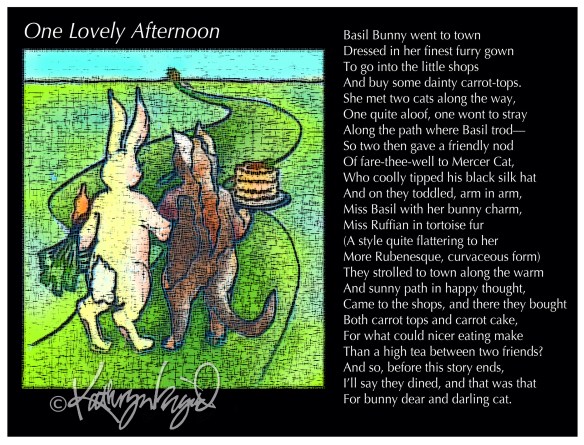
My sister’s cat Mercer has been sick and suffering for a while lately with some mystery malady, and his symptoms have thus far refused to explain themselves to his faithful veterinarian, so we’re in a watching, waiting and hoping phase. It’s sad and frustrating, and poor Mercer needs some serious respite from his ailments. I’m afraid I haven’t the skill to give him anything more palliative than the occasional pettings he allowed me to give him while we shared living quarters this summer. So I send out this little ditty to bring him good vibes of well-wishing long distance, as it stars the two most faithful fellow fur-babies who live or visit in his home, Ruffian the cat and Basil bunny.

Digital illustration + text: One Lovely Afternoon

The Hours of the Day

Some pieces of music have an especially profound affinity with particular times of day. Those composed deliberately for such hours are of course likelier to fit so well, but even among them there are certain works that are so miraculously fitting they almost seem impossible to separate from their appointed times. Much music composed for the divine offices and devotions of the Roman Catholic church recognizes such affinities because, like many prayers and devotions in other faiths, these practices are meant to be performed at specific times of the day and evening. Like the muezzin‘s call to the mosque, a moving chant or song suited to the hour sets the heart and mind in just the right place for the meditations and oblations of the time.

I wrote this poem long ago and came across it again, remembering that it was written while listening to a specific Angelus played on the organ—Marcel Dupré’s, if I’m not mistaken—and being struck by that wonderful meeting of sound and spirit in it.Painting + text: The Angelus

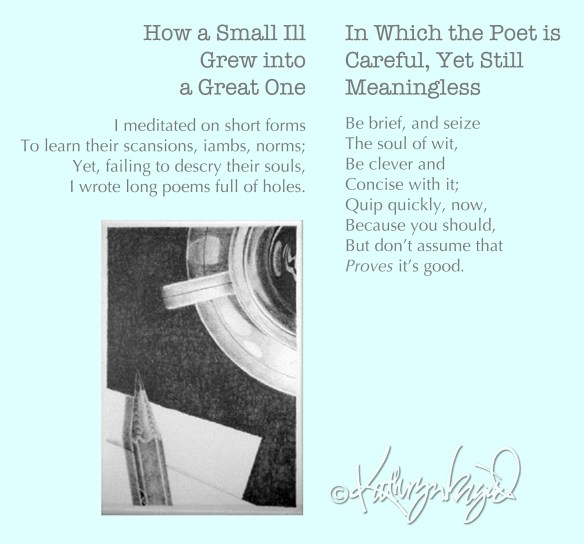
The Miniaturist’s Challenge

When my family and friends were conscripted to help install the artwork for my master’s thesis exhibition, they could not help but note that it would have been a kindness on my part to specialize in something a little more manageable, say, postage stamp illustration. Hanging murals of up to nine by thirty feet in dimensions is admittedly more unwieldy than mounting a bunch of tidy little framed life-sized insect portraits or installing a series of elfin sculptures made from shirt buttons and walnut shells. Alas, though I did segue into much more portable forms in later years, it was not soon enough for my loved ones’ sakes.

My verbosity is a similar burden on my circle of acquaintance, as I am not famous for knowing when to shut up any more than I am known for limiting my opinion to those who have actually asked for it. But just as I have learned to appreciate and work at smaller and less physically demanding visual media along with my enjoyment of massive and messy kinds of art, I have a fondness for smaller and less epic essays and poems, too, and have been known to craft these with similar avidity. While scale in no way guarantees quality or lack thereof in any medium I know, it is sometimes a relief to me as much as to my friendly audiences when I get my kicks by producing petite expressions of my inventive urges.Graphite drawing + text: Movements in Miniature