Maybe They *Don’t* Make ‘Em Like They Used To…

Happy Birthday, Dad!Photo: Classic Models

Today is my father-in-law’s natal anniversary. Though I’ve no doubt he sometimes feels his age and then some, as all of us do, he remains marvelously youthful in his wit and charm in general, and like a certain favorite toy car of a somewhat similar production date (one passed around by kids in our family for many happy years), has all the more appeal, truth be told, because of all the stories behind the few dents and scratches.

Not only am I most fortunate among persons in having found life partnership with a best friend who suits me in ways I could never even have imagined, I got a fantastic package deal, his parents being from the beginning the best sort possible. I knew before I met them that they must be rather extraordinary to have produced such a dandy son who really liked, loved, and respected them, so I wasn’t all that nervous about the meeting, a fact all the more remarkable when you consider that I still struggled with a fairly extreme level of persistent anxiety at the time. I was more afraid of meeting my beloved’s then part-time housekeeper, an old-school German lady who clearly thought anyone hanging around with her adopted charge had better meet her rigorous standards. Maybe Irma paved the way to make Mom and Dad Sparks seem that much less intimidating. In any event, from that first time I met them I was quickly falling in love with them, too. In any case, it turned out that I had attached my heart not only to a great life partner but to a great life partner with great parents, who immediately became my parents along with the ones who gave me my birth.Photo: Elegance on Wheels

Our Dad S is a thoughtful, gentle, good-humored, positive person who served honorably in the Army, who with Mom S raised a pair of superb sons, who worked with computers from those early days when a single one still filled a massive, refrigerated room to when they became ever so much smaller yet far more powerful, and even trained for and had a post-“retirement” career as a Myotherapist. He continues to be curious and dedicated enough to keep taking classes, traveling, and beginning new adventures as a seasoned but lively octogenarian. He is indeed a man of a ‘certain vintage’ by now, having had many adventures and being the repository of myriad stories as a result, but never fails to have new tales to add to the inventory because his spirit is so lively.

Most of all, he has as loving and generous a heart as he always did, and makes me hope that he will have not only a lovely and fulfilling birthday celebration (or ten) for his birthday but as many more as possible. He is, after all, a classic.Photo: Classic Good Looks

Foodie Tuesday: A Balanced Diet

Photo montage: Fun with Fruit & VegetablesI appreciate good health and all of the dietary elements that can determine whether I’m healthy, and if so, just how healthy I am. I know that diet includes not only the things I eat but how I combine them, when I eat, how much I eat, and many more factors that interact to create the ever-changing state of good health I seek. I realize, too, that nutritionists and scientists and other dietary mavens are always learning new things, and nearly always getting new ideas, too, some of which they can prove and others, not so much. That doesn’t stop tons of people, including me, from becoming obsessed, however temporarily, with the latest dietary trends and tweaking our diets without always considering whether those new, however ingenious seeming, ideas have anything to do with how our own bodies operate best.

Huh.

Yeah, I’m always thinking of new and better ways to make my diet more seemingly ideal for me, and I have some goofy thoughts on the subject at the best of times, and that’s the truth. What I can say in my defense is that among the relatively few things I have managed to learn in my lifetime thus far is that there is a whole lot more involved in my health and well-being than food.

I love when I can find the balance I need in any day by eating when I’m hungry, stopping when I’m no longer hungry, and focusing on getting not only a reasonable apportionment between protein and fat and carbs and vitamins and minerals and all of that dandy stuff. I love when it’s satisfying to my taste buds as well. Most of all, I love when that’s all fitted into a balanced diet of being with loved ones, going wonderful places, learning new fun things, and not least of all, of making art. There are always going to be theories, guides, charts, Rules and expectations about what constitutes the ideal way to eat, from the old spa cures that had people eating nothing but blandness or drinking rather large quantities of vinegary-dry white wine to the FDA-approved Food Pyramid, to the various independent dietary regimes from Scarsdale to South Beach, from Paleo to the Perfect Health Diet. I’ll outlive some of them, and many more will follow me. My budget and schedule, my taste preferences of the moment, and the company I keep, will continue to change my dietary wants and needs as well.

As long as I can keep listening to music, writing and drawing, and surrounding myself with great and interesting people, I will feel well fed.

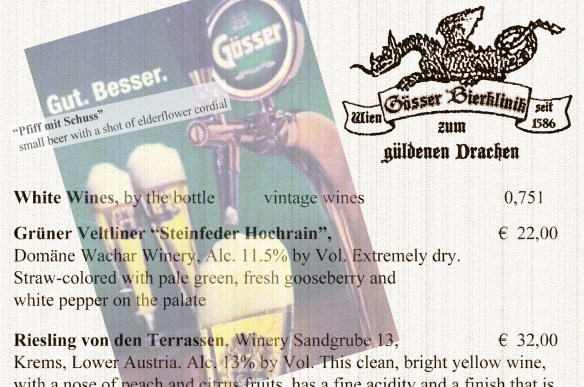
Photo montage: Another Balanced DietI need to tell you that there’s one sure way to have just the right diet, at least if you happen to be me and visiting Vienna. You just wend your way down a couple of funny little narrow byways and find the welcome that waits for you behind the door of the Gösser Bierklinik. That’s right: a clinic dedicated to beer. If that doesn’t make you feel better, you don’t know a healthy diet at all, wink-wink. Hail, Austria! It’s really a lovely old, old restaurant—don’t miss the neatly labeled Türkenkugel, the cannonball reputed to have been shot into the place in 1683 and still enjoying the pride of place where it sticks out of, or into, the wall.Digital illustration: Bierklinik Highlights

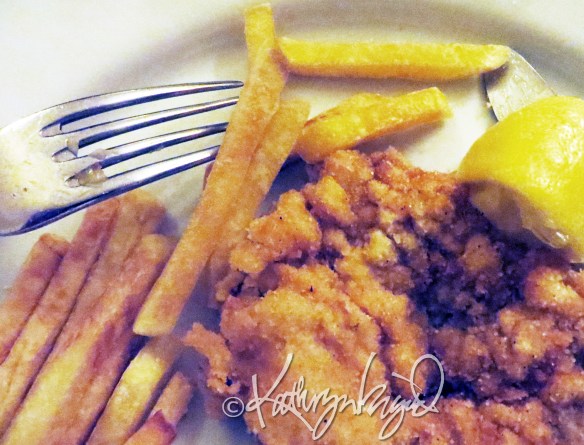
But don’t get hung up on ancient history too much, or you will miss out on one of the best Wienerschnitzeln I’ve had anywhere, and I am a fan, so I’ve enjoyed a few. The Bierklinik’s is tender inside, lightly seasoned, crispy on the outside, and unadulterated with anything other than the requisite lemon wedge for squeezing a drop or two of extra sunshine on it. Fabulous. Combine that with some ordinary but blazing hot fries and a bracing drink of anything from water to the titular beer, to what our server assured me was the ‘ladylike’ way to have a beer, a Pfiff mit Schuss, or beer spiked with elderflower cordial—I can’t speak to the waiter’s assertion, not being so incredibly ladylike myself, but it was a light and sprightly accompaniment to the Schnitzel, and given the perfectly convivial group with whom we were dining on the evening I tried it out (my husband and I were with three delightful friends, but also joined eventually in conversation with the marvelous German couple and his parents who were sitting at the next table), it was no more, and no less, effervescent than the conversation. Schnitzel, fries, a good drink and excellent company. Sounds like a perfectly balanced diet to me!Photo: Gösser's Schnitzel


Slipstream

Digital illustration from a graphite drawing: SlipstreamPeople often speak of the person ‘behind the power,’ the right-hand associate who always plays a large role in making the boss look good or the spouse who remains relatively unseen in the shadows while his or her partner is the well-known face of the duo, but I rarely hear anyone mention the full benefits of this kind of relationship. There are, of course, plenty who abuse such an arrangement as purely a platform for self-aggrandizement and advancement and treat their faithful supporters as unseen and unacknowledged slaves. An image comes to mind of the great old Jean Cocteau film ‘La Belle et la Bête,’ wherein the prince’s entire household was condemned by the curse he’d earned and continued to serve him, but even more abjectly, as virtually invisible helping hands. Even in the case of spouses and assistants and supporters who are treated with fairness and generosity and given regular recognition, however, there remains the probability that in normal circumstances, one is more visible and probably more publicly compensated than the other.

There can be, though, a handful of fine, if unexpected, benefits to this arrangement for the person behind the scenes. I think I can speak with a certain amount of authority, having been in this position both by default and willingly in various ways all of my life. I have always traveled in the slipstream of the leader, the marquee character in the act; I fly somewhere behind the lead bird in the V formation, hunt behind the chief lioness, swim behind the flashing silver of the strongest swimmer in the school of fish. I live in the slipstream of those wiser, braver, and more skilled than I am. And I like that very much. It allows me to see at close range where I am headed, led by the example of someone better prepared, while maintaining a sense of safety in my innate introversion and fearfulness from having to set the example or blaze the trail myself It offers me opportunities to find ways to help showcase those I admire in what they are and do best. It puts me on the periphery of events I would never, on my own, have had access to and often gives me the awestruck feeling that my privilege extends, through those I love, respect and admire, beyond any level I could hope to achieve or acquire alone.

I started early: as the next sibling born to a first child who was, and is, extremely bright and wide-ranging in her interests and accomplishments and unabashedly her own opinionated, funny, clever and challenging self—and admired by a great many others for it—I could easily have been, or felt, eclipsed by her. Instead, I tended to feel shielded and guided from the start; others (along with me) generally found her a more interesting focus for their attentions, so she bore the brunt of any critical scrutiny before I would ever feel any, and if there was any entertaining to be done, she managed quite effectively to keep the occasion afloat intellectually and/or with her trademark smart-alec witticisms. That she did all of this shielding of me and leading the way without my hearing much complaint or entitlement either one from her remains a marvel.

On top of that fortuitous training of mine in playing a willing and contented behind-the-lead role, I had parents who were the leaders in their community, too, and in a particularly exemplary version of this star + supporting player arrangement. Dad, the natural extrovert, led active congregations in his primary work role as a pastor and later, bishop, but always had parallel roles as chairman of this, board president of that, and consultant or advisor to the other; Mom, as his one-woman entourage, managed the household so that he was both free to do all of this stuff and looked after enough to be healthy, fed, rested and prepared as well as possible to do so to the best of his abilities. She was also his sounding board at home for anything of import that was underway in his life away from home, helping him to find his way to tough choices and decisions and think through all of the permutations of those situations that anyone tends to carry outside of official work hours. She stood as his consort for official functions, his representative when serving on committees and boards and doing community work as well.

Besides that my father’s work and status allowed me, again, to be quietly in the shadows while attending and participating in all sorts of events and occasions I’d never otherwise have had opportunity or reason to do, my mother was equally quietly setting an example for how to take advantage of all of that in a way that was mutually beneficial. During and through all of those years, I saw Mom come into her own as an equally respected leader among their community, a person looked to for influence and inspiration and committed, intelligent work, but all in her modest and unfussy way. When I finished graduate school and started working at my undergraduate alma mater as a teacher, it was near enough my parents’ house that I simply moved back in with them and paid the cheap rent that put me close to work affordably and, it turned out, in a position to train as the next-level behind the scenes person. Living there, I could keep the household running when they were on the road for work, be assistant-to-the-assistant when they were home by helping to set up for a few of the social obligations or special events tied to their work, and even get assistance from them when I was beginning to have such obligations of my own. By the time that I first went out with the man whom I got to marry, I was remarkably well-versed in the ins and outs of this sort of partnership.

I did, of course, have to learn new variations and nuances to the operation when he and I got together. My spouse is a music conductor. He teaches classes, like I did, but beyond this similarity of standing in front of classes and the variety of preparatory work that gets teachers ready for the classroom time, he had, and has, a much more publicly visible leadership role when he is in conductor mode. I am very glad to stay out of the limelight at those times!

The administrative and preparatory work, the selection of literature, score study, negotiations with guest performers, board interactions, service in the community, publicity commitments, writing program notes, collaborations with commissioned composers—these and so many other aspects of backstage life remain hidden from the public yet can’t be accomplished without time and concentration that are harder to afford if I’m not there to keep him in clean clothes and check that he’s had a meal or two, to chauffeur him to and from places where there’s no parking close enough to get him to a rehearsal on time, and yes, to be a sounding board for him when tough choices or decisions loom. I’ve learned a few things about music along the way, but not so much that I fancy myself anything like a musician or music scholar. But it’s the other parts of his life that I consider the arena for my contributions and participation. It’s the stuff that gets him to the podium that I think I can do best.

When my husband is conducting singers and/or instrumentalists in a concert, my role is to happily sit in the audience and bask in the music along with everyone else. My vocation, my modest part in earning our living, is to slide along in his slipstream and do what I can to keep impediments from holding him back or dragging him down, and whether that happens because I stand near him and shake hands with his bosses and supporters after a concert or because I took the car in for service while he was in administrative meetings doesn’t matter. I’m happy to be a small fish in the big pond as best I can.

Grandchildren (and Others) on the Loose

Digitally painted photo: Granny at PlayAt Granny’s House

That impish twinkle in her eyes

might lead you to hypothesize

that Granny’s up to something good,

and you’d be right, oh, yes you would—

There’s something in the oven now,

sweeter than Mama’s rules allow,

and some wild playtime to be had

surpassing anything that Dad

prefers, as well, and there’s a tree

you’ll climb, you and your sisters three—

Before your parents spoil the romp,

she’ll make her funny false teeth chomp,

make goofy faces, mad as yours,

all five will then get on all fours

and roll around the living room—

Eight-thirty! chimes the clock, and boom!—

Just as their car pulls up the drive,

you all head for the couch and dive

into a tidy line, as calm

and placid as a Dad and Mom

could hope to see, and Granny’s eyes are

twinkling. Parents?

None the wiser.Digitally painted photo: Playtime

While I was Sleeping (It Off)…

I’ve only twice thus far in my happy, healthy life been under anesthesia, at least when I was old enough to remember it. The first was during college, when I had my third molars removed, an act that I consider was more about wisdom on my part than on the molars’, despite their being commonly named “wisdom teeth”. It was good preventive medicine in my case, being the only invasive procedure I’ve ever had to have a dentist do and as a bonus, keeping me from getting them infected or impacted or, quelle horreur!, having them come in by shoving my naturally straight other teeth askew. I must have had a terrific anesthesiologist, because I don’t remember any particular suffering during or after the event, other than an unpleasant reaction to the first and only pain pill I took upon waking, and I was well enough after a day of devoted ice-packing by my mom to venture out to the mall the next day with the family, and dine comfortably on crisp green salad and toast.

The second time was when I underwent that happy coming-of-age ritual, the half-century tune-up of my chassis when I was given what felt like a really delightful extra night’s sleep so as to while away the time during which I had my colonoscopy. I, unlike other people, have no interest whatsoever in watching myself on TV in the process of receiving medical attention of any sort. Despite that potential glamor and entertainment of that approach, I felt myself cheerily fortunate in having a splendid nap instead, not to mention getting the desired clean bill of health in the bargain.

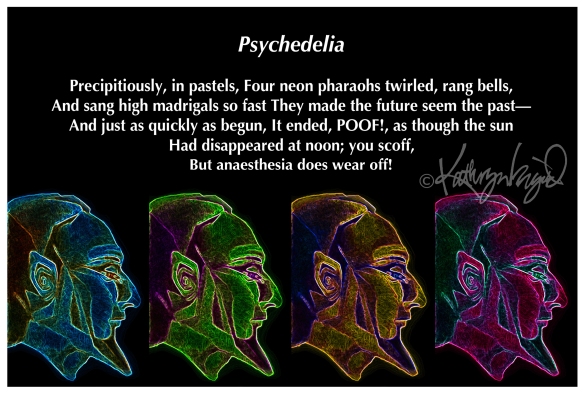
Though I’ve had limited personal experience with going under anesthetic, I certainly know plenty of people who’ve had all sorts of adventures with it, both good and bad. And I am all the more pleased, on knowing some of the tales of hallucinatory glory, that I have nothing to show for my own such trips but a gleaming set of straight choppers in my healthy jaws and an equally pristine stretch of plumbing in my abdominal regions. And I plan to have no further need of being anesthetized any time again soon, pretty please. Though I truly appreciate good medicine, I appreciate even more not needing any.Digital illustration + text: Psychedelia

Pessimism is Its Own Reward

—or recompense, at least!Digital illustration from photos: Gloom = Doom

Pessimism is Its Own Reward

To Whom Much is Given

For unto whomsoever much is given, of him shall much be required.

That’s a passage from Christian scripture, but it’s a precept that I’ve read, heard and seen in the texts and teachings of other religions, and it’s commonly enough reflected in social policy and proposals for humane and ethical action in all sorts of places that it deserves more general notice and attention, I think. There seems to be an underlying assumption amongst many people of all kinds and cultures that if one of us has more than another and that other is in need, one ought to take some responsibility for her neighbor’s well-being and share the resources. It’s arguably a foundational principle of civility and hospitality everywhere.

Yet it’s practiced so much less often than is possible. For all of my love of time with friends and family, I also crave quiet and reclusive time, shutting out the world and curling into my own self, and that applies to all parts of my life. And I think that’s probably more common than not. Who does not prefer the company of her own self or her very small circle of kin and kind, especially when the workaday world has seemed particularly demanding and rest and retreat as hard to come by as clear water in the swamp? Who doesn’t covet the privileges she feels she’s chosen and earned for herself?

I was reminded of this particularly when we were in Hungary this summer and I had the privilege of going with a number of the touring choir members and my husband to visit the ancestral home of a hereditary Count and his wife the Countess. The Count himself made only a brief appearance at the end of our visit, his wife having participated with staff and supporters in the greeting of our group, speechmaking about their work with orphans and special needs children in the family-sponsored home on the grounds of the residence, and a small but lovely reception in the main public-room of the place, a large parlor filled with art and artifacts passed down through the lineage. The Count was charming and rather cheery when he did appear, but I sensed that he preferred his privacy as well.

The Countess, on the other hand, had a rather regal bearing and while she was generous in hosting us and very willing to share her home and thoughts with the group, I heard some quiet comments aside that she seemed a touch condescending or even a bit put out by our visit. I had been at the back of the room during her parlor commentary about the family history and the work of the orphanage, not able to see her over the number of people in the room, and her tone was very subdued, so I got the gist of the story, but didn’t see any of the expressions that might have influenced the commenters.

What I did hear was probably a fairly common tale among the nobility in Europe during the previous centuries: a privileged kinship, whether by their own efforts or honors conferred upon them by royalty, this family had done as they were both able and expected to do with their wealth, which was to live quite elegantly and surround themselves with art and beautiful landscaping and magnificent homes. At the same time, they saw themselves very much as caretakers of the larger community, responsible for the well-being not only of the people who staffed their private holdings but those living in proximity as well. This is of course the story of noblesse oblige, a practice of good that may have been at its core a defensive move but served the purpose in any event. Like many noble families, the one we visited had essentially founded a town around themselves over the generations, supporting educational or healthcare or other needed resources and, in this instance, building a magnificent basilica where the town could worship and where, not coincidentally, the touring choir were performing on the evening of our visit in a benefit concert for the children’s home.

Also like so many other noble families, this one had gradually seen its fortunes decline in the years between the World Wars, and on advent of German action in the region in World War II, was ousted from their land and holdings and fled for safer places. Their palatial home first became military headquarters during that war (in which the Hungarians quickly and brutally learned that their alliance with Germany was a general pretext for annexation and Nazi rule), and then was used for Communist offices in the years after. It wasn’t until just a few decades ago that the Count and Countess were able to return to his family property and renew their residence in the place. The good news was that there had been no interest on the occupying military’s part in redesigning the buildings, nor any money for the Communists to do so, so the architecture remained for the most part intact. The bad news was born of the same circumstances, though: the military’s disinterest in redesign and the Communists’ lack of funds extended to any concern for maintenance. Naturally, the park in which the palace stood, the palace and outbuildings all fell into a state that even in their heyday the real owners could probably have scarce afforded to mend, and it all added to the sorrow that the art and fabulous book collections had been heavily looted.

This is a long way of saying so, but on the day we visited there, I stayed after the others had left that once-elegant parlor, pausing to thank the Countess and to ask her a couple of questions about what I understood were the Count’s and her attempts to resurrect some of the property, if only for the appreciation of the locals and the young wards and their caregivers now living in closer quarters with these two owners. Her tone, perhaps because she was no longer addressing a whole roomful of people, or maybe because she felt she didn’t have to represent her husband’s whole heritage anymore, not acting in any official capacity at the moment, softened greatly, and I sensed mostly melancholy. There was sorrow for what had been lost, yes, but after we spoke about that and the enormity of the restoration needs for a moment or two, I simply asked her in the middle of that once-glamorous hall if she had a personal favorite artwork in there.

It was almost as if she became for a moment the young bride who had come there with the Count before the war, a little in awe of his family and the wealth that surrounded them, the power and the weight of the name upon her shoulders seeming rather immense even in the midst of her happiness. I can’t say she became suddenly shy, though it seemed to me that there was the slightest hint of it as she walked across the room and, instead of choosing one of the showy ancestral treasures or superb museum-quality portraits but this moderate-sized, unrestored and slightly bleary, painting of peasant girls dancing around in an Impressionistic meadow, and said simply, “This one.” I asked her what made it so, and she did little more than offer a soft comment that it was pretty and it made her happy.

Digital artwork from a photo: The Countess's Favorite

This is my digitally painted version of the Countess’s beloved artwork, which besides being in great need of restoration was under glass and hard to see without much maneuvering. But even in its retouched state here, I think you can catch a glimpse of what filled her with such longing: a sense of sweetly carefree innocence that must seem now like a distant, faded dream.

And I thought that perhaps what had been asked of her, she who had had quite a lot at one time and might even be seen in town nowadays as a bit of a remnant of things past, was her innocence. It must have been a long, sorrowful journey from being a young lady inducted into the nobility by marriage and impressed, if not overwhelmed, by the lavish life and the heavy weight of what was expected of her in her new role, to the life she knows now. However she and her husband might work to regain a place in the community through their labor and largesse, the world has changed, and they with it.

What must it have been like, as she moved through the war and later years in exile, knowing that everything tangible she had known at home might well be gone? On returning long after, though she saw that it wasn’t demolished, her happy ease was clearly broken and irretrievably changed. Finally, settling into her new role as figurehead of a still somewhat nebulous but ambitious attempt to find a way to make all that was left have real meaning again, looking into that painting must have become rather like looking into a mirror at her past self, not as a dancing peasant girl but as a naïf who thought the world was simple and clean and kindly and that all she had to do was make the best of what had been given to her in order to be happy in it.
Water Babies Athirst

There was a whopper of a rainstorm in Dallas recently. We were at our friends’ home, enjoying a little birthday party, and heard a few low growls of thunder in pauses between the chatting and laughter but had no great confidence rain would follow. It’s been overcast or cloudy often enough lately without granting so much of the hoped-for watering as it seems to promise, so we never take it as a given that we’ll be watered nicely. Not, in this instance at least, until the front door smashed open under the force of sideways gales and blasts of firehose rain. Bashed open once, and closed; then, a second time. And latched tight; the neighborhood was pelted well and truly until just a little before we left for home.
Photo: Drinking-Fountain Fountain

At home, it appears, no rain had come at all. Our gardens and spirits remained thirsty. I’m quite certain that a coastal-born person of my Washington upbringing and Scandinavian roots is a little more water-conscious, if not obsessed, than average. But the hints of rain that do arrive here, whether in sky-splitting gouts that last but an afternoon or in a steady series of lightly sprinkling days as we are sometimes blessed to see, are a fairly universally admired gift. And I find that north Texas is hardly alone in this.
Photo: Swan Like

The traveling we did this summer in Europe had very few rainy days among the many sun-soaked ones, and while we neither regretted the warmth and light of the sunshine nor bemoaned the drizzling times, we saw plenty of people in Budapest, Vienna, Prague, Stockholm, Port Angeles and Seattle who relished their rain-baths and their waterfront or fountain-side relaxation every bit as much as we did. Even the swans, geese, ducks and waterfowl seemed all the more pleased with their daily peregrinations on the days of and after the rains.
Digital illustration from a photo: Falling, Falling

I think that there might be in all of us a certain kind of thirst that mere water only reinforces and reminds us is different from the sense of desire and hope that can fill our spirits. River or fountain, a strong and cleansing rain, ocean or streaming tears of joy, the only water that can quite slake our longing for wholeness and growth and hope is the remembrance that we are primarily made of water ourselves, and as such, will always seek a way to the well or the shore that reassures us we belong.

Another Wild Hare

When we revisited the lovely Bellevue Botanical Gardens with Mom and Dad Sparks this summer, there were some excellent new elements to enjoy throughout the park. As always, the plantings were bursting with color and perfume and native beauty, but in addition there was a handsome new educational and administrative building complex in the entrance of the place, a splendid new suspension footbridge spanned the ravine in the most thoroughly naturalized section of the gardens, and the progress in that segment toward fuller removal of the invasive plants is more impressive than ever.

One new addition we enjoyed on this visit to the Botanical Gardens was not listed anywhere in the visitors’ pamphlets, as far as I could see, but no less delightful, welcome, natural and local: a pert little wild rabbit who sat nibbling the grass next to the biggest flowerbed in the middle of that pretty afternoon. Never let it be said that there’s nothing new under the sun.
Photo: Funny Bunny

The Miniaturist’s Challenge

When my family and friends were conscripted to help install the artwork for my master’s thesis exhibition, they could not help but note that it would have been a kindness on my part to specialize in something a little more manageable, say, postage stamp illustration. Hanging murals of up to nine by thirty feet in dimensions is admittedly more unwieldy than mounting a bunch of tidy little framed life-sized insect portraits or installing a series of elfin sculptures made from shirt buttons and walnut shells. Alas, though I did segue into much more portable forms in later years, it was not soon enough for my loved ones’ sakes.

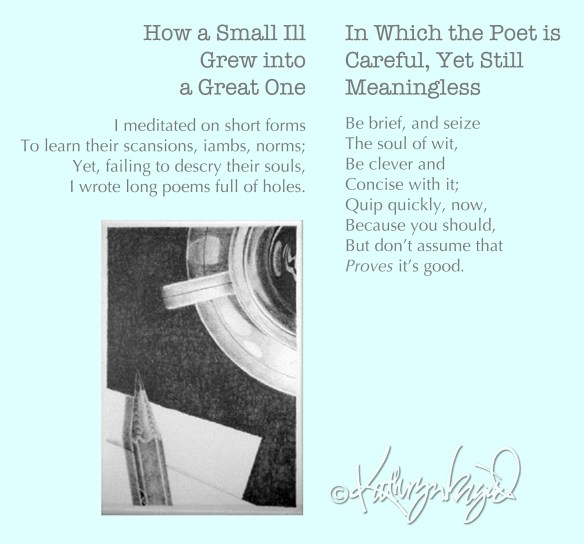
My verbosity is a similar burden on my circle of acquaintance, as I am not famous for knowing when to shut up any more than I am known for limiting my opinion to those who have actually asked for it. But just as I have learned to appreciate and work at smaller and less physically demanding visual media along with my enjoyment of massive and messy kinds of art, I have a fondness for smaller and less epic essays and poems, too, and have been known to craft these with similar avidity. While scale in no way guarantees quality or lack thereof in any medium I know, it is sometimes a relief to me as much as to my friendly audiences when I get my kicks by producing petite expressions of my inventive urges.Graphite drawing + text: Movements in Miniature