I’m in the Support Group for “I Can’t Help being Human” (Part 2 of a 3-part series)

Disclaimer: I’m no doctor, therapist, counselor, or genius. If this post about hope in the midst of depression and anxiety and related mental-health experiences is in any way true for you, know that it might be uncomfortable to read in the first place, but much more importantly, that reading it will not, cannot save you from your troubles. What you need is not a word of empathetic support from a fellow mortal with related experiences but genuine professional help, just as its what I needed first. Come back and visit me if and when you’re ready. If you don’t have any such problems, hurray for you! And read on anyway, because you might be able to help another person if you know better how she or he is living. Everyone’s truth matters, even when we don’t agree with or share it.

♥♥♥♥♥♥♥♥♥♥♥♥♥♥♥♥♥♥♥♥♥♥♥♥♥♥♥♥♥♥♥♥♥♥♥♥♥♥♥♥♥♥♥♥♥♥♥♥♥♥♥♥♥♥♥♥♥♥♥♥♥♥♥♥♥

Digital illo from a photo: Depression & Anxiety Cloaked the GardenI’ve recently met a new friend who is dealing with levels of anxiety and depression that sound like where I stood about a decade ago. It makes me both sorry for her struggles and incredibly glad I don’t have that same weight to carry consistently anymore myself. Depression and anxiety, especially the kind of chronic or recurring stuff, both work differently for everybody I know who deals with them, but one characteristic that I see pretty universally is that they can’t be cured or solved purely by smart practices. Real anxiety and clinical depression are inherently opposed to logic. They flatly refuse to listen to reason, and that is what makes us feel afraid, angry, useless, and without options.

It doesn’t help that some people who have never dealt with similar things can be ignorantly dismissive and believe that if we just shut up, pull up our socks, and get over ourselves all will be right in the world. I may know a perfect solution to my mental health problems, or a whole slew of solutions, and be able to imagine myself accomplishing the rescue flawlessly in my mind, but even if the means to that end is sitting less than an arm’s length from me I don’t have the clarity, will, or energy to make like a Nike commercial and Just Do It, not even if I sit staring at the conveniently available means all week long. Another classic and frustrating aspect of deep depression is that it saps us of energy, strength, and will to such a degree that we’re robbed of both clarity and the drive to do what we long most to do, even for the sake of those we love most dearly. It’s no wonder depressed people feel useless—they have been robbed of all of their power and hope, and worst of all, the culprit lurks right inside and can’t seem to be evicted.

When one’s brain or biochemistry can’t process the facts of the situation in sensible ways, the natural instinct is to curl up in a fetal position and hide from everything/one, including oneself. For me, when I’m in the middle of an acute anxiety attack or even a period of general anxiety, my rational brain can still assess the present situation quite neatly and spell out all of the logical explanations—what I could do to solve what’s making me anxious, and why I would be perfectly safe to just let go all of that discomfort—but I’m immobilized by anxiety instead and only feel more afraid, sick, confused, and as a bonus, tremendously guilty for “not taking my own good advice.”

It sounds, frankly, ridiculous to anyone who’s never experienced it, and even to me when I’m not stuck in an attack. But it’s the reality, and it’s awful. It has absolutely nothing to do with whether your life is good, with whether you’re smart, lovable, or desirable, or are surrounded by supportive people or wealth or any other grand resource you can imagine; you can have all of those things in abundance and still fight depression and anxiety. I have had a great life, with very few major causes for even normal kinds of sadness (you know, those well-known major stressors like the death of a loved one, changing jobs, moving to a new home, and so forth), yet when I finally ‘crashed’ with clinical depression in my 40s, I learned that I had probably had not only previous periods of severe depression in my life but also chronic anxiety all of my life. The lack of obvious causes or catalysts for the existing state in an otherwise pretty charmed life only further confirmed my doctor and therapist’s diagnoses—in my case, of an inherent chemical imbalance that various “triggers” simply helped bring to the surface periodically and that, over time, became harder to manage without both counseling and medication.

This may all be TMI for a non-sufferer or casual passerby, but I think it helps explain a few rather useful things. Again, these are my own thoughts and experiences, not yours. Only you can find your way through them.

Those who do experience various forms of mental illness are far from alone. I happen to believe that mental health, along with all sorts of other aspects of personal health and identity, is not merely a ‘spectrum’ of states or conditions, but a cloud of them, a thick and rich matrix in which each of us is created. That in any one person, his, her, or my place in all of the matrices of physical and mental health, skills and interests, sex identification, attitudes and beliefs, and the many other aspects of humanity that make us our individual selves shifts gradually but constantly, however the pace may vary from one time or characteristic to another. If I multiply all of the changes within one such self-identity matrix by how many different matrices of personality can make up the whole and how much they are likely to shift their Me point of intersection over a lifespan, it seems entirely probable that everybody hits the occasional crossroads of whatever for them qualifies as less than prime mental health and well-being.

I’m a firm believer in daring to ask for help, whenever/wherever you possibly can, starting with your counselor and/or doctor; find better suited ones, if the ones you have aren’t helpful! I know as well as anybody how near-to-impossible it is to ask for help, and it doesn’t matter if the reason is insecurity or lack of self-worth or sheer tiredness. It’s just that I also know that my life and sanity have been saved more than once by those little moments of supreme effort it took for me to humble myself and crawl toward help. I could sit around singing infinite maudlin verses of ‘Nobody Knows the Trouble I’ve Seen‘ or, as I always tended to do, wear a mask of pretension that everything was just spiffy, but no matter how much anybody else loved or cared about me, they couldn’t read my mind—how I expected them to when I couldn’t read it myself, I don’t know—so nothing would have happened if I hadn’t just let go of all my ‘should’ ideas and asked.

Treatments vary just as much as bodies’ and minds’ uniqueness differentiates us. It’s hard work to find strategies that help us individually, but it’s the only path I’ve seen whose light at the end of the tunnel isn’t that of an oncoming train. Somebody else’s quick fix or longterm “cure” isn’t necessarily what will serve my needs. I love life in a whole different way nowadays than in my earlier years, thanks to stumbling into and muddling through the process of finding what was best for my situation.

It is a lifelong process, make no mistake. For me, it means I will probably always be on medications in addition to checking in with my doctors occasionally. One of my doctors opened my eyes about this, first overcoming my resistance to medicinal intervention by explaining to me how much the current varieties differ from earlier forms of antidepressants and their ilk in terms of long-term safety and efficacy, and then keeping close watch to insure a good ‘fit’ for me.

On one visit, I asked the doctor whether, feeling so much healthier and better, I should start weaning myself from the medication. “How do you feel?” she asked. “Great!” “Do you want to feel different from ‘great’?” [Me, grinning and shaking my head NO.] “Then why would you stop taking your medication?” Duh. “Come and see me if things change for the worse.” Ten years later, I noticed I was slipping and feeling the old, familiarly dark fears and discomforts creeping in on me and suffusing my sense of self. My current doctor—we’d moved to another state, meanwhile—agreed I could add incrementally to my current dose. Barely ten days later, back to my New Normal. My sense is that depression and anxiety, like alcoholism, are states of imbalance that aren’t curable but can and may be managed over time with consistent care.

I understand very well the resistance to meds that comes from feeling like one has lost a certain amount of emotional depth or dulled some personal distinction when medicated. Yes, I have experienced deep, and superb, lasting joys from my earliest years when not in the abyss, and sometimes I do think that my emotions since ‘entering recovery’ might be slightly duller in general than before, but I would not trade a single second of what I have now as a healthier person for that tiny, shiny bit of edge, if it really is gone. Once the right meds kicked in for me, and it wasn’t instantaneous, I knew that I was my REAL self in ways that I had never, ever experienced before: able to feel normal pain, fear, sadness, or worry without the absolutely constant sense that they would never pass or that each one meant sure disaster.

I could ride in a car without the conviction that every other car approaching mine was aimed directly for me. I’d always known, objectively, that they weren’t, but I couldn’t stop that irrational inner sense from warning me endlessly that they were. I could now plan to meet a new person and not have to spend a number of days before it feeling physically ill and crying and being sulky and short-tempered because I was so terrified of meeting her. If I tried to learn or do a new thing and didn’t get it perfectly on the first try, it wasn’t an indictment of me as a human but a teachable moment of setback.

Now, when I shed tears, they’re not in the uncontrollable flow of incurable grief but born of a sadness that even in its midst I know will abate in time. Or, thank goodness, they’re sometimes tears of joy. Because not only is my life still good, now I can genuinely feel it. I wish the same for all people. It’s why, as an avowed non-expert, I still feel responsible, compelled, to answer when asked out of the darkness, ‘Is there anyone who knows me?

More tomorrow, friends…

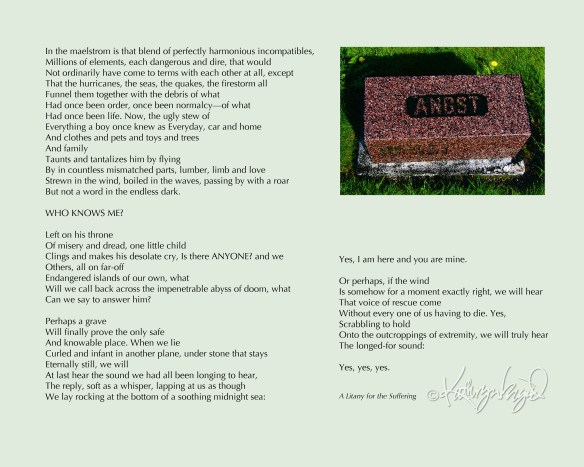
Is There Anyone Who Knows Me?

This is the first post of a three-part series on depression and anxiety, so if that’s an off-limits topic for you, I’ll see you again on the weekend! But it’s really intended as a series on hope from someone who has been-there-done-that and loves life in all of its complicated craziness as I know it now, on the other, generally sunnier, end of the tunnel. Today, for your contemplation, a meditation based on a true story of fear and loneliness and the possibility of triumph through one faint but persistent call for help.Photo + text: Under Sea, Under Stone 1

Photo + text: Under Sea, Under Stone 2

Nice Kitty

I’m a little ambivalent about certain acts or behaviors. While I would hate to be bumped off before my actuarially predicted time, having all sorts of thoughts about things it’d be nice to do before I croak, if it happened that I got knocked off some precipice in a windstorm and smashed into smithereens, it would be only fair for a bunch of buzzards to come and pick over my guts for the tastiest tidbits, even if I weren’t quite wholly dead yet, because… well, because that’s what buzzards are made for. It’s what comes naturally to them. They can’t be blamed for taking my squishy repose as an all-you-can-eat buffet sign.

On the other hand, you can’t take this as carte blanche and go shoving me off any handy cliff. As a person, you are expected to wait patiently for the wind to come up sufficiently for the aforementioned to take place and not be trying to hustle me off this mortal coil. It may come naturally to some humans to be quite treacherous, too, but there’s this little thing called ethics, if not sheer good manners, that ought to stand in the way of such things. So you’ll forgive me if I keep up the occasional glance over my shoulder at you but expect in general that you’ll keep your paws to yourself and let nature take its course, howsoever much you might wish to speed things up and all. I’m not that awful, am I?Digital illustration from a photo + text: My Stomach is Growling

Slightly Haunted Houses

Digital illustration: Transmitter

Perpetual Haunts

Children always know where danger lies—the goblin in the corner who’ll surprise

And bite you on the ankles as you pass—grownups forget to fear it, though, alas!

For in the passage of the years they’ve grown to fear only the earthly, and bemoan

Mere politics and taxes, while a child retains the wisdom that the brute and wild

Still hides among the passages of day, waiting to snag unwary young at play.

On Halloween, adults recall but faint and humorous details of ancient taint

And treachery, the light dust, if you will, of ghostly tracks upon the windowsill

Or campfire tales meant less to warn than joke at quaking children by the fires’ smoke,

Forgetting that what was, remains still here: the monster that can swallow all is Fear.

Digital illustration: Receiver

Metallic Melange

As a shiny-object addict, I inevitably crave making artworks with shiny parts from time to time. It’s one of the reasons I started making found-object sculptures so many years ago: a way to make use of my stash of sparkly, quirky, and metallic Junk bits that I still spy and pick up on my walks out of that compulsion. No surprise that I would, in turn, be cheered by others’ fascination with the multitudinous curios and clockworks so embedded in the likes of Steampunk and Sci-Fi, Industrial interior styling, Grunge and Goth, and Cabinet of Curiosities interests.
Mixed media artwork: A Sort of a Wreath

So here’s one of my latest concoctions, a wall sculpture that plays on all of those themes. It means nothing at all, or perhaps, everything, depending upon your preferences and whimsies. I like to think of it as evoking a variety of hints and hyperbole, of the histories, mysteries, and fantastical foolishness that both underly and defy nature and invention. In that sense, I suppose it might be considered a reasonable facsimile of the contents of my cranium. All of you amateur psychiatrists out there, have at it. If you dare.

Sleep Writing

I know that my brain works overtime, coming up with strange and atmospheric stories while I sleep. Maybe it’s meant to balance my waking laziness. I won’t ask! Here’s another one of those few from which I have awakened with a crystal clear memory. Not of its putative symbolism, of course, if you’re wanting to analyze my weirdness for dreaming surreal tales with death in them that are somehow not nightmares but simply strange and (literally) colorful, unexpected nocturnal in-head cinematic confabulations.Photo: Wheat Field

Text: Color Coded 1

Digital illustration from photos + text: Color Coded 2

The Darker Side of Kid Scientists

Photo + text: Too Bad for the Bug

I know it’s generally preferred that scientists take a detached and dispassionate approach to their subjects so as not to skew their studies or experimental data, but I rather think that even entomologists should show a little respect for their subjects. But kids will be kids. Also, I happen to know from my own youth that if you let on that you find something creepy or gross, it’s pretty much guaranteed that some other child will eventually figure out how to use it to torture you. Kids are charming that way.

PessimOptimism

Graphite drawing: Self-Inflicted“Prepare for the worst but hope for the best.” It’s part of my credo, I guess, and may well have been aided in its development by doing those hilariously futile duck-and-cover atomic bomb drills of the Cold War era. And the air raid drills—we lived in a Ground Zero area near several military bases, strategic coast, and a handful of Nike missile sites in those days—fire drills, earthquake drills, tsunami drills, and later when we lived in the midwest, tornado drills. You’d think we’d all have grown up incredibly paranoid after such stuff in childhood. But I think that besides being remarkably resilient, kids use logic on such daily puzzles far better than they remember how to do when they hit adulthood and have been taught their prejudices, and are much more easily distracted and blinded by grey areas.

I don’t remember ever believing that crouching under a flimsy little wood-and-steel desk would save me even from the shrapnel of shattering windows and imploding walls in the event of an attack or large-scale disaster, particularly since I imagined the desk itself would become shrapnel along with everything else in the atomizing roar of a bombing. Little and naïve though we were, we had gleaned hints of the enormity of such things from our beginning school studies of the world history of war (skewed to our own culture’s view, of course); no matter how grownups think they’re shielding kids by sanitizing and limiting the information the wee ones are allowed to see and hear, children are quick to notice the blank spaces where redacted information interrupts the flow of facts, and no adult is more curious than a child to hunt for clues as to what was redacted. Frankly, if there really is any use for an institution like the CIA in this day and age when practically anyone can find out practically anything with the aid of easily accessible tools like the internet, cellular phone, and, apparently, privately owned drones, along with all of the more traditional tools of spy-craft, I suggest that the crew best equipped to uncover any facts not in evidence would probably be a band of children all under the age of about twelve.

Meanwhile, we still have large numbers of people who think it prudent to withhold or skew the information passed along to not only kids but even fellow adults, giving out misguided or even malevolent half-truths or remaining stubbornly silent and in full denial about things considered too dark for others’ knowledge. And what do we gain from this? Are there truly adults among us who still think that even smallish tots can’t quickly discern the differences between a fable or fairytale, no matter how brutish and gory it may be, and the dangers and trials of real-world trouble? Does delusion or deception serve any purpose, in the long run, other than to steer us all off course in search of firmer, more reliable realities?

As I just wrote to my dear friend Desi, it seems to me that the majority of humans always assume a fight-or-flight stance in new or unfamiliar circumstances before allowing that these might be mere puzzles to decipher, and more importantly, we assume the obvious solution to be that whatever is most quickly discernible as different from self IS the problem. Therefore, if I’m white, then non-white is the problem; if I’m female, then male. Ad infinitum. And we’re generally not satisfied with identifying differentness as problematic until we define it as threatening or evil. This, of course, only scratches the surface—quite literally, as the moment we get past visible differences we hunt for the non-visible ones like sexual orientation, religious or political beliefs, and so on.

Unless and until we can change this horribly wrongheaded approach on a large scale, we’ll always have these awful problems, from petty playground scuffles right into the middle of the final mushroom cloud. The so-called justice systems of the world are set up and operated by the same flawed humans who make individual judgements, so the cycle is reinforced at all levels. Sometimes it truly makes me wonder how we’ve lasted this long.

Can we learn from kids? The younger the person, the more likely to blurt out the truth, whether it’s welcome or not. The subtleties of subterfuge are mostly wasted on children, who unless they’re engaged in happy storytelling for purposes of amusement and amazement, would rather be actively puzzling out the wonders of life than mucking about in search of evasive answers and duck-and-cover maneuvers. We might gain a great deal by reverting a little to a more innocent and simplistic view of the universe, one that blithely assumes that others are not always out to get us, that direness and doom aren’t lying open-jawed around every blind corner, and that the great powers of the internet and cell phones might just as well bear cheery tidings of goodness and kindness, and drones be removed from deployment as spies and weapons to work instead at delivering birthday presents to friends and packets of food to hungry strangers.

I’m not fooled into thinking any of this is easy to do, any more than any savvy kid would be, but I’m willing to believe it’s possible if more and more of us will commit to such ideals.

Tiger Time

If you remember anything about primary school (and I do, if little) you hopefully have a few memories of one or more of the fantastic sort of teachers who were the virtual equivalent of extra aunties and uncles and grandparents, but neatly spun into the form of educators whose wise teaching made you learn things without even knowing you’d worked at it, and want to learn things you hadn’t even known you wanted to know just because they were such fine pedagogues that they made it seem possible, if not easy.

You undoubtedly also have a memory or two of teachers who were quite the opposite. My personal least-fave was the third grade teacher who had no compunction about excoriating and humiliating a student in front of the rest of the class regardless of the infraction or any of their previous achievements or behavior, even cracking a yardstick onto desktops to make a point when she was het up, regardless of whether there might be some small knuckles in the way of the stick. At the very same time, she apparently thought it perfectly logical and beneficial to ‘level the playing field‘ and make all students feel they could accomplish something in her class, lest the PTA or school board think her not supportive and informative enough, and this she would do by sitting and doing the weakest students’ homework for them.

I knew nothing of this until one time when I was the unlucky receptacle for her ire, having failed a penmanship test in the first weeks of school because that school required students to learn cursive writing in the end of the second grade and the one in another state where I had spent my second grade did not. Had she asked us all to sing a song in Spanish, I might have been the star of the class, because my second grade teacher Mrs. Mosqueta let us learn a little elementary Spanish from one Señor Ybarra, who taught by the ultra-newfangled medium of televised classes, and I don’t think my new classmates in Illinois had yet had access to such magicks themselves. But there I was, little miss Goody Two-Shoes, who had never gotten anything but perfect scores because I was too prim and much too afraid to not do my homework to the nth degree—if I had any actual training or homework to prepare in the event—flunking my attempt to make Pretend Cursive when that mean lady in her sausage-casing dress didn’t even ask whether I’d ever been trained to write that way. If you think I still sound remarkably bitter about such a small thing from so long ago, well, I probably ought to let it go but I tend to enjoy my little revenge fantasies more than is entirely good for me.Digital illustrations + text: Tiger TimeThis is all in jest, of course. I wouldn’t be so cruel as to want to give any poor innocent tigers indigestion.


Contagion vs. Compassion

“One bad apple spoils the lot.” That creaky aphorism is based on equally venerable experience. Rot is contagious.

Bad company makes bad behavior seem the norm, and we adjust our own standards ever lower accordingly. One or two disheveled houses bring down the values of the others in the neighborhood, and those, in turn, fall into neglect and decay as their owners lose the courage and determination to resist the incredible pull of entropy. What isn’t growth is death.

What leads otherwise good and sane people to fall apart like that? Doubt; fear; despair. These are the hallmarks of contagion: the plague succeeds in felling us not only through its own virulence but because rather than seek its cure with full courage and determination we flee with it hot pursuit, and when it eventually catches up with us, we topple, curl up in the fetal position, and succumb.

The fall of one member of the world community—like Mr. Duncan, who was felled by Ebola in Texas—is a very real and terrible loss for all. The loss of thousands—those dying in West Africa—is indeed a plague and a thousand-fold grief we all must recognize and bear. The response, though, cannot be equally contagious doubt, fear, and despair. That can only make us choose unconstructive, even destructive, responses like blame, xenophobia, retreat, and the neglect of our fellow citizens of the earth. Then, no matter how many or few have been overtaken by disease and disaster, the contagion will have won.Photo: Snakebit