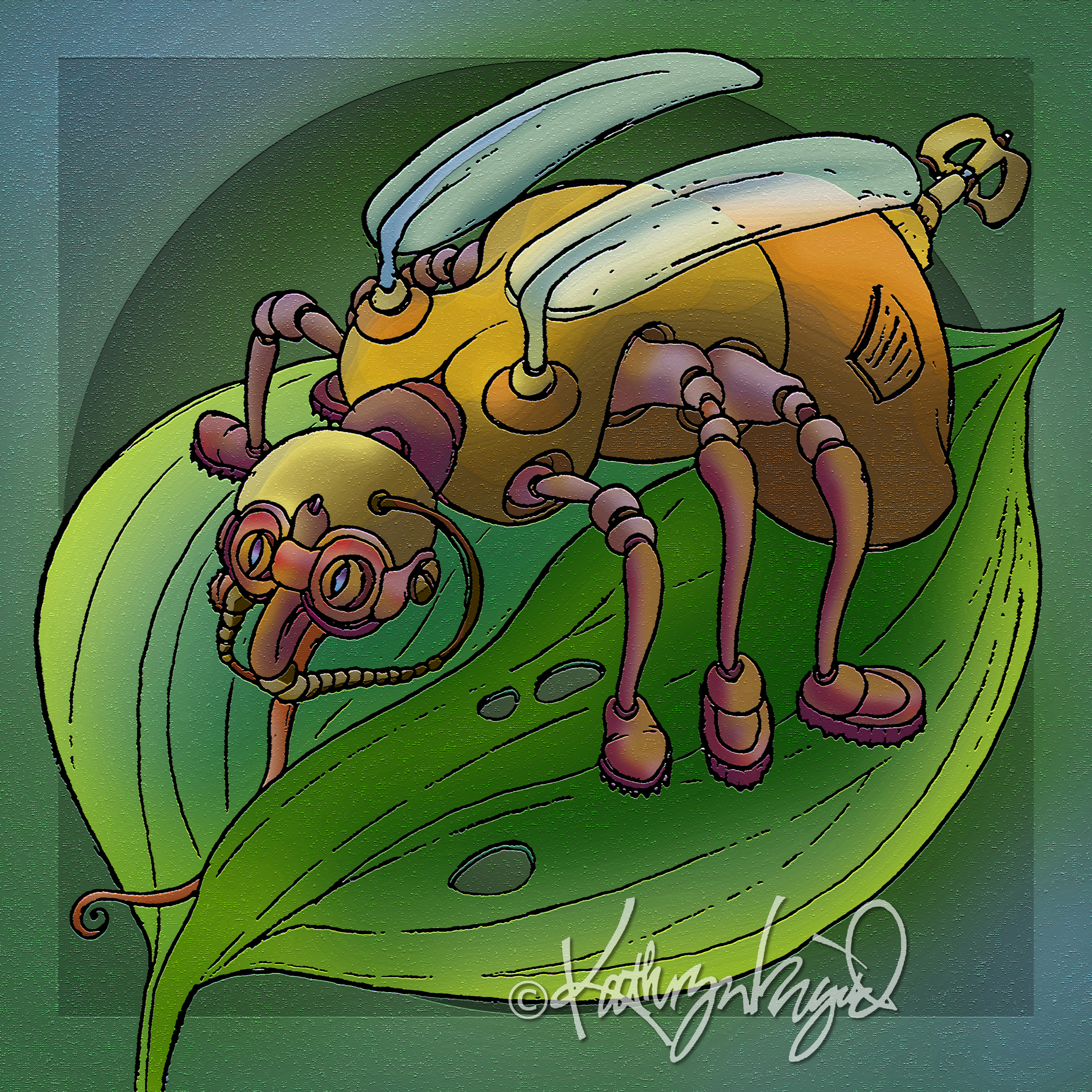
Let’s be a Toothsome Twosome

digital illustrationInssssssinuations

Don’t worry, Dear; take no alarm—
I’m just designed this way!
If my appearance threatens harm,
Don’t suffer such dismay!
You sense I’m glaring hate, perhaps?
Just something in my eye
That irritates me between naps—
Not meant to make you cry!
This whiplash tail so menacing
Waves only out of habit—
It really doesn’t mean a thing,
You silly rabbit—grab it!
Fear not my hiss or venom’s kiss:
They’re breath and smiling, merely—
There is no threat in all of this—
I would embrace you dearly!
Ignore my hard, ignoble sneer—
It’s just coincidental
That my dentition’s pinking shear
Does not appear more gentle!
So snuggle up among my curves
And let me hug you closely
And cuddle you to soothe your nerves—
You have misjudged me grossly!

Hard Boiled Character

I’m very much a child of the Sixties. I was born at the beginning of the decade that brought to a point of confluence such disparate events and ideas and people as space exploration and spaced-out hippies, the Beatles and the Batmobile, suburban composting and the Cold War. Every one of those might be said to have had at least a little influence on aspects of my self and my character, but one of those I particularly remember from preteen days is that the very little I knew of the politics of the day was that my classmates and I were trained in school drills to dive under our desks and cover our heads with our arms as protection against The Bomb. Because we all know that there’s nothing better than skinny little kid arms and a plywood desk to save us from nuclear holocaust.

A corollary of this perhaps, is that even as a shrimp I could recognize the futility and insane ridiculousness of what the world’s Superpowers liked to tell us was inevitable and what, conversely, was going to stave off such things, so I preferred to play the 60s’ iteration of the 50s’ cowboys-and-Indians, that being a game that, as far as I’ve been able to discern, was all about galloping around on invisible horses, making a lot of noise, chasing each other, and brandishing toy guns in ways that would’ve cleared the Old West in an instant by accidental and ‘friendly’ fire had they been loaded. Our upgrade for the sixties was Spies, because as it was utterly clear no politicians in ours or any other country was going to be sensible and deal in saving self and planet by means of either successfully waging a visible war or, even more remotely, by learning to sit at table and negotiate anything like Peace.

So we played Spies, the cowboys-and-Indians or Us vs. Them variant that swapped invisible pinto ponies and buckskins for invisible (or better yet, pedal car) sleek, speedy autos with magnificent tail fins, the ten-gallon hats for fedoras and the chases across the Western plains for slinking around our own houses to peer Unseen into the windows—the ones we could reach—and spying on our own parents who stood in for Commies. And only if we were really lucky maybe really were Communists, though I knew no one who would have said so openly in suburban America in those days. In point of fact, I had no goal of catching anything other than perhaps a glimpse of where Mom kept a box of candy hidden, and certainly no wish to fire my terrifyingly realistic plastic squirt gun at anyone with anything other than a zip of icy cold water, but it was all Terribly Exciting.digital illustrationThat, however, was pretty much the pinnacle of my career as anything racy or dangerous, and I’m quite content with that. But the memory of how thrilling the entirely artificial and manufactured world of child’s play was still charms me, and I still kind of like to revisit the image of self-as-desperado with a laugh and, yes, a tip of my broad-brimmed hat.

Hot Flash Fiction 10: At the Very Back of the Shelf

In Dash’s closet there was a very hard-to-reach spot at the very back of the top shelf, and he was quite happy that his younger sister Mattie couldn’t reach anywhere near it. There was a large jar there that he prized beyond any other thing he owned, even his pocket knife and the doll that he loved as long as his parents would only call it an Action Figure in front of any of his friends. The jar gave off a very faint blue glimmer that was even visible on the darkened closet ceiling after the bedroom light was switched off, and it pulsed comfortingly at young Dash as he lay across the room gazing on it while drifting off to sleep each night, dreaming eventually of the wonderful things that would happen when the creatures he kept in the jar finally came to their full maturity. He remained, as far as I know, blissfully unaware that they were beings of his little sister’s making and left for him to find and nurture. He may have begun to wonder what exactly was brewing when his Action Figure seemed to have moved to the far end of the shelf one morning of its own volition and then disappeared entirely until it resurfaced at the end of the week in the bathtub drain, one arm missing and covered with some kind of sticky corrosive ooze, but I imagine that he guessed Mattie might have had a hand in this trickery. The relocation of Dash’s pocket knife underneath the heavy jar was a harder to explain, more puzzling development.digital collage

Leave the Lights On!

digital illustrationWhile I’m closing out an old notebook that I kept in blog form a number of years ago, I found yesterday’s post and this companion one. So what the hey, I’ll share this one with you, too.
It’s Thanksgiving Day [2005!] and I am particularly thankful this year for having celebrated a whole year of emergence from clinical depression. For anyone out there who has been mired in it, or still is, I send out a fiercely made wish for your recovery and new joy in life, along with this meditation I wrote after realizing not only how far and how long I had been away from my true self, but the cultural setting in which it is possible to get there without realizing it or even having others see it clearly.And with deep thankfulness that it is possible, with help, to be revived.* * * * * * * * * * * * * * * * * * * * * * * * * * * * * * * * * * * * * * * * * *

Let’s stop all this rubbish about Depression as a romantic notion.

The myth of suffering being necessary to ennoble the spirit or, more commonly, to shape creativity and artistry and the personalities that foster them, is an inaccurate and unhealthy construct that belies the potential power of sanity and contentment. The idea that much of the great art that has sprung from the work of troubled or diseased artists throughout history would have been impossible, or the artists Not Themselves, if they’d been well or happy is simply a gross assumption of the inflexibility of the human spirit at best, and an insult to mortal intelligence, invention, and character at worst.

In a telling moment of literal as well as figurative turning-on of the lights, participants in a 2004 Canadian study on Deep Brain Stimulation as a possible treatment for otherwise-untreatable depression noted that the world became a visibly, physically brighter place when “area 25”, or the central zone of depression response in their brains, was stimulated to relieve depression. Many of the patients described a distinctive, even poignant, instant of pleasurable shock when the electrode stimulation, suitably placed, flooded them not only with unaccustomed sensations of contentment and ‘rightness’ in their world but also a clearly discernible brightening of their visual perception. It was as though, one commented, he had suddenly remembered a whole range of colors and values and sensory impulses and emotions that had been locked away for decades.

Nowhere in this was there any indication that the participants in the study experienced a negative change in their self-concept when their depression was eased. No mention is made of the patients losing their creative impulses or intellectual depth. Not a note of regret or sense of personal diminution.

The breezy optimist, on the other hand, is not by definition dimwitted or shallow or uninspired. While cultures that have embraced a darkly Romantic mythos of the suffering genius tend to dismiss brilliance that emerges from happier sources as a fluke or as slick, glib cheapness that won’t withstand the value-test of time, many stars and their accomplishments defy those definitions.

Yes, depressed, manic, even twisted and tortured souls with the deepest of psychological, physiological, or chemical-addled warps and wounds have been the vessels and sources of high art and equally high drama, but they are far from alone in that. To say that they only achieved their greatness because of their damaged state is a cruelty, an insult, and a cop-out that says we all could not be greater than we are, if not equally “gifted” with darkness. If being let off the hook ourselves is what we seek, then let’s just be honest and say we don’t relish the burdens of effort and experimentation and get on with other things. I have a suspicion, as it is, that if there’s a notably higher percentage of mental illness among persons who could be classified as particularly ‘creative’, then the cause/effect relationship is one of persons being used to having to problem-solve their way out of unusually difficult circumstances on a regular basis, and so developing stronger problem-solving (read: creative) skills.

Meanwhile, cheer up! Look at the dazzle that being joyful brings. See the energy and wit that, when not wasted on grief and moroseness and morbidity, can be devoted to pursuing greatness instead, and run after it with childlike delight.

The Ordinary Romantic

I’ve not re-posted anything from my own blogging before that I can recall, but happened upon this (admittedly lengthy) piece I wrote a number of years before I even started this present blog and was reminded of a few things I’ve said here but in quite different ways. So I share it with you now, lightly edited to update it, just because it piqued my own interest once again. Cheer up, my friends: I love that this is written from something like an outsider’s view of the experiences of depression and deep melancholy, after all these years!digital illustration from a photoI highly recommend reading the book I just finished reading [when I originally wrote this post], Peter D. Kramer’s ‘Against Depression‘. He’s the author who wrote ‘Listening to Prozac‘ – a book that, surprisingly, wasn’t really about depression or even Prozac, per se, but due to its bestselling status raised those two specters so frequently that he finally had to respond with this book. He has some sections in it dealing specifically with the effects of depression on arts and creativity, intellect and education, and vice versa. But there’s also a ton about the physiology and pathology of depression, the affect and effect and the impact on self and others. Very thought-provoking for me.

If you want a really scary companion-piece before, during or after the reading of that book, one that for me confirmed the urgency of wellness by any–no pun intended–sane means, look up ‘My Lobotomy‘ – it was a presentation on NPR that horrified me more than umpteen war- and disaster-stories (including true ones) and makes stories by Edgar Allan Poe and Stephen King sound like skipping through a copse picking violets. ‘Lobotomy’ is the harrowing memoir of a lobotomized man who, at 56, finally got up the courage to investigate and explore what happened to him when he was operated on at 12, why it happened, who else was affected, and much that followed. Incredible. Terrifying. I can barely even think about it. But it did make me feel all the more intensely that I want to stay in charge of my own mental health just as much as I should my physical health.

For the moment, since I’ve so often been asked, I will say that when I call myself Ordinary, what “ordinary” means to me is wide-ranging and a bit variable, but in the sense I’m using here in the land of my blog, it covers all of what seems possible, believable, normal or otherwise expected in the universe of human experience. More significant, perhaps, is defining what it doesn’t mean for me: things found at the extremity of experience: brilliance or genius or unearthly, once-in-a-lifetime skills, talents, and insights. Me, I’m not interested in being a supernova. They tend to burn out fast anyway.

What I really pride myself on is taking the simple raw material of being a middle-of-the-road mortal and managing to pull out of that clay my own few moments of dazzle – an outstanding artwork here, a worthy kindness there, and a few sprinkled bon mots or glorious deeds in between – these shine all the more in the setting of my ordinariness. People take note of them precisely because they are deserving of note–because coming from a typical luminary or wunderkind they would be the expected thing, no matter how exciting, and from me they are not. There’s no intrinsic negative value to ‘ordinariness’ for me, no implication of self-abnegation or false modesty, just the sense that only a few in history are genuinely set apart as spectacular examples of either desirable or undesirable traits and gifts, and we in the main herd can still go on and live rich, full, complete lives just as we are. With maybe a little less pressure to perform, too, so that anything extraordinary we do actually shines that much the brighter. Surprise! Aren’t I fabulous!

Why do we see ten tortured geniuses for every happy one? I think it’s primarily a function of taste: the culture that covets over-the-top emotion isn’t interested in supporting and reporting anything that doesn’t have that dangerous gleam. Good news is no news. If the artwork is upbeat, it must be tacky and shallow. If the artist is happy, she must be an air-headed clown. Prettiness and simplicity and everything that pleases the mainstream must, by definition, be playing to the lowest common denominator.

I’m actually a dyed-in-the-wool Romantic myself, but I have been contemplating that old adage “write what you know” and decided that it lends itself to far too tiny a concept of possibility. In the first place, if taken strictly it would mean that we should automatically dismiss as useless falsehood any attempts at empirical or even historical writing, because practically everything that has been once believed absolute has taken on different shadings over our cultural lifetime, if not been disproved. Never mind how we should treat the authors of murder mysteries and crime novels! The aphorism may be a needless dictum or even a myth: one doesn’t necessarily have to BE suffering to appreciate what suffering is. And perhaps anyone who has suffered in the past can be considered to have earned the stripes of exactitude anyway and can rely on recollection rather than continuing to wallow.

There is certainly a bit of truth when people insist that others can’t know what they’re going through; in its most complete sense, I’m sure that’s accurate. But anyone with a little life-experience and the ability to sympathize or even–if imperfectly–empathize, can puzzle out in his or her own way an approximation that makes communication of it possible in art. And, frankly (this goes back to that idea of an Ordinary person doing something Extraordinary), if I can make someone slap his palm to his forehead and go, “YES! That’s what I’m talking about!” when they recognize a shared feeling or insight, then I think it’s all the more memorable and impressive, not the predicted brilliance of some savant.

So thanks to the perpetual discussions of such topics with colleagues and friends and given my understandable interest in depression and its effects as well as more strictly Romantic artistic concepts, focus on the impressive influence and hold of Romanticism on all our lives, I continue to search. If Romantic ideals glorify and sympathize with a dark world-view, with sorrow, cynicism, pain, suffering, and so on, and if arts and beliefs that support those ideals are valued, then how can we respond to things that defy or fail to uphold them? How can we wish to be happy and healthy if what we love is, really, decidedly neither? Since the prevalent taste for Romantic qualities has been in vogue for a number of generations, and cultural memory is dangerously short, few recollect that being In Love with Darkness is a relatively new trend in recorded human history; an externally imposed one at that. As with so many of our beliefs that we take not only for granted but as eternal, immutable fact, all is not necessarily as it always has been or will be. There are larger patterns in the life and development of art, history, healthcare, personal experience, politics, and religion that act and cycle broadly, often inducing in each other significant change as they intersect along the way.

As Dr. Kramer notes in his excellent polemic against depression, even tuberculosis used to be idealized. People who had Consumption were presumably consumed by the unusual intensity of their inner being: larger than life passions, intellects, artistry, love and spiritual astuteness were all attributed to these dramatic sufferers. When it was finally seen that that oh-so-sexy tuberculosis was in fact not only a genuine physiological disease but also a degenerative, communicable, and difficult to treat pathology, and that it would not only kill the patient eventually but also deprive the rest of us of those idols, the tide began to turn toward the desire for palliative care and cure. Depression, also arguably a disease of at least equally destructive dimensions, and demonstrably damaging to such physical attributes as brain tissue and adrenal glands, not to mention to social structures surrounding the patient, is certainly deserving of the same considerations.

So what do we do with our Gothic worldview? Give up our love for the dark? Hardly. Strip it of its value and depth? Not likely. Perhaps, though, we can rebalance the scales a little and say that it’s no longer chic, let alone necessarily accurate, to assume that all things pretty and pleasant and uncomplicated and cheerful are stupid, dull, vacuous, or shallow. Realistically, we’ve all seen attempts at art that cling to the Romantic ideal and yet manage to be stupid, dull, vacuous, and/or shallow. And, as I constantly remind[ed] my beginning art students, one of the hardest things to accomplish well is simplicity. When you take on the task of making a work that appears simple, you make yourself vulnerable to every would-be critic who can find the tiniest flaw as it stands out against that backdrop. Because you have tackled the familiar, it takes far more sophistication and subtlety and inner resource to make the work distinct and worthy, not just a good imitation of what has been done before. Anything can be badly executed, art or otherwise. Anything has the potential to be scintillating and brilliant.

The difference should lie not in one element alone, especially not some preset element like whether the theme is Dark or Light, but in the miraculous confluence achieved of content and intent, medium, methods, and moment. Is it beautiful? Is it successful, deep, lasting, influential, meaningful? We will, and should, continue to make value judgments and assessments and be willing to revisit them from time to time. Because beauty and meaning, whether you believe they’re strictly in the eye of the beholder or not, can change as the beholder’s eyes are changed by a life full of adventures, by time and tide and every nuance of history that washes over us. It should be equally visible in full, bright Light or in cavernous Romantic darkness.
Death is Never Out of Season

photoDid I worry you for a second? Never fear, friends; I’m not going to be a big old humbug, let alone a grand tragedian, here. It’s just that, living where I live, I’m always in the shadow of some circling or perching vulture sussing out his or her next all-you-can-eat buffet. I’m pretty sure that I too would look fairly delish if I just had the kindness to croak somewhere out in the open within a vulture’s purview, yet they don’t turn up their beaks in disdain at smaller game. So I can get a regular reminder of my mortality just by looking over in the tall grass next to the road, where there is often a vulture or two munching on someone else’s gnarly remains, any time I need said reminder.

I am, as you’ve seen if you’ve spent any time around this blog, of the school that still has an appreciation for a good memento mori as a reminder of the fine and great and joyful things that being Not Dead can have to offer. It’s just about time for the biggest holidays of the year in many cultures, and as workers in the life-supporting jobs that include medicine and law enforcement and social services will tell you, depression, health crises (both physical and mental), family violence, crime and all sorts of other terrible social ills tend to peak. Unreasonable schedules and outsized expectations of delirious happiness around holidays and other celebrations are practically doomed to failure, and even those who are fairly realistic about their expectations may have actually built in a sort of assumption of disaster that only adds to their stress.

Letting go of a lot of this overwhelming and impractical perfectionism and most of the silly entitled assumptions that the world owes me satisfaction and pleasure has greatly simplified my life. It has certainly lightened the load of worry and wishing. And every time I walk under the perch of a local vulture and look up at it as a fellow living creature, I am thrilled to pieces that I have the greatest way of all to celebrate whatever holidays and special occasions I want to enjoy: alive. Not particularly wanting, not overburdened with Stuff and needs and promises I can’t keep, and simply, happily Alive. Just having one of those massive birds circle over my head without interest in me as an entree reminds me that death is close at hand, since the avian beast is clearly keeping a keen eye on something nearby that is already deliciously deceased, yet also says that I am not quite yet on that side of the equation and can go on to enjoy my holidays. Kind of makes every day seem more worth the celebrating.

Is the Sound of My Voice Bugging You?

digital illustrationDrone

I’m not a soldier or a bee, but when I’m passing through

You might mistakenly think me a drone, for what I do,

More than a bagpipe ever did, is blow and bloviate

And buzz so much–I do not kid–you’ll wish the kinder fate

Of early death, deafness at least, enveloping with fog

Your tender soul, until it’s ceased–my tedious monologue.

I Dance on Their Graves

digital illustration

Epic Epitaph


Let’s just keep this

Short and snappy:

Yes, I’m dead;

Some folks is happy.

Yes, I had

The plague. Ahem,

They’re all infected.

Joke’s on them.photo

Look Both Ways Before Crossing


digital illustrationI know that it’s always wise to be observant, especially when I might be walking directly into the teeth of danger. But trouble is hardly limited to the known and the seen. How sorry I’ll be for my foolishness if I get so obsessively focused on what I fear most that I fail to notice something equally important–or perhaps more imminently so.digital illustrationWorst of all if I’m so  immobilized by my phobias and fears that I just lose my nerve, my will to forge ahead and past them, and in doing so stay fixed in the very place where I’ll forever be the most vulnerable.digital illustration

Self-Annihilation

P&I drawingWhat does it mean to repress or suppress others? We humans have found so many awful and horrific ways to abuse and torment each other, to subjugate and enslave, belittle and diminish and depersonalize them, that homicide and genocide seem afterthoughts, if not almost a mercy at times.

What do we demean or demolish when we do so to other people? Community. Diversity. Complexity. All of those things that enrich our own lives. Things, indeed, that make our survival possible. We become trees hacking at our own roots and branches, all the while drinking toxic rain and poisonous streams.

If we lessen or lose one life, the whole tribe hangs in the balance. If we lose one tribe, we risk the loss of all humanity.