The Strangest Kind of Strangers on a Train

The old tale of complete strangers meeting in transit, discovering they have identical problems, and “solving” the problems by trading crimes to eliminate the people they see as the root of their unhappiness, makes for a striking mystery drama, in fiction. Ask Patricia Highsmith and Alfred Hitchcock fans! But I was reminded recently that we give too little credit to our commonalities as a positive solution to our problems, and end up missing crucial opportunities as a result.

The filmic version takes as its thesis that the two strangers who meet can find not other, or at least no better, solution to the problem of having bad relationships with inconveniently incompatible people than to murder them, and by ‘exchanging’ murders with each other they hope to escape detection by each having no apparent connection to, or a motive for killing, the other’s nemesis.

While this makes for startling and even compelling imagined mystery, it’s horrific if imagined in real terms. Yet we do similar things all the time in this world, don’t we? Because I tend to agree with a particular point of view in general, say, a specific philosophy or political party’s policies, or my country’s traditions, does that mean it’s wise or humane or practical or generous to follow along without question, no matter what my group, party or nation says and does? We mortals are remarkably good at noticing and magnifying our differences, as genuine and large as they may be. But we’re frighteningly weak, in opposing measure, when it comes to recognizing, focusing on, and building upon our true kinship. This, I believe, easily outweighs in both quantity and importance, our separating characteristics. Digital illustration from a photo: Opening Doors
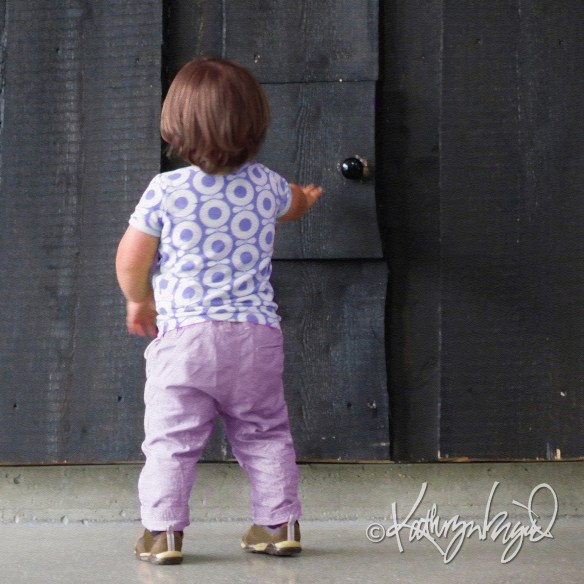
The recent train outing in Sweden that reminded me so pointedly of this also confirmed my belief that it’s an area where youth is wiser than experience. In a railcar where a young father, not a local or a native speaker of the language, was keeping his fifteen-month-old daughter occupied and contented during the trip by helping her practice her tipsy walking, she made her way with his help to where another family, also foreign but not of the same culture as father and daughter, was sitting together. That group was of two adult sisters and their four or five school-age children. The toddler was naturally attracted to the friendly and spirited older children, and as soon as they saw her, they too were enchanted. What followed was perhaps twenty minutes of delighted interaction between them all, with occasional balance aid from Papa and photo-taking by the Mamas. And barely a word was spoken, much less understood by any of the participants, during the entire episode.

The greatest among the many beauties of this endearing one-act was that the conversation essentially began, continued and ended with the kids reaching toward one another with open hands, waving and gesturing and generally putting on an elaborate pantomime together, and above all, giggling and chortling with peals and squeals of ecstatic laughter.

Needless to say, all of us adults in the railcar grinned, giggled, chortled and otherwise became happy kids right along with them. Resistance was an impossibility and a pointless attempt, at that. And isn’t that an excellent lesson for all? Adults are too busy being territorial and fearful and downright feral to remember that the open hand of welcome and sharing is as quickly reciprocated as any gesture, and a smile of greeting and acceptance is contagious beyond any language, age, or cultural barriers. We can nurse our terrors of the unknown as supposed adults, or we can choose to laugh together like children.Digital illustration from a photo: As If in a Mirror

Changing Directions

Digital illustration: Changing Directions

Do I move at the whim of the slightest breeze? Often enough, I suppose. But what really changes my direction in life? Chance? Passion? Accident? Will?

I’d say it’s been one or another of all of those at various times, and perhaps occasionally a combination of elements. What I would say most definitely and commonly is that I have rarely known very far in advance what direction my life would be taking, let alone exactly when. Living with uncertainty is at the heart of the human condition. We can’t know (nor would I wish to know) much of what lies ahead for us. Being an artist, and married to an artist, I have made some choices that guaranteed perhaps an even deeper and more frequent susceptibility to wondering what comes next. While both of us have taught at times, an occupation that has a degree of predictability and dependability absent in most other employment that involves our artistic skills and training, it never prevented the question from arising in other ways.

For me, as a longtime adjunct at the university, it meant that though I’d been there for nearly seventeen years (most of those, full-time) before I stopped teaching, I never had a contract in hand for more than a year at a time, nor was my class load or schedule in any way predestined; I taught what I was asked to teach, when I was asked to teach it. For my spouse, a tenured full professor and director of his division, he still had questions about how he might change and grow as a teacher, never mind whether to apply for or take any of the other positions on offer at other places from time to time.

We are, I think, pretty much the ordinary pair when it comes to that sort of thing. Even now, after many years of doing particular kinds of work at specific places and getting plenty of satisfaction from those various tasks, it doesn’t in any way stop us from asking, What next? Will we continue on the present path exactly as we are just now? Do we opt to  make any kinds of transitions, either changing the way we do what we do or the venue for doing it, or does something entirely new entice and draw our interest? If it does, is it attainable? Is there some utterly unimagined thing lurking just around an unsuspected corner, waiting to draw us in?

At times, it can make me feel as though I can never quite catch my breath or my balance. I tire of asking myself all of these whys, hows and what-ifs, yet I can’t resist scratching at the questions the minute I thought I’d put them to rest for a while. Even when I’m most happy and fulfilled and contented, I always wonder what lies ahead.

And that, of course, is the very heart of that human condition. We know that change is inevitable. We know that some of it will be by our choice, and much of it will be thrust upon us or sneak up subtly and surprise us all the same. And we know that, in some ways, the only guarantee we have is that we will all die wondering. It’s what we do, and it’s who we are.

A Whispering Medium

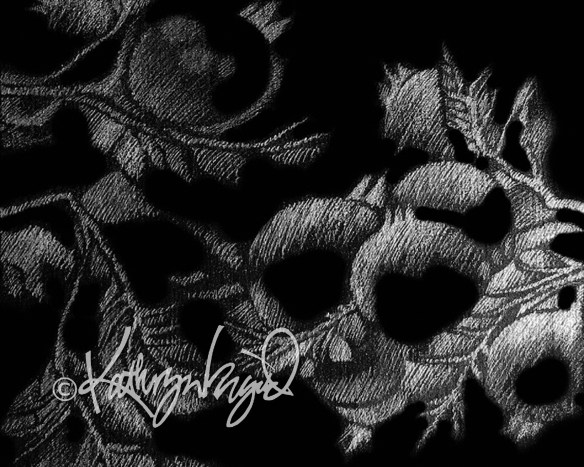
Silverpoint is relatively rarely seen nowadays, but it remains a delicate medium for drawing. Putting a point of real silver onto gessoed paper allows the same kind of fine detail and fragility to be expressed that are characteristic of harder graphite pencils’ work. The effect is of pale and careful imagery, a wisp of smoke, a mist, a whisper.Drawing: Silverpoint Apples

There’s an appealing air of the arcane to a medium that’s old and seldom used nowadays, and silverpoint qualifies on both counts. It’s also effective, as I found in my little experiments, on a black background to create gently ghostly drawings, but as ghosts seem wont to do, has a tendency to disappear at the slightest whiff of air, since oxidation darkens silver and it becomes less and less visible against the dark ground. Of course, that very ephemeral quality might be a further attraction, an encouragement to see the medium as a passing fancy best appreciated ‘fresh’ and gone in the blink of an eye.

Drawing: Silverpoint Blueberries

This is, after all, an age in which change comes at an ever-increasing speed and in growing quantities, and we become accustomed to nearly everything having the shelf life of a mayfly at best. We adapt, we move on. Yet we crave the sense of permanence and connection, so here I am marking in graphite over the top of the silverpoint as it fades, or scanning the images to enhance the contrast while it can still be seen. And while I still love the sense of tactile attachment and involvement that writing longhand, pencil on paper, gives me even when I’m up to my elbows in graphite dust, not to mention hoping that the neural connections such physical action reinforces better than keyboard manipulations will stay with me longer somehow, what do I do with my writings? Transcribe the scribbles to the electronic medium by sitting at my keyboard afterward anyway.

So passes our world; we labor with new tools to speed things up, revisit and relish the old methodology and tools to slow down and remember, and then run back to catch up with the new again. We, too, are ephemeral as faint images, as ghosts, and we feel our mortality even as we strive to make our marks on the world while passing through it. Our tiny voices and messages may be lost in the ether forever, and that, almost at the instant of their making, but the urge to tell our tales remains. Our little silver trails will fade, but we will have moved on elsewhere as well.

I am a Three-Year-Old

Digital illustration: Coloring Book/Stained GlassHave I matured as much in three years of daily blogging as a toddler does in her first three years of life? Highly unlikely. I was, after all, already a half century old and probably set in many of my ways to a degree that could forestall any large amount of progress toward real change, or at least drag it by the ankles dramatically.

Chances are, I haven’t made a huge number of changes as a person in general during the last three years. But I can lay claim to some growth, after all.

Moving to the wholly new world of life here in Texas in 2009 certainly necessitated some change. My aging corpus may not have made the transition perfectly: being over-endowed with the internal furnace function of middle-aged hormonal fun isn’t entirely compatible with the outdoor temperature norms here, and like many transplanted citizens I’ve done some battle with the local slate of allergens new to my system.

On the positive side, what I’ve found as a blogger echoes the best of what I found in migrating from my longtime home in the Pacific Northwest to the new-to-me frontier of North Texas, an entirely different sort of northern-ness. Entering new territories, both the real and the online ones, presented the possibility of encountering insurmountable tasks and challenges, or worse yet, unfriendly natives. Of course, my being still in Texas after five years and still blogging after three tells you that none of those fears proved true. Quite the reverse, in fact, considering that I’ve had some lovely experiences in both worlds during my brief tenure here, and I’ve garnered a whole cadre of wonderful friends in both, as well.

In short, I would amend my initial statement so far as to say that anything leading to such an exponential increase in the size and variety and quality of my circle of compatriots seems to me the very best kind of growth possible. Happy blogiversary to me this week—and more importantly, from me to all of you, who have made the journey so worthwhile and still so inviting. Who knows where the next three years may take us all!

We were So Civilized

Digital collage: We were So CivilizedNo matter where I am on the Fourth of July I am likely to think about the country in which I was born and have lived all of my life thus far: the United States of America. The Fourth is the official birthday of the nation, though many of the current states joined the union long, long after that July in 1776 when it was established by its founders. Like so many nations around the world, this country and its history are a tremendously complicated and varied patchwork of fact and fiction, hope and fear, two steps forward and one step back. Over and over and over again.

Imagine this: a pack of refugees from religious persecution left their homeland and sailed into the unknown across an ocean of which they also knew very little except that their passage across it was dangerous and miserable and killed plenty of them before they hit the new shore. When they landed, to their surprise there were already plenty of other people living on that new turf, and did that stop the interlopers from moving in, too? Of course not. I don’t expect it ever occurred to them, to be honest, that there wasn’t room for everybody or that if they took a ton of the resources around them that might just mean there were fewer for the previous residents of the land, folk who had, indeed, already long established a very different relationship with the continent.

That the illnesses and diseases the newcomers brought with them from Home would endanger and kill many of their new unwitting and unwilling neighbors could never have entered these interlopers’ minds, when they were so preoccupied with not only their current survival but their escape from the hardships and sorrows back in their own homeland. That they themselves would suffer privation, fear, danger, loneliness, and the loss of their lifetime homes, belongings, families and friends across the vast ocean they had crossed was a stark enough reality that perhaps they willed themselves not to think too hard about all that they faced next also affecting the long-tenured native peoples across whose lands they moved like human bulldozers.

The establishment of this new home was far from smooth and easy too, as anyone could probably guess, though I wonder if any of them really considered that the goal as much as simple escape from what they’d known before. Still, none of those inhabitants of North America—invaders or original denizens—could possibly imagine at the time, I suspect, quite how vast the whole continent was and what that meant in terms of creating new colonies within it, let alone new nations. In the years that followed, the westward migration confirmed the existence of innumerable tribes and clans of people not before known to the new arrivals, but also of wild creatures unimagined, of terrain unlike any they had dreamed possible, of climates that had been the stuff of legend until then.

In those many decades of carving out new paths and territories, it was inevitable that, just as it had been with the foregoing generations of various indigenous peoples, there would be struggles over who had access to what, who could live where, and who belonged together with or as far as possible away from whom. No surprise that this led not only to separated towns and enclaves and ethnic, religious, political or philosophical communities but also, in turn, to a wild array of accents and ideas that might as well have been different languages and different species altogether.

Amazing that all of this could remotely possibly coalesce into what is known as the United States of America. Today’s states are still so diverse, even sometimes from county to county or one side of the railroad tracks to another, that it’s nearly laughable to call them United. We fight like pesky siblings with each other all the time; it’s a miracle, in my book, that the so-called Civil War, one of the most uncivilized events in the country’s history, hasn’t simply continued from its beginning to the present day. It does, perhaps, at subtler levels. Just because the invasion of the continent by a bunch of frightened Pilgrims who only thought themselves seeking freedom from tyranny didn’t destroy the whole land and kill every one of them off outright, and because the various internal skirmishes that led to, but were far from limited to, the Civil War didn’t complete that annihilation doesn’t mean we’re not still perfectly capable of incredible incivility at every turn. We try, we fail.

On the Fourth of July, I think of how astounding and—generally—good it is that this messy nation has managed to survive this long without self-destructing. But I can’t help also thinking this of most of the rest of the world. Humans just plain are messy. We form and break alliances; we argue over being Right instead of being compassionate or practical, let alone pursuing justice. We blunder around, hog resources, ascribe privileges and powers to ourselves and our chosen comrades that we willfully deny others, or just pretend the others don’t exist, and thanks to our weirdly, wonderfully diverse array of accents, when we do get around to discussing the least of these things, even those who ostensibly share a language can’t understand each other half of the time anyhow.

Just possibly, our life form may have been civilized at a few choice moments. There is plenty of potential in this odd species of ours, I like to think. Even we Americans aren’t entirely irredeemable; we keep bothering and beating up on each other like so many brothers and sisters, and yet most of us still manage eventually to just agree to disagree and, in moments of precious lucidity, even to see each other’s point of view and operate in an environment of respect and hope. As rotten as we can be to each other, we care enough to wrestle it out and try to find ways to go forward. Together, even. If that isn’t a family worth saving, I guess I don’t know what one is. Happy birthday, USA. Go forth and get a little more civilized, if you can.

Spaceships, Time Machines, Bicycles

Photo: One for the RoadWhen I think about it, I’m amazed at how many modes of transport exist. Contrary to the fantasies popular in the middle of the past century, we’re not all traveling in levitating cars and being atomized and reassembled on opposite sides of the world. But it’s still fiction-worthy stuff that emerges when I realize we’re within reach of fully self-driven cars and can already travel at light speed, drive under the sea, and fly to the moon and, yes—more importantly—back again.

Fiction, however, has always outstripped real-world progress, as well it should. If we don’t imagine it first, how can we build it? If we didn’t travel thus in dreams, what chance would there be of our ever doing so in life?

I have invented an item or two in my time, but my ingenious machinations have never yet been realized in concrete form, at least those unrelated to my art. Still, I hold dear the idea that ideation is the necessary precedent of exciting discoveries and meaningful inventions. As silly as they may seem, then, I’m unlikely to quit developing my odd creations of the imaginary sort.

Who knows what journeys might someday spring from them?Digital illustration from photos: Time Machines

No Surprises Here

Digital Illustration from a Photo: Baby Carriage

Kids have an amazingly flexible sense of time. The week at the lake, playing with cousins, is so shockingly short that the suggestion of leaving there provokes crying fits of desperate sorrow over its unbearable brevity. The twenty-minute regular doctor’s appointment, with a quick squeeze from the blood pressure cuff and a thermometer swiftly passed across a healthy forehead, well that might as well have taken ten years, because the same child is now certain she’ll die in a matter of seconds from the prolonged trauma of it all.

But to be fair, isn’t this exactly the way we see time as supposed adults, too? I may not want anyone to catch me whimpering over the end of a holiday or the beginning of a doctor visit, but generally, I’m not less inclined to feel that way than I ever was in youth. The real difference, for adults, is that we have the perspective and experience to recognize the true brevity of our lives within the broad arc of time. We have, if anything, a deeper desire to cling to and attenuate all of the good moments and avoid the bad. It’s not childishness for a kid to abhor pain and sorrow and crave ease and pleasures, it’s an innate wisdom that tells us the clock is ticking.

I won’t tell you to stop wasting your precious time reading my blog posts, no, I am far from that angelic and selfless. But I hope that time thus spent is indeed a refreshment and pleasure, however small. And that, in the larger scheme, it serves to remind both you and me, if gently, to value our limited time of life enough to choose those things that reduce the ills of life and expand upon the joys—for self, for others—forever. Or as close to it as we can manage to stretch.Digital Illustration from a Photo: Carousel and Other Horses

Beings without Substance

The measure of a human is not in her wealth, or success, or any of those worldly attainments to which we so happily ascribe great value in the popular realm, but in her simplicity. So much can be accomplished by the reduction of focus on unimportant things, the removal of distractions, and reverence for the smaller and more ephemeral stuff. This, this is how we shine.Photo: How We Shine Best

The Bones of the Beach

I grew up pretty near the Pacific Ocean. It was a matter of a couple of hours to get to its shores from home, and mere minutes’ drive to Puget Sound, and I have always loved any chance to spend time along the water. At home in Texas, it’s not so easy: there are a few man-made lakes within a short drive, with a few public beach spots along the edges of each, most of the time too hot for strolling, and that’s about it. So that recent trip to Puerto Rico was a brief but lovely reminder of what pleasure I find in wandering the beach when I can, absorbing not only a bit of salt water through my happy bare feet and the tangy air through my expanding lungs but also the great sense of history and adventure inherent in all of the findings strewn along the tidal brink.Digital collage: Beachcomber's Trove

Despite being so much a water-baby at heart, I’ve never so much loved open water swimming—after all, my people are the pale, easily fried folk of Norway who transplanted to the familiarly brisk spank of the coastal waters to fish and farm and forest-hunt as they’d done back in the old country. But I’m drawn all the same to explore the tide-pools and comb through the heaps of hidden-and-revealed treasure that line the beach, sucking deep breaths of sea breeze happily right down to my soul. I love to see all of the bits of shell and bone and stone piled up and intermingled with molted feathers, ship detritus and the petrified lace of corals and seaweed. Every tiny piece seems to hold such a storied past that I can stare and sift and dream endlessly.Photos: Beach Bones

What caused that lone shoe to wash up here from unknown shores? Why are those pieces of sea-soaked driftwood burnt but not in the fire pit, rather appearing like a dragon-singed skeleton in a distant heap down the shore? How did so many colors of ghostly and sandblasted beach glass come to bejewel the line of the tide together? Who were the creatures that fished the shore and left bleached fish bones here, a crab shell there? When did the storms kick up such a foment of foam that the inland side of mean high tide has a gloss of it lacquered firmly across the surface of its sand? Where are the children whose sandcastle ruins are still tucked behind the biggest boulders on the beach, waving flags of leaf and kelp from their stunted battlements? And most importantly, when can I return to the beach to stroll and dream of such things again?

The Baby of the Family

When my older sister has birthdays, I’m not overwhelmed by thinking about her age. I’m close enough behind her that I kind of feel her age already, myself. No big problem. Sister number three is a little further behind me, and being the first of my younger sisters to hit each milestone after me, is the one who always makes me feel that little twinge: ‘I have a younger sister who’s that old!’

Baby sister eases into place after the rest of us without creating much ripple. The fact that the youngest sibling is approaching any notable mark is mitigated by three predecessors having beat her to it. Today, her birthday, she’ll do her little bit toward ‘catching up’ again, and yet, naturally, she will continue to remain younger than the rest of us. Once the youngest, always the youngest.

Part of me can’t help but subscribe to the cute and cuddly image held by youngest siblings. For one thing, she is beautiful. All three of my sisters are beautiful. Only one can be the youngest, of course, so I can’t help it entirely if the picture in my mind of my baby sister keeps looking quite a bit like she did as a small child. That adorable infant thing, once seen, is hard to undo. Both little sisters, as a result, are at times in my mind the human equivalent of kittens or puppies or fawns, despite having grown up into fantastic women with real lives and real families of their own.

I have nothing against aging, either mine or my sisters’. As long as we get to do it for a good, long time, and my sisters are doing it wonderfully well so far. I might think of them, the youngest especially, with the soft-filter glow of nostalgic youth painting them into charming little toddlers all over again, but only in light of knowing that they continue to grow more wonderful and marvelous with their actual progress through the years.

Digital illustration: Little Woodland Creatures

Happy Birthday to my—ahem!—foxy baby sister!

I can say as a dandy postscript to this bit of nostalgia that my baby sister is getting some suitable attentions during her birthday celebrations, which began just a little bit early this year. Her youngest, our nephew Christoffer, is in the previously mentioned punk rock band Honningbarna, and they opened for Aerosmith and Alice Cooper last night. My sister and niece got to watch from very near the stage (yay, earplugs!), and when our nephew came off the stage to give his mom a birthday kiss, the crowd responded with all appropriate enthusiasm. Not bad birthday entertainment for a lady who is doing her best to catch up with my advancing age!