Hot Flash Fiction 13: Eternity Beckons

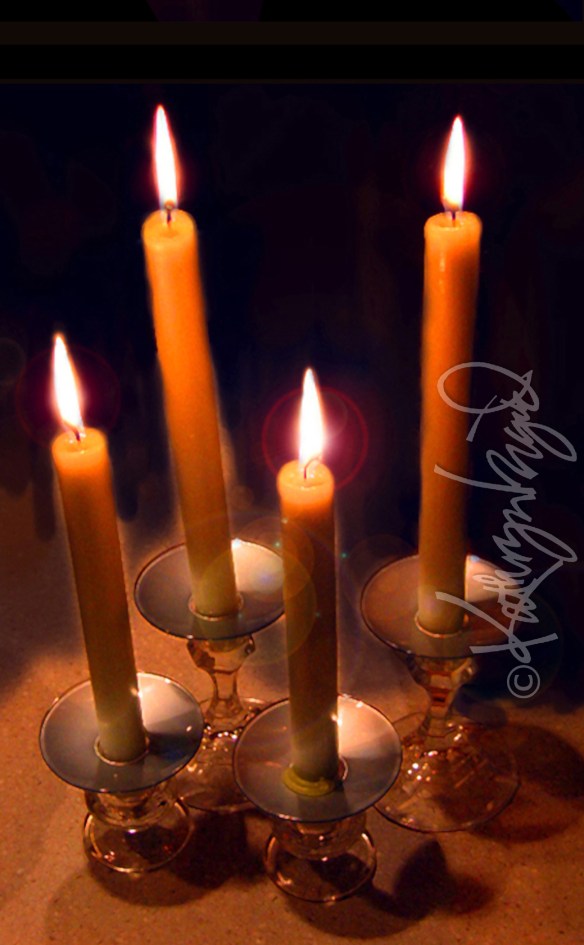
Photo: Science by CandlelightEternal life has always been the masters’ magnificent goal; no wonder that great magister and alchemist Osteodaimon was also determined to solve this elusive mystery himself, to plumb the Stygian depths of knowledge collected by the most piercing minds and intrepid souls ever to walk this dangerous earth. He began with years of reading, apprenticeship, exploration, privation, and experimentation. What Osteodaimon learned most quickly was that the process of becoming immortal was in fact incremental; it was a long series of tiny steps and grand leaps, of fallings-backward and soaring upward, all of which took him through both his long and arduous life of study and also a few strange periods of stasis, in which, all told, he began this mystical transformation of his into one truly able to transcend death. Many and terrifying were the missteps and passages, rites and elixirs, incantations, and the heart-shaking, wrenching feats of bravery and agility required of his profound intellect and the ever-disintegrating body that sought answers from that abyss.

One winter’s night, when he had traversed the grueling routes both between his birth and the ninety-two cycles of the seasons that already marked him as uniquely time-defying by his ancient era’s reckoning, and between the smoothly un-furrowed innocence of youth and his avidly acquired brilliance, he recognized in the ice crystals forming along his lashes the last increment required to complete his journey. Carrying the tinctures and potions that would preserve his last bits of mental and physical strength for the ritual, he set forth in the falling snow and moonlight to go farther into the frozen wilderness than he, or anyone, had ever plunged before. He began to notice as he went forward that the slower he moved, the faster the vastness of ice seemed to recede before him, until it was clear that his pace of progress was directly opposed by the increasingly swift passage of time. He knew that his own final breath was hardly a hairbreadth ahead of him, racing both toward him and away, and that only by letting the speed of it catch up with the glacial slowness he himself was approaching, at exactly the right juncture, and by taking the last dram of his precious medicine at exactly the same instant, could he affect the perfect circumstances for his final transformation.

Osteodaimon finally marked the spot. He lay down on the bottomless swath of blue-black ice, took the last draught of his alchemical magic into his gaunt grey mouth, and stopped. He became fused to the ice there instantly, his eyes made into a pair of wide, dull mirrors for the relentless moon and faded stars of perpetual polar night.

When he returned to himself and forced his eyes to focus again, his vision was oddly fragmented, and he sensed that he had drifted from his last stopping place far more than he had imagined he would have done. But the new place, also moonlit and cold, was pleasant enough, and he knew that soon his vision would clear and the slight buzzing in his ears would pass as he regained his strength. His sense of physical power, indeed, astonished him immediately as it returned; it was not only as though he were young again but as though he had new and exhilarating powers that would easily surpass those of his remembered early years, when he had labored so mightily in his pursuit of conquering death. This new Osteodaimon was a super-being to be reckoned with, and he took off at great speed to see what he could now accomplish in this next passage of his life.

It startled him how quickly he was able to go from place to place, how he seemed now to see things from so many new perspectives and rarely wearied of dashing about, looking, stopping to sup cold water or wine, or have a little food when he chose, but endlessly pursuing the delights of his renewed life. We cannot be sure, for history has failed to record all of the details perfectly, but it may be that it was only a matter of days, or at most weeks, before he realized that he could no longer read.

This proved a surprising disappointment that he would attempt to address soon enough. Not quite soon enough, perhaps, that he was ever able to learn the story of how, in A.D. 1867, a small group of botanists on the steppe discovered a perfectly preserved man encased in ice at the edge of a receding glacier. How the intrepid scientists chiseled their magnificent find out of his tomb in a manageable block and labored to drag it back to their fledgling university by sledge and wagon and train. How they built an ice-house museum room for the express purpose of preserving and examining this amazingly lifelike ancient man. How, one awful night in 1871, the city and that little-known museum in it were consumed by fire. How the ice-entombed mystery man had been spared cremation himself only because the conflagration had taken so long to melt his ice block that he remained weirdly, wonderfully intact, his eyes dully mirroring the moon once again.

Surely Osteodaimon could not have learned how to read again even in time to make sense of the tale that followed, of the chaos after the city’s destruction that prevented anyone from having further sightings of this miraculous time-traveler that had so clearly been the earthly form of the great magister and alchemist himself. Even if he had been able to read again, there would be no document to explain that his ultimate disappearance meant neither that he had finally ceased to exist nor that his old ideas of perpetual life being possible were entirely incorrect, for in the days and weeks immediately following the Great Fire, there was far more concern for removal of dangerous debris and rescue of injured and homeless known victims than for tidying up the remnants of an obscure museum. Had there been a witness to record it, there might have been something that Osteodaimon could hope to learn to read, something telling him that his thawed remains had rotted in the post-apocalyptic drear of an abandoned building, showing no more activity than the usual decay and natural recycling would show.

He might also, of course—had he been able to read it—thought that perhaps the early philosophers and proto-scientists were not entirely wrong but only slightly misdirected in their belief in spontaneous generation. For he would have found in the documentation of the ice-man’s progress that feeding on his mortal remains had been the usual generation or two of avid creatures that led to his emergence, eventually, as revivified carbon in the form of a blowfly. Once alive, always alive, but not, perhaps in precisely the way he had long imagined it.Digital illustration from photos: From Here to Eternity. Maybe.

Name that Malady!

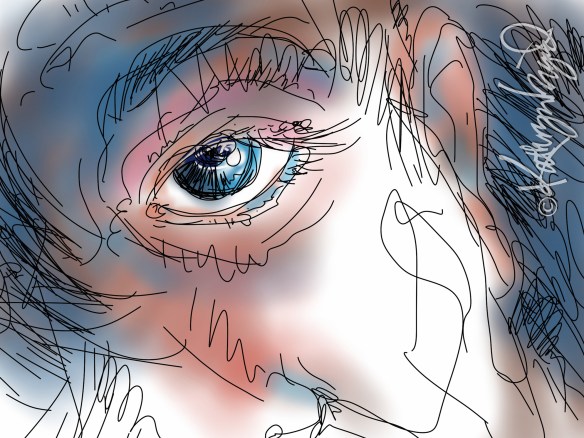
Photo: Something in My Eye

Do I have Onchocerca volvulus, or is there just an eyelash stuck in my eye?

All Other Martyrdom is Naught before Mine

This harsh, persistent pain I have, O Doctor, tell me, please,
Can it be cured by some cheap salve, Or have I some disease
Beyond the scope of modern meds And pessaries and pills,
Like something Biblical in scope, One of those icky ills
You read about in magazines, See movies-of-the-week
About so frightful that you Realize that you’re a freak
To have such creepy plague, To be afflicted so, withal,
That even specialists will cringe And dash off down the hall
To hide behind their file Cabinets until you leave
Because they’re overwhelmed by the Bizarreness they perceive
Upon your person when they see Disturbingly displayed
Such malicious malady It makes them sore afraid.
What say, Sir Doctor? You detect My source of agony?
Who suffers worse than martyrs who Have papercuts, like me!

Photo: Open Wide!

Well, shut my mouth! Maybe that nasty odor wasn’t Trimethylaminuria, but don’t just give me the brush-off.

A Plague on All Our Houses

Even the most steadfastly unquestioning among believers in various versions of mainline religions will allow that, if their deity cares for them as a shepherd cares for sheep, their own religions, yes, even their own temples, mosques, and churches, sometimes harbor wolves in sheep’s clothing. Partisans of every political and philosophical school of thought have seen the unmasking of many such monsters that have hidden behind the guise of goodness and faithfulness, selflessness and judiciousness, or at least experienced the dire effects those have on the lives of the truly committed. There are reasons most languages have such large inventories of words like heretic and traitor, infidel, apostate, renegade, impostor, infiltrator, double agent, betrayer, and hypocrite.
Digital illustration: A Pox on Both Your Houses!

So it astounds me every day that such experienced, otherwise reasonable people are either afraid, or simply refuse, to regularly and thoroughly question and examine the sources of their information, whether they are people or inanimate forms of evidence. Even among the most dedicated, wise, and well-meaning persons the human flaws we all bear cause mistakes and missteps. The most widely accepted proofs of truth may have come about by means of equally imperfect human study and the telephonic accidents of human transcription and translation. No matter how inspired the origin of the wisdom, it can’t be guaranteed to get to the page and from hand to hand, meeting to meeting, one end of the surprisingly not flat earth to the other, without sometimes being misinterpreted or co-opted, whether it’s by the false sheep in the flock or by our own good intentions.

All I can say is that if such stubbornness against rigorously examining our beliefs and every source of them is at its roots a terror of self-examination, we are doomed. We will forever repeat the grim side of human history, by acting out of doubt, cowardice, and ignorance, assumptions that have as much chance of being incorrect as not, and hidebound inability to see the wolves in our very midst for fear of discovering our own culpability. Circling each other with rapiers drawn and fighting to uphold traditions or beliefs or codes that we have so ingrained that they are unquestioned no matter how wrong, we will only deserve the curse of Shakespeare’s Mercutio—who, by the way, may or may not have said “A plague a’ both your houses,” in the original text, but various scholars over the years have guessed at such a reconstruction of it. Even Shakespeare, that demigod of English literature, is only as reliable a source as the many readers and interpreters since his time can determine, assuming that there was one playwright and poet of that name and not, as some believe, some cadre of the great literary minds of that era. Don’t get me started.

I will say right out that I know full well that I am guilty of being poorly or misinformed on a host of topics, and a stubbornly slow learner on top of that. I am trying, however I may stumble along the way, to grow beyond such ossified thinking. If only we could all begin with the premise that the fault might be not in our stars but in our selves, I think we might discover that our reliance on incomplete or incorrect information puts us constantly at risk for inner and outer conflicts we ought to have laid aside or, better yet, avoided altogether. The Other Guy might in fact deserve a listen, and acting first, asking questions later is not a conversation but is likely instead to end in swords crossed and lives lost. Acting in haste or acting in hate, the result may be the same because we were ill prepared to ask the right questions, let alone come to a wise and humane conclusion as a result. There are, sadly and unquestionably, baddies among us. But even so, if we all insist on clinging to our own versions of the truth without regularly and rigorously questioning their verity, then the attack we are all under begins inside, not from any external enemy, real or imagined.

Hey, Lookit What I Found!

Crows are a great source of pleasure to me. I admire their bold, graphic good looks: wiry legs and strong beak, shining eyes, and smooth feathers accented with iridescent shine. I enjoy listening to their noisy announcements and conversations, knowing that whether one is broadcasting his name in braggadocio or informing the rest of the neighborhood of what she’s discovered, there is often more brainy expression and interaction going than in many a text-messaging flurry from a pack of attention-deficient humans.

Crows can be aggressive and mean-spirited like humans, too, as I well know from working many years on a heavily treed campus where nesting season was Open Season on certain passersby whom the crows chose to bully. But for the most part, when they’re not busy trying to defend their territory they devote a goodly amount of time and energy to exploring and problem-solving and even humorous play, that is also surprisingly easy to see through an anthropomorphic lens. If I see a crow taking a particular interest in anything, chances are pretty good that I’ll find it interesting myself, should I follow its lead.
Digital artwork from photographs: Curious Crows

Shore Enough

I am too smart for you by half; you think you’re bright? Don’t make me laugh!

You think me infantile and boisterous, but cannot crack an oyster

With no knife? Ha! Silly chums: no fingers, no opposing thumbs,

And yet, I’ve dined on oysters thrice before you’ve opened one. How nice

That you consider yourselves wise to have your thoughts and synthesize

Them into action, yet still fail to see that mine makes yours seem pale,

When you consider that you’ve got advantages that I have not,

And still I’m able, while you strive and strain to merely keep alive,

To caw this jeering little poem at you from this, my beachfront home.

Foodie Tuesday: A Balanced Diet

Photo montage: Fun with Fruit & VegetablesI appreciate good health and all of the dietary elements that can determine whether I’m healthy, and if so, just how healthy I am. I know that diet includes not only the things I eat but how I combine them, when I eat, how much I eat, and many more factors that interact to create the ever-changing state of good health I seek. I realize, too, that nutritionists and scientists and other dietary mavens are always learning new things, and nearly always getting new ideas, too, some of which they can prove and others, not so much. That doesn’t stop tons of people, including me, from becoming obsessed, however temporarily, with the latest dietary trends and tweaking our diets without always considering whether those new, however ingenious seeming, ideas have anything to do with how our own bodies operate best.

Huh.

Yeah, I’m always thinking of new and better ways to make my diet more seemingly ideal for me, and I have some goofy thoughts on the subject at the best of times, and that’s the truth. What I can say in my defense is that among the relatively few things I have managed to learn in my lifetime thus far is that there is a whole lot more involved in my health and well-being than food.

I love when I can find the balance I need in any day by eating when I’m hungry, stopping when I’m no longer hungry, and focusing on getting not only a reasonable apportionment between protein and fat and carbs and vitamins and minerals and all of that dandy stuff. I love when it’s satisfying to my taste buds as well. Most of all, I love when that’s all fitted into a balanced diet of being with loved ones, going wonderful places, learning new fun things, and not least of all, of making art. There are always going to be theories, guides, charts, Rules and expectations about what constitutes the ideal way to eat, from the old spa cures that had people eating nothing but blandness or drinking rather large quantities of vinegary-dry white wine to the FDA-approved Food Pyramid, to the various independent dietary regimes from Scarsdale to South Beach, from Paleo to the Perfect Health Diet. I’ll outlive some of them, and many more will follow me. My budget and schedule, my taste preferences of the moment, and the company I keep, will continue to change my dietary wants and needs as well.

As long as I can keep listening to music, writing and drawing, and surrounding myself with great and interesting people, I will feel well fed.

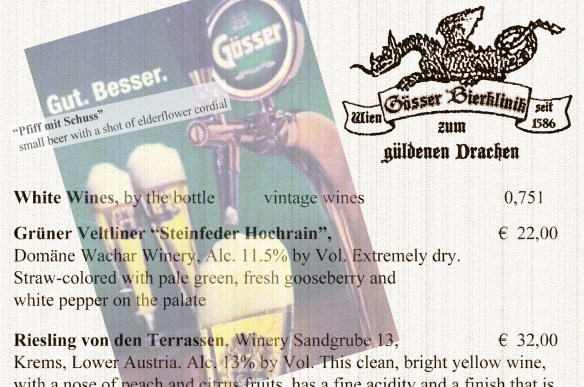
Photo montage: Another Balanced DietI need to tell you that there’s one sure way to have just the right diet, at least if you happen to be me and visiting Vienna. You just wend your way down a couple of funny little narrow byways and find the welcome that waits for you behind the door of the Gösser Bierklinik. That’s right: a clinic dedicated to beer. If that doesn’t make you feel better, you don’t know a healthy diet at all, wink-wink. Hail, Austria! It’s really a lovely old, old restaurant—don’t miss the neatly labeled Türkenkugel, the cannonball reputed to have been shot into the place in 1683 and still enjoying the pride of place where it sticks out of, or into, the wall.Digital illustration: Bierklinik Highlights

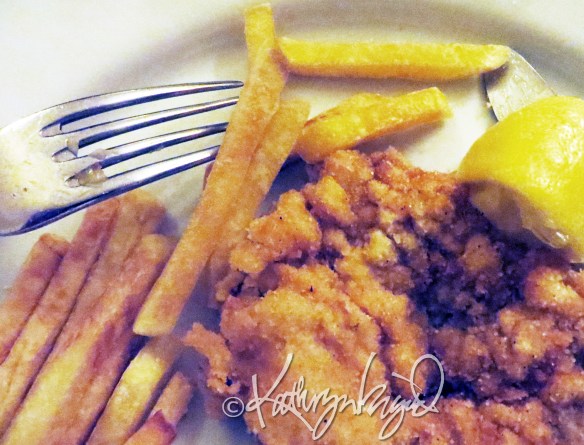
But don’t get hung up on ancient history too much, or you will miss out on one of the best Wienerschnitzeln I’ve had anywhere, and I am a fan, so I’ve enjoyed a few. The Bierklinik’s is tender inside, lightly seasoned, crispy on the outside, and unadulterated with anything other than the requisite lemon wedge for squeezing a drop or two of extra sunshine on it. Fabulous. Combine that with some ordinary but blazing hot fries and a bracing drink of anything from water to the titular beer, to what our server assured me was the ‘ladylike’ way to have a beer, a Pfiff mit Schuss, or beer spiked with elderflower cordial—I can’t speak to the waiter’s assertion, not being so incredibly ladylike myself, but it was a light and sprightly accompaniment to the Schnitzel, and given the perfectly convivial group with whom we were dining on the evening I tried it out (my husband and I were with three delightful friends, but also joined eventually in conversation with the marvelous German couple and his parents who were sitting at the next table), it was no more, and no less, effervescent than the conversation. Schnitzel, fries, a good drink and excellent company. Sounds like a perfectly balanced diet to me!Photo: Gösser's Schnitzel


Cat-astrophe

While I did borrow my sister’s cat Mercer’s image for the following tail [ahem!] of hubris and humiliation, it would be unfair to accuse him of such plebeian emotions and activities as are recorded herein, mostly since he would be tearing off at top speed if any cat other than his companion Ruffian were within spitting distance of him. I can’t say for certain whether this is because he’s far too important to be approached by mere ordinary cats or he’s absolutely petrified of all of them, but I can take a guess. His Royal Highness indeed!

Photo + text: Tom Slingshot

There’s Always Room for Silliness

The Wriggling JellybaggleDigital illustration: The Wriggling Jellybaggle

The Wriggling Jellybaggle and his relatives all laugh

at their own selves, each other, and at each faux pas and gaffe;

at funny things, ridiculous and silly things, and too,

at serious and sober stuff and fretful folk like you;

if you think you’re too dignified to snicker, laugh, and giggle,

you obviously haven’t seen a Jellybaggle wriggle;

and, furthermore, if you have failed to join the goofy gaggle

and goggle and guffaw a bit, your average Jellybaggle

would pity you, at best a fool, at worst, a stubborn stinker,

too stupid to enjoy yourself and thump your sullen thinker

with just the touch of tickling that takes the harm and haggle

out of your life, when you could be a Wriggling Jellybaggle.

Doesn’t Matter If I’m the Only One

There are ways in which solitude and solitary pleasures are among the loveliest, the most inexplicably un-shareable delights we can have. Even those things that are enhanced by happy sharing with one companion, or many, can only be experienced internally in our own unique ways, through our own highly individualized filters and lenses of taste, belief, experience, knowledge, and longing.Digital illustration: From this Angle

The beauty of this is that the best things I experience or encounter can be met at several different levels. Even when I am among a host of fellow travelers on the occasion, I can have that communal adventure and be guided and shaped in my sense of its goodness and meaning by any or all of those around me, while the reflections in my heart may say to me, “and yet…” or find me collecting all of the data of the moment in some private interior compartment for later examination.

In those after-times, I am at leisure to contemplate the whole and all of its components and think whatever I will, feel whatever I will, now that I’m left to my own devices. From this slightly removed angle, my own particular skew, I may find that the true enjoyment of this part of my life comes as much from within, from my imperfect yet fully tailored perspective being so well suited to make me like what I have seen, heard, tasted, and sensed in it. That is a subtly different but wholly wonderful part of living life: being able, in solitude (whether actually alone or not) to see what is marvelous and admirable, exciting and fine, to me on my very own terms.

Slipstream

Digital illustration from a graphite drawing: SlipstreamPeople often speak of the person ‘behind the power,’ the right-hand associate who always plays a large role in making the boss look good or the spouse who remains relatively unseen in the shadows while his or her partner is the well-known face of the duo, but I rarely hear anyone mention the full benefits of this kind of relationship. There are, of course, plenty who abuse such an arrangement as purely a platform for self-aggrandizement and advancement and treat their faithful supporters as unseen and unacknowledged slaves. An image comes to mind of the great old Jean Cocteau film ‘La Belle et la Bête,’ wherein the prince’s entire household was condemned by the curse he’d earned and continued to serve him, but even more abjectly, as virtually invisible helping hands. Even in the case of spouses and assistants and supporters who are treated with fairness and generosity and given regular recognition, however, there remains the probability that in normal circumstances, one is more visible and probably more publicly compensated than the other.

There can be, though, a handful of fine, if unexpected, benefits to this arrangement for the person behind the scenes. I think I can speak with a certain amount of authority, having been in this position both by default and willingly in various ways all of my life. I have always traveled in the slipstream of the leader, the marquee character in the act; I fly somewhere behind the lead bird in the V formation, hunt behind the chief lioness, swim behind the flashing silver of the strongest swimmer in the school of fish. I live in the slipstream of those wiser, braver, and more skilled than I am. And I like that very much. It allows me to see at close range where I am headed, led by the example of someone better prepared, while maintaining a sense of safety in my innate introversion and fearfulness from having to set the example or blaze the trail myself It offers me opportunities to find ways to help showcase those I admire in what they are and do best. It puts me on the periphery of events I would never, on my own, have had access to and often gives me the awestruck feeling that my privilege extends, through those I love, respect and admire, beyond any level I could hope to achieve or acquire alone.

I started early: as the next sibling born to a first child who was, and is, extremely bright and wide-ranging in her interests and accomplishments and unabashedly her own opinionated, funny, clever and challenging self—and admired by a great many others for it—I could easily have been, or felt, eclipsed by her. Instead, I tended to feel shielded and guided from the start; others (along with me) generally found her a more interesting focus for their attentions, so she bore the brunt of any critical scrutiny before I would ever feel any, and if there was any entertaining to be done, she managed quite effectively to keep the occasion afloat intellectually and/or with her trademark smart-alec witticisms. That she did all of this shielding of me and leading the way without my hearing much complaint or entitlement either one from her remains a marvel.

On top of that fortuitous training of mine in playing a willing and contented behind-the-lead role, I had parents who were the leaders in their community, too, and in a particularly exemplary version of this star + supporting player arrangement. Dad, the natural extrovert, led active congregations in his primary work role as a pastor and later, bishop, but always had parallel roles as chairman of this, board president of that, and consultant or advisor to the other; Mom, as his one-woman entourage, managed the household so that he was both free to do all of this stuff and looked after enough to be healthy, fed, rested and prepared as well as possible to do so to the best of his abilities. She was also his sounding board at home for anything of import that was underway in his life away from home, helping him to find his way to tough choices and decisions and think through all of the permutations of those situations that anyone tends to carry outside of official work hours. She stood as his consort for official functions, his representative when serving on committees and boards and doing community work as well.

Besides that my father’s work and status allowed me, again, to be quietly in the shadows while attending and participating in all sorts of events and occasions I’d never otherwise have had opportunity or reason to do, my mother was equally quietly setting an example for how to take advantage of all of that in a way that was mutually beneficial. During and through all of those years, I saw Mom come into her own as an equally respected leader among their community, a person looked to for influence and inspiration and committed, intelligent work, but all in her modest and unfussy way. When I finished graduate school and started working at my undergraduate alma mater as a teacher, it was near enough my parents’ house that I simply moved back in with them and paid the cheap rent that put me close to work affordably and, it turned out, in a position to train as the next-level behind the scenes person. Living there, I could keep the household running when they were on the road for work, be assistant-to-the-assistant when they were home by helping to set up for a few of the social obligations or special events tied to their work, and even get assistance from them when I was beginning to have such obligations of my own. By the time that I first went out with the man whom I got to marry, I was remarkably well-versed in the ins and outs of this sort of partnership.

I did, of course, have to learn new variations and nuances to the operation when he and I got together. My spouse is a music conductor. He teaches classes, like I did, but beyond this similarity of standing in front of classes and the variety of preparatory work that gets teachers ready for the classroom time, he had, and has, a much more publicly visible leadership role when he is in conductor mode. I am very glad to stay out of the limelight at those times!

The administrative and preparatory work, the selection of literature, score study, negotiations with guest performers, board interactions, service in the community, publicity commitments, writing program notes, collaborations with commissioned composers—these and so many other aspects of backstage life remain hidden from the public yet can’t be accomplished without time and concentration that are harder to afford if I’m not there to keep him in clean clothes and check that he’s had a meal or two, to chauffeur him to and from places where there’s no parking close enough to get him to a rehearsal on time, and yes, to be a sounding board for him when tough choices or decisions loom. I’ve learned a few things about music along the way, but not so much that I fancy myself anything like a musician or music scholar. But it’s the other parts of his life that I consider the arena for my contributions and participation. It’s the stuff that gets him to the podium that I think I can do best.

When my husband is conducting singers and/or instrumentalists in a concert, my role is to happily sit in the audience and bask in the music along with everyone else. My vocation, my modest part in earning our living, is to slide along in his slipstream and do what I can to keep impediments from holding him back or dragging him down, and whether that happens because I stand near him and shake hands with his bosses and supporters after a concert or because I took the car in for service while he was in administrative meetings doesn’t matter. I’m happy to be a small fish in the big pond as best I can.

Flourishes, but Quietly

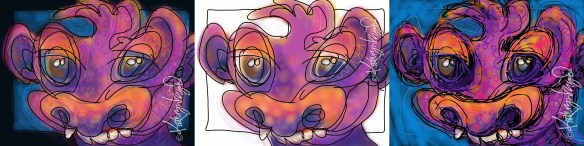
Digital illustration from a painting: Splashy-FlashyNo Talking in Class

Am I a showy character? It may be that I am…

A bold display of color makes me happy as a clam—

The splash of waves or fireworks delights me deep within

Enough to make me run and leap and wear a silly grin—

An anthem sung; a symphony or jazz or drumline played

Or children’s playground chanting—yes, by all of these I’m swayed

To passion and delirium, to ecstasy and dance,

But mostly, from the audience, where I can hide, perchance…

I have to tell you honestly, I’d rather you’re the star

And I the meekly happy fan who worships from afar,

For though I love the big and grand, extravagant and wild,

I’ll gladly leave that up to you and stay a quiet child.Digital illustration from a photo: No Talking in School