Aging Gracelessly

If I started out without being very lithe and blithe and graceful—just ask my dance teacher from when I was in second grade—there’s little hope I would suddenly have become any more so in the years since unless I had been working assiduously to defeat my cloddish nature. But I haven’t. Your first clue, of course, should be that word “working,” as you all know so perfectly well that I am opposed to, if not utterly incapable of, being a worker bee and exerting energy. That is neither new nor likely to change radically with the passage of further years, in which I will naturally become more ossified and less willing and able to assimilate new knowledge, less flexible and worlds slower in my reflexes.

What I do have in my favor as I age is an ever-growing ego and ever-shrinking ability to be embarrassed by my evident weakness and silliness and fallibility. So as I go skipping my way through yet another birthday, I am not much troubled by my actually achieving this advance in age by, you know, getting older. As it’s always been said, it sure beats the alternative. And there really are a lot of great things about aging and the passage of time that tend to offset the cost.

So don’t mind me if I stumble and fumble around, making quite the fool of myself as usual and hardly managing to avoid absolute implosion. The occasional face plant isn’t nearly so hard to take as not being alive enough to fall on my kisser once in a while. Making plenty of mistakes and missteps keeps me interested in not only how to avoid the same pratfalls the next time or two around but also in how to enjoy the goofy glories of just being an extra in life’s always grand action. And you never know when I might manage a real, if awkward, pirouette or plié before collapsing in creaking and squeaking and laughter. Keep your eyes peeled.Graphite drawing + text: Aging Gracelessly

Fugue State in the Studio

It’s not always the case, but sometimes I find that I can lose track of time and self rather thoroughly when I’m deeply engrossed in making art. Writing even a simple email can take ages, if it’s about something or to someone I consider important; an essay or poem can take hours or days, if I get involved and forget where I am. It’s a bit like driving a familiar route; when I’ve been on the same track enough times, I am occasionally startled to realize that I don’t remember passing through the last number of miles, because my brain is so used to noting what is or isn’t as it’s expected and supposed to be that it operates nearly on autopilot, though thankfully if I examine my memory I can indeed recollect noticing real details along that ostensibly missing section of the trip. With making visual images, I can (and sometimes, I think, absolutely should) let go of and turn off my editorial mind for a good period of the work time. If I’ve practiced enough and prepared enough, inwardly, for a session of art-making, letting my attention take a back seat to my instincts and actions before returning to critical mode is at the very least going to produce some worthwhile, thought-provoking, challenging Stuff that will either lead directly to an artwork or, as a bit of not so fabulous yet earnestly glimmering potential, lead to something on the next try.

No matter how that part of the process goes, I’m quite sure that an easy 90% of what I do to make art, whether it’s textual or visual, happens internally and not externally, so it’s no wonder if I wander off at times.Digital illustrations from photos + text: Work Patterns

Unique Talent

Some of us are terrific at doing things the hard way. I can blame some of my peculiar talent for that on being dyslexic enough to consistently, persistently turn right when I should go left, push when I ought to pull, and stand up when I am expected to sit down. A bit of my wrong-way gift comes from being too intimidated to ask for help and too impatient to study the proper technique. Some share of the problem lies in my sheer stubbornness and iconoclastic eccentricities. Even when I ‘get it’ I can be resistant to sticking to the recipe or just plain forget what I know at precisely the wrong moment.

As I finished writing that last paragraph, in fact, I realized that I’ve been using my little notebook back-to-front and can’t remember why I started using it ‘in reverse’ in the first place.

The great thing about being and upside-down and inside-out sort of person is that most of us outlier sorts manage to muddle through anyhow. There’s a reminder in all of our strangely variant approaches that life offers us more options than we often think to use. Sometimes the sidelong slide into a task proves to lead through unexpectedly wonderful byways or to an unpredictably elegant end.

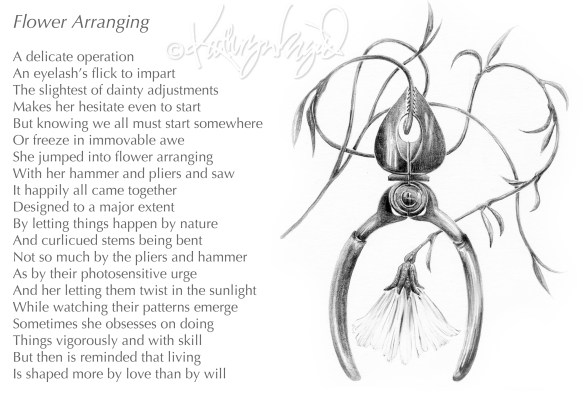
Falling headlong into life, it seems, is sometimes a happy and wholesome thing.Graphite drawing + text: Flower Arranging

Tiger Time

If you remember anything about primary school (and I do, if little) you hopefully have a few memories of one or more of the fantastic sort of teachers who were the virtual equivalent of extra aunties and uncles and grandparents, but neatly spun into the form of educators whose wise teaching made you learn things without even knowing you’d worked at it, and want to learn things you hadn’t even known you wanted to know just because they were such fine pedagogues that they made it seem possible, if not easy.

You undoubtedly also have a memory or two of teachers who were quite the opposite. My personal least-fave was the third grade teacher who had no compunction about excoriating and humiliating a student in front of the rest of the class regardless of the infraction or any of their previous achievements or behavior, even cracking a yardstick onto desktops to make a point when she was het up, regardless of whether there might be some small knuckles in the way of the stick. At the very same time, she apparently thought it perfectly logical and beneficial to ‘level the playing field‘ and make all students feel they could accomplish something in her class, lest the PTA or school board think her not supportive and informative enough, and this she would do by sitting and doing the weakest students’ homework for them.

I knew nothing of this until one time when I was the unlucky receptacle for her ire, having failed a penmanship test in the first weeks of school because that school required students to learn cursive writing in the end of the second grade and the one in another state where I had spent my second grade did not. Had she asked us all to sing a song in Spanish, I might have been the star of the class, because my second grade teacher Mrs. Mosqueta let us learn a little elementary Spanish from one Señor Ybarra, who taught by the ultra-newfangled medium of televised classes, and I don’t think my new classmates in Illinois had yet had access to such magicks themselves. But there I was, little miss Goody Two-Shoes, who had never gotten anything but perfect scores because I was too prim and much too afraid to not do my homework to the nth degree—if I had any actual training or homework to prepare in the event—flunking my attempt to make Pretend Cursive when that mean lady in her sausage-casing dress didn’t even ask whether I’d ever been trained to write that way. If you think I still sound remarkably bitter about such a small thing from so long ago, well, I probably ought to let it go but I tend to enjoy my little revenge fantasies more than is entirely good for me.Digital illustrations + text: Tiger TimeThis is all in jest, of course. I wouldn’t be so cruel as to want to give any poor innocent tigers indigestion.


The Love that Dare Not Bark Its Name

We all know that there are certain kinds of thrills that are worth the risk, that the forbidden fruit can taste sweetest when it’s a chocolate sneaked from Mom’s birthday gift selection (not that I would know anything about any such thing from my youth!), the extra hour out past curfew when one thinks one’s parents are out of the house, the bouquet picked from a neighbor’s flowerbed en route home from grade school. And there’s no doubt that some are drawn to romance most powerfully when it is risky, when it defies convention, when it defies logic. Is anyone really immune to the lure of breaking with tradition, just a little?Graphite Drawing + Text: Precarious Position

Who’s the Wisest?

I give myself credit for being smarter than I am. I suspect, given what I see around me in this wild and woolly world, that I am far from alone in the practice. Even owls, a favorite symbol of wisdom, are not likely as perfectly ingenious as we imagine them, but they might still be more intelligent than the half of us.
Digital illustration: The Owl King

The Search Continues

Parsing paragraphs to find

The author’s complete state of mind

Is no more useful than to ask

A Word how it performs its task,

If we assume we’ve read aright

What’s only there in black and white.


The Long and the Short of It

How quickly pass the hours and days

and weeks and months and years,

And yet, how slowly pass our worries,

paranoiac fears;

This is the great conundrum that

presents in mortal time,

And quite enough of food for thought

in one quick, measly rhyme.

Unnaturally Lightfooted

We’ve long since established that I can’t dance. I couldn’t dance well enough to stay in a second-grade dance class; heck, I couldn’t even be trusted to remember whether we were supposed to show up wearing tights with our tutus or not, for the class picture before the big recital. Though it’s only fair to give myself credit for having been obsessed with the ugliness of our getups to such an extent that I forgot the part about the stockings, and I promise you, they were hideous costumes.

But you also know that I am enamored of beautiful dancing of nearly any kind, if allowed to watch it from a safe distance. So I think I can be forgiven for letting others take to the floor in real life and only doing so in my imagination and, occasionally, in my poems. I think any creature, real or imagined, that can dance beautifully deserves my attention and admiration (as long as it wears the correct tights with its tutu).Graphite drawing: Swinging Dragonflies


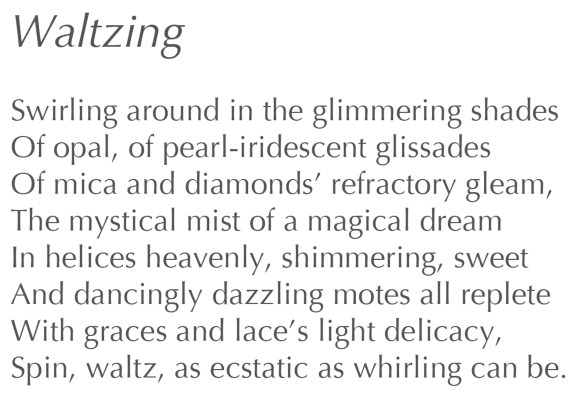
Text: Waltzing

What Wounds can Teach Us

Cut

Skin, though as taut as rawhide, and as strong,

Still splits under a jagged, cruel knife,

Opens its jaws to scream a gout of life

As blood that would atone and end the wrong—

But wounds, no matter what the cause or source,

Cannot withhold their sorrows or their rage;

Injustice must be shouted off the stage,

So bleed they without pity or remorse—

Break, then, both skin and soul, and sear the heart

Of any who is cognizant of pain;

Who cries for justice and can’t sleep again

‘Til order is restored as at the start—

What’s done cannot be undone should a scar

Reveal the fragile creatures that we are.Digital illustration from a photo: What Wounds can Teach Us

Through Winter’s Window, Dimly

Photo: Light Looks In

Change of Season

Between the rain spells, when the sun is glinting onto rose and road
The youthful smells of spring are hinting that ahead the broken code
Winter left in seed and scion will reveal its inner life,
Where what had appeared as dying wakes again with newness rife.
Open eyes and open windows! Let indoors the fresh new air,
Breathing in what melts the snows and pushes out all winter’s cares.
So renew the self and senses and embrace the growth and light
Breaking down all old defenses, setting earth again aright.

Early Music for Breakfast

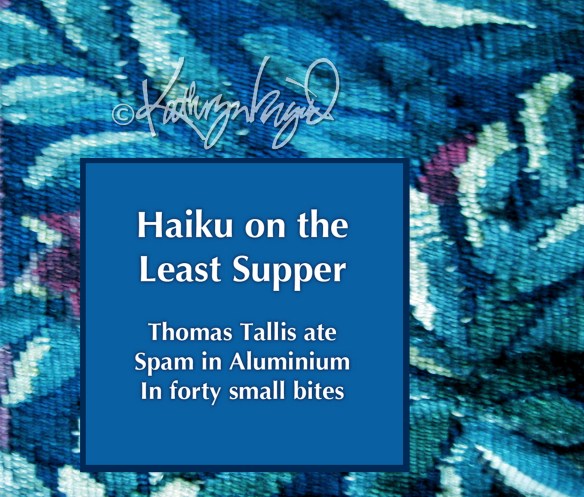
Digital illustration + text: Haiku on the Least Supper

If you haven’t already crossed paths with Thomas Tallis‘s landmark Renaissance motet Spem in alium, I highly recommend it. It’s a truly astounding piece of European music history, representing the confluence of the political and artistic competition for primacy in that time period; it’s believed to have been composed as England’s answer to Italy’s Alessandro Striggio‘s own, earlier 40-part motet, or possibly to Striggio’s 40-60 voice mass. I’m no musician, but I’ve learned, mostly through witnessing a few performances of the Tallis by different groups led by my husband and his colleagues, just what a feat this piece really represents.

While the creation of Striggio’s works for 40 and more independent voices is amazing in its own right, the 40-part motet he wrote specified that the voices be doubled instrumentally. That is impressive enough. For my fellow non-musicians, think of it this way: a typical piece of music for a mixed choir requires singers to perform different notes and lines of music, often at the same time, so that what is heard is not one single series of notes, one after the other the way we sing by ourselves, but layers of notes that become deeper and more distinctive expressions of the words being sung. Instrumental doubling means that some or all of the vocal parts are supported by one or more instruments “singing” the same notes at the same time. This can intensify the effect of that singer or section’s line, and it can sometimes also help a less skilled singer or choir stay on target with the line.

In any event, the more typical choral works tend to have soprano, alto, tenor and bass voice parts, or singing lines, (or some combination of those) and generally, not more than eight or perhaps twelve different lines intermingling at once. Anything more than that means that every singer in a moderate-sized choir is responsible for knowing and performing his or her own notes, on pitch, at the right moments, and with exactly the right loud-soft dynamics and flow at every point throughout the piece. Being in a choir is a thrill; being in a good choir is a real intellectual and artistic and even physical challenge.

What makes the Tallis Spem so incredible is that it comprises not only forty individual, fully independent singers’ voices all singing their own distinct parts of the song, but indeed, doing so entirely unaccompanied. Every one of the singers has to be spot-on at all times without the support of either a fellow singer or any kind of instrumental doubling. If one singer goes off the rails, there’s the possibility that others will be thrown off of their pitch, timing, or even their place in the whole work. It could well lead to a musical train wreck. Think you’d be intimidated by doing this? I think any sane person should be!

But it’s powerful stuff, when it’s well done. I’ve had the privilege of hearing this feat beautifully accomplished by singers surrounding me in a cavernous cathedral space, and by singers standing onstage in a modern performance hall with a carefully engineered acoustic. I’ve experienced it in art galleries where Janet Cardiff‘s intriguing installation of forty high fidelity speakers on stands are placed in a circle in the otherwise rather bare room, each playing in synchrony the recording of one of the singers in a performance of the Tallis, so that one can stand outside the circle or in the center of it surrounded by the speakers, or can move to stand at one individual speaker at a time, getting entirely different effects depending upon which part of the score is being performed and where one stands in relation to the speaker playing that part.

No matter how it’s done, once you’ve gotten a little of the idea how this piece of music intertwines voices that seem at first to be operating without a clear relationship but then, more and more, to be converging into a meditative, chant-like, layered song, it is quite mesmerizing. There are some recordings and performances out there on CD, iTunes, and YouTube worth a listen, and if you get the chance to visit the Cardiff installation, called simply Forty-Part Motet, do it. Best of all, of course, is if some fine choir nearby offers a live performance that you can attend. It’s rather haunting and ethereal, and made all the more impressive by the knowledge of its complex origins.

Meanwhile, I have given you this bite-sized humorous meditation on the work. A haiku seemed the ideal vehicle for acting as either commentary on or antidote to a choral masterpiece so complicated and virtuosic. And I sort of wonder if, in the process of composing this grand work, Mr. Tallis had any chance to stop for rest or was so deep in concentration that he barely had time to do the Renaissance equivalent of opening a tin of luncheon meat and dining directly from it, pen and parchment in one hand and dripping Spam juice on the other. Thankfully, it doesn’t appear that this effort of his was entirely detrimental, let alone leading to his personal version of the Last Supper, since he went on to compose other fine works up until nearer his death some fifteen years later.