Reverence for Beauty

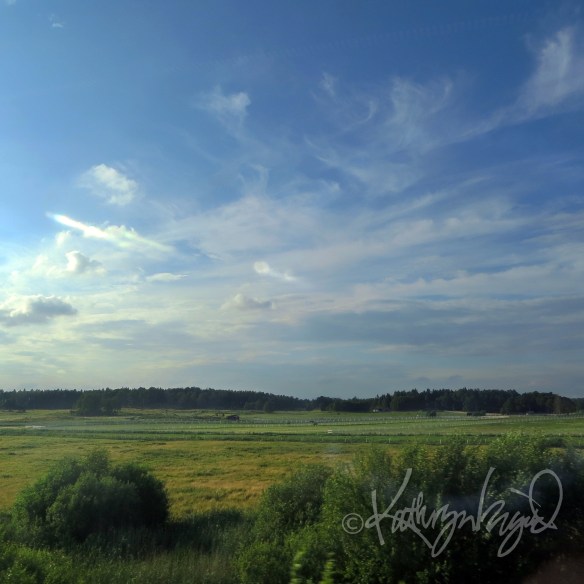
Photo: Blissful NothingnessThe whole of nature has its ways of reflecting perfection, when we take that momentary pause in which we can step back to appreciate such things. Even, as I posted yesterday, in death there is room for new life; out of captivity, freedom. In silence, I come to better appreciate the small and unobtrusive ways, not just the large, noticeable ones, in which sound enriches my world: water burbling down a ditch, breeze-stirred grasses, bees that sing soft love songs to their golden pollen treasures. In stillness, I relish each breath and every tentative movement as the wind kicks up a little and sets the empty park swings in motion again. Out of wintry darkness and overcast days, I more consciously embrace a bright afternoon and its combed, silky clouds.

In a moment of quiet reverence, I, too, can reflect such perfection better and am made more whole and beautiful.Photo: A Brilliant Day

Just a Second

Photo: Newness 1

What do you see? It’s not a trick question, only an invitation to look for the small and temporary delights right at hand. Newness and beauty are present all around us.

For all that we think of lives as finite and fleeting and time, constantly racing by, I don’t think we take it so seriously when we tell someone who’s waiting for us, “just a second.” After all, so much can happen in a second or less, yes, evening in a millisecond, as we can now measure it. Races are won and lost by the tiniest increments of time. On one side of the little mark signifying a clock’s second-long increments is the Now, and before the very thought of it is completed, Now already resides on the other side of the mark.

Photo: Newness 2

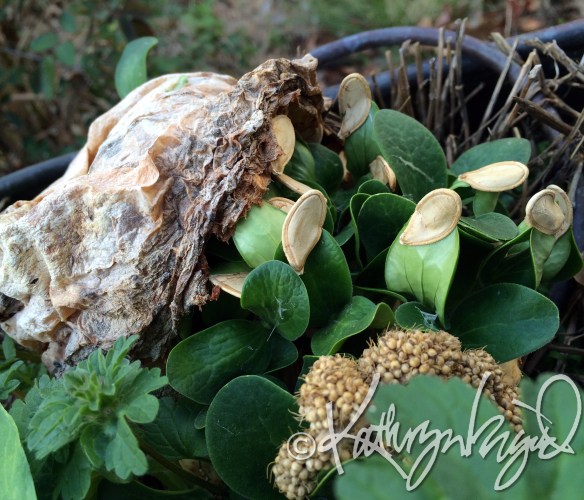
Dead stems of the past give birth to lively leaflets for the season to come…

No matter how protracted the process leading up to it, one nanosecond is the last one I will spend alive, and the next one will be the first one in which I’m dead. The thought has no moral value one way or another, and not much emotional value either, since as soon as it is likely to seem fully important to me in the most urgent of terms, it’ll be all done.

The only real value for me, in practical terms, is if I invest enough thought in this very moment of being still alive to commit to being wide awake as well: deeply present, and grateful for all of the good that is in my life at every piece of time I’m granted along the way. Whether it’s thanks to honoring spiritual values in the practice of mindfulness or it’s because I’m keenly aware of those lives that, however brightly they’ve burned, were far too short, it matters little unless I take advantage of the perspective these afford me and live my own life more richly because of it. Regardless of how I choose to spend this magnificent currency of breath and sentience and health and hope, even if it’s on sitting on a park bench and holding hands with my beloved (one of the highest and best things I know how to do, to be sure), making a conscious and committed choice is well worth the effort, and following through, all the better.

Just now, the value of mindful living in the present is particularly lovely because we are on the cusp of spring here in north Texas. And if you’ve read even a few of my locale-related posts, you can appreciate just how fleeting and tenuous is the very idea of springtime and how ephemeral its joys. I would be a fool to be so encumbered by longing for things past or worrying about things yet to come that I don’t pause, however briefly, to savor the wonder of what these treasured nano-joys can bring to my existence.

Photo: Newness 3

Out of death, life. The cheery pumpkins and gourds brightening the fading allure of the autumn garden have in turn rotted, dried, and decayed—but from their secretive hearts, the burst of seed and greenery returns to begin it all again…

Continuo

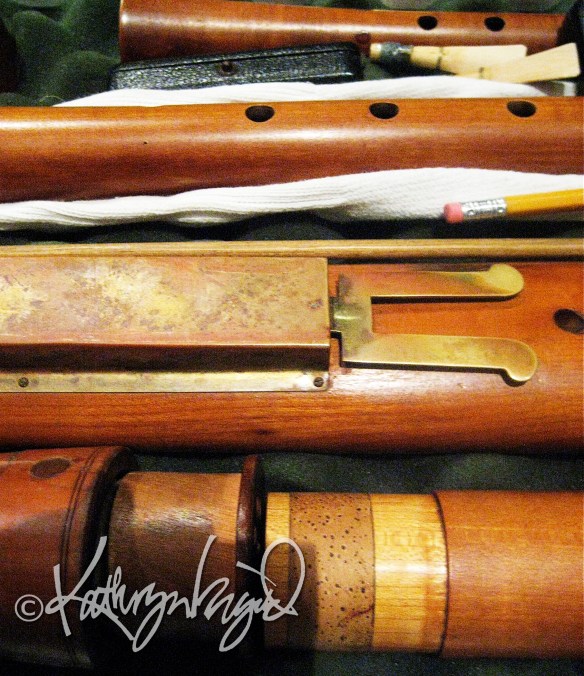
Photo: Early WindsRehearsals of Early Music vary more than those unfamiliar with the stuff would guess. Explaining to others why I, a non-musician, love sitting in music rehearsals of any sort is an iffy enough proposition in itself, but at least I can condense my main reasons enough that they may appreciate how much watching and listening in on the preparatory process—hearing what the musicians are working on, how, and why, not to mention any backstory of the pieces in question that gets shared en route—informs and enriches my experiences in concert performances. Tell them I love sitting in on rehearsals for early music, and I can get quizzical stares as though I’d said I love the temperate climate of Seattle. Isn’t that where it rains all the time? Well, the Pacific Northwest gets a fair quantity of rain, or it might be hard pressed to maintain its evergreen status, but in addition to lots of other notable and varied climatic features of the region, it gets truly spectacular sunshine as well.

Rehearsals of early music, too, are far more varied and nuanced and, at times, downright surprising than you’d guess if all you’ve ever heard of the entire body of work leading up to the Baroque period is that 30-second clip of background music advertising the local Renaissance Faire.  It can range from the most tender, measured votive chant to the rollicking, rowdy, and bawdy; from plaintive solos through angel-choir harmonies and right on to shockingly modern sounding rhythms and dissonances, early music is an incredibly rich tapestry of sounds.

One thing that does remain consistent in a great deal of accompanied or instrumentally supported vocal music from early Western sources is the use of continuo. To a layman or amateur listener like me, this means that while there will be portions or movements of larger musical works when either the choir sings a cappella (unaccompanied by instruments) for a while or, conversely, together with the majority of the orchestra ‘singing along’ in accompaniment, there are often sections where one or more of the singers, or the entire chorus, is supported by a small group or individual’s continuo playing, too. Continuo is not an instrument, or at least not a specific one; rather, it is the practice of supporting sung music with a continuing and enhancing undercurrent of instrumental accompaniment.

The result, at its best, is that the sounds blend so seamlessly that listeners might well forget that they’re not hearing human voices exclusively, and the instrumental strains seem to disappear into the sound. Yet when the continuo is not played in the same passages, as may be the case in rehearsal, the phrases can sound strangely pale or incomplete.

A great continuo player, like a great accompanist, is a species of artist quite distinct from the great solo instrumentalist or even orchestral player. It is, in very rare instances, possible for one player to excel in all of these roles, but such magical creatures are truly few and far between. What distinguishes the fine continuo artist, and to some extent accompanist, is not only sheer musicality but an extrasensory ability to think in sync with the other artists in the performance—the other players, the singers, the conductor—and a remarkable degree of prescience in always giving just the help or polish needed at just the right instant without either being asked or demanding the spotlight for it. The best so seamlessly enhance the work of those around them that they raise the level of the whole performance in ways that a self-aggrandizing soloist cannot. There’s an element of generosity in the skill set that not only shows true mastery but also the confidence of knowing that such excellence is its own reward and the beauty and pleasures of the concert are great enough to cast their golden glow over everyone.Photo: Lute's Heart

There’s a good lesson in there for all of us, musicians or not, isn’t there.

Vegetable Bliss

Photo: Vegetopia IIn addition to the under-appreciated benefits of simply vegetating for rest and personal renewal—the old R&R that current generations seem to forget to practice in our constant race for connectedness and communication and “productivity”—vegetating is a state in which the highly desirable happy accident of inspiration has room to occur. Some inspiring thoughts could even lead to a great invention or contribution to society. Mine, not likely. But if I don’t take the opportunity to allow that creative space, how will I know?Photo montage + text: The Faithful Gardener

It’s worth the risk, in my view, of fulfilling my destiny as one who will never have the Great Idea. By trying the intentional-vegetative approach, I might surprise even myself. And I’m certain that having a little more time spent as a human plant form is bound to have a positive effect on my general well-being, at the least. Indulge me. Better yet, indulge yourself from time to time.Photo: Vegetopia II

We are All Lost at Times

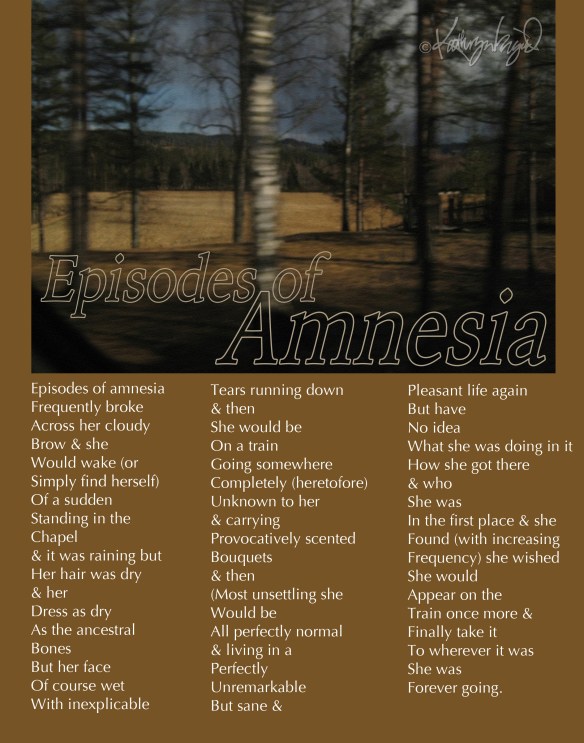
Awake or asleep, physically or only in spirit, we all have moments to wander. It may be that we do so with good reason, or without any sense of reason at all, but the roads we take can twist and turn unexpectedly. What we do with these surprises can be the crux of real meaning in our lives. Or it can lead onward, ever onward, the mystery never seeming to abate and its clews unravel intelligibly before us…Photo + text: Episodes of Amnesia

Chaos is the Order of the Day

Whenever I think I’m finding my balance, getting the hang of things, or otherwise making rational sense of my life, something happens to remind me that in my reality, these things are impossibilities. And probably unnecessary anyhow. The longer I look at anything, the more its illogical qualities emerge; the more illogical and foolish the world appears to me, the more at home I feel in it. Go figure. Graphite drwg + text: First the Egg, Then the Toast

A Touch of Existentialism

Like most people, I suppose, I am an odd collection of contradictions. Having a pretty dandy education and good genes, I’m not entirely dimwitted, in fact, would say that I’m not only intelligent enough to have gotten good grades in school right on up through my graduate studies but even so much so that I get along rather well in my life. But everybody who knows me also knows that I am also almost supernaturally dyslexic, being unable to read with ease or tell left from right, up from down, forward from back, and a host of other handy life skills that others, as I’ve observed, seem to come by naturally. This is not a complaint or bragging, either one, just a statement of fact. I do well, when I do well, because I have found sidelong ways to get the job done, whether it’s by reading any text at least three times through before it falls into sensibility in my quirky brain or by traveling on trust and a fairly reliable eye for landmarks to keep me finding home base despite my utter lack of an inner compass.

I am by nature exceedingly shy and have had from early childhood what I only learned as an adult was an unusually high level of constant anxiety that, with serious therapy and a consistent supply of low-level medicine, turns out to be manageable. So even though it seems incredibly unlikely and counterintuitive to people who meet me now, I appear to be a lifelong social butterfly, an extrovert, and naturally fearless about interactions even though without the meds and training I would be wholly unable to function at this happy level. My vocal cords are irritatingly subpar for regular use thanks to my SD*, but when I’m with someone I really enjoy and trust, I can be counted on to chatter without stopping (*other than when forced to) for great lengths of time.

And I have no magical powers. Again, I think myself essentially ordinary in having no skills or talents, knowledge or gifts, of special note. I am not overly self-deprecating or sad on this account, merely noting that if you’re looking for the person who will end all wars, cure cancer or the common cold, or discover a way to stabilize the planet’s climate forever, you should jolly well be looking at almost anybody else imaginable as a better go-to heroine. Yet I really do think we all exist for some sort of reason or purpose. It might well be that mine is nothing more than to spend a lifetime figuring out what my purpose is, and die slightly more contented than otherwise if I should be so lucky as to solve that puzzle any time before I’m taking my last breath.

You know what? That’s good enough for me.Digital illo + text: Hovercraft

Art in the Middle of Dying

Digital illo + text: Angels DescendingThere’s little in the world that gives more meaningful respite from earthly trials than art. Those sorrows and struggles that range from the brutality of human weakness and evil to the most monstrous of natural disasters have no true cure, no end. Safe to assume that they have existed since long before recorded history, and will outlast the lives of any of us now present. But art—a painting, a dance, a song, a story—in its turn outlasts, too, the horrors and madness of the darkest time. What exists in the background, dwells in the underground, during suffering and oppression, so strong that it cannot be extinguished, and both records the terrible event and defies it? Art.

If we learn anything from our history, it should include the knowledge that any threat to eliminate or suppress art by force or merely by neglect and dissolution is a time when we should most avidly practice our defiance of oblivion. When it is bleakest, we should dance most wildly and gracefully; when dark, sing boldly and sweetly; when empty, we should fill the void with thought and challenge it with beauty. The blank Nothing may not mock us into meek obsolescence if we refuse to silence our passion and surrender our dreams.

Sometimes It’s Better to Part Ways with One’s Parts

When something goes wrong inside, for most of us it’s no big deal; just an off day in the old innards, whether physically or emotionally, and it’ll pass. But when something goes wrong in a more complicated way, I tend to think it’s pretty good luck if “all” one has to do to get well is remove a malfunctioning part and either replace it or live without. Modern life makes that possible: a swift appendectomy with a tiny scar to show for it, a manufactured hip here, a transplanted kidney there. Lots of things that, if not chronic, are reparable and survivable when they used to lead to long, slow, miserable declines or instant death.

There’s still plenty of the latter kind of illness and injury to keep doctors busy and patients unhappy and money funneling from the latter to the former in ever-widening streams, and that’s no joke. But I think it remarkably good that I live in an era when far less stuff is fatal by default. I was especially glad that when my poor brother-in-law was violently attacked by his own gallbladder recently and it tried to stone him to death, there was adequate artillery to fight back and win. What did he ever do to it, to deserve such lousy treatment! I can tell you from (supposed) experience that gallbladder pain is horrendous. I can’t tell you what it’s like to have the offending organ removed, or even have the stones destroyed and extracted, because either I don’t have a gallbladder at all or it is an expat living in a foreign part of my body from where they are normally located: the doctor and ultrasound technician spent a lot of time hunting and could never find the little hunk of meanness before the pain, thankfully, dissipated on its own.

Photo: Plumbing

Don’t you just hate it when something goes wrong with your plumbing?

My BIL was not such a fortunate escapee, and the pain persisted and worsened until he ended up with several exceedingly un-fun procedures to zap the stones and remove the offending organ, which if you ask me did have a heck of a lot of gall to treat him like that. I am ever so glad he has already begun a full recovery! I wrote him a silly poem, ’cause I love him.

Parting with Parts

is Such Sweet Sorrow

Can anything be worse, or sadder,

Than to give up one’s gallbladder?

Well, perhaps one worser quirk:

Still having one that doesn’t work…

And one worse yet: the wails and groans

Induced by one that’s filled with stones.

So I’ll amend Assertion One:

Having a gallbladder’s no fun.

But then again, I must concede

That surgery is bad indeed.

It all comes down, if I should guess

To what will save my happiness

More fruitfully: intact gallbladder?

None? Can’t say: it doesn’t matter,

Since the choice will not be mine—

‘Til then, I s’pose I’ll be just fine—

I hope. Of course, I still don’t know

Whether I even have one, though.
Ride Like the Wind, Even When Stationary

Photo: Deep-Seated FearsI’m told that once one learns to ride a bicycle, the innate sense of balance and knowhow to do so is easily reawakened after a long interval, the moment one gets back on the thing. Which, if it proves true, will be a boon to me after all of these years of not even owning such a contraption. Though that’s not entirely true; I merely own one that travels only in my interior world—an exercise bike.

This could be considered a concession to the oft-overheated world of Texas, where I find it hard to get motivated enough to stroll from the front door to the mailbox on a typical summer’s day let alone do something as strenuous as pedaling at speed on a bicycle. It could be considered a mere kindness to all who would rather not see me teetering on the brink of disaster no matter what my speed, let alone have to try to navigate safely around me. It could even be considered a cheapskate solution to the expense of bikes nowadays relative to what I remember paying for my first grownup sort of bike.Photo: A Whole Rack of Bikes

The latter, however, is quickly canceled out when you know how much indoor, stationary bikes for exercising personages really cost. They’re just as outrageous in price as any that can tootle down the roads. At least, this one was. But the big difference in price is in the personal health, safety, and well-being of this particular rider and all who are freed from the dangers of surviving my biking skills should I hit the actual pavement. I am not in danger of heat stroke on this baby, since it sits in the bedroom not far from the convenient ceiling fan, should I go so far as to break a sweat or simply fall into an unwelcome hot flash mid-ride. It stays upright, no matter whether I am properly centered on the seat or pedaling evenly enough or paying reasonable attention to the terrain, or not. In fact, I can lean back on its amply cushioned recumbent seat with my iPad or laptop propped on my midsection, reading articles and watching video and blithely ignoring anything to do with my steadily cycling feet without any fear of riding off a cliff or into a vortex-like pothole.

And nobody will ever have to see me in bicycle shorts. Period. You can thank me now.

Do I miss real bicycle riding? I can’t say that I do. When and if I live in a climate where I feel comfortable mounting up on one of the real-thing bikes again for a genuine outdoor ride, I will likely enjoy the change of scenery enough (barring any strenuous terrain, because I am a lazy cuss) to make it worth my while. Until then, I’m quite content to pedal furiously, or as leisurely and gently as I like, around the confines of a square meter or so of my own bedroom, ogling digital scenery or perhaps, if the bird feeder is freshly filled, a few wrens, cardinals, and chickadees whose chatter is probably about the crazy bicycling lady on the other side of the window who is obviously so feeble that she’ll never catch up with them.Photo: Red Bicycle No. 2