It’s almost midnight here, but there are a couple of hours left of Mom and Dad’s 59th anniversary back in western Washington state, where they began, and still practice, the fine art of marriage. So before I tuck myself into bed, and because I couldn’t reach them in person to say so the first three times I called, I will take this opportunity to thank them for having had the excellent taste in partners that put them together in the first place, the temerity or mild insanity—or both—to have us kids and keep us, and the strength of will and love and hope to stick together for all of these amazing years. Blessings to you, Mom and Dad, and may whatever comes only strengthen your joy in each other.
There’s the *Good* Going Viral and Then There’s the *Bad* Going Viral
As a blogger, an artist, and a writer-type person, it almost goes without saying that a I would find it beneficial, if not outright pleasing, to have my work catch on like wildfire for some (or no) reason. Few people, I’d guess, get into blogging in the hope that no one ever notices them.
Nobody who spends any time on the interwebs, of course, has any excuse for not seeing and understanding that what ‘goes viral‘ is often nasty, lowbrow, and destructive stuff. We all still fall for it, but that’s a failure to accept experience, observation, and logic, not one of lacking evidence: tell me there aren’t a dozen topics, from celebrity rumors to fake medical claims and offers of specious Free Fabulousness galore that are patently impossible. And our collective gullibility, willful or not, leads us to pay attention to such lunacy, even to buy—or buy into—it, until the Likes and Shares, the Tweets and Pins reach critical mass. Fans and friends are lost over this stuff, health and fortunes risked, and even governments stand on the edge of oblivion over it. This is not the pretty side of going viral.
Yesterday I was reminded of the sense of the word “virus” I first knew: bugs. Ugh, bugs. Not insect-type bugs, which in the abstract sense I admire greatly. Germ-type bugs. Which I really, really do not.
Apparently, they don’t like me much either. Yesterday when I went grocery shopping around dinnertime, I was not feeling especially perky, but didn’t think much of it. I was a bit hungry, and attributed my discomfort to having let dinner wait too long. I got home, started having a little pain around my midriff, fixed a quick dinner, felt much more awful all of a sudden, left dinner in the kitchen, and curled up on my bed like a snail.
I won’t go into further details, but by 10 last night I was feeling lousy enough that I asked my dear spouse to call the 24-hour nurse line to see what the person on duty would recommend I do. Go to the Emergency Room, she said. And so I did, with a lot of help from my sweet chauffeur, of course. After the examination, a couple of nice refreshing pints of rehydration, a small whack on the head from a dose of morphine, and a long morning’s sleep, I am intensely glad to say that the flu bug that knocked me for a loop appears to have been the classic 24-hour variety. Viral gastroenteritis sounds so much more interesting and magical than Flu. It can, obviously, still knock me for a loop. This was only my second-ever trip to the ER (my first, for stitches over a tiny hockey-acquired slash on the chin when I was in grade school), and I hope it’s my last-ever, but I am grateful that the personnel there diagnosed and helped me so quickly.
And boy, am I glad that I had what looks like a narrow escape from the 3-8 day version that the paperwork tells me is the norm. Going viral sucks. Bugs suck.
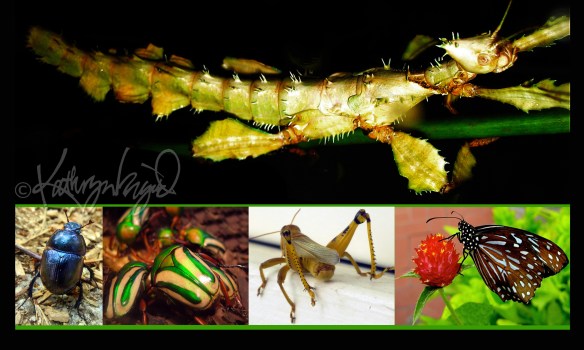
That kind, anyhow. I haven’t by any means lost my admiration for insect-sorts of bugs. Real bugs, by definition, are only a smallish portion of the insect population, but since I’m recovering from an illness that I grew up knowing as a Bug when it was really a viral infection, I shall indulge my childhood terminology and leave you with a few pretty pictures of insects that, though they are not bugs, cheer me up whether I’m bug-bedraggled, bugged, or just a bit buggy.
Totems, Tokens, Things Taken
Since I got on the tangent of thinking about various indigenous-culture/immigrant persons and themes in recent times, I’m now in that phase one has of noticing connections with them everywhere.
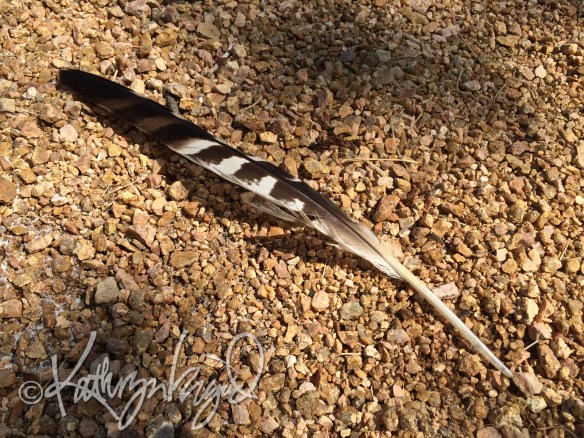
Today’s little starting episode was that of walking up my front yard path and spying on it a lovely wing feather. I’m quite certain it was shed by the same hawk that I’ve heard giving its piercing cry and seen circling over our place on numerous occasions, and that I saw a couple of weeks ago slurping up a foot-long snake like so much hawk spaghetti right out under my backyard flowering pear tree. I’m relatively sure it’s a Cooper’s Hawk that watches over me here at home, and I love it. I’ve mentioned before that I’m fond of and fascinated by animals in general, birds among the favorites, and corvids and accipiters my particular royalty. I may have even noted earlier that I specifically think of a hawk as something like my personal secular icon, or the companion of my heart, given how often I find I’ve seen one nearby, seemingly watching over me at various times and events that turn out to be important in my life. This, of course, can be attributed to the aforementioned habit of noticing that one cultivates, but I like to think there’s room in the coincidence for a causality conundrum, a chicken-or-egg puzzle, too. Either way, I admire hawks.
So I was pleased to see the wing feather there, looking to my mind’s eye rather like a “thinking of you” note left for me by my guardian hawk while I was away, or sleeping. I picked it up and pondered it. I set it on my table as I started writing my post.
Then, reality began to set in, of course. A very quick web search in an attempt to confirm or correct the identification of my hawk companion led me to discover that I was suddenly a criminal, since American law forbids possession or use of migratory bird feathers, a law enacted during a period of mass avian murder on behalf, mainly, of milliners and their customers in an era of highly feathered fashions. Given those massacres, not to mention the extermination of whole animal species, both native and not, in times past in this country, I am neither shocked that such a law would have been deemed necessary nor opposed to the intent of it to protect animal life. I have no desire to hunt any animal for sport nor to denude it of its natural beauty for my amusement.
But I can understand those who are irked by the hard-line status of the injunction, given the common experience of finding shed or molted feathers of all sorts on every beach, in every garden. “No animals were harmed in the making of this” object. Still, the law is the law. So my feather went back outdoors to disintegrate naturally, as we all will do. (With the exception, I guess, of plastinated creatures, but that’s decidedly another topic altogether.)
Not before I took pictures of it, of course, because I am allowed to photograph things I’m not allowed to own.
And that law, of course, led me back to the whole idea of ownership with which these native-vs-nonnative thoughts are inextricably tied. The indigenous or aboriginal peoples of the continent I call home, and where I consider myself equally native though my ancestors immigrated to the place in times past, are known to have had religious and practical reasons for thinking of ownership as a notion that simply couldn’t be applied to nature: that one existed at all was a gift of nature, and whatever one did in life and death should be done with respect for that benevolence. I’ve no doubt that some applied this attitude better than others, as is true for all people and their beliefs and rules, but the concern was deeply enculturated and not easily ignored—at least until the near culturcide brought on by the colonization of the continent by various immigrant powers.
We did not inherit Mother Earth from our Ancestors…..
We have borrowed Her from our Descendants.
Attributed to Chief Si’ahl (Seattle) of the Suquamish People [to whom is also attributed the magnificent speech and subsequent letter about the impossibility of land “ownership” in response to the new government demand that the natives relinquish their home territories to US rule and non-native occupation]
Man belongs to the Earth…Earth does not belong to Man.
Attributed to Black Elk of the Lakota People
As an enthusiast of little biological or scientific knowledge of, but great admiration for, nature and all of its wonders, I find I walk a wavering line in my relationship with it. The attractions of living creatures, of all sorts of things animal, vegetable, and mineral, are often for me first noticed as visible beauties and/or curiosities, or as other sensory (often, sensational) experiences. I am drawn to the amazing characteristics and anomalies of the whole natural world. But I also live in it. I depend upon its resources for my life and health and happiness. The very fact of my existence affects, and can even destroy, other parts of nature. When I take a breath, I process the air into something that it was not before, and send it back out into the universe as a new and different thing.
I don’t begrudge myself my breath. I don’t feel I’m evil for intruding on the rest of nature by means of my very existence. But I hope that with every breath, every moment I do exist, I grow a bit wiser in what it means to be allowed to exist by nature, this planet, and the vast Otherness that holds us all in its spacious embrace. And I promise that when I do die, I will return whatever I can of what I took with me, feeding later generations of nature’s bounty with the space I once occupied, the physical remains of what I garnered from this plane, and the hawk-befriended spirit that will be grateful for as long as is possible.
Inspiration in Waiting
In the cooler corners of my crooked little room
There gleams an iridescence that defies the chilly gloom,
The pale enchantment of an eye that never shuts in sleep
Or wavers in its glowing gaze, whose watch is wont to keep
A careful, mystic, present love that guards me from all harm
And teaches me her secrets when I curl beneath her arm
So I can rest in confidence with this companion, whose
Great beauty is to fill my soul, for that she is
Documented/Undocumented
I’ve been thinking more, lately, about history. About cosmic and cultural, political and personal history. About the way that people do and don’t keep records of any kind of history, how each documentarian shapes the way things are remembered or forgotten, and how each person on the receiving end of the documentation shapes it all further, given the multitudinous filters of experience, intelligence, and personality each brings to the process. School learning, book learning, deep research, and autodidactic learning all depend upon the vicissitudes of human understanding and communication. And a whole lot, also, on luck and succeeding history, since all of the learning can be lost or found many times over the decades and centuries.

My family recently unearthed the above little slip of paper that marked my maternal grandfather’s completion of his first machinist training. Gramps had immigrated to the States some years earlier in search of work, and had kept busy and alive in the piecemeal way that [willing, as opposed to indentured or enslaved] immigrants have done since time immemorial, bunking in cheap rented quarters with other young immigrant men, laboring long hours for little pay, and playing greenhorn pranks on each other in the few hours outside of work when they weren’t downing a hasty bite of food or sleeping exhaustedly. His machinist training eventually led to his working at General Motors for quite a long time, even serving on the team that built the first Duck prototypes for the army. And then his life took various turns, over the years, and I grew up knowing him as a skillful carpenter and homebuilder and the hobby-farmer tending beautiful produce gardens and a handful of Cheviot sheep.
But of course I knew very little of his life story. I did have the privilege of sitting and quizzing my grandpa over dinner more often than most, since I rented a bedroom from him and Granny for the three years I worked near their home in between my undergraduate and grad studies. So I heard some of the tales, like the one about his flatmates sending each newest member of the household to town to buy “ten cents worth of Piggly Wigglies,” a silly quest after a mythical grail that afforded the rest the cheap entertainment of watching from afar as their victim tried in his broken English to persuade shopkeepers to hand over something that didn’t exist even if his speech could be deciphered, and the store owners eventually sending the series of foreign-born youths off, each now smarting with the same outsider embarrassment they’d all experienced in their early days in the US. I heard, too, of that uncle of my grandpa’s who had tried to dissuade him from going to America, and if he did, to at least be as wary and canny as possible because “those Americans will sue you for anything.” This was, mind you, not in the modern day that we generally agree is such a ridiculously litigious one, but in 1929 or so. (Apparently some things haven’t changed very radically in this country.) Still, I know only scraps of Grandpa’s whole biography.
I can at least say with conviction that I come by my stubbornness honestly. Despite the family pleas and warnings, Elias Omli sailed willfully ahead, and lived most of the rest of his life in the US of A. In those early times, he must have struggled immensely, yet found fulfillment enough in the life he forged for himself and later, his family, that despite his longing for the old country and one brief but unsuccessful attempt to reintegrate with the family in Norway when my mother was very small, he lived and died an American. Between those atoms of information he shared with any of us his descendants about his childhood and youth in Norway and the rest of his existence in the US, there was a whole, complicated, adventure-filled, and ordinarily colorful life, very little of which anyone really knows, or could know.
That is how we all exist. Even the most documented, celebrated, and historically dissected characters and the events in which they take part in life or death cannot be fully known, let alone understood, by anyone but themselves. If I’m any example, I suspect even such self-knowledge is pretty shallow in the long run. Having written and shared over 1500 posts here in Bloglandia, where I immigrated from the semi-real-world over 4 years ago now, I may in some ways be better documented than a few other people, should anyone care to sift through all of my imagery and verbiage at any point, but even in this, I share what I choose to share, and only my point of view on it all is represented, so that skew is also bound to be imperfect, if not a little disingenuous.
(I’ll at least aver that the stuff I tag as Fiction is really fictional, and leave determining the rest of it up to readers, who will of course interpret it at will anyhow.)

Gramps’s story was unique, but not dissimilar from many others’ in history, whether they decamped to new homes and lives from their birthplaces or not, whether they had vocations that called them at an early age and flourished throughout their days or they followed more unpredictable routes. The fate of an individual is inevitably affected not only by his own choices and acts but by the natural and national events and changes that fall in his life’s path. The person who penned the Swedish grocery and supply list above, many years ago, did so as the manager of a remote coastal household for not only the family but probably also a handful of townsfolk who shared the responsibility for overseeing the safe arrival of boats and their occupants on that forbiddingly rocky shore. What this little slip of paper denotes is a glimpse into the everyday life of not just the one person who wrote it but of a small group of people whose names are no longer known and whose life stories probably exist, if at all, only in the bloodstreams of distant great-grandchildren, yet the quaint harbor town they once labored to keep in existence all those decades ago is today a thriving and colorful, lively place. New stories are born there all of the time, and I can attest that the dry goods and groceries now available there are, respectively, more plentiful than and as delicious as ever.
Individuals, communities and cultures all have their times of trial and those of triumph, some noticeably more of one than the other.

A recent reminder of that came into my view when my spouse and I spent a few days in Halifax. It is as beautiful a part of the continent as I’d always imagined, and yet like the rugged coast of that Swedish island it certainly presents difficulties to the ships that approach it today, and all the more must have challenged the lives, safety, and ingenuity of all comers in days long gone. I loved exploring as a tourist and seeing, especially, the natural beauties of the area with all of its geographical wonders, sea-borne marvels, and magnificent greenery, and also the wide variety of architectural styles that hint at the multicultural roots of the region. Not surprising that the shores are dotted with lighthouses large and small, as well as the houses of those who tended them.
When at the waterfront of the city proper, I admired the old lighthouse and the humble buildings near it on the island most visible from the piers. For a lighthouse location, which is by nature placed in a potentially volatile coastal setting, it looks sweetly bucolic, ideal, and peaceful. Indeed, it is nowadays a quiet and pretty place, a heritage site in mid-restoration for its intended future as an historical park. But that heritage is far from peaceful, let alone ideal; like many other islands in such prominent coastal positions, it has a long and storied past as a fort, a military encampment and, even darker, as a prison and internment camp.
Some of those imprisoned on that place now known as Georges Island, Nova Scotia, were among the estimated 1660 prisoners out of 11,500 local Acadians expelled from their homes and lands en masse by British forces during the 18th century imperialist battles between English and French forces over New World territories. Three quarters of the entire Acadian population were deported in those times and thousands died in raids, counterattacks, and battles; others died under torture, of drowning on the deportment ships, of disease, or of starvation. And Acadians were far from alone in being imprisoned or worse on that pretty-looking little island.
Their own comrades, the Mi’kmaq (and other aboriginal Atlantic inhabitants), with whom Acadians on their arrival as French colonists are said to have lived quite equably, suffered on the island along with numerous captured French sailors and soldiers and any number of other “enemies” of the British rule. Something far less benign than a lovely coastal outpost of protective presence came to exist on this sorrowful promontory at the edge of the proto-Canadian world.
Can I look at this island in ignorant imagination anymore as a picture of vintage calm? Of course not. But I can also guess that there are very few acres of earth anywhere that are not stained with ancient cruelty and the blood of untimely deaths, whether of the innocent or not. It’s easy to sit in judgement from my place of comfort and call the expulsion of the Acadians an attempt at genocide or ethnic cleansing. Certainly, records and recollections of the historians present offer ample reasons that I should think there were all kinds of wicked intentions at play, from land greed to hatred of unknown races, from religious and political imperialism to maneuvering for resources. There were clearly personal elements involved, and as in all wars, military actions that turned into personal vendettas, fights over disputed borders into plundering and petty theft. Just as, undoubtedly, the aboriginal Atlantic peoples must have initially feared, and perhaps fought, the Acadians, and the French and British spent great resources and innumerable lives on their distrust and fear of each other and of the inhabitants of their intended expansion zones.
But earlier centuries’ worldview was also vastly different from today’s, all around the globe. Today, we have knowledge of a much larger and more developed world, of the richness of other cultures, even of the possibility of peaceful coexistence, and we have no excuses for not trying in every imaginable way to resolve differences without being exclusionary or violent. But past times and people didn’t all have the advantage of our expanded view. Every cultural center or nation of significant size in Europe, Africa, Asia, and the Americas has had its powers, each of them assuming a natural, if not divine, right of rule over all that they had not yet explored, by dint of their own isolated mastery. It’s not just that leaders, explorers, and conquerors themselves have seen it as their right, and often as benevolent duty, to claim ascendancy over whatever and (assuming they’ve managed to recognize indigenous residents as people) whomever they encounter, and to rule as they see fit. Those who write down history, or tell its tales, also continue to believe or disbelieve in ways that are unique to them, and the biases that sneak into our views are inextricably mixed into how we, and future generations, think about history.
What can I take away from these musings? Only the usual self-admonition that I look beyond what is visible. That I question and try to learn further, and not rush so quickly to the judgement that comes oh-so-naturally to me. That I ponder whether any slight thing that I do or say myself can perhaps help others, individually or globally, to remember the lessons of history, both bad and good, and to move forward away from our worst selves. We may remain undocumented in these attempts, as in so many other aspects of being small mortal beings, but I think that existence itself bears the marks of our passing as a document that will spell out the difference between annihilation and rehabilitation of our world.

Drawn to Dragons
This is yet another of my obvious addictions: the otherworldly or fantastical. I can’t stay away from dragons and faeries, aliens and archetypes, for any great length of time.
Thankfully, I seem to be in good company in this regard. So I doubt I’m either shocking anyone or even likely to bore them with it too terribly, since those not equally smitten will happily ignore or delete my many posts containing such curiosities. I’m also happy that, because of the very unfettered nature of the topic, I will never run out of subject matter for my drawings when I feel it’s time to get back in that gear.
It might be that I am something of a fantastical creature myself, of course, so perhaps that helps to explain my affinity with other denizens of the unknown realms. (Grins to self, scribbling away as usual.)![Drawing: Enter the [Spaniard's] Dragon](https://artcoloredglasses.com/wp-content/uploads/2015/07/2015-07-29-1-back-to-the-drwg-board-conquistadragon-4.jpg?w=584&h=779)
Foodie Tuesday: Dangerous Longings & Forbidden Fruit
Comeuppance. Karma. A need to get way, waaaaay better behaved and healthier after a number of weeks of recklessly overindulgent behavior in the dietary realm. Whatever you want to call it, this is the time when I’m thinking I need to scale back and revamp my approach. For a few days, having returned Monday from the last of the summer’s travels bigger and much less healthy and fit than when I left at the beginning of June, I have been in the mode of, well, repentance.
New plans, however, can be exciting and inviting, too. What I have to try to discover now is what the true sources of my joy are when it comes to eating and how to access those without being so overindulgent and foolish. I know. I’ve promised myself before that I’d behave better, and it’s never stuck all that well, has it. Still gotta try.
Because there really is a lot of yummy stuff out there, and it’s not all bad for me. What I need to get smarter about is recognizing what leads to my downfall, what I crave and find most compelling, most especially when it seems inaccessible…and figure out all of the best possible ways to assuage my pangs instead of giving in to more self-destructive behavior. We’ll just see how I do.
There are a lot of delicious Beaver Tail fried dough treats out there, lathered up with maple icing or snow-dusted with cinnamon sugar just begging me to break my commitment to reducing my sugar intake and cutting out wheat as much as possible. Creamy desserts are flagrantly showing off their dangerously dairy-rich fabulousness at every turn, egging me on constantly to renew on my promises to myself that I will avoid more milk products that aren’t on the healthier end of the spectrum, say toward probiotic-loaded yogurt or a reasonably forgiving hunk of cheese. Pizza’s beauties are many, but one slice is seldom enough for me, even a slice as big as my head, and the one-two punch of wheat-rich crust and cheese’s oozing gooey goodness are too good at breaking my slim resolve. A magnificent slice of perfectly fresh fruit pie is pretty irresistible to a weak-willed piggy like me, but it’s loaded up with sugar most of the time and one slice—one bite—usually has the power to zap my strength. I just roll over and right off the wagon.
Now it’s time to embrace the new approach. Self-improvement in tiny, sustainable, and simple increments. Thinking hard for now. What makes me love wheat-based baked goods? Tender plus chewy texture. The scent of yeast. Crazy-good toppings and fillings. Thinking hard about what favorite other things can substitute for the wheat content. What makes me go crazy over creamy treats? Silky, fatty mouthfeel with a mellow sweetness that complements practically everything it touches. Thinking about substitutions. Things I already also love, but that aren’t quite so hard on the operation of my innards and the general shape of my outer shell, too. What is the real allure of sugary stuff? That little rush of energy, even though it is generally followed by a bigger fall-off; the bit of pleasurable serotonin buzzing up in me, and the flavor boost to other seasonings. Thinking, thinking…
Sure is easy to think about food. Now I hope I can think about it in smarter, healthier ways until I form a smarter, healthier relationship with it. But still while having as much fun as possible. Yep, not giving that up anytime soon.
Dis Guy’s Disguise
I love the way that superheroes remain unrecognized, even by their nearest and dearest, despite nearly always having camouflaged getups as thin as a politician’s commitment. Glasses on a person who doesn’t usually wear glasses: so much coverage! A little mask with big eyeholes in it…yeah, that’ll fool Mom when she looks me straight in the face! At least in more of the fairytales there’s a serious enough literal transformation that I can believe it would confound a reasonable amount of investigative zeal. I mean, I can imagine that Beauty’s pal the Beast could conceivably be tough for most people to spot as his former princely persona, at least more so than a cape and a staggeringly revealing, body-conforming spandex super-suit would tend to do.
When I become a superhero, and, of course, I will, eventually—it kind of seems like few people on earth don’t at some point fall into a vat of toxic waste and vow revenge on those who allowed it to happen, if you read at all these days—I plan to be so well hidden in my new identity that even you people who have been meeting me here in Bloglandia for four-plus years won’t flinch. Meanwhile, you’ll probably be too distracted by the latest zombie apocalypse or alien invasion (also well documented in current entertaining literature and film) to notice I’ve changed anyhow.
More likely, though, is that the whole hidden-in-plain-sight thing is much closer to reality than I like to think. It’s amazing to consider how many large-looming realities I am capable of missing or simply convincing myself don’t exist because I’m too small-thinking to accept them as present. I don’t like to believe I was wrong, so I convince myself the other person is the one at fault. I don’t want to believe that someone I’ve liked and admired is terribly flawed, so I keep up the idealized image in my mind, pretending that he doesn’t have a detectable alcohol problem or she hasn’t been the obvious only person with access to the accounts that have consistently failed to remain in balance. Might as well be wearing neon signs that say Hey! Lookee here!! Big PROBLEM!!!, and wearing clown costumes.
I still like superhero stories and fabulations and fairytales. I enjoy them immensely. But there is a little part of me that always gets as grouchy as the Beast that they’re so patently improbable, what with all of the costumes that couldn’t fool a baby seeming to deceive the world at large for great lengths of time. Mostly because I know I can’t count myself in the baby’s camp when it comes to such discernment. Fool me twice—a thousand times—shame on me. Grrr!
I Wish for You…
May you find all the courage you need to get you through the hour, the day, a lifetime…
May you find the wisdom to untangle whatever vexes you and revel in what you love…
May you find companions who give you comfort, elevate you, and fill you with laughter both in the moment and through the years…
May you find kindness embracing you, erasing your pains, and softening all sorrows…
May you be so enriched by the beauty and goodness around you that you find you can’t help but pass it along and share your gifts with others…