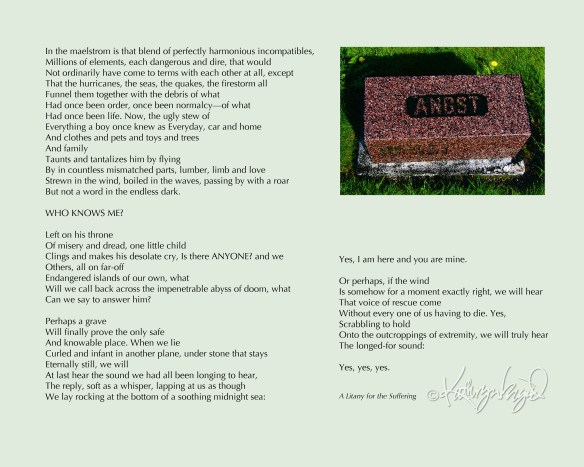
This is the first post of a three-part series on depression and anxiety, so if that’s an off-limits topic for you, I’ll see you again on the weekend! But it’s really intended as a series on hope from someone who has been-there-done-that and loves life in all of its complicated craziness as I know it now, on the other, generally sunnier, end of the tunnel. Today, for your contemplation, a meditation based on a true story of fear and loneliness and the possibility of triumph through one faint but persistent call for help.
Tag Archives: community
The Façade isn’t Worth It
Ask for help. Short phrase, simple concept. Really, really hard to execute sometimes. We place such high value on ‘keeping face’ or seeming tough and cool and untouched by mere human foibles, trials, and concerns that many of us are perversely frightened at the idea of doing what should be the one easy thing. Ask for help.
It doesn’t pay to play the brave one or the willing martyr when your world is caving in on you, and even less so when you consider the ripples through the host of people who—though you may forget it at times—count on you, whether for equally small and simple things or for being the love and joy of their lives. It doesn’t do any good to sit and wait for help to come to you: remember how hard it is for you to know your own mind, let alone read anyone else’s, and know that they can’t read yours any better. Even if they realize how deeply in need you are, they may be fearful of offering their assistance because of that very mask of competence and courage you’re hiding behind, and you both lose.
There might not be help enough in the universe to fill your need, never mind your desire. But there’s no Maybe, if you ask that from yourself alone; you will fall. You will fail. When you feel you have nothing further to lose, there are really no such things as “acceptable losses.” Accept, instead, the handout, the hand up, whatever it is that anyone at all can offer you, and with it the hope of better things. It might mean nothing more significant than lightening your mood, and that is important enough. It might save your sanity, or your life. Ask.
Keep the Lines Open
In a general sense, I know life is better and easier when the lines of communication remain open and flow freely in both directions. Recent notes from friends and family who have been visited by disasters—natural or otherwise—remind me of how spectacularly crucial the communication becomes in moments of crisis. The mere words “it’s okay” have virtual magic powers in those instances when we know that something big is happening and we can’t be there to offer help or consolation. I have mostly been incredibly fortunate in this regard, rarely hearing of terrible goings-on in progress without being able to get regular reports from my connexions in their midst, but like everyone, I have had enough moments of that intense fear and anxiety arising out of ‘dead air‘ to know what high value is in keeping the flow of information steady.
The latest round of wind- and snowstorms in various parts of my loved ones’ worlds is an instant review of those times when, amid a winter howler or while driving through flooded terrain or hunkered down in a good-sized earthquake, I had no easy access to a telephone or (if they were yet a household item) computer. A perfect example from my own memory is one clear winter Saturday when I was working around the house and the winds began picking up significantly. I hadn’t watched the weather forecast and was unaware that any storm was incoming, only realizing over a matter of a couple of hours that the gusts had grown to a point where I was hearing the towering evergreens and maples close to the house creak and branches snap, and could look out the back windows and see Douglas-firs dancing like hula dancers. But nothing major had broken when I looked outside. I was so preoccupied with the impressive action and the whistling and moaning noises of the trees that it startled me into an electric jump when the phone rang.
I trotted into the back bedroom to grab the phone where I could sit at bedside and watch the wind’s power at play through the window while reassuring my sister, who had called from a bit farther north to see if everything down our way was safe since the reports of the storm had in fact preceded it northward. I was cheerily reporting on the show and the snug and intact condition of house and inhabitants when I saw a six-by-four-foot section of the back fence uproot twenty feet behind the house and sail like a kite right through the plate glass window. Thankfully, the shards of flying glass went in the direction of the fence, which in turn was not aimed directly at me, so as soon as the crash and shatter quieted I could speak into the receiver that was still gripped in my hand and assure my sister that I was quite all right, tell her what had happened, and promise to call back after the window was closed off again. Because, of course, with that wind, the rain was close behind.
The instance was fortuitous in many ways, not least of which was that my mother arrived on the scene mere moments later, and that we had pieces of plywood in the garage large enough to cover the whole big window with just two hunks. We dutifully covered the new opening with plastic sheeting, screwed plywood panels over it to close, and put up a bit more sealed plastic to hold off the remaining elements, and managed, if I remember right, to beat all but the first sprinkles of the downpour. A good seal was, we knew, important, since in our region there were not only vast swaths of evergreens to knock over or prune limb by limb onto roofs and through windows but many of them were Douglas-firs, a shallow rooted variety that is not hard to fell full length if the wind catches it just right. And in such windstorms in the area, many do go down. Growing up in a family of carpenters, I knew full well that even if we could reach one of the relatives and set up repairs earlier than other folk, their calendars would be jammed for days or weeks after a storm like this one.
The first order of business was, of course, to call my sister back and tell her that not only were we all safe but the house was closed up tightly again, the bedroom carpet vacuumed about six times over to get all of the glass out of it, the fence section dismantled and relocated outdoors, a temporary barrier put up where it had been so that the neighbors’ horses couldn’t just walk over for an unsupervised visit, and that the wind was already abating, leaving mostly rain in its wake. She, in turn, called the other sisters to pass along the news. No one else was ‘visited’ by anything untoward in that storm, and we all lived happily ever after. And though it was a challenge to reach my uncle’s construction company and get a repair appointment, we even managed that before the day was done. Of course, having closed up the broken window sufficiently, we did have to get in line behind people without roofs, with trees lying lengthwise through their bedrooms, and the like, as was only fair. For them, I could only hope that they hadn’t also been harmed themselves—and could still call their loved ones to report on their safety.
Tenderheartedness isn’t for Softies
It takes strength to maintain the goodwill and generosity that creates true bonds between people—individually and corporately. But through that steadfastness is the best path to peace and wholeness, a consummation devoutly to be wished.
River of Stars
A river made of silver stars with sapphire deeps below,
The sweet compassion of the heart is ceaseless in its flow—
A font of healing, kindness, care; a waterfall of grace;
A draught to slake the deepest thirst; and with it, keeping pace,
Persistent hope, watered withal, along its banks to grow,
To bloom as peace, compassion’s flow’r, where starry rivers flow.
All Together Now
One of my favorite vocal coaches is fond of characterizing people who focus on their own singing to the point of losing track of and/or sticking out from the rest of a performance at inappropriate times as expressing their “individual enthusiasms.” I’m doubtful I would be as tactfully euphemistic. We’ve all seen and, more importantly, heard concerts where one unplanned solo ended up hijacking the whole event, and it’s hard to forget what was so frustrating and embarrassing about it for the other performers and the audience and even harder to remember all of the probably fine or even excellent things that were supposed to be the stars of the day.
The same is true, naturellement, outside of musical performances as well. Our individual enthusiasms lead us to speak out of turn, act squirrelly in the middle of serious events, blurt out exceedingly inconveniently unfiltered thoughts, and generally act like little kids at the best of times. At worst, they make us deeply uncivil, unwilling or unable to negotiate, and self-centered to the point of implosion. Or, more often, explosion. This world does not need my opinion, unless I’m willing to get the rest of the passionate populace to engage in the conversation and collaboration that will make it needful. And in that case, they’ll quite generally be on board with my enthusiasm already and there will be little to negotiate.
None of this means that everyone should think and act in lockstep. What a horrific idea! Most of the great performances of our time are not solos, even those that feature soloists, but rather collaborations with the entire cast, crew, production staff, and audience, at a minimum. The deliberate and thoughtful give-and-take of everyone performing his and her part to the very best level possible is what creates the ideal of harmony, even in times when fruitful dissonance is desirable to throw that harmony into beautifully sharp contrast. Music is obviously full of grand examples of this stuff, but so is life in general. The sorrows and hardships, if they are carefully shared burdens, throw the joys and pleasures into higher relief, and the larger song of human experience continues to grow in beauty.
10 Terrible Words that Shouldn’t Exist in Any Language
One person who hates is a Weapon of Mass Destruction. One who cares and shares? Perhaps the only antidote.
As I recently said to my friend Maryam: poverty—both of concrete, material resources like food and shelter, and of intellectual and ephemeral resources (education, spiritual enrichment, the arts, community engagement, etc)—seems to me to be perpetrated and perpetuated more by selfishness than by an actual shortage of any of those resources. The rich and powerful always want more riches and power, and what they do have makes them able to afford and acquire more and to keep their feet firmly on the backs of the have-nots. Plenty is never enough. The resulting imbalance is as old as history, and rotten as ever. Only those who will speak up and resist entrenched inequities and injustices will have any hope of making change.
The badger and the wolverine have a reputation for being among the most tenaciously savage brutes of all the mammals. Yeah, Honey Badger even has his own meme to show for it. But let’s be honest: no beast of earth, air, or sea has a capacity for vile, rapacious cruelty rivaling that of the human animal. Even creatures of the natural enmity of predator and prey compete, fight, kill, and are sated. They have little apparent ideation of hatred and war to match people’s. A wolverine or badger will fight to defend, or to kill for food, but unlike the human, doesn’t seem inclined to attack indiscriminately outside of its primal needs for safety, shelter, and food; when the skirmish is done as efficiently as possible and the need assuaged, the sharpest of tooth and reddest of claw among them doesn’t do an end-zone dance to celebrate its pleasure in winning but will usually depart the scene or go to rest for the next time of need. The remaining food and shelter and other resources stay in place for whatever creature comes next, hunter or hunted, cousin or not.
Can we humans not learn from such a thing? I’m pretty sure that if we destroy each other and ourselves in our constant self-righteous, self-congratulatory belief that we deserve everything we can get our hands on, Honey Badger won’t be the only creature that doesn’t care.
PessimOptimism
“Prepare for the worst but hope for the best.” It’s part of my credo, I guess, and may well have been aided in its development by doing those hilariously futile duck-and-cover atomic bomb drills of the Cold War era. And the air raid drills—we lived in a Ground Zero area near several military bases, strategic coast, and a handful of Nike missile sites in those days—fire drills, earthquake drills, tsunami drills, and later when we lived in the midwest, tornado drills. You’d think we’d all have grown up incredibly paranoid after such stuff in childhood. But I think that besides being remarkably resilient, kids use logic on such daily puzzles far better than they remember how to do when they hit adulthood and have been taught their prejudices, and are much more easily distracted and blinded by grey areas.
I don’t remember ever believing that crouching under a flimsy little wood-and-steel desk would save me even from the shrapnel of shattering windows and imploding walls in the event of an attack or large-scale disaster, particularly since I imagined the desk itself would become shrapnel along with everything else in the atomizing roar of a bombing. Little and naïve though we were, we had gleaned hints of the enormity of such things from our beginning school studies of the world history of war (skewed to our own culture’s view, of course); no matter how grownups think they’re shielding kids by sanitizing and limiting the information the wee ones are allowed to see and hear, children are quick to notice the blank spaces where redacted information interrupts the flow of facts, and no adult is more curious than a child to hunt for clues as to what was redacted. Frankly, if there really is any use for an institution like the CIA in this day and age when practically anyone can find out practically anything with the aid of easily accessible tools like the internet, cellular phone, and, apparently, privately owned drones, along with all of the more traditional tools of spy-craft, I suggest that the crew best equipped to uncover any facts not in evidence would probably be a band of children all under the age of about twelve.
Meanwhile, we still have large numbers of people who think it prudent to withhold or skew the information passed along to not only kids but even fellow adults, giving out misguided or even malevolent half-truths or remaining stubbornly silent and in full denial about things considered too dark for others’ knowledge. And what do we gain from this? Are there truly adults among us who still think that even smallish tots can’t quickly discern the differences between a fable or fairytale, no matter how brutish and gory it may be, and the dangers and trials of real-world trouble? Does delusion or deception serve any purpose, in the long run, other than to steer us all off course in search of firmer, more reliable realities?
As I just wrote to my dear friend Desi, it seems to me that the majority of humans always assume a fight-or-flight stance in new or unfamiliar circumstances before allowing that these might be mere puzzles to decipher, and more importantly, we assume the obvious solution to be that whatever is most quickly discernible as different from self IS the problem. Therefore, if I’m white, then non-white is the problem; if I’m female, then male. Ad infinitum. And we’re generally not satisfied with identifying differentness as problematic until we define it as threatening or evil. This, of course, only scratches the surface—quite literally, as the moment we get past visible differences we hunt for the non-visible ones like sexual orientation, religious or political beliefs, and so on.
Unless and until we can change this horribly wrongheaded approach on a large scale, we’ll always have these awful problems, from petty playground scuffles right into the middle of the final mushroom cloud. The so-called justice systems of the world are set up and operated by the same flawed humans who make individual judgements, so the cycle is reinforced at all levels. Sometimes it truly makes me wonder how we’ve lasted this long.
Can we learn from kids? The younger the person, the more likely to blurt out the truth, whether it’s welcome or not. The subtleties of subterfuge are mostly wasted on children, who unless they’re engaged in happy storytelling for purposes of amusement and amazement, would rather be actively puzzling out the wonders of life than mucking about in search of evasive answers and duck-and-cover maneuvers. We might gain a great deal by reverting a little to a more innocent and simplistic view of the universe, one that blithely assumes that others are not always out to get us, that direness and doom aren’t lying open-jawed around every blind corner, and that the great powers of the internet and cell phones might just as well bear cheery tidings of goodness and kindness, and drones be removed from deployment as spies and weapons to work instead at delivering birthday presents to friends and packets of food to hungry strangers.
I’m not fooled into thinking any of this is easy to do, any more than any savvy kid would be, but I’m willing to believe it’s possible if more and more of us will commit to such ideals.
Contagion vs. Compassion
“One bad apple spoils the lot.” That creaky aphorism is based on equally venerable experience. Rot is contagious.
Bad company makes bad behavior seem the norm, and we adjust our own standards ever lower accordingly. One or two disheveled houses bring down the values of the others in the neighborhood, and those, in turn, fall into neglect and decay as their owners lose the courage and determination to resist the incredible pull of entropy. What isn’t growth is death.
What leads otherwise good and sane people to fall apart like that? Doubt; fear; despair. These are the hallmarks of contagion: the plague succeeds in felling us not only through its own virulence but because rather than seek its cure with full courage and determination we flee with it hot pursuit, and when it eventually catches up with us, we topple, curl up in the fetal position, and succumb.
The fall of one member of the world community—like Mr. Duncan, who was felled by Ebola in Texas—is a very real and terrible loss for all. The loss of thousands—those dying in West Africa—is indeed a plague and a thousand-fold grief we all must recognize and bear. The response, though, cannot be equally contagious doubt, fear, and despair. That can only make us choose unconstructive, even destructive, responses like blame, xenophobia, retreat, and the neglect of our fellow citizens of the earth. Then, no matter how many or few have been overtaken by disease and disaster, the contagion will have won.
Lounging Around
There’s nothing like a long stretch with a too-busy schedule to remind me how important it is to slow down and do some meaningful Nothing once in a while, even if it makes me miss one or two seemingly crucial other things. Every time I remember to take that kind of break, I notice that no matter how much I think I was letting go of, leaving undone, and missing out on doing, the world has not once ceased to turn. Civilization has not only not ended while I was ‘off duty’ in a moment of relaxation, but has very likely been somewhat improved by having a little break from my ignorant interference in its progress.

Sometimes it’s really useful to deliberately put my head in the clouds. Or to stare at the floor, for that matter. When I stop gazing exclusively at the stack of paperwork in front of me, thinking only of the next three items on my to-do list, or listening merely to the rattling of the voices on TV, telephone and in email correspondence that are all demanding my attention, I can notice that I’m walking across incredibly worn but still vibrant Majorcan tile in a room full of paneled walls and acres of ancestral portrait paintings, and that’s just en route to some other thing entirely. I might get to that Other Thing and find that it’s only a small courtyard, but one full of sunlight split into dazzling rays by a fretwork of wrought iron artistry that may very well have been behind deadline in its production because the artisan thought it was more important the work be done well and beautifully than that it arrive on time.

Why do we persist in making little things mean so little when they can make a great change in our perspective? Don’t we fuss enough when we think the universe is treating us so neglectfully and with such unwarranted disdain? I think it’s only fair that if I want to be treated with any sort of respect by the universe, perhaps I ought to give it some of the same attention and admiration as well. Far better than wasting my precious life resources on endless effortful chores that will only wait for my return anyway, is to spend a bit of that time instead on admiring the goodness of a threadbare Turkish rug and relishing the thrum of steady conversation about unimportant yet interesting details of the day’s quiet events, talk between real people who stand on that very same carpet at the very same moment and, amazingly enough, listen when I reply.
Calling All Saints
This is a day designated by the Christian church for the remembrance of all the good, fine people who have lived, illuminated our lives, led the way for the rest of us, and now are also gone before us in death. Recollection, commemoration and admiration of those who have lived as great-hearted souls on the earth and set an example, large or small, of excellence for those of us who follow is, I think, a practice that anyone of any stripe, religious or not, can embrace; we are certainly all made better by such meditations, especially if and when we are made stronger by their guidance to follow in our honored loves’ radiant footsteps.
Spending a day in remembrance of loves lost is bound to be bittersweet, of course. When the bond has been close in life, it remains so in death, and however the pangs of loss may subside over time, on a day devoted to thoughtful recognition of our trusted and beloved friends, mentors and avatars of all things great and good, the pain can be as sharply new again as in the first sweep of sorrow. But if I am genuinely mindful and respectful of their gifts in life, I think that this can be transformational and healing and comforting, too.
Can I live as a reflection of my most-admired angels? It’s too tall an order for any ordinary mortal, I know. But that’s exactly why I think we have these living and loving models among us: to show that in community and mutual, loving support and with determined and patient growth on our own, greater things can happen than if we try to do significant and meaningful things independently. We are raised up by the waves of support around us. How can I not be grateful for that! This realization sweetens the day perceptibly. Do I wish that I could have my lost loves back again? Who would not! But I wouldn’t trade one tear, one iota of the hurt and anger and grief I’ve felt over any of their losses, to miss out on recognizing the beauty and joy and brilliance that they brought to this world in their too-short tenure here, and I know that some lights seem so bright in life that they can blind me at close range to what’s more easily discerned, when seen from this greater distance, as having the distinctive shape of an excellent soul.