Early Music for Breakfast

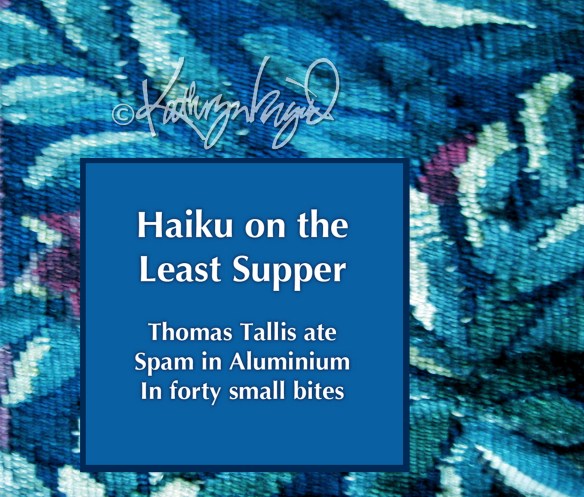
Digital illustration + text: Haiku on the Least Supper

If you haven’t already crossed paths with Thomas Tallis‘s landmark Renaissance motet Spem in alium, I highly recommend it. It’s a truly astounding piece of European music history, representing the confluence of the political and artistic competition for primacy in that time period; it’s believed to have been composed as England’s answer to Italy’s Alessandro Striggio‘s own, earlier 40-part motet, or possibly to Striggio’s 40-60 voice mass. I’m no musician, but I’ve learned, mostly through witnessing a few performances of the Tallis by different groups led by my husband and his colleagues, just what a feat this piece really represents.

While the creation of Striggio’s works for 40 and more independent voices is amazing in its own right, the 40-part motet he wrote specified that the voices be doubled instrumentally. That is impressive enough. For my fellow non-musicians, think of it this way: a typical piece of music for a mixed choir requires singers to perform different notes and lines of music, often at the same time, so that what is heard is not one single series of notes, one after the other the way we sing by ourselves, but layers of notes that become deeper and more distinctive expressions of the words being sung. Instrumental doubling means that some or all of the vocal parts are supported by one or more instruments “singing” the same notes at the same time. This can intensify the effect of that singer or section’s line, and it can sometimes also help a less skilled singer or choir stay on target with the line.

In any event, the more typical choral works tend to have soprano, alto, tenor and bass voice parts, or singing lines, (or some combination of those) and generally, not more than eight or perhaps twelve different lines intermingling at once. Anything more than that means that every singer in a moderate-sized choir is responsible for knowing and performing his or her own notes, on pitch, at the right moments, and with exactly the right loud-soft dynamics and flow at every point throughout the piece. Being in a choir is a thrill; being in a good choir is a real intellectual and artistic and even physical challenge.

What makes the Tallis Spem so incredible is that it comprises not only forty individual, fully independent singers’ voices all singing their own distinct parts of the song, but indeed, doing so entirely unaccompanied. Every one of the singers has to be spot-on at all times without the support of either a fellow singer or any kind of instrumental doubling. If one singer goes off the rails, there’s the possibility that others will be thrown off of their pitch, timing, or even their place in the whole work. It could well lead to a musical train wreck. Think you’d be intimidated by doing this? I think any sane person should be!

But it’s powerful stuff, when it’s well done. I’ve had the privilege of hearing this feat beautifully accomplished by singers surrounding me in a cavernous cathedral space, and by singers standing onstage in a modern performance hall with a carefully engineered acoustic. I’ve experienced it in art galleries where Janet Cardiff‘s intriguing installation of forty high fidelity speakers on stands are placed in a circle in the otherwise rather bare room, each playing in synchrony the recording of one of the singers in a performance of the Tallis, so that one can stand outside the circle or in the center of it surrounded by the speakers, or can move to stand at one individual speaker at a time, getting entirely different effects depending upon which part of the score is being performed and where one stands in relation to the speaker playing that part.

No matter how it’s done, once you’ve gotten a little of the idea how this piece of music intertwines voices that seem at first to be operating without a clear relationship but then, more and more, to be converging into a meditative, chant-like, layered song, it is quite mesmerizing. There are some recordings and performances out there on CD, iTunes, and YouTube worth a listen, and if you get the chance to visit the Cardiff installation, called simply Forty-Part Motet, do it. Best of all, of course, is if some fine choir nearby offers a live performance that you can attend. It’s rather haunting and ethereal, and made all the more impressive by the knowledge of its complex origins.

Meanwhile, I have given you this bite-sized humorous meditation on the work. A haiku seemed the ideal vehicle for acting as either commentary on or antidote to a choral masterpiece so complicated and virtuosic. And I sort of wonder if, in the process of composing this grand work, Mr. Tallis had any chance to stop for rest or was so deep in concentration that he barely had time to do the Renaissance equivalent of opening a tin of luncheon meat and dining directly from it, pen and parchment in one hand and dripping Spam juice on the other. Thankfully, it doesn’t appear that this effort of his was entirely detrimental, let alone leading to his personal version of the Last Supper, since he went on to compose other fine works up until nearer his death some fifteen years later.

The Hours of the Day

Some pieces of music have an especially profound affinity with particular times of day. Those composed deliberately for such hours are of course likelier to fit so well, but even among them there are certain works that are so miraculously fitting they almost seem impossible to separate from their appointed times. Much music composed for the divine offices and devotions of the Roman Catholic church recognizes such affinities because, like many prayers and devotions in other faiths, these practices are meant to be performed at specific times of the day and evening. Like the muezzin‘s call to the mosque, a moving chant or song suited to the hour sets the heart and mind in just the right place for the meditations and oblations of the time.

I wrote this poem long ago and came across it again, remembering that it was written while listening to a specific Angelus played on the organ—Marcel Dupré’s, if I’m not mistaken—and being struck by that wonderful meeting of sound and spirit in it.Painting + text: The Angelus

It Speaks to Me

What attracts us to certain artworks? Whether book or stage production, painting or photograph, dancing or theatre, singing or instrumental music, there has to be something with which we can connect for the work to have any meaning for us as individuals.Photo: Book of Languages

Some of those connections are obvious: an author with whose philosophy or politics I tend to agree is more likely to produce a book or script I enjoy than one whose beliefs are wildly different from mine; if I favor a specific style or period or medium, I’ll probably always find the works within them resonating in my heart more often than those from unfamiliar or less loved types.Photo: Familiar Passages

Other attractions might be more tenuous or less overt. I read a whole lot online nowadays, both factual and fictional, but I still enjoy reading magazines and books, and there is no digital substitute quite yet for the fine roughness of antique paper pages in my hands and the musty scent of old books.

From the Highest Towers

Digital illustration from a watercolor: Summer Stained GlassRinging In

Every time I hear them, I remember that first morning,

That moment in a narrow street when brightly, without warning,

The bells loosened their tongues to sing and raised their clarion voices

In that wild hymnody of joy at which my heart rejoices,

And now, wherever I may be, whatever is the weather

Or the occasion driving me, those voices joined together

Stop me, and make me raise my eyes while all the bells are ringing,

And search the gladness of the skies where Carillon is singing.Digital illustration from a watercolor: Springtime Stained Glass

If My Song could Last Forever

Photo: Well Seasoned 1Hours into Seasons

There’s a sweetness in the morning when the sun has yet to rise

And the blooms lie, still unopened, under sleeping butterflies;

When the stars still wink and glimmer, while the frogs yet softly sing—

There’s a sweetness in the morning that is like the breath of Spring.Photo: Well Seasoned 2

There’s a graciousness at midday when, amid the racing streams,

All arise and put in motion yesterday’s profoundest dreams;

When the past its chains has loosened on the race of all alive,

That in joyful forward motion we, like Summer, grow and thrive.Photo: Well Seasoned 3

There’s a calm amid the evening when the birds come to the trees’

Respite from the day of flying, echoed by our evening ease;

When the cares of noon have lessened as the dusk swept into place—

There’s a calm amid the evening, peaceful as the Autumn’s grace.Photo: Well Seasoned 4

There’s a beauty to the nighttime, glorious and peaceful bliss,

Treasured for the kind renewal of the souls that rest in this

Cradling darkness and this languor, in this place of mending rest

That, like Winter’s dormant healing, lets us wake refreshed and blessed.Photo: Well Seasoned 5

I would take these hours’ presents as my guide through seasons long,

Through a lifelong path that’s pleasant as a choir’s finest song;

I would be a seasoned traveler, happy above everything,

If my song could last forever,

Summer, Autumn, Winter, Spring.Photo: Well Seasoned 6

All Together Now

Another day, another rehearsal. More study, more practicing. And for all but the most independent and reclusive researchers or out-and-out hermits, this means work done in company. We need each other. The best progress is usually possible only with the support and aid of collaborators and fellow workers in all kinds of related tasks. We build on the work of our predecessors and colleagues; we stand on the shoulders of others.digital illustration from a photo

Nowhere is the necessity of such mutuality, of working very literally in concert, truer than in choirs and orchestras. I have written here plenty of times about the privileges and joys of my life in being able to attend not only so many wonderful concerts but the rehearsals where they are prepared. Beyond that, though, I feel fortunate to have the example and reminder constantly before me of an approach that can be tremendously beneficial in all kinds of life’s activities: surrounding myself with all of the resources that smart and able and collegial, supportive fellow laborers can bring to the task.digital illustration from a photo

Time alone is valuable. It offers all sorts of useful room for quiet reasoning and planning, uninterrupted cogitation and problem-solving, and the mental and emotional space to put all of those aspects to work for me. But there would be little in the way of material with which I can do any of that if it weren’t for the rich stores of fact and imagination prepared by all of those who have preceded me in any task I choose, and there can be only the kind of progress that my own limited stores of wisdom and experience, skill and talent and imagination can cobble together if I don’t work in tandem with others. So I am happy to enlist all of the company I can, and aim for working in harmony toward whatever purposes we can dream and achieve. Then, perhaps, my projects will have a chance of culminating in choruses of satisfied approbation.

Alive & Well

photoSing Now & Always

To celebrate at breaking of the dawn

Or close of evening, or the stroke of noon,

There is no sweeter pleasure than a tune

Well sung by everyone, an antiphon

To peace, to sorrow, or to happiness;

No matter what the poetry or text,

It truly matters most that what is next

Is choral concord to renew, redress,

Resound through all the unseen years ahead,

A clarion, an anthem or motet

Grander than any ear has heard as yet,

And run to distant history, a thread

Of melody and harmony so strong

That no one can resist joining in song

Everything is Rehearsal

photoIf we are willing to listen, learn, and practice, everything that happens can be rehearsal for a better performance the next time. Musicians know this. We should all recognize it.

Being perfect isn’t the goal. Even being exactly the same each time isn’t it. Mechanically identical reproduction of an event or a feeling or an occasion is for machines; life is messier and more complicated and more artful than that and means we have to be ready to use all that we’ve learned in all of our rehearsals, combined in whatever way gets us the best result in the present moment. It means, too, that what is the best solution for that moment may not be reproducible or even desirable next time. A CD is a lovely evocation of memory but the live performance takes hold of us down to the soul in a very different way.

I want to become better at whatever I am. Some of the betterment may come fairly easily as I recognize more clearly what I am, as I grow older and have more experiences and find my way through more of my life’s journey, picking up clews as I go. More of it will happen, if at all, because I work hard to improve myself in one way and another.

There’s no guarantee that any given moment or event will find me at my best, or even that I will become the best version of myself that I am capable of being no matter how long I live. But I’ll certainly have a better shot at any of that if I commit to practicing.photo

Bland Like Me

photo montageThe marvelous Diana of A Holistic Journey has been writing posts asking about the influences of race, culture, national origin, education, and so forth and the ways that they shape who we are and how we perceive ourselves. This series of hers is proving an outstanding eye-opening and thought-provoking exercise for me, too. I have spent most of my life living amid and being part of The Majority—middle-class, white, English speaking, native-born, educated, boringly predictable, etc, etc. There were a few touches of diversity around me here and there, of course, this country of the so-called United States being what it is, but those were relatively small and isolated, so mostly I grew up sheltered and unchallenged in nearly all ways.

Yet as an individual I came to know myself as being different in one way or another from most of what I thought of as the ‘norms’ of my own environs, and even learned over time that what I thought was my Majority milieu was mostly just my very narrow path through it in life. While a lot of my classmates, immediate neighbors and friends when I was a kid, for example, were also little pasty white critters like me, the friends I remember best as seeming most interesting to me were ones like Eha, the Estonian girl, or Karen, one of my few black classmates, or the Japanese friends who shared exotic treats from their lunches and who performed classical Japanese dance in a miniature celebration of the Cherry Blossom Festival at school. I have hardly any memories so suffused with longing as that of watching the girls flutter their fans, while dressed in exquisite kimonos and dancing their stately, courtly dance to the strains of the tune ‘Sakura’, which melody in turn still fills me with delicately melancholy love.

My ideals of human physical beauty, as my husband and I have often noted musingly, are nearly all attached to non-whites or mixed-race people, not something I think of as a conscious or intentional choice but a persistent reality for me ever since I can remember. My superficial list of Most Beautiful People would probably have a paucity of caucasian members among its top fifty. While I have never been either very adventurous or flexible in my choices and tastes and experiences, I suppose I have always been fascinated by what seemed different or even exotic to me. I am a fantasist and a romantic in the cheap, popular versions of those ideas, I guess.

I have even wondered, in a broader sense, if part of my very nature is simply to feel like an outsider for no very specific reason. I was always shy, and learned as an adult that this expressed not only a naturally introverted character on my part but also demonstrated lifelong social anxiety and probably the incipient state of my developing depression that didn’t come to full fruition until later. Those, along with undiagnosed dyslexia, tremors, the dysphonia that came into play in my forties, and who knows what other quirks of my unique persona and biological makeup, could perhaps explain why I never felt I fit in with any particular group or was especially central to its character. But I still can’t say I felt consciously sad or was overtly unhappy or removed or, certainly, ostracized for any of this.

What was odder was that as I reached adulthood and gradually began to find a more comfortable sense of self and direction, I have a feeling I may have chosen to put myself into groups where it was plain that I didn’t quite match the norm, specifically because, if I knew there was no possibility of my being an exemplar in its midst of the highest standard, I might unconsciously feel safe from being expected to be so by anyone else. This might be complete nonsense, but it gives me pause. In any event, I spend a great deal of my ‘quality time’ nowadays in the company of people who are immersed in and even expert at music, pedagogy, administration, and a number of other topics in which I have no training whatsoever and only a very little observational knowledge, and I am very happy in this environment.

Conversely, I tend to keep my company of good visual artists and writers and others with training or knowledge more likely to be similar to mine at the seemingly safer arm’s-length of cyberspace, and that probably doesn’t reflect well on my personal fortitude. I never did, at least, make any claims of being any better than a big ol’ chicken. Being a scaredy-pants is probably not race-specific. Or attached with any particularity to culture, social stratum, nationality, educational accomplishment, religion, language, income level, or anything else in question. Being a scaredy-pants is just part of being myself, and the unique combination of qualities and characteristics that make up the wonderfulness of Me.

On the other hand, being attracted to, frightened by or otherwise connected to or dissociated from people who are Not Like Me is a central consideration of understanding how the human species works. Or doesn’t. And there’s no doubt that all of those things influenced by proximity (physical or metaphorical), the aforementioned race, culture, social strata, and so forth, are very potent indicators and influencers of how we will experience the concept of Self and Other at any level.

So what does that ‘solve’ about me, about how I feel about those who are or seem in any way different from me? I’m still not at all sure. Perhaps the best I can say is that my feeling of being, in a value-neutral way, unlike those around me makes me unwilling to assume much about them, in turn. I would generally rather let personalities and individuality be revealed to me and my understanding of my surroundings at the moment unfold in their own sweet time than that I jump in and make any precipitous assumptions. I’m perfectly capable of finding lots of other ways of being wrong and making a fool of myself without constantly worrying over whether I’m being judged, rightly or wrongly, as a stereotype of either the majority or the minority on hand.

Most of my blogging friends and acquaintances are significantly different from me in nearly all of the aforementioned identifying categories, and yet I feel remarkably at home among you. So I’ll let you decide if sameness or difference affects how you see me. I feel at home, and that’s good enough for my part of the bargain.photo montage

Connected

What is this Song?

First the carillon, and then,

Voices of children, women, men,

The organ sounds, lute, harp and lyre,

And as the song grows clearer, higher,

Sweeter and more joyful still,

Ring out the notes from hill to hill,

Across the night, straight on to day,

The melody flies out, away!

What is this potent symphony?

It’s love, my Love, that sets us free.photoToday seems like a particularly good day to remember that love is larger than romance, peace is larger than a desire for sameness, and joy is larger than a moment of personal happiness. I wish you all love, peace and joy.