My Little Night Music

Invocation

From the settling of the evening to the whispering of dawn

Lies a tenebrously winding way that wanders bleakly on…

What’s ahead is hid in veiling; what has been, lost in a mist,

And with strength and spirits failing goes the wayfarer, who kissed

Fond farewell to all familiars, bade goodbye to every known,

And set off to see tomorrow; now it seems all hope is flown.

But a flicker in the darkness sparks the vision of a wing,

And the silence now is shattered as a voice begins to sing!

Glorious, the song is lifted in its swelling, sweet refrains,

And the wayfarer is gifted with new courage in his veins.

What a loveliness is in it when such music comes along

To illumine every minute; what great powers in a song!

When the journey seems unending and the dark rules every vale,

For whoever needs the tending, let me be

A nightingale.Digital illo: Nightingale

Oliver Sacks & Other Friends I have Never Met

Digital collage illo: RIP Oliver SacksRIP Oliver Sacks (1933-2015).

Many of you who have been visitors to my blog for some time know that Oliver Sacks has for many years been one of my heroes, a deeply admired person because of his almost superhuman intelligence, his incredible breadth and depth of interests in a miraculously polymath-painted life, and most of all his quietly humane character. He lived a life so full of remarkable adventures, of openness to thought and passion, and seemingly endless ability to express his unique insights and experiences in language that was both approachable and lyrical that it seems ridiculous to believe all of this was only part of the substance of one single person’s life.

He died yesterday after a life that he self-described most aptly as that of being a perpetual Explorer, and I think that he will always, even in death, in some ways remain unchanged from the otherworldly spirit that he was on the terrestrial plane. His interests, while so many of them were decidedly practical and rational in his approach to them, were at bottom more genuinely in the philosophical realm of How, Why, and What-if than strictly scientific, a matter all the more notable because of his stated distaste for the perceived veils and distractions of organized religion. He was, indeed, sometimes criticized by fellow scientists, particularly in neurology (his central area of study), for being more interested in writing about and even, supposedly, exploiting the experiences of his patients and subjects than in performing and documenting the hard science that might explain and even cure them, but that, to me, was precisely his greatest strength and gift: that by translating the coldly factual into story form and making a simplified narrative both more approachable by and engaging to a wide readership, he made all of these disparate character studies and discoveries—both his and others’—far more meaningful and important in the lives of a whole generation who would otherwise have no reason to concern ourselves with or even grow to love this strange inner world of neurology and what it means to our being human.

All of this is only a small part of what endeared Dr. Sacks to me, as it clearly did to the tens of thousands who wrote him letters, consulted him, and studied and lauded his manifold accomplishments during his colorful life. Most of all, because he more and more fearlessly allowed us into his own inner life, to see how he himself experienced this complex, lovely, infuriating, and mysterious existence of ours, we were allowed to see him as a peer and a flawed, eccentric, humorous, and daring person all at the same time. This kind of intimacy is rare, for most of us, even with our closest companions, so being given so freely, vividly, this relatively unvarnished view into his inner workings made me join those thousands in thinking him a unique brand of Friend. We will all bear this loss. Yet we will all continue to benefit from the wonderfully ethereal quality of our presumptive Friendship, as well; he will remain with us in his books, the documentation of interviews, film, and all sorts of other recorded parts of his life and work, and of course, in the intense spirit of exploration that he fostered in himself and admirers alike.

I say these things here not only because of the unparalleled character I think Oliver Sacks shared with so many of us in his life, nor merely because I always found him a rollicking, endearing, and thought-provoking Good Read. It’s because his life and his death, for me, underscore what I have found to be profoundly true and increasingly obvious in my own smaller sphere of living: that what is universal in us transcends simple explanations or first person contact and allows us to befriend and treasure others who may share in daily life very little strong commonalities but remain in this larger and more complicated universe unimaginably interconnected. I have friends through this very blog who, though I have not met you and may never have that privilege on this earth, feel as bound and happily related in our mortal way to me as those who keep my physical company and speak to me face-to-face each day. I understand these connexions, however slightly, better because of the work and words of Oliver Sacks. It seems to me that his peculiar genius, despite his own avowed struggle with emotional incoherence or remoteness at times, was to find through studying, learning, expressing, and teaching others about the supposedly quantifiable attributes of the brain’s workings, a sweet, lasting, truly human kind of love.Digital collage illo: Oliver's Rainbow

Our Mountain

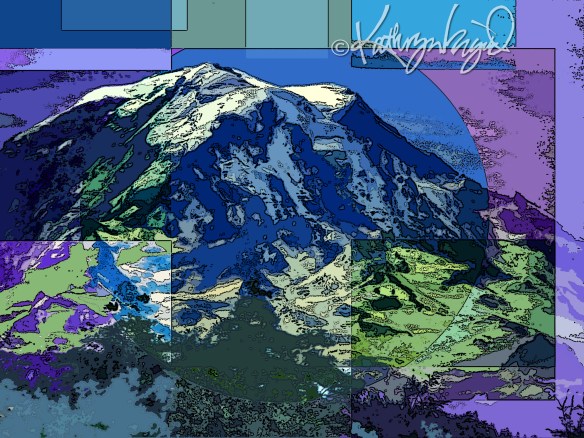
Digital illo: Our MountainMy many years spent as a lucky resident of the Pacific Northwest were dominated, as are many such fortunate souls’, by The Mountain. Mount Rainier can be coy, hiding behind not only her customary jaunty little beret of lenticular cloud but veiled further in the often hazy skies of Western Washington state. She can be mighty capricious, being after all a volcano whose natural habit is to lose her temper occasionally, diva that she is.

If you click on any of the site links above, there’s plenty of information to tell you far better than I could just how alive and powerful this entity is. So it’s not surprising that many of us refer to Mt. Rainier merely as The Mountain. Or, just as often, My Mountain. She owns us, in many ways, for when she makes an entrance, dominating the horizon with her granite glory, bedecked in a dazzling gown of white snow and fur-trimmed in, well, firs—we can’t help but be in awe. Such presence. Such beauty. Such danger, too, though we can’t think about that too closely, since we don’t know when or how; even if we did, there’s little chance we could do anything about it. But yes, deserving our respect. And in some ways, perhaps, because of this understanding along with the tremendous beauty, we feel an intense connection to the perpetual presence standing above us. So we call her Ours.

The valley where I lived for seven school years, and my parents remained resident for longer, is one of the most logical outlets for the lahar that would follow a pyroclastic flow from a Rainier eruption. That will likely wipe out much of the valley, whenever it comes. From our house above the valley, I stood out front in 1980 and watched the massive plume rise when Mount St. Helens, about seventy miles directly south of us, blew her lid, and that mountain also sits on the same Ring of Fire as the whole seismically busy left coast of the United States. Tiny amounts of volcanic ash drifted onto our neighborhood occasionally for a brief period thereafter, the same ash that was both ethereal looking grey ‘snow’ in a wide swath around the mountain and in traces across the continent, fully nine hundred miles across. St. Helens started at something slightly under ten thousand feet (3000m) high before the blast; her taller sister Rainier is a bit above fourteen. Mt. Rainier could have a smaller eruption…or be more powerfully, radically, explosive yet. Meanwhile, stunningly gorgeous. But isn’t that just our life all over? Precarious, yet all the more exquisitely precious because of that very tenuous quality. The Mountain owns us, and we in turn look on her as Ours.

This summer’s short visit to family and roots, naturally, gave us both the urge to visit Our Mountain, too, and Mom and Dad S—also longtime admirers of the magnificent mountain—joined us for that wonderful earthly element of our roots tour. Rainier smiled benevolently as we approached, doing that magic trick of hers where, as foreground terrain changes, that peak looks like you could just reach out of your car and stick your hand in the snow; you go around the corner a mere tenth of a mile ahead, and the mountain looks incredibly remote, hours away; just over the next rise, everything has shifted once more and you realize that you’ll be entering the national park at the foot of Rainier in a few minutes, the trees rising up like a cathedral colonnade through which we process onward for our audience, our reconnection.

No matter how long I live, The Mountain will outlast me; whether that next, inevitable, eruption comes during my tenure on this planet, whether it’s when I’m near enough to be killed or directly affected, or that this particular cataclysm finds me distant and leaves me unmarked, there will still be traces of Mt. Rainier for eons after I’m forgotten dust. I just found out, to my surprise, that it’s possible to get permits to scatter funerary ashes in Mt. Rainier National Park, and that seems like a delightfully apropos gift to give to an entity whose own ash will most likely someday blanket much of the Northwest. But I hope that my turn at that, should my survivors choose that option, is in the distant future. For the present, I happily remain an admiring acolyte of the splendid wonders of my mountain. Our Mountain.

Totems, Tokens, Things Taken

Since I got on the tangent of thinking about various indigenous-culture/immigrant persons and themes in recent times, I’m now in that phase one has of noticing connections with them everywhere.

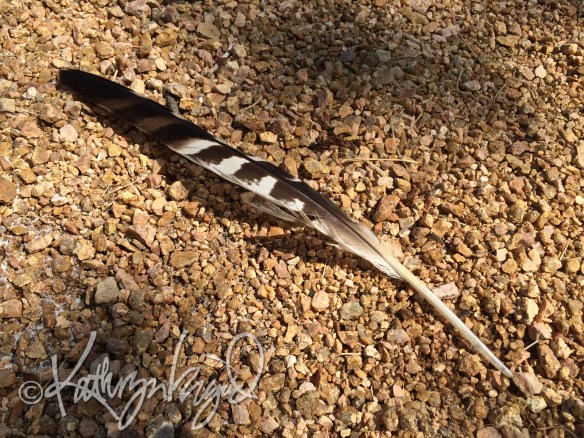
Today’s little starting episode was that of walking up my front yard path and spying on it a lovely wing feather. I’m quite certain it was shed by the same hawk that I’ve heard giving its piercing cry and seen circling over our place on numerous occasions, and that I saw a couple of weeks ago slurping up a foot-long snake like so much hawk spaghetti right out under my backyard flowering pear tree. I’m relatively sure it’s a Cooper’s Hawk that watches over me here at home, and I love it. I’ve mentioned before that I’m fond of and fascinated by animals in general, birds among the favorites, and corvids and accipiters my particular royalty. I may have even noted earlier that I specifically think of a hawk as something like my personal secular icon, or the companion of my heart, given how often I find I’ve seen one nearby, seemingly watching over me at various times and events that turn out to be important in my life. This, of course, can be attributed to the aforementioned habit of noticing that one cultivates, but I like to think there’s room in the coincidence for a causality conundrum, a chicken-or-egg puzzle, too. Either way, I admire hawks.Photo: A Fugitive's Feather

So I was pleased to see the wing feather there, looking to my mind’s eye rather like a “thinking of you” note left for me by my guardian hawk while I was away, or sleeping. I picked it up and pondered it. I set it on my table as I started writing my post.

Then, reality began to set in, of course. A very quick web search in an attempt to confirm or correct the identification of my hawk companion led me to discover that I was suddenly a criminal, since American law forbids possession or use of migratory bird feathers, a law enacted during a period of mass avian murder on behalf, mainly, of milliners and their customers in an era of highly feathered fashions. Given those massacres, not to mention the extermination of whole animal species, both native and not, in times past in this country, I am neither shocked that such a law would have been deemed necessary nor opposed to the intent of it to protect animal life. I have no desire to hunt any animal for sport nor to denude it of its natural beauty for my amusement.

But I can understand those who are irked by the hard-line status of the injunction, given the common experience of finding shed or molted feathers of all sorts on every beach, in every garden. “No animals were harmed in the making of this” object. Still, the law is the law. So my feather went back outdoors to disintegrate naturally, as we all will do. (With the exception, I guess, of plastinated creatures, but that’s decidedly another topic altogether.)

Not before I took pictures of it, of course, because I am allowed to photograph things I’m not allowed to own.Photo: Birds of a Feather aren't Necessarily Allowed to Flock Together
And that law, of course, led me back to the whole idea of ownership with which these native-vs-nonnative thoughts are inextricably tied. The indigenous or aboriginal peoples of the continent I call home, and where I consider myself equally native though my ancestors immigrated to the place in times past, are known to have had religious and practical reasons for thinking of ownership as a notion that simply couldn’t be applied to nature: that one existed at all was a gift of nature, and whatever one did in life and death should be done with respect for that benevolence. I’ve no doubt that some applied this attitude better than others, as is true for all people and their beliefs and rules, but the concern was deeply enculturated and not easily ignored—at least until the near culturcide brought on by the colonization of the continent by various immigrant powers.

We did not inherit Mother Earth from our Ancestors…..
We have borrowed Her from our Descendants.
Attributed to Chief Si’ahl (Seattle) of the Suquamish People [to whom is also attributed the magnificent speech and subsequent letter about the impossibility of land “ownership” in response to the new government demand that the natives relinquish their home territories to US rule and non-native occupation]

Man belongs to the Earth…Earth does not belong to Man.
Attributed to Black Elk of the Lakota People

As an enthusiast of little biological or scientific knowledge of, but great admiration for, nature and all of its wonders, I find I walk a wavering line in my relationship with it. The attractions of living creatures, of all sorts of things animal, vegetable, and mineral, are often for me first noticed as visible beauties and/or curiosities, or as other sensory (often, sensational) experiences. I am drawn to the amazing characteristics and anomalies of the whole natural world. But I also live in it. I depend upon its resources for my life and health and happiness. The very fact of my existence affects, and can even destroy, other parts of nature. When I take a breath, I process the air into something that it was not before, and send it back out into the universe as a new and different thing.

I don’t begrudge myself my breath. I don’t feel I’m evil for intruding on the rest of nature by means of my very existence. But I hope that with every breath, every moment I do exist, I grow a bit wiser in what it means to be allowed to exist by nature, this planet, and the vast Otherness that holds us all in its spacious embrace. And I promise that when I do die, I will return whatever I can of what I took with me, feeding later generations of nature’s bounty with the space I once occupied, the physical remains of what I garnered from this plane, and the hawk-befriended spirit that will be grateful for as long as is possible.Digital illo from photos + text: The Earth is Our Mother

Mine for the Taking

Precious Things

Copper in the morning hours and gold at peak of noon,

And sparkling like a thousand gems until the silver moon

Highlights the constellations of diamonds in the sky—

None has a richer treasury than Nature has—and I.Digital illo: Natural Treasures

I’m Dying to Know

Do you dare to think about your own death in reasonable, detached terms? Do you think that’s morbid and grotesque to even consider, or do you find it easy? If you find it easy to contemplate in the abstract, is it because you suffer from depression or are suicidal, or is it simply that you recognize living as an inherently terminal condition?

This is big stuff. Even the clinically depressed are sometimes able to recognize, on those tiny instants of light in the midst of the abysmal dark, that their death, no matter how insignificant and unworthy they may think themselves, will affect others. I know this from experience, and from lots of reading and conversation and observation. I know that even when I was at my lowest—thankfully, not as hideously low as that reached by many, as I know in retrospect—my rational moments told me that no matter how they felt about me, or even if they didn’t notice me at all, when I was alive, everyone who was peripheral to me in any way would have some tidying-up to do after my death. Physical, perhaps, for those to whom body removal and disposal fell, but whatever tiny tasks I was not present to perform anymore would either default to another’s To Do list or leave a gap, incomplete. I realized that I am the butterfly effect, in human form. You are. Every living, breathing being has a space in the universe, a purpose, and however unnoticed in life, has an impact both by living and by dying.

All the same, I feel especially fortunate that in my family, talk about death and dying were far from taboo. It wasn’t all that uncommon to find the dinner table talk veering in that direction, if somebody we knew was unwell or had just died. We didn’t need euphemisms and pussy-footing to protect us from the reality of death. It’s nothing more or less than the inevitable cessation of life, and if we can’t talk about that, we’re stuck dealing with all kinds of petty and logistical nonsense just to get through the process when we’d rather be spending time living and loving each other and getting through the complexities of the occasion with a modicum of grace and humanity.

So my family already knows that I would prefer they donate what they can of my organs or remains to someone who has a better chance of survival and health if I give it to them, or to scientists who can learn how to give future patients that better chance. In fact, the government know this: I’m on the organ-donor registry, should I die unexpectedly or with usable parts intact. My loved ones also know that I’d prefer a minimum of fuss disposing of whatever remains of my physical shell after that, the cheapest and quickest cremation and scattering of my ashes being my top choice. I figure that any Supreme Being capable of inventing the human creature from scratch can easily put me into another, newer shell if and when it’s my turn to exist in any other form, and as for the current body, it’s a good source of recyclable carbon and nutrients to replenish any part of the earth that enjoys a good, tasty meal of ashes, say, my long-loved flowers the irises.

Those close to me also know that I have far less interest in what they do to celebrate or mourn my passing than the still-living will. If the occasion of my death can be used as an excuse for a marvelous concert to raise awareness or funds or mere pleasure for the sake of a musical group, whether my spouse is still alive to conduct or attend such an event or not, that would be lovely. But hey, I’ll still be dead, so y’all can do whatever it is that makes sense to you and I promise I won’t roll in my grave or be a pesky poltergeist or complain in any other way. Still dead, if you didn’t catch my drift.

And that, in fact, is a beautiful thing, and a great comfort to me. I don’t look forward to the actual process of dying or the moment of my death. I’d happily live a long, long life in great health and an approximation of sanity that seems cheery enough to me, before dying for real. But once I do, I feel genuinely confident that none of this worldly stuff will matter to me in the slightest, so as much as I like to “plan” ahead to keep my survivors from any terribly fussy practical matters in the event, I’m not worried. Go ahead and dance on my grave, if there is one. Keep on living. Don’t worry about me; I’ll be fine. Really.

Digital illo: Mine was a Death's Head

Turn on the Waterworks

I don’t own a pool. Poor, poor me. Weep for me, all ye who have any tears to spare. Ha ha! Just kidding!! I’ve never, ever owned—or even felt compelled to own—a swimming pool, actually. I’m much too lazy to want the responsibility of either maintaining a pool or keeping it secure, and even too lumpish to be an avid swimmer. My only claim to fame in the latter regard is that I managed, almost inexplicably, to pass the required lifesaving/pool safety class at my high school, and this I only accomplished because I was stubborn and kind of unsympathetic as a rescuer, having learned some dandy but unfriendly tricks for subduing a panicked person who was struggling ‘uncooperatively’ while drowning.

When the weather gets hot enough, I might turn a slightly more longing eye toward any swimming pool in my vicinity, if only for the cooling of my heels. But I’m too pragmatic in my aversion to labor to indulge in the fantasy for very long. Just until the latest hot flash or external heat wave diminishes a bit, at most.
Digital illo: Turn on the Waterworks

So it’s kind of funny, even to me, how incredibly rejuvenated and rejoiced I am the minute I get to the coast anywhere. I forget, conveniently and blessedly, between times quite what an impact being near open water has on my spirits even though I don’t relish swimming in it and don’t even care especially about wading in it. The tang of the water’s salt and the occasional spritz of mist when a breeze carries it to my cheek, these are the attributes that pull at my heart. The gentle, steady lapping of tidewater as it sweeps back and forth across the scree and sand, this is the soundtrack of my contentment.

You can keep your gently chlorinated, mosaic-spangled, sanitized beauties, all of you pool owners out there. I don’t mind the special occasion of dipping my toe into the temperate, turquoise splendors of such sparkling basins when I can, but I will always lean toward the shore. Call me when your tidepool sports dancing anemones and bold sea stars, your lap pool spontaneously cleans itself with a refreshing swish and spray of tidal movement, and your patio is scattered with shells and sandblasted gems of glass and dried seaweed in graceful bouquets and…well, I guess I’ll see you when I get back from the ocean.

Strange Landscape

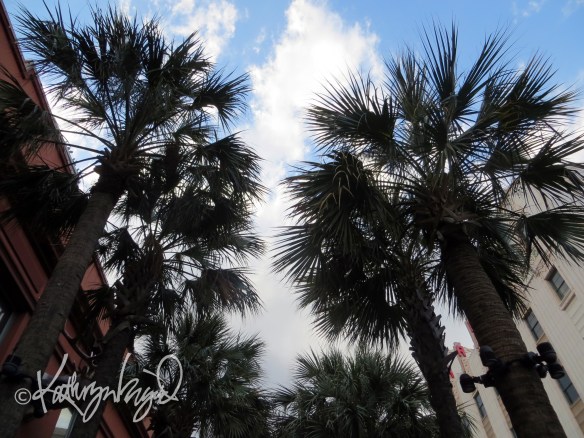
Photo: Palm Trees 1No matter what the reasons, the weather is different these days than both what I grew up with (all those centuries ago!) and what the locals in most places call ‘the usual’—really, really different. It’s not that Toronto has suddenly become the center of the tropics or San Salvador is now an iceberg floating along the edge of a glacier, it’s just different. The highs and lows have become both more pronounced and more prolonged in many places, from what I can see.

Where I grew up in Seattle, for example, its mythic status as Rain City and the region’s fame as being constantly wet were exaggerated, much of the truly soaking rain happening on the Olympic Peninsula as a result of the mountains’ effect on traveling clouds, weather fronts, and so forth, and thus less of it eventually reaching Seattle’s sheltered spot on Puget Sound. Instead, there were lots of grey, overcast days and light drizzling ones, but the measurable rain was moderate. In fact, the region generally has had plenty of rain to sustain, in its temperate climate, a stupendous variety of plants year-round, from the great towers of evergreen trees to their tiniest replicas in forest-like carpets of moss.

There were, as anyone anywhere knows, secrets and surprises in this unique climate. In the neighborhood where my grandparents had their apartment when I was young, right next to the shores of the Sound, I was awed by a few yards sporting healthy palm trees. These were not native to the northwest, nor even the slightest bit common—hence, my amazement at their exotic punctuation of the expected landscape—but they grew there without requiring any particular magic, because the microclimate along the West Seattle shoreline has remained remarkably sheltered and coddled by Mother Nature.

Now, it’s a more frequent phenomenon to see all sorts of semitropical plants creeping into the Seattle area landscape, and at the same time, more and more xeric plants. The hot weather of summer does, in reality, get a little hotter and stick around a little longer than it did in years past. It also tends to be drier. The total annual rainfall average hasn’t fallen into a chasm, but it’s creeping lower gradually, and this winter-spring cycle has been a record-setter for low snow pack, sending a fair number of ski resort owners into early and/or even permanent closure and more than a few homeowners into rethinking their home sprinkler systems and dispatching lawns in favor of water-saving raingardens. A few years down the road, it wouldn’t surprise me especially to see yards that look remarkably like the iconic ones of Las Vegas popping up on many northern properties as well.

Some of this change in nature’s attitude toward us is bound to change how we can and should live our lives. The watersheds that once supplied an abundance of cheap, readily available drinking and gardening water and hydroelectric power to wide swaths of the country are shrinking and already being bargained for more aggressively, even disputed. The world is already water-poor, despite newly over-watered and flooding regions, and I wouldn’t be entirely shocked if at some point water becomes the basis of more wars than oil and politico-religious reasons are today. I hope I’m not around to see the day.

Meanwhile, it’s still something of a novelty, never mind those long-ago days of perhaps two or three landmark palm trees in West Seattle, to see what’s happening in the gardens and seasons of this changing world. Never thought I’d see things the way they are, and that’s not just talking about the weather. Maybe I’ll get a grass skirt and celebrate it with a neon-colored summer drink served with its own paper mini-umbrella while it lasts.Photo: Palm Trees 2

Just Another Oddball Day in Paradise

Digital illo: Got It Made in the ShadeIt was a day of superb weather. As expected. It’s only that it was the kind of weather expected at entirely different times of the year, or at least in entirely different parts of the world. At least, by me.

In that way, it was par for the course in the modern world’s weather, at least. One doesn’t really know what lies ahead further than a few minutes, though now it’s less for the reason that weather forecasting is such an inexact art (it’s far less so than it used to be, anyhow) and more that previous centuries’ patterns have apparently been twisting and turning and emerging in wholly new directions and shapes. Exciting stuff, to be sure. Not so easy to manage our lives within it, given the difficulty of knowing whether the rain that’s begun requires a light, windbreaker sort of slicker or the building of an ark.

Meanwhile, superb weather at the “wrong” date and place.

One could spend plenty of time and energy trying to figure out why, or what it might mean in the grand scheme of things, and surely, thousands of smarter people have done so. I am not the one to solve those puzzles. I went for a walk, enjoyed the superb weather, and when it grew too hot for my taste, found a few trees in whose shade I could continue to enjoy the weather without being quite so warm.

It’s a weird world, this, and not quite like the one I thought I’d known all these years. But it still has some mighty nice shade trees here and there, and if I’m not too silly to take advantage of those, I can still think of it as a great home planet. Works for me.

Sunlight and Shadow

Photo montage: Sun & ShadowThe last few weeks of unaccustomed rain serve as the perfect reminder, if I should need one, of how quickly change is upon us at all times and in every way. Stormy weather and lower than average temperatures notwithstanding, the volatile fluctuation between cloud and clarity, bursts of sunlight and swiftly falling curtains of darkness, wind and rain, continue to amaze me.

The visiting children in our house right now confirm in their own way that the weather is not the only source of constantly astonishing change. The three year old swings between sleepy and energetic, bored and fascinated, sober and delightedly giggling as if sprinkled with fairy dust. Her one year old sister, teething, fusses for a while in frustrated pain, not wanting to be placated—wanting relief instead—until her naturally irrepressible sunny nature wins out and she breaks into a grin like the sun bursts through those nagging, lagging clouds.

Here, the forecast has switched from yet another week of storms to one of sunshine, and that sounds welcome at the moment. But if the weather pivots suddenly again, no worries.  Sun shines more brightly in contrast to deep shadows anyhow.