It’s All Rehearsal, Really

Blog.08-30-2013.all-rehearsalWe may look like we’re all geared up and doing important stuff, but mostly, we spend all of our lives practicing, learning and getting ready for one thing or another. Some of those things happen in due course and many more of them either never quite come to fruition, or far more often, change along the way and we end up following along and seeing where it all takes us. All of this is quite normal and perfectly valid.

As a privileged observer and listener in many musical rehearsals long after the years when I was an active amateur participant, I can tell you that I think these more explicit practice sessions can have much the same sorts of both trajectories and outcomes. What anyone not privy to the backstage view of any sort of practice may easily forget, even if they once knew it, is that whether the moment is strictly obligatory, is amateur in the finer sense, or is wholly professional, it can have the same range of characteristics, studious, soulful, playful, predictable, heartrending or hilarious–or some grand combination of them all.

The experience of listening in on the preparations for musical performances is distinct from the performances themselves in a multitude of ways, but perhaps the most striking to a non-participant is arriving at a high-level rehearsal and seeing all and sundry set up camp for it in their work clothes. The star soloist is wearing old jeans. The conductor, who no matter how rigorously the singers and players enact their parts will likely move around and sweat the most, is wearing shorts and a short-sleeved, thin shirt. The players have open cases near their chairs with spare instrument pieces and alternate score parts strewn across them, and the singers, no matter what the temperature, are wearing neck scarves and lugging big containers of fluids to protect their own precious instruments. The rehearsal accompanist at the beat-up old piano is wearing glasses both on the bridge of the nose and the crown of the head, one for the easier to read individual parts and one for the microscopically reduced full score. All of this in a sort of ordered chaos the shows they are all there to Do Things. It’s work. It’s fun. It’s messy, like life.

Our Big Summer Road Trip, a driving circuit of over 6000 miles this July and August, was a multipurpose travel package designed to accomplish a number of ends, not least of them to attend and study and enjoy music-related adventures with friends, colleagues and other musicians and music lovers in several disparate events. First, we went to the Oregon Bach Festival to see the newly anointed Artistic Director make his debut interview marking the occasion, and more importantly to see maestro Helmuth Rilling conduct his grand finale performance as AD in this season when he officially passed the baton to his successor after 44 outstanding years at the Festival’s helm. The Festival is a fine one, Rilling a justly revered conductor and teacher, and many of the singers and players who participate, along with many regular OBF attendees, are longtime friends and colleagues, so it’s always a joy and privilege to go to the Festival ourselves, but particularly meaningful to see Rilling lead the B Minor Mass on his way to Conductor Emeritus status, since my husband Richard had the good fortune to sing the same piece under Rilling during the maestro’s second year at OBF. A great deal of water has gone under the bridge, and though a lot has changed in that flow of time, many things remain the same. Rehearsals and performances, practice and action go on as ever.

I had been reminded of all of this, of course, by the opportunity to attend the Boston Early Music Festival and see my spouse conduct and his Collegium Singers and the university’s Baroque Orchestra in June, along with admiring all of the other marvelous artists and events at BEMF. So many wonderful concerts and recitals; so much hard and happy work to prepare them! And how quickly June disappears into the mists of memory as the summer rolls forward. Thus, a long road trip seemingly becomes an amazingly fresh outing to experience more variations on this theme.

The second of the trio of musical events we attended on the road trip was the regional gathering of choral conductors in our former home area, a great opportunity to renew ties with longtime fellow conductors, teachers and friends over grilled wild salmon and to revisit musical literature options, audition processes, mull over the usual academic topics, share hints about favorite new compositions and gossip about who is the up-and-coming hottest new choir or conductor in anyone’s neighborhood. Driving up to the chapel that serves as the main conference space, whom should we see sitting visiting on the porch but a man who was the excellent recording engineer serving in that artistic task for many of my husband’s choirs’ recordings over the years, and with him, the teacher-conductor-mentor who led Richard to music as a vocation and profession in the first place and so became not only his ‘choral father’ but a lifelong dear friend. To follow this greeting with collegial renewal among many other fellow musical artists, from colleagues and collaborators to singers and students, composers and coordinators of conferences and musical programs at all levels, and then to have dinner a week later with both of those two first friends we’d spotted, was rich beyond words.

Third on our list and rounding out the road trip with our stop in Vancouver, BC, was the Vancouver Early Music Festival. A perfect bookend to starting the trip with OBF in Eugene, VEMF attendance had much the same purpose for us as the Oregon visit: see and hear good friends and other artists at work, and attend the events honoring the longtime AD’s retirement. While Jose Verstappen has served a mere 34 years in Vancouver, he has had as much impact of his own on the Festival there as Rilling has in Oregon, just a very different sort. Jose is a modest and self-effacing man, but as warm and as hardworking and dedicated, and certainly as hard for donors and supporters to say No to, as Rilling, and so both have created environments of commitment and excellence that will thrive long after both have abdicated their thrones. Matthew Halls, Rilling’s successor, and Matthew White, Verstappen’s, are both bright, gifted and able men and I expect to enjoy attending both festivals with as much outstanding artistry on display as ever in years to come.

While in Vancouver, besides the great fun of attending Verstappen’s farewell party, seeing many dear friends, meeting Bruce Dickey–the leading light of cornettists nowadays, he will be playing in the production of the Monteverdi Vespers Richard’s conducting in October–and hearing some terrific music of various kinds in concert, the highlight was sitting in during rehearsals for Händel’s ‘Israel in Egypt’. It was there that I was most struck by this lovely interweaving of labor and lightness that can happen when the people at practice are fully engaged in their work and love what they do. The piece itself is a marvel, full of potent and piquant and even picaresque melodies and moments, and those singing and playing it made the most of these riches. When Tyler Duncan and Sumner Thompson started singing the bass duet ‘The Lord is a Man of War‘, not only was the music and text mesmerizing (never mind my personal feelings about the story’s theology) but their obvious pleasure in exploring the expressive potential in the piece together with the players and conductor (the impressively sensitive and dramatic Alexander Weimann) moved me to pay special attention to this juxtaposition of the remarkable and the workaday, the plain and the powerful. So to all of you out there who sing, play, work, rehearse, prepare and perform, and especially to the players, singers, composers, conductors, administrators and Artistic Directors encountered on this summer tour of ours, I dedicate this poem.digital illustrationNumber Thirty-Eight

Strike, then carry on, and so the sound

Belies in beauty such a martial start,

When ragtag troops in everyday are found

To sing and play at battle from the heart–

Who seemed so simply destined for the soil

As laborers in neither art nor war

But some plebeian, plodding sort of toil,

Then strike, and decimate what came before–

Show the illusion is not acted out

Through violence or merely artifice,

But rather, note by note dispelling doubt

That mystery’s all quite undone by this–

Where love and war are mingled in their way

By songs more eloquent than words can say.

Good Conduct Medal

graphite sketchesEvery season of music has its marvels, masters and moments. In my life of following a conductor and his fellow artists around, I am privileged to be on hand for more such fine pleasures than most, and I never forget that this is a great bit of good fortune indeed.

Still, not every instant is guaranteed to be a glowing example of the highest and best of the musical arts. After all, there is all of the practice that must come first, and to be fair, no amount of practice can assure us of perfection. Mistakes happen; if  we’re lucky, learning happens as a result. But the distance between first-try and performance may be a long one indeed, and sometimes the distance isn’t quite long enough.

So I am grateful all the more when I attend a performance and hear something magical and meaningful and magnificent. I know that it took the performers a lot of concerted effort to come from wherever they started the process to this peak, and I am all the happier and richer for it. I know and appreciate, too, that it takes massive amounts of effort and energy and other resources on the part of organizers, managers, fans, logistics handlers, boards, angels, financiers, educators, ushers, ticket dealers, audience members, and all of those other assorted friends of the arts needed to make this work pay off in any way beyond the artists’ own satisfaction in the process, and that’s yet another level, another realm of generosity entirely that makes my little spot in the aural universe fuller.graphite sketches

Most of all I give my fervent thanks to all of the singers, players and conductors who strive to make this miracle happen again and again. Without your dedicated pursuit of the musical muse, there would be no such happy task for all of the friends of music who are not musicians ourselves. And unquestionably, the world would be a far less beautiful place.graphite drawing

Musick has Charms

The charms of music can, indeed, soothe the savage breast–and it can bring the terrible savage right out of the calm breast just as well. It’s a power that few can resist, love the music or not; it gets under the skin and slides on into the soul. The marvels of music are not, as you know, unknown to me and yes, I have been both incited and soothed at various times by it.

But I haven’t lived the life of total immersion. That is, as are most fully engulfing passions, left to the titans of the art. Not necessarily people known and celebrated by a large and laudatory world, indeed, but those who, whether in that pop-culture celebrity way or from deep in the dark of the behind-scenes action or somewhere in between have shaped history in whatever bold or subtle way their particular art could do.

I said I was going to be a bit dark and Halloween-ish these days, but I was reminded that this day deserves a different kind of recognition, being a memorable date of another kind altogether: the birthday of one of those titans of musical arts aforementioned. So you get a break from my grimmer humors while I bow to a great musician and a lovely man.pen & ink drawing

My husband, you ask? No, I would surely call him both as well, but I refer just now to one of the musicians who helped pave the way for my spouse, inspires him in his work, and befriended him both professionally and personally in ways that made it more possible for my partner to be quite the accomplished musician and artist that he himself is. I’m talking about the man sometimes known as the godfather of Swedish choral music, Eric Ericson.

He is celebrated by far more than just his family and friends, more even than his numerous choirs’ members and his almost countless students, because he stood at the center of an almost unbelievable burst of musical art flowering in the little Scandinavian nation of his birth and spreading throughout and beyond Europe quite immediately after World War II, sooner than it should have happened by rights except that his own country remained neutral and mainly untouched by the physical depredations of the war, and enough so that a number of outstanding leaders in culture took refuge there during and after the war, creating a remarkable hothouse where those fertile minds could put their restless art to work, and often did so together.

He is celebrated also because, as one of the central figures in this new bloom of music, he helped to shape the whole modern state of choral music, both in the church and in secular circles, in Sweden and to foster its wide spread via his own work and travels, via that of his artistic and intellectual partners and rivals and colleagues, and especially via the many, many young musicians that between them they all trained and sent off into the wide world. Their collective influence, expanding at the virtual rate of plant cell division and sending tendrils around the globe, is a rich and vital gift that will long outlive them all.pen & ink drawing

Thankfully, Eric Ericson, for one, is going to give that theory a run for it, as he has attained more than ninety years already himself. And his artistic offspring will undoubtedly keep the music sounding and growing for a very long time too, and for that I am happy and grateful indeed. We who love choral music today owe him thanks.

With that, I will say that the gracious and generous kindness that he and his dear wife have shown on a personal level to both my husband and me makes me as glad as anything to think of him on this day with great admiration and fondness. I hope that every note I have seen him conduct, heard him play on the piano while conducting and discussing the finer points of music or listened to him hum under his breath as he recollected another bit of his own fascinating and incredibly complex history as a musician will linger in the atmosphere for many years yet to come, and that in turn, no matter where on that spectrum of artistic or intellectual accomplishment any one of the rest of us happens to perch, we too will make our own kind of music echo happily in the hearts of all those whose lives we touch.

Happy birthday, Eric Ericson, may the music you hear always soothe and delight you.pen & ink drawing

May I Suggest . . .

photo

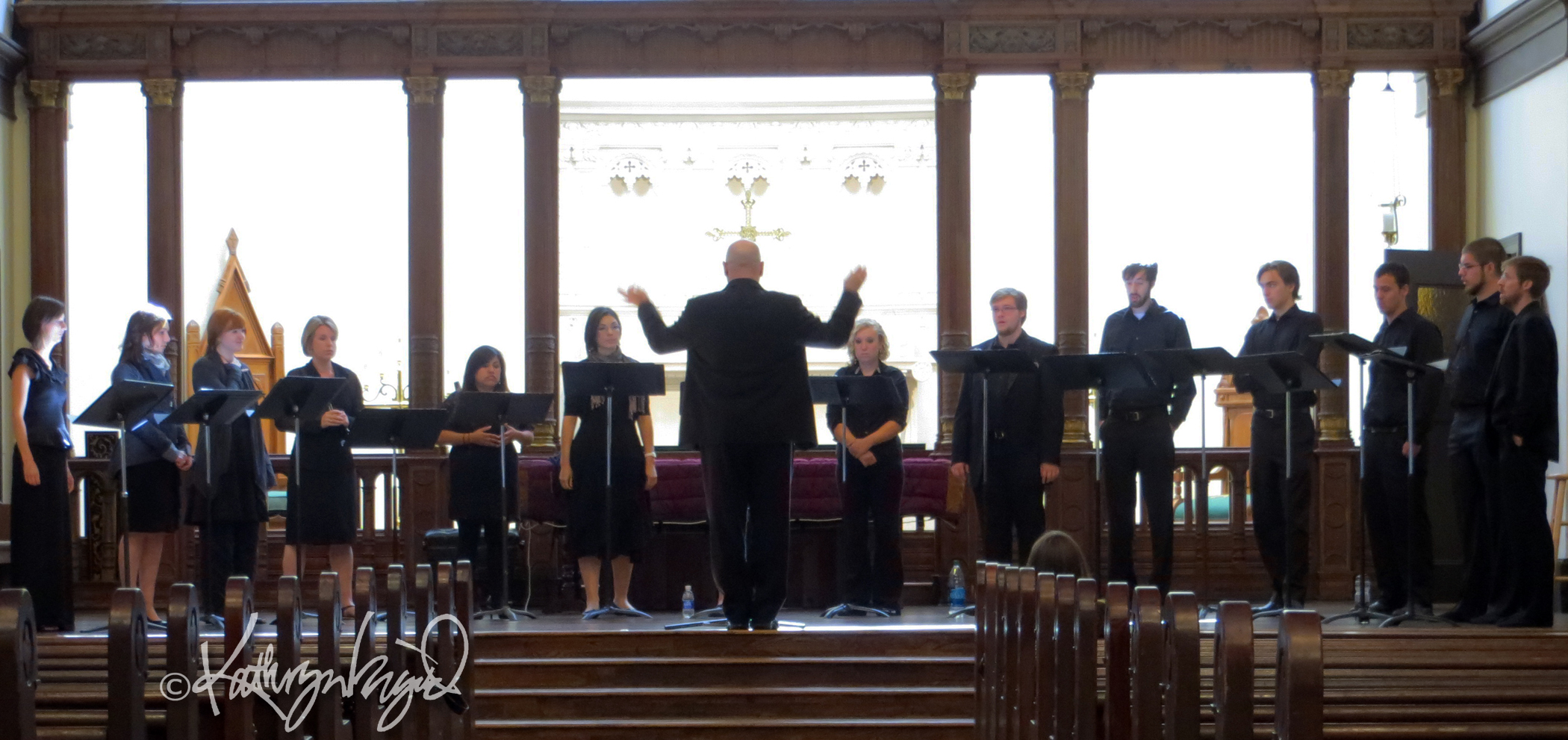
The University of North Texas Collegium Singers in dress rehearsal for their performance at the Berkeley Festival of early music, June 2012, Dr. Richard Sparks conducting. Yes, *that* Richard Sparks.

MUSIC.

Having had my senses immersed in the bath of fall season-opener concerts of all sorts lately, to the literal tune of hundreds of voices and instruments in symphonies, marches, art songs, musical theater melodies, electronica, motets, chaconnes, folk songs, choral masses, lullabies and all sorts of other lovely music, I am reminded as always at this time of year that such an intense schedule of events, however fabulous and rich they are, can be exhausting. More importantly, though, I am reminded that it’s also invigorating, inspiring and often utterly thrilling.

It’s also the time of year when the European choral magazine for which I proofread and text-check translations goes back into full production for the year. The articles and news items are all full of reviews of the summer season’s festivals and conferences and the amazing machinery that underlies these productions, from choosing and ordering music scores through civic action, political efforts, fundraising, singer scholarships, educational programs for participants and audiences, performers’ uniform shipping, young composers’ symposia, etc, and right on down to whether ‘civilian’ supporters of the group are allowed to arrange the music stands or chairs onstage if the local symphony hall union members are on strike. At the heart of it all is such a profound passion for music that millions of people worldwide, including those from countries and cultures one might be surprised to find even having the time or energy amid their economic, social or yes, war-related battles to sing and to listen to singers. If there’s a genuinely possible force for world peace, my friends, it may well be in music.

More personally, it’s music that is a central force for my own happiness, for a large number of reasons. Every one of those listed above comes into my own life and being regularly. But as you know, I am partnered for said life with a musician, and so the whole topic comes that much more sharply into focus. Music has been a glue for us two from the very beginning of ‘us’. Ask our mutual dear friend, a fellow musician, if I were single and might therefore be ‘available’? Check. Collaborate over a large-scale music performance and its visual presentation as a way to get to know each other a bit, hovering around each other during rehearsals and preparation? Check. Go on a first date to a Mark Morris Dido and Aeneas dance performance [yes, truly spectacular, by the way] for which my suitor had prepared the singers? Check!

photo

Since thousands vie for the dozens of positions in the final selected groups, high school students in Texas undergo a rigorous preparation for All-State Choir auditions, studying the literature in workshops and camps across the state each summer to compete in their local and regional trials before the year of All-State even arrives. This is the UNT group working in the summer of 2012, rehearsing in the camp organized and run by Dr. Alan McClung, assisted by UNT students and graduates and conducted each year by a different guest conductor–this year, by my spouse. What can I say, it’s what he does. And what I love to hear and see.

What followed is, was and ever shall be musicocentric. Our honeymoon (more about that in a future post) was built, in fact, around my fiance’s conducting gig–a gig including, naturally, our aforementioned Dual BFF as accompanist–at a choral festival in Veszprém, Hungary, arranged under the auspices of the parent organization that spawned the magazine for which I still do editorial duties, if you can follow that sprawling, meandering melody line. One might say that it all began with music and went racing straight downhill from there. Or, if one feels as I do, that music has brought uncountable joys into my life from earliest memory to the present, and will sustain me until the end. In any case, one of the clear high points of musical pleasure has been attending the myriad concerts, events, conferences, performances, and festivals that bring musicians and music lovers together all over the world. A huge number of our favorite people are those whom we’ve met in and through all of this music-related stuff. We have deeply loved ‘family’ literally around the world whom we’ve met and with whom we’ve bonded through musical acquaintance.

If you haven’t done so yet, or not recently enough, may I suggest that you ‘get thee to’ the nearest conference, symposium or festival involving music as soon as you’re able. If, like me, you aren’t an active participant, know that every artist needs his or her cheerleaders and fans and supporters, and that your mutual love of the art will mean more than that you stood onstage during the work or the bows. Yes, even non-musicians can and should pitch in–even those with no sense of pitch can fold programs, stuff envelopes, recruit audience members and donors and board members and political supporters, can drive the shuttle that carries the singers and their accompanists from venue to venue at the festival, and can buy tickets and bask in the glorious sounds from town square to church nave to school ‘cafetorium’ to symphony hall and shout a resounding Bravissimi! to all and sundry.

Beyond that, though, the immersion of being in a place where a huge number of people, participants and supporters and happy observers alike, have come together from a wide range of territory for an extended period of days solely for love of music–that is a wholly different and magical experience everyone should have the opportunity to enjoy at least once. So I commend them to you, the small-scale community events offered by your local affiliated high schools and the international events hosted by long-lived organizations in exotic places and every variation on the theme you can find. I promise you will leave with a song in your heart and memories to last you to when all of your other memories have faded to dust and perhaps beyond. If music be the food of love, play on! For though in this line opening his play ‘Twelfth Night‘ Shakespeare exposed the Duke of Orsino’s conviction that being surfeited with love (in this instance, via its musical surrogate) would cure him of his hunger for it, I think that quite the opposite is true: if they are excellent, the more we experience them and are filled with them, the more we crave both love and music.

Food of that sort for thought: visit first the websites and then the events offered by your local choirs, bands, orchestras, theaters, and performance companies. My own favorites are hosted by professional organizations of music educators, conductors and performers simply because those are the ones I’ve naturally had the privilege to attend, as consort to my musical prince charming, and these all offer performances by top artists that are open to the public, sometimes even with free admission. Explore them! The organization that ‘sponsored’, or inspired and was the jumping-off point for, our honeymoon with its Singing Week in Veszprém–with its half-dozen ateliers conducted by musicians from Europe and North America and singers and whole choirs from all over as well–was what is now called the European Choral Association-Europa Cantat and it hosts a wide variety of such choral events throughout each year, with a focal youth choir festival occurring triennially in places like Passau, Leicestershire, Barcelona, Utrecht, Torino (2012), and Pécs, Hungary (a locale to be repeated in 2015).

photo

Just this month, the newly minted University Singers at UNT performed their first concert of the season with my spouse at the helm. If you live in or near a college town, you’ll find endless opportunities for attending all sorts of musical events, many of them free and most of them truly outstanding–after all, these people are all here gaining expertise for what may be their whole life’s passion, and performers need great audiences too.

Pop, folk, jazz, rock, blues, punk, bluegrass, Early Music, all flavors and kinds of music and individual organizations from the Oldtime Fiddlers [I once got to run the stage lighting for their competition in Washington state–fabulous fiddling, huge fun and even some fantastic yodeling!] to the Verona Opera [I can say from my one experience there that genuine opera under the stars is something not to be missed, even if it’s still 40°C when the singing ends in the middle of the night]: there is something for practically any musical taste out there, and many of them that I enjoy immensely are included among these. My personal pet organizations among the professional gang also include many others: IFCM (International Federation for Choral Music), ACDA (American Choral Directors Association), ACCC (Association of Canadian Choral Communities), TMEA (Texas Music Educators Association), Chorus America, the Boston (odd-numbered years in June), Berkeley (even-numbered years in June), and Vancouver (annually in August) Early Music festivals, and ever so much more.

Here in Music-land

photoWhile our neighbors, housesitters, et al., languish in the rain and heat back home in north Texas, we are enjoying the gentle zephyrs of coastal breezes, California-fresh seafood, and the retro-rrific air of counterculture that still wafts about in the refined west coast air of Berkeley. More than that, we are reveling in the good company of my spouse’s musical compatriots: his Collegium Singers from the university, many longtime instrumentalist and singer and arts administrative friends from all over, and fellow enthusiasts attending the Berkeley Early Music Festival. The Collegium crew sang, appropriately, like angels in their concert this morning, performing the Victoria Requiem they’ve been refining with such jewel-like precision and sweetness that I wouldn’t be surprised if the dead had resurrected just to listen in, had it been a true funeral service. Instead it was exquisitely meditative and left me–and clearly, the rest of the audience–feeling newly alive.

photophoto

It’s lovely enough to be back on the Left Coast and greeted with such stellar weather, to have my first glimpses of Berkeley’s laid back, live-and-let-live pleasures as a city, and to be in yet another university town where the average walk down a street takes me past representatives of countless countries and cultures, avidly breaking down the latest puzzle of physics or chattily discoursing on the political influences on the contemporary literature emerging from central Africa. It’s a delight to see (yes, and eat) classic dishes from France, Thailand, India, and almost any other culinary heaven imaginable, all within a quarter mile’s stroll of each other in the heart of town. And it’s unspeakably fine to smell the familiar resinous breath of the redwoods, firs, pines and cedars, to see olive trees and palms and Strelitzia reginae and succulents cheek-by-jowl with purple rhododendrons and lawns full of tiny English daisies. California. It’s been a while.photo

The musical immersion is as marvelous as always at festivals and conferences devoted to the art: the rehearsals, the post-concert critiques and deconstructions among friends and colleagues, and hearing fabulous pieces old and new is so invigorating. Heard in concert this afternoon was a vocal-instrumental ensemble that included in its quintet a dear former student of my husband’s, as marvelous a person and musician as ever, and among the works the group performed that were new to me were a pair of certainly not new (ca. 13th century), stunning anonymous compositions from the Montpellier Codex that simply took my breath away. Everything old is new again. Not least of all my amazement at the beauty and variety of music out there in the depths of the melodic pool whose surface I’ve barely begun to skim.photo

The other charms of Berkeley are many, including some of the most outstanding examples of nineteenth century American architecture anywhere. We took a short side trip on our first day in town to stop in and see the superlative work of Julia Morgan, perhaps best known as the designer of Hearst Castle, that monument to extravagant American ego, but to my mind better represented by the Berkeley City Club, a more refined and slightly more restrained palace of culture originally meant to house and host the many women’s clubs of the city. Every inch of the place speaks of thoughtful attention to detail and the cultivation of gentility. Signs of Berkeley’s longtime perch on the front edge of tech development and IT culture are everywhere, too, from storefront displays of vintage technological hardware that seem remarkably antiquated and quaint for being relatively recent iterations of what we now consider so commonplace. The constancy of the city’s citizens in bucking any idea that feels imposed or compulsory is still seen in the posters plastering every flat surface to promote individual choice, dedication to intellectual pursuits and challenges to anything that smacks of dull pedantry or legalism.photo

There was much more marvelous music this evening and will be tomorrow. Today alone, there were concerts at 11 am, 2:30, 4 and 8 pm–with a Heinrich Schütz reading session led by my husband sandwiched in between. Oh, and lunch with another wonderful former student. I can certainly guarantee there will be plenty more enthusiastic eating, drinking, visiting, strolling and happy wool-gathering in the sun as we idle (or dash) along on the way to the next event. For now, a brief pictorial and a wish that everyone who loves music may have an opportunity to attend some such grand events in their own places and times.photo

The Large and the Small of It

The depths of Space carry miraculous sparks of inspiration at a seeming infinity of levels.digital collage

A couple of years ago my husband was conducting a concert of choral works all, in one way or another, exploring the idea of Space, and he asked me to provide projected images that would act as a visual companion to the music. Since the centerpiece of the concert was to be a selection of movements from Estonian composer/astronomer Urmas Sisask’s ‘Gloria Patri‘–wonderfully meditative, somewhat minimalistic yet still quite melodic music which was to be accompanied by photographs taken through the Hubble telescope, I was given a clear starting point for the collection of visual images. The good people of NASA willingly agreed to let us use any Hubble images we liked, without any constraints and at no charge, so my task was to find the images I thought best suited the music at all points, edit them (some extensively, some less so) in order to fit the format of the projections, and collate all of it into a pre-arranged program that I could manually ‘play’ as the concert was performed. Looking for, and then through, hundreds of Hubble images was a bit of a project in itself; reformatting and resizing, digitally ‘cleaning’ and grouping and ordering them proved to be a little more weighty. But it was a pleasurable and energizing project all the same, staring at the stars and constellations in all of their miraculously varied glory. ‘Gloria Patri’ indeed!digital collageGoing forward to work out images for the rest of the pieces on the docket for this program, I was moved by both the enormity of the Hubble’s scope and our own galaxy’s tininess within the vastness of space to think that it would be wonderful to explore those strange dissonances and harmonies that occur in the known world, microscopic to massive, blurred by our limited vision and knowledge and delicately detailed by our constant finding of new facts and ideas in all of it. So for the other pieces in the concert’s repertoire, I sought out images that would complement each other yet emphasize the astounding range of contrasts in our spatial existence, from the granular to the grand. Pollen and planets might in fact have more in common than we can imagine, if we stretch our thinking just a little. Snowflakes and stars might be merely opposite ends of a spectrum that transcends dimensions, scale and vision.digital collageI was reminded throughout this process not only of my minuteness in the great spectacle of existence, but also of how fantastically treasure-filled that existence is, from the level of the subatomic to things and thoughts so massive that the Hubble telescope and all of its exponentially larger generations of offspring may never quite be able to encompass the enormity of it all. If I ever think I’m running out of ideas, I only need to remember this one exercise in humility and happiness, and I should be able to break out of my stasis as a flood of newly sparked inspirations stream like comets out of me.