Angels of Mercy

graphite line drawingThere are a lot of distinguishing features that we associate with Goodness, in the general sense of that construct. There are the usual ethical and even moral qualities we impute to a person or action or event in our humanist or religious ways: honesty, justice, kindness, compassion, hospitality, wisdom, patience and other such characteristics are almost universally recognized as positive and admirable. And while we can sometimes recognize these things in our fellow mortals, many of us find it easier to represent them in our minds’ eyes as some kind of super-beings that transcend human limitations, because it’s hard to imagine much of this happening or being sustainable in the hands or lives of mere people.

So we have our superheroes and our faeries, our special agents and goddesses, avatars and angels. But we’re still either too limited in our mental vocabularies or perhaps simply a little bit too insecure and egocentric to imagine or depict much that is Good without giving it a recognizable hint or ten of humanness. We make our gods in our own image, unable to picture them as truly different enough from ourselves to be genuinely Other and unique. We need to feel a concrete connection if we’re to make any sense of our own ideals.

And there’s nothing wrong with that, to my mind. How can I talk about the sweetness of a ripe pear with someone who has no sense of smell or taste? What it feels like to stand mid-stream in an icy creek with someone who has no legs or is a lifelong quadriplegic? How could I hope to discuss a complex topic with a deaf person from another country? We have to have some little commonalities, at least ones that we perceive as such, for us to have any kind of relationship, including the philosophical or emotional or spiritual.

So we, thankfully, have our Helpers, our unseen supporters and caretakers and watchers and guides, and we give them features that help us to understand and trust them. The other day when I was drawing I was thinking of a friend who, as I write this, is undergoing cancer treatment. Many friends and relatives and acquaintances have done so in times past, and many will yet again, and I think of them in their times of need and send, in my own way, my love and hope and concern, but most of them cannot use anything tangible that I have to offer. I think for cancer patients, my versions of angels would most certainly be beautifully smooth-headed creatures.

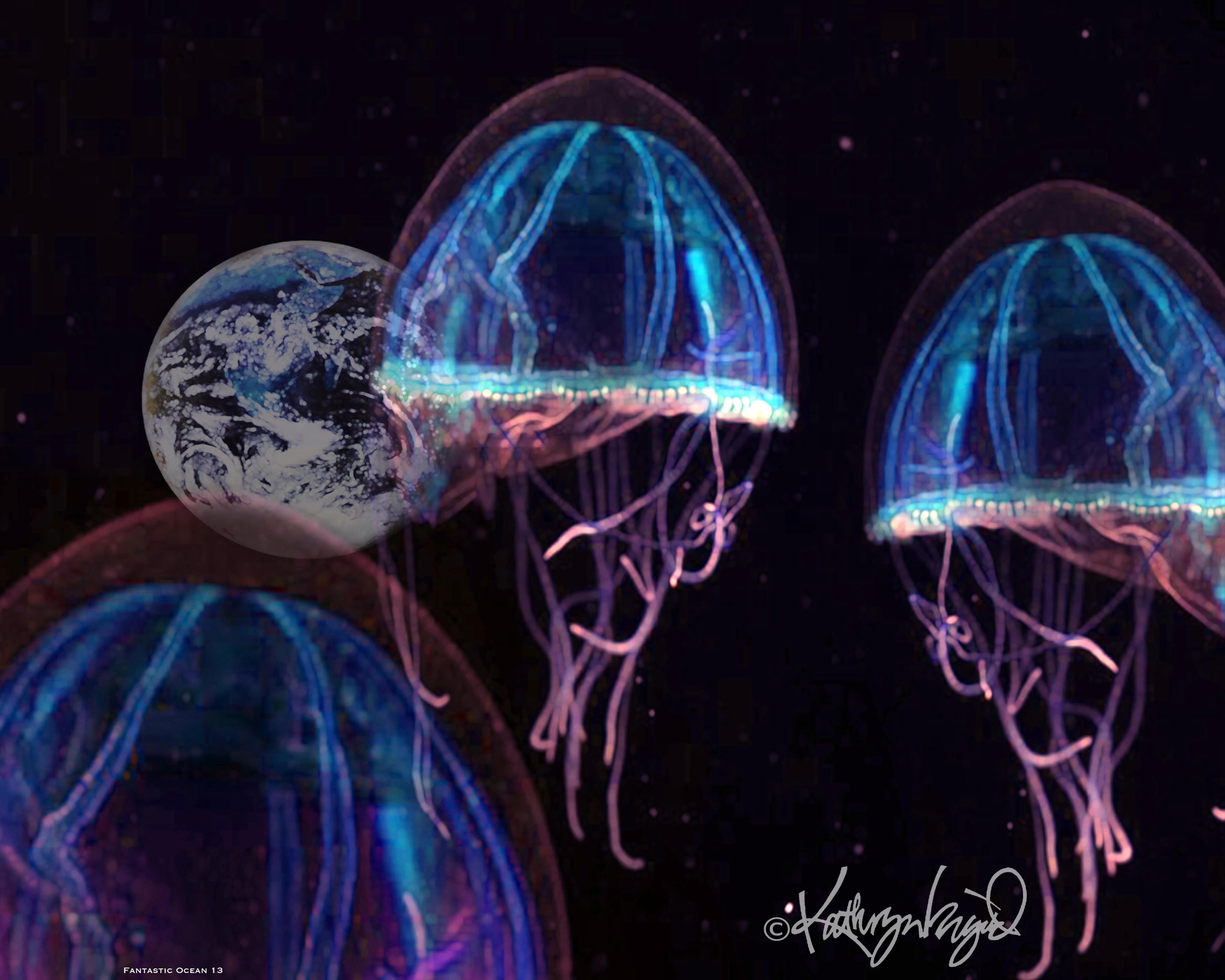
I am no surgeon, healer, scientist, caregiver or therapist of any sort. If you live close enough you might get some homemade chicken soup from me, or an armful of flowers from my home meadow, or a little note, but I have no cure to offer, have not even enough encouraging wisdom of my own to get you through the day better. What I do have is my own vision of what I would hope to have at my bedside or hovering around me as I tread any dangerous paths, a sort of gracious, singing, laughing and–when I need a modest and quiet companion who understands the sorrow of it all–gently embracing angel of mercy. And my particular versions of such beings work in force, and also make house calls, so I will gladly send regiments of them in all their shining, vaguely human, terribly purposeful Goodness to watch over all.digital illustration

A Moment for Contemplation

photoWorlds of Peace

In the sleepy little world where

kindness can prevail and thrive

The beasts and people live in peace,

all happy just to be alive

Their gracious ways, generous hearts,

their gentle speech and thought and will

Protect them all throughout the day,

and through the nighttime hold them still—

Would that this dreamy little world

could bloom and flourish here on earth

And that such hopeful tenderness

pursue us all straight on from birth

My wistful wishing is not vain;

this virtue could embrace us all,

For we do know how to be so,

if only we would heed the call

And so each morning as I rise

I make a small and silent prayer

That by the night’s new-darkened skies,

we’ll find ourselves all living there

photo

Sin Boldly, Fail Dramatically

Anyone who knows much about the instigation of the Protestant Reformation knows that its leadership was not enacted by prim and prissy sorts. Martin Luther, besides being quite the rabble-rouser in the event, loved his beer, offended the all-powerful Church that was his employer and effectively, his owner, and married a rebel nun, with whom he had six children. His being credited with advocating that fallible humans should ‘sin boldly’ rather than live in denial of their mortal failings and inability to produce or buy redemption comes as little surprise in light of this life history. But in all of this there’s also more than a tiny hint of very useful everyday advice as well: thinking ourselves capable of perfection tends to stand in the way of getting anywhere close to it. Making mistakes is the only real way to learn and improve. Practice doesn’t make perfect, it enables us to get closer to our ideal of it and, if we’re really smart and lucky, to change and improve our concepts of perfection.photoOur failures do tend to cling to us. There would be no name for Schadenfreude, not even an inkling of its existence, if it weren’t for our feeling relief in and even reveling in, others’ mistakes and disasters; the more public their occurrence or exposure, the better chance of their (sometimes literally, in this digital age) going viral. But for every ninety-nine spectacular pratfalls, there is one person who, by dint of dusting herself off and jumping up with agile alacrity to redo the test and win the day, makes the fall look like a flashy prelude to a show-stopping grand finale that everyone will envy rather than ridicule. What makes this person enviable is not perfection but the ability to rise up from the ashes with new wisdom and determination, both gained from what was probably a whole series of dazzling falls in the process. Even more desirable is the one who manages to let us all in on the secret, admitting fallibility and mortality from the start and leaving the curtain wide open so that we can revel in the learning process with her before she ever hits the stage, can learn from her mistakes. This is a kind of brilliant generosity I have always admired.photoRisk. Taking risks means you will have bumps and bruises to ego and, possibly also, body. Taking none guarantees you will have a dull life and probably, a colorless soul. Worthwhile risks might conceivably include real danger: one can take chances that cost money, job, power, relationships, physical injury–life. More often, they will cost a measure of pride, and that’s something nearly all of us can afford to lose (and some probably should offload a ton or two of it). A policy I developed for myself when I was in college and such a fearful ninny that I would hardly have survived my undergraduate years let alone moved forward in any other part of life if I hadn’t finally forced it on myself, was to accept that whether I believed it or not in the moment, whatever it was that scared me probably wouldn’t kill me. Sounds silly to all who know how minor were the things that held me in utter terror, but the fear was real even if the danger was not. The adjunct rule I decided to apply to this idea was that if It (the risk of the moment) did kill me, it certainly wouldn’t bother me anymore.photoI may have worded these rules in a slightly tongue-in-cheek mode, but I conceived of them as an actual, practical reassurance that anything life hands to me I ought to be able to handle sufficiently. And that hey, if I don’t end up managing quite that well every time, I’ll make some meaningfully big mistakes, learn from them, and do better the next time. I’ve learned that I can’t be humiliated unless I allow myself to be–in truth, it’s strictly an internal experience when you really boil it down, and there’s nothing that says anyone or anything can force me to feel mortified if I refuse to do so. If I make enough mistakes along the way, I’ll get better and smarter to the degree that I’m unlikely to deserve anyone trying to humiliate me anyhow. Being wrong doesn’t necessarily mean burning because I’m flushed with embarrassment, let alone guaranteed burning in Hell; letting it get to me and not taking the opportunity for growth from it is the true error.

Meditations

digital collageStillness at the Edges
I
We stood along the shore at break of day,
The water lapping gently at our heels,
And heard the distant crying of the seals
At gulls for stealing all their fish away–

The dawn was chill and misty, palely blue,
Our hearts in morning shadow just as cold,
And bone and sinew feeling early old
As soul and body waiting day will do–

The sea was restless, slowing at the last
To push up foam as streaky as the clouds
And gather shells and pebbles in those shrouds
Around our feet, we statues standing fast–

All this, because our spirits captive are
Until revived by sun, our morning star.
digital collageII
So lifeless, silent, still and cold are we
When gold has yet to tinge the morning sky,
So empty is the world but for the cry
The seals and gulls raise up in minor key–

So heartless is the morning chill ashore
We stand like stone and cannot take a breath
Until the sun releases us from death
And brings the flame of sentience once more–

At last the light of day draws us to wake,
And we’ll bestir ourselves to act and thrive,
Rejoicing to discover we’re alive
Until the world’s foundations start to shake–

We know the night will come again, and fast,
And so must live each day as if our last.digital collage

Perfectly Imperfect in Every Way

In a comment on my gardening post last week, Ted reminded me of the inimitable Mary Poppins, and I was in turn moved to recollect her frank self-description as ‘Practically Perfect in Every Way‘. In the case of that charming fictional character, it was simply and inarguably the truth. The rest of us, mere mortals, can’t quite go that far if we’re honest.

mixed media

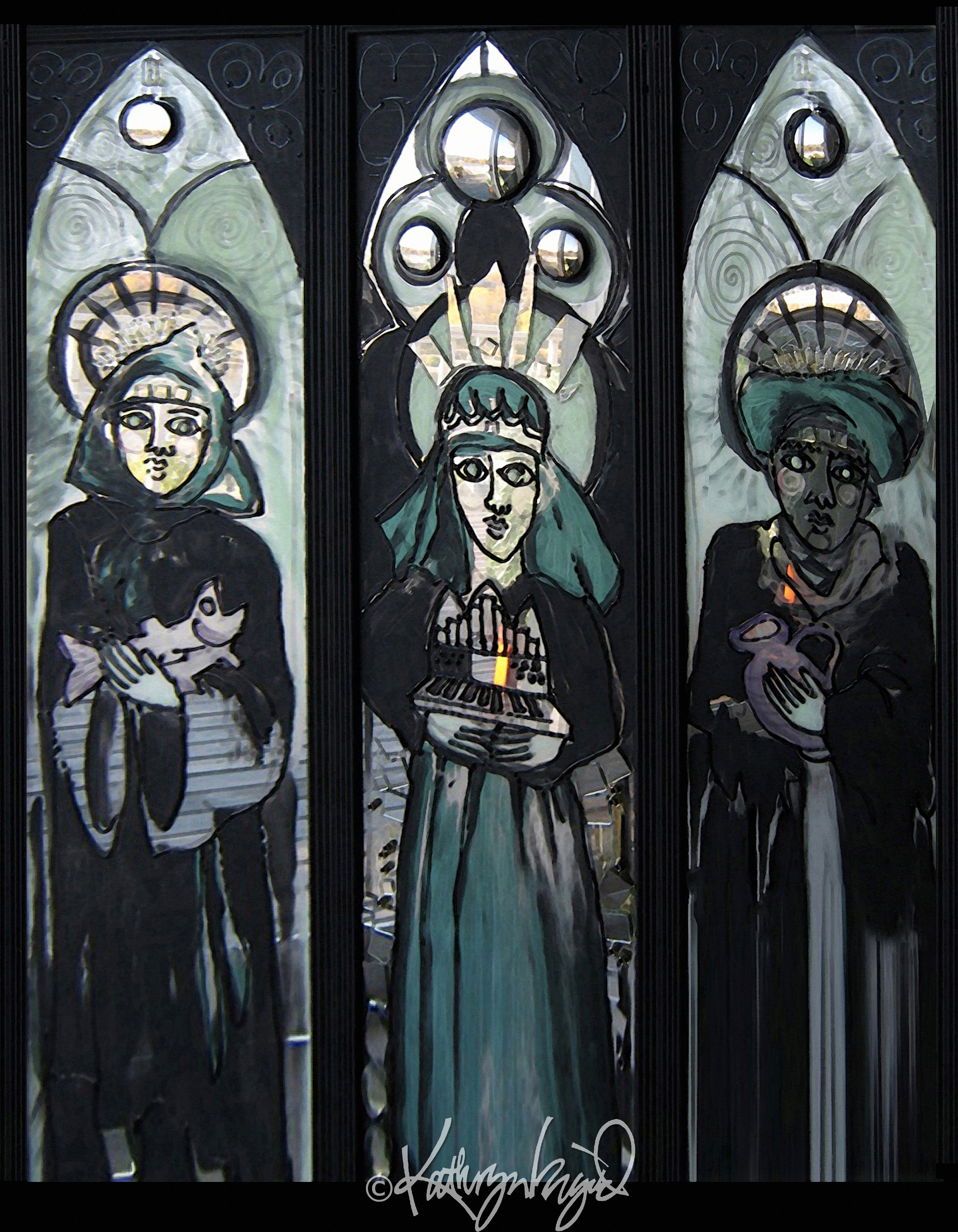
Saints Cury, Cecilia & Goar. I selected these for portraiture in this modern-medievalist piece because of very earthly interests: Cury is one of my birthday saints and famed mainly for his 'miraculous' hospitality; Cecilia is the patron of musicians (for my husband, of course) and even sometimes purported to be the inventor of the pipe organ; Goar's feast day is celebrated on our anniversary and he, sometimes portrayed as a potter, was thus also an artist. He also happens to have a lovely little town on the Rhine named after him. There *can* be perks to being a saint, even a minor one, apparently . . .

Which is why I like saints. It’s doubtful I’d really enjoy meeting them in person, to be precise: it’s the nature, the character of them, that really fascinates me. Because, as I understand it, what separates the saints from the rest of us ordinary slouches is not that they were born or made saints but that they became saints by rising above the ordinary way they began. Unlike superheroes and the majority of fairytale protagonists, it’s not often a transformation that’s accomplished by the wave of a wand or inadvertent exposure to radioactive substances, but rather is brought about by internal change and will and choice.

There is hope for me in the idea that most saints–and I gather this is true of the heroines and heroes of many significant belief systems, along with many of the major religions–start out as plain, simple, unimpressive and very mortal humans and for one reason or another are moved to do the things they do that gradually re-shape them into extraordinary beings. Some of those avatars, indeed, start out as pretty sketchy characters, if not outright jerks, despots, and other first-rank varieties of meanies. It’s the process, the journey, and the ultimate commitment to do and be something else that makes them extraordinary.

mixed media

Saint Monica could be the perfect example of overcoming obstacles--much of her sainthood was earned just through working to see that her ne'er-do-well son shaped up, the outstanding troublemaker who eventually reformed enough to become himself Saint Augustine of Hippo. Apparently her efforts did not go unrewarded . . .

Chances are beyond-excellent that I will never become a saint of any sort. But the real hope and inspiration in the lives of heroes, saints and exemplars is that nearly all of them began their lives as someone or something far less extraordinary than the way they ended them, and if so there’s always a possibility that with a little thoughtful effort I might actually improve along the way too. Don’t hold your breath, but I might just turn out slightly better than expected. Apparently, miracles do happen.

mixed media

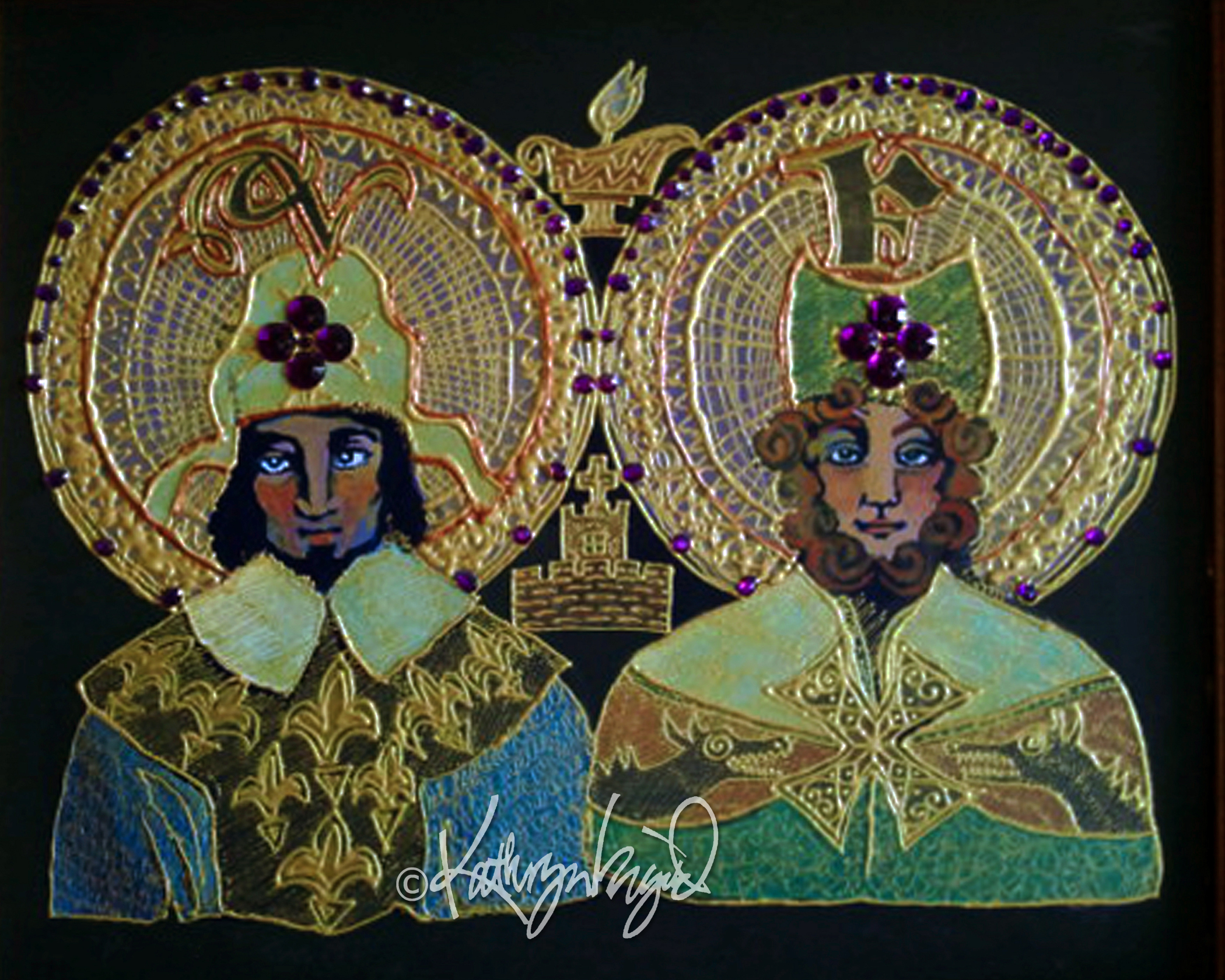
Saints Valery (a French abbot) and Finian (an Irish bishop)--hereafter known as the Feastie Boys since they're also among my birthday saints. They remind me as well that one can come from different places, times, backgrounds and any number of unique circumstances and rise beyond them all to distinctive heights . . .