Be Very Afraid. If You Really Like that Sort of Thing.

I have neither the knowhow nor the tangible resources for filmmaking, but if I did, I think my concept of the perfect horror movie subject would be the infamous occasion of Black Friday. As we Americans approach the national holiday I like the most of them all, Thanksgiving, I think with a shudder that Black Friday’s grim shadow lurks just behind it.
For if I have a tender feeling for the holiday that not only marks the anniversary of my first date with my soon-thereafter life partner and makes me immensely thankful for that gift but also marks the national celebration of gratitude in general, I have an almost antithetical feeling about the retail frenzy that follows it. The former only throws the latter into higher, less flattering relief.

I love shopping, don’t get me wrong, but I hate being told how and when to do it, and what or whom for, and to what magnificent extents. I dislike being so easily manipulated by commercial ploys and plugs as it is, and the stink of desperation mixed with hyperbolic greed on Black Friday becomes overwhelmingly off-putting to me.

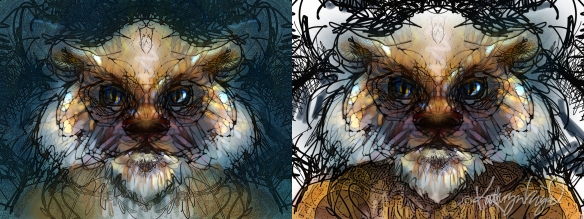
Digital illustration

What makes us turn into beasts when we get a whiff of the hunt? When a crazy sale is advertised, do I become predator or prey? Or should I just pray?!

There are obviously large numbers of people who are not only comfortable with the event but energized and entertained by the spectacle and Olympian scaled enthusiasm packed into the post-Thanksgiving shopping extravaganza. I wish them all happiness and success in it. For myself, the greatest pleasure will derive from managing as successfully as I can to not even know it’s happening and staying immersed in the afterglow of my most overtly grateful time of year. Accomplishing that will be yet another reason for me to give thanks.
If I need any diversions during my quiet hideout from Black Friday, I can always work on a script for a rollicking thriller film with plenty of retail rowdiness and gruesome greed. Coming soon to a theatre near you!

Adrift in a Skiff

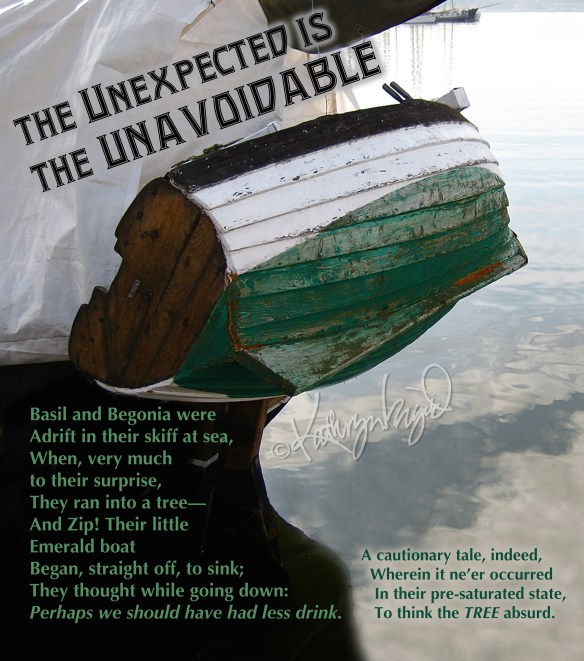
Some things simply can’t be planned, foreseen, or avoided. The impossible is surely one of those things, and I happen to know that the impossible happens amazingly often. At least, in my part of the universe.Photo + text: The Unexpected is the Unavoidable

Inexplicably Impressive

Image

Text + photo: International Intrigue

Ethereal Amours Heating Up the Interwebs

Infernally Yours

Thou mak’st me hot, O swain of mine, afire with passion, sure,

and art my furnace, blazing beau, so flaming your allure;

What is it getteth in my groove that thou hast, O my heart?

How heat I up, so quickly broiled, as roasting from the start?

Mayhap, thou sneaky Devil, thou hast dropped affection’s bomb

When I misjudged it literal and went to Match.com!Photo: Infernally Yours

It’s Not Always Bad to be All Tied Up in Knots—Beats Falling to Pieces

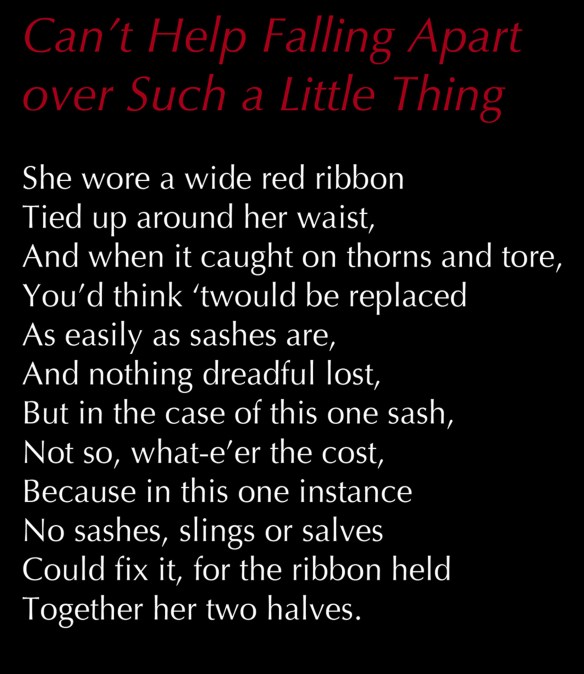
Digitally colored drawing: She Wore a Red Sash

Text: Such a Little Thing

Digital illustration: Cut Along This Line

Hot Flash Fiction 13: Eternity Beckons

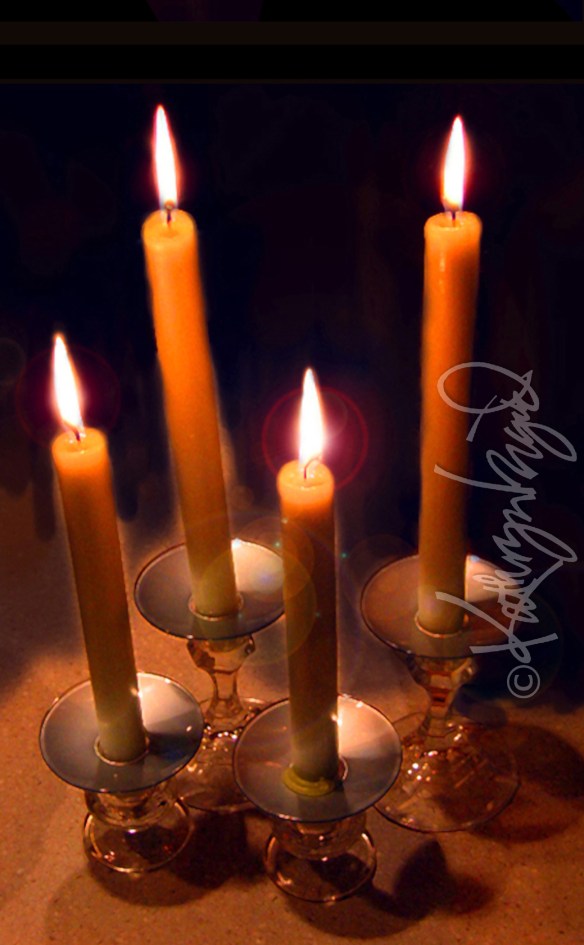
Photo: Science by CandlelightEternal life has always been the masters’ magnificent goal; no wonder that great magister and alchemist Osteodaimon was also determined to solve this elusive mystery himself, to plumb the Stygian depths of knowledge collected by the most piercing minds and intrepid souls ever to walk this dangerous earth. He began with years of reading, apprenticeship, exploration, privation, and experimentation. What Osteodaimon learned most quickly was that the process of becoming immortal was in fact incremental; it was a long series of tiny steps and grand leaps, of fallings-backward and soaring upward, all of which took him through both his long and arduous life of study and also a few strange periods of stasis, in which, all told, he began this mystical transformation of his into one truly able to transcend death. Many and terrifying were the missteps and passages, rites and elixirs, incantations, and the heart-shaking, wrenching feats of bravery and agility required of his profound intellect and the ever-disintegrating body that sought answers from that abyss.

One winter’s night, when he had traversed the grueling routes both between his birth and the ninety-two cycles of the seasons that already marked him as uniquely time-defying by his ancient era’s reckoning, and between the smoothly un-furrowed innocence of youth and his avidly acquired brilliance, he recognized in the ice crystals forming along his lashes the last increment required to complete his journey. Carrying the tinctures and potions that would preserve his last bits of mental and physical strength for the ritual, he set forth in the falling snow and moonlight to go farther into the frozen wilderness than he, or anyone, had ever plunged before. He began to notice as he went forward that the slower he moved, the faster the vastness of ice seemed to recede before him, until it was clear that his pace of progress was directly opposed by the increasingly swift passage of time. He knew that his own final breath was hardly a hairbreadth ahead of him, racing both toward him and away, and that only by letting the speed of it catch up with the glacial slowness he himself was approaching, at exactly the right juncture, and by taking the last dram of his precious medicine at exactly the same instant, could he affect the perfect circumstances for his final transformation.

Osteodaimon finally marked the spot. He lay down on the bottomless swath of blue-black ice, took the last draught of his alchemical magic into his gaunt grey mouth, and stopped. He became fused to the ice there instantly, his eyes made into a pair of wide, dull mirrors for the relentless moon and faded stars of perpetual polar night.

When he returned to himself and forced his eyes to focus again, his vision was oddly fragmented, and he sensed that he had drifted from his last stopping place far more than he had imagined he would have done. But the new place, also moonlit and cold, was pleasant enough, and he knew that soon his vision would clear and the slight buzzing in his ears would pass as he regained his strength. His sense of physical power, indeed, astonished him immediately as it returned; it was not only as though he were young again but as though he had new and exhilarating powers that would easily surpass those of his remembered early years, when he had labored so mightily in his pursuit of conquering death. This new Osteodaimon was a super-being to be reckoned with, and he took off at great speed to see what he could now accomplish in this next passage of his life.

It startled him how quickly he was able to go from place to place, how he seemed now to see things from so many new perspectives and rarely wearied of dashing about, looking, stopping to sup cold water or wine, or have a little food when he chose, but endlessly pursuing the delights of his renewed life. We cannot be sure, for history has failed to record all of the details perfectly, but it may be that it was only a matter of days, or at most weeks, before he realized that he could no longer read.

This proved a surprising disappointment that he would attempt to address soon enough. Not quite soon enough, perhaps, that he was ever able to learn the story of how, in A.D. 1867, a small group of botanists on the steppe discovered a perfectly preserved man encased in ice at the edge of a receding glacier. How the intrepid scientists chiseled their magnificent find out of his tomb in a manageable block and labored to drag it back to their fledgling university by sledge and wagon and train. How they built an ice-house museum room for the express purpose of preserving and examining this amazingly lifelike ancient man. How, one awful night in 1871, the city and that little-known museum in it were consumed by fire. How the ice-entombed mystery man had been spared cremation himself only because the conflagration had taken so long to melt his ice block that he remained weirdly, wonderfully intact, his eyes dully mirroring the moon once again.

Surely Osteodaimon could not have learned how to read again even in time to make sense of the tale that followed, of the chaos after the city’s destruction that prevented anyone from having further sightings of this miraculous time-traveler that had so clearly been the earthly form of the great magister and alchemist himself. Even if he had been able to read again, there would be no document to explain that his ultimate disappearance meant neither that he had finally ceased to exist nor that his old ideas of perpetual life being possible were entirely incorrect, for in the days and weeks immediately following the Great Fire, there was far more concern for removal of dangerous debris and rescue of injured and homeless known victims than for tidying up the remnants of an obscure museum. Had there been a witness to record it, there might have been something that Osteodaimon could hope to learn to read, something telling him that his thawed remains had rotted in the post-apocalyptic drear of an abandoned building, showing no more activity than the usual decay and natural recycling would show.

He might also, of course—had he been able to read it—thought that perhaps the early philosophers and proto-scientists were not entirely wrong but only slightly misdirected in their belief in spontaneous generation. For he would have found in the documentation of the ice-man’s progress that feeding on his mortal remains had been the usual generation or two of avid creatures that led to his emergence, eventually, as revivified carbon in the form of a blowfly. Once alive, always alive, but not, perhaps in precisely the way he had long imagined it.Digital illustration from photos: From Here to Eternity. Maybe.

Cat-astrophe

While I did borrow my sister’s cat Mercer’s image for the following tail [ahem!] of hubris and humiliation, it would be unfair to accuse him of such plebeian emotions and activities as are recorded herein, mostly since he would be tearing off at top speed if any cat other than his companion Ruffian were within spitting distance of him. I can’t say for certain whether this is because he’s far too important to be approached by mere ordinary cats or he’s absolutely petrified of all of them, but I can take a guess. His Royal Highness indeed!

Photo + text: Tom Slingshot

There’s Always Room for Silliness

The Wriggling JellybaggleDigital illustration: The Wriggling Jellybaggle

The Wriggling Jellybaggle and his relatives all laugh

at their own selves, each other, and at each faux pas and gaffe;

at funny things, ridiculous and silly things, and too,

at serious and sober stuff and fretful folk like you;

if you think you’re too dignified to snicker, laugh, and giggle,

you obviously haven’t seen a Jellybaggle wriggle;

and, furthermore, if you have failed to join the goofy gaggle

and goggle and guffaw a bit, your average Jellybaggle

would pity you, at best a fool, at worst, a stubborn stinker,

too stupid to enjoy yourself and thump your sullen thinker

with just the touch of tickling that takes the harm and haggle

out of your life, when you could be a Wriggling Jellybaggle.

A Highly Troubling Scenario

Image

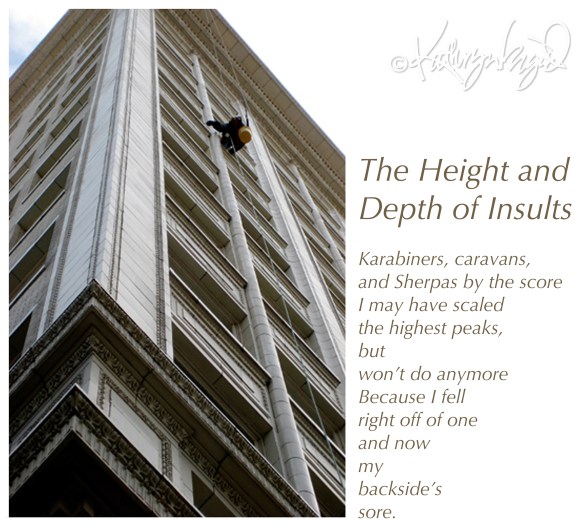
Photo: The Height and Depth of Insults

The Magic of Books

Photo montage: The Magical BookIlluminations

A leather-covered volume with its pages edged in gilt

Slipped from the deck into the sea but, cradled in the silt

Where oxygen could not intrude, nor prying eyes descry

Its ancient glimmer in the mud, a century did lie;

One century—another—no, nine centuries of dark

It passed in sleeping silence after falling from that bark.

And then one day, a ray of light passed through the waves above

Just at the perfect moment for a mermaid, as she dove,

To catch a glimpse of gilded pages in that sea-deep sun

And swim down to investigate this treasure—only one

Quick sparkle of that golden edge brought her so close to look,

To brush aside the lazy silt and so, reveal the book.

Nine hundred years in darkness had it lain in quiet wait

For just this passing moment to wake up, illuminate,

And catch the passing fancy of an unsuspecting maid

Who’d bring it to her grotto in the deepest ocean’s shade.

In dappled dark, her opal eyes lit up the page, and next,

She read it, eager, mesmerized, the calligraphic text

Transforming, leaping from the book, becoming swiftly wild

And glorious, and telling tales that moved the mermaid child

To bend with sorrow, weep with joy; to palpitate with fear;

To live the story as her own; and, as the end drew near,

To grieve that such a magic fable had to end at all,

For it had seemed so rich and real, had held her in such thrall

That she’d begun to think it true, this tale of mythic men

And women wondrous wise and brave—she turned to read again—

Thrice through, in fact, she read the tome, and every time the more

Believed its great, compelling tale of life beyond her shore.

Full hearted, then, she closed the book, but never ceased to wish

That other mermaids, other seas, and other sorts of fish

Than those she knew in her own place were, as the story’s, real,

And though once happy, now she longed to see and hear and feel

What was beyond her native coast. One day she must return

To where she’d found that magic book, and see what she could learn.

One day, indeed, an older lass, but nonetheless enthralled

By the old book (she’d read again six times, if she recalled),

She caught the rolling afternoon’s most fearsome wave and rode

Under its lashing, crashing crest to where the book was stowed

Within its silken, silty bed so long, so long ago,

And knelt down on the ocean’s floor, and watched the water’s flow,

And saw the ripples up above, a thousand fathoms high,

And wished a little inward wish that something from the sky

Up higher still would pierce the waves, would light for her one ray

Of visionary hope the way it had upon that day.

Out of the darkness streaked with kelp, the passing sea life came

To look at her, this pearly lass, but swam off just the same,

For curious though she appeared, they’d naught to give or tell

That would assuage her longing or relieve her of her spell.

For days she hovered in that place, to gaze with fading hope

And heave a soft and bubbling sigh, and comb the gentle slope

To see if some small, overlooked companion to her find

Would rise to hand and help explain; but none was left behind.

At last she turned, quite woebegone, to drift for home, undone,

Her childhood fantasies all dashed—but wait! A ray of sun,

One faded spear, had pierced the deep; it beckoned her to draw

Back to the place her book had lain, and in its light she saw,

But faintly, now, another book, this one yet older still,

And as she took it in her hand, she felt a silent thrill

Race up her spine. She sailed for home as swift as mantas fly,

Gripping her treasure to her heart, this book dropped from the sky.

There in the grotto, as before, she read with trembling care

The prologue to her favored tale, the key unlocking there

The meaning of that history and mystery so grand,

The explication of her longed for never-ever-land.

Page One of this tremendous tome opened the secret wide

And startled her to drop the book, for there she saw inside

The preface to her deepest loved tale of that mystic place

Began with an engraving of her own familiar face!

Around her portrait, mirror-like, the title read, in part,

“The Story of Our Lady-Queen, the Owner of My Heart.”

Her own heart skipped a beat or two ere she once more to read

Took up the opus in her hand, to see where it might lead—

There in the shell-lined grotto sweet, she pored over the lines

Telling her life from this day forth, as writ by kingly hand:

Who authored this spoke of his love, and how she ruled his land

Long years to come, and how, in sum, her people throve as well,

And in the book, she met her love, who had such tales to tell,

And read them through with eager joy, to see what else she’d learn,

‘Til by the end-page she loved too, and had begun to yearn

To know this King and how it came that time had backward spun

So that these books of things yet dreamed fell from the present sun.

The end-page held, as she had hoped, engraved once more, two eyes

Whose gaze made her young, beating heart in recognition rise!

She dashed outside into the swell, and ne’er looked back again,

To find that place the boat was moored, to greet the sailing men,

To follow them to distant seas where they in their bark would roam,

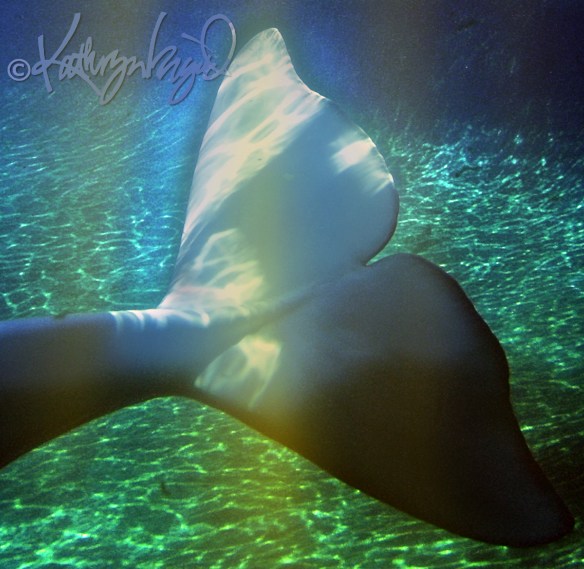
And find the heart that from its start had known she would come home.Digital illustration from a photo: The Mermaid's Tale