
If you remember anything about primary school (and I do, if little) you hopefully have a few memories of one or more of the fantastic sort of teachers who were the virtual equivalent of extra aunties and uncles and grandparents, but neatly spun into the form of educators whose wise teaching made you learn things without even knowing you’d worked at it, and want to learn things you hadn’t even known you wanted to know just because they were such fine pedagogues that they made it seem possible, if not easy.
You undoubtedly also have a memory or two of teachers who were quite the opposite. My personal least-fave was the third grade teacher who had no compunction about excoriating and humiliating a student in front of the rest of the class regardless of the infraction or any of their previous achievements or behavior, even cracking a yardstick onto desktops to make a point when she was het up, regardless of whether there might be some small knuckles in the way of the stick. At the very same time, she apparently thought it perfectly logical and beneficial to ‘level the playing field‘ and make all students feel they could accomplish something in her class, lest the PTA or school board think her not supportive and informative enough, and this she would do by sitting and doing the weakest students’ homework for them.
I knew nothing of this until one time when I was the unlucky receptacle for her ire, having failed a penmanship test in the first weeks of school because that school required students to learn cursive writing in the end of the second grade and the one in another state where I had spent my second grade did not. Had she asked us all to sing a song in Spanish, I might have been the star of the class, because my second grade teacher Mrs. Mosqueta let us learn a little elementary Spanish from one Señor Ybarra, who taught by the ultra-newfangled medium of televised classes, and I don’t think my new classmates in Illinois had yet had access to such magicks themselves. But there I was, little miss Goody Two-Shoes, who had never gotten anything but perfect scores because I was too prim and much too afraid to not do my homework to the nth degree—if I had any actual training or homework to prepare in the event—flunking my attempt to make Pretend Cursive when that mean lady in her sausage-casing dress didn’t even ask whether I’d ever been trained to write that way. If you think I still sound remarkably bitter about such a small thing from so long ago, well, I probably ought to let it go but I tend to enjoy my little revenge fantasies more than is entirely good for me. This is all in jest, of course. I wouldn’t be so cruel as to want to give any poor innocent tigers indigestion.
I give myself credit for being smarter than I am. I suspect, given what I see around me in this wild and woolly world, that I am far from alone in the practice. Even owls, a favorite symbol of wisdom, are not likely as perfectly ingenious as we imagine them, but they might still be more intelligent than the half of us.

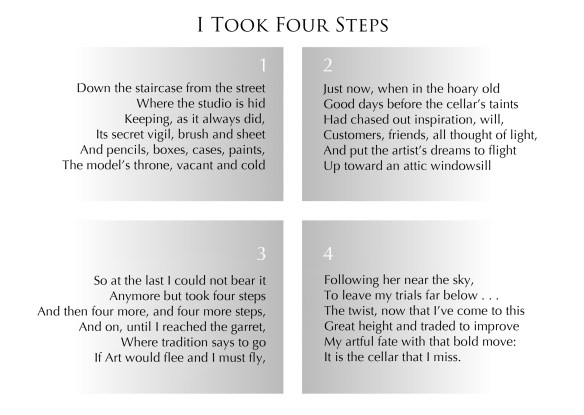
The Search Continues
Parsing paragraphs to find
The author’s complete state of mind
Is no more useful than to ask
A Word how it performs its task,
If we assume we’ve read aright
What’s only there in black and white.
The Long and the Short of It
How quickly pass the hours and days
and weeks and months and years,
And yet, how slowly pass our worries,
paranoiac fears;
This is the great conundrum that
presents in mortal time,
And quite enough of food for thought
in one quick, measly rhyme.


 So many real-world things have such fanciful names that it’s a pity we really don’t pay much attention to them very often. Magical, rollicking words and names just roll off our tongues like music, yet we fail to pause and marvel at the wonderfulness of the sounds or ideas contained therein. If we must talk and listen and cogitate, why not relish, too, the sheer flavorful euphony of the language in which we do it?
I know, even as someone who barely manages a few words and phrases in various other languages (most of these, not surprisingly, food-related), that each language has its own elements of amusement, astonishment and alchemy embedded amid the ordinary terms and concepts of everyday use.
In the vestibule is one of the most wonderful of places one can be, in my estimation; it’s not for any innate fineness or elegance or appeal the room itself may well have or that being in it might confer upon me, but rather for the arcane and esoteric quality of the very word Vestibule, which leaps from lip to tongue to tooth with alacrity and verve long since arrested in lesser words that we use too commonly. For the same reason, one should seek out Encumbrances and Perspicacity, Snapdragons and Doodling and Capybaras: no such thing as a mere dictionary can explain the depth of pleasure derived from slurping the juices of a luscious, under-exercised word.
When my family and friends were conscripted to help install the artwork for my master’s thesis exhibition, they could not help but note that it would have been a kindness on my part to specialize in something a little more manageable, say, postage stamp illustration. Hanging murals of up to nine by thirty feet in dimensions is admittedly more unwieldy than mounting a bunch of tidy little framed life-sized insect portraits or installing a series of elfin sculptures made from shirt buttons and walnut shells. Alas, though I did segue into much more portable forms in later years, it was not soon enough for my loved ones’ sakes.
My verbosity is a similar burden on my circle of acquaintance, as I am not famous for knowing when to shut up any more than I am known for limiting my opinion to those who have actually asked for it. But just as I have learned to appreciate and work at smaller and less physically demanding visual media along with my enjoyment of massive and messy kinds of art, I have a fondness for smaller and less epic essays and poems, too, and have been known to craft these with similar avidity. While scale in no way guarantees quality or lack thereof in any medium I know, it is sometimes a relief to me as much as to my friendly audiences when I get my kicks by producing petite expressions of my inventive urges.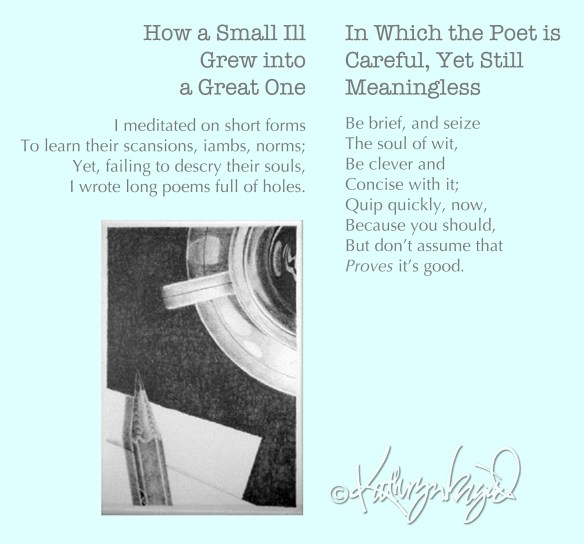
 Coming up empty? Never! Well, okay: sometimes. That’s closer to the truth. I’ve managed to put up three years’ worth of daily blog posts thus far without missing too many beats, but do I have the occasional day of blanking on what I think would be of interest for me to write about, draw or photograph, and post. Outright brilliance would be a stretch for me on the best of days, and on many, it’s just good old showing-up-and-working that gets the job done.
Pretty much the way life works everywhere, isn’t it.
I get up and brush my teeth and take a shower and get dressed, and there’s no guarantee I’ll look less like a goofy, sleepy person than I did a half hour earlier. Some days, it’s flat-out worse, especially if I have to be up before about 9:30 in the morning. But I’m still me. I’m still going on to have a day, to do my writing and picture-making, do my household tasks, go to events, whatever the calendar demands. I’m always planning to have a really good day, if at all possible.
So whatever the agenda, I choose to give it my best, pretend (if I have to) that all is swell in the world, and see if I can’t do something myself to make it as good a day as I’m wanting. We can’t all be pretty all of the time, so I like to let my imagination offer me some fun alternatives to perfection and prettiness, and then the day has a better chance of hitting the happy mark.
 Have I matured as much in three years of daily blogging as a toddler does in her first three years of life? Highly unlikely. I was, after all, already a half century old and probably set in many of my ways to a degree that could forestall any large amount of progress toward real change, or at least drag it by the ankles dramatically.
Chances are, I haven’t made a huge number of changes as a person in general during the last three years. But I can lay claim to some growth, after all.
Moving to the wholly new world of life here in Texas in 2009 certainly necessitated some change. My aging corpus may not have made the transition perfectly: being over-endowed with the internal furnace function of middle-aged hormonal fun isn’t entirely compatible with the outdoor temperature norms here, and like many transplanted citizens I’ve done some battle with the local slate of allergens new to my system.
On the positive side, what I’ve found as a blogger echoes the best of what I found in migrating from my longtime home in the Pacific Northwest to the new-to-me frontier of North Texas, an entirely different sort of northern-ness. Entering new territories, both the real and the online ones, presented the possibility of encountering insurmountable tasks and challenges, or worse yet, unfriendly natives. Of course, my being still in Texas after five years and still blogging after three tells you that none of those fears proved true. Quite the reverse, in fact, considering that I’ve had some lovely experiences in both worlds during my brief tenure here, and I’ve garnered a whole cadre of wonderful friends in both, as well.
In short, I would amend my initial statement so far as to say that anything leading to such an exponential increase in the size and variety and quality of my circle of compatriots seems to me the very best kind of growth possible. Happy blogiversary to me this week—and more importantly, from me to all of you, who have made the journey so worthwhile and still so inviting. Who knows where the next three years may take us all!
 The old expression in my title here—close cousin of ‘you could knock me over with a feather‘—is a colloquialism for great surprise. It’s also, was so many colloquial phrases are, comically colorful and exaggerated. Hyperbole and humor grow out of genuine life experiences and events. They are anchored in recognizably real sensations and situations as much as in silly imagination.
After all, when in shock, don’t I feel my knees suddenly go uncomfortably loose and slack, and go all light-headed as though not only my hat but the whole top of my head might just fly off at the slightest whiff of a breeze?
The appeal of the idiomatic phrase, regional quirks of language, colloquial expressions and other ‘decorative’ forms of description is that they can often communicate far more about the situation than mere facts can do. They share more of our personality and character and our own experience of the moment than the dry recitation of what can be scientifically charted could ever be able to convey. And they amuse and entertain, which gives much more impact to any statement than simple and bald recitation, and what has such verve is more likely to stick in the memory as well.
Also, it’s kind of hard to make a little illustrative sketch that conveys the astonishment with which an unforeseen hat-snatching or similar surprise nearly so well as one that says, Well, Blow Me Down! If you know what I mean.
I do not shy away from using superlatives. Instead of, “thank you, that would suit my taste nicely,” if someone offers me anything that pleases me I’m generally much more likely to blurt, “perfect!” even though I know perfectly well that almost nothing in this universe is in fact demonstrably perfect. Quite the contrary, I should think.
But I do get a bit tired of hearing extreme words bandied about with such frequency in less-than-worthy circumstances that they can quickly become meaningless. If I am trying to pay anyone a compliment, it would sadden me to be unable to find a single proper turn of phrase worthy of the occasion because all of the fitting terms are so watered down and hackneyed by then that whatever I say will end up sounding like sidelong sarcasm. I hear people described as geniuses often enough that it would seem my own modestly strong intellect is actually appallingly lowbrow in comparison with the general population’s much more impressive IQ average. Even calling people brilliant, unless they’re visibly beaming with phosphorescence or incandescence, is probably overdoing it; most of the time I’ll bet it’s something that a fine yet ordinary person did or said or thought in a specific instance that was brilliant, shining so brightly in part precisely because of its having appeared in the setting of its less sparkling human source. Isn’t that spectacular enough? Most of us never get to think, do or say anything wildly impressive and distinctive in our entire lives, so why not appreciate the rarity and beauty of each occurrence of such brilliance without flattening it out through excessive flattery.
“Awesome” is one of my most mourned of these half-dead words. The popular practice of calling all good things Awesome not only tends to defy the full meaning of the word as breathtaking, wildly impressive, and awe-inspiring, but makes it sound fatuous and empty to call anything genuinely deserving the title Awesome. I was reminded of this the other day when, on the drive home, I was startled to see what looked like a four-meter-tall stalk of asparagus growing in a neighbor’s front garden, right by the road. It was the flowering spike of a ‘century plant‘—a magnificent blue-leaved agave of the sort that grows to rather massive proportions in its native climates (Texas included), though only for about 1 to 3 decades rather than an actual century. The centennial reference is to the habit of this beautiful but spiny plant, in that it bears, only once in its lifetime, such an impressive tree-like stem as this that can sometimes reach eight meters in height, and when it’s reached its peak it bursts, almost frighteningly quickly, into a firework of magnificent, prehistoric looking yellow flowers, and then dies, leaf rosette and all, with the exception of whatever offshoots it has meanwhile nursed to, quite literally, supplant it.
And let me tell you, the sight of one of these beautiful monsters rocketing into bloom in my very own neighborhood is not only tremendously surprising, it is awesome. It is a rare and showy natural oddity and worthy of jaw-dropping, gasping, stomping on the brakes very suddenly, awe. So I’m here to tell you, if you weren’t already fully aware of it, that I have no hesitation about using any and every superlative I can dredge up when I think the occasion calls for it. I’ll keep trying to be more accurate and varied in my terminology so as not to denude the language of its full use. But, admittedly, I’ll keep falling down on the job like most others do. I’m not perfect, after all.
 Art-Colored Glasses