Keeping Watch with Love

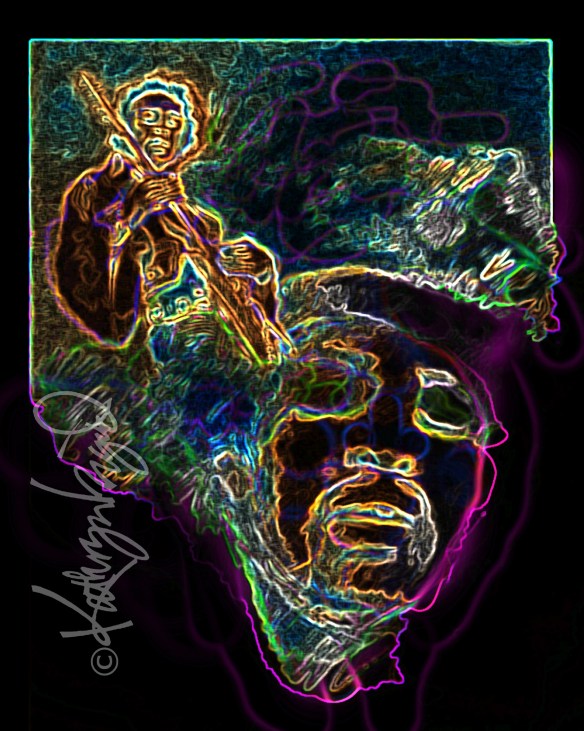
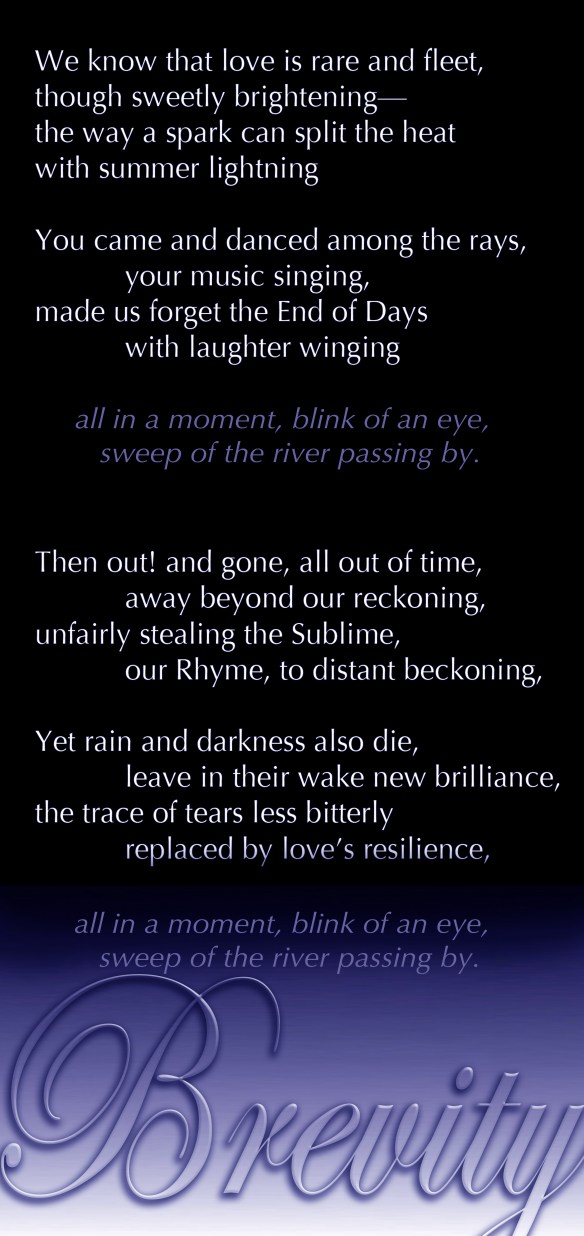
Text: BrevityJust because there are designated days (All Saints, Memorial Day, Defence Day, Anzac Day, Volkstrauertag, Poppy Day) for recalling those we’ve lost doesn’t mean in any way that we restrict our respectful, loving and admiring remembrances to those days. Those whom we hold in our hearts remain there, living or not, forever. That’s our path to peace.Digital illustration from a drawing + text: May We All Rest in Peace

The guarantee that we will die, and that all of those we hold dear will die too, means we will do best by finding ways to embrace and recall, most of all, the good and the uplifting things from their lives and ours, and expand on such things for the sake of our finest predecessors’ honor, if not our own.

Maybe They *Don’t* Make ‘Em Like They Used To…

Happy Birthday, Dad!Photo: Classic Models

Today is my father-in-law’s natal anniversary. Though I’ve no doubt he sometimes feels his age and then some, as all of us do, he remains marvelously youthful in his wit and charm in general, and like a certain favorite toy car of a somewhat similar production date (one passed around by kids in our family for many happy years), has all the more appeal, truth be told, because of all the stories behind the few dents and scratches.

Not only am I most fortunate among persons in having found life partnership with a best friend who suits me in ways I could never even have imagined, I got a fantastic package deal, his parents being from the beginning the best sort possible. I knew before I met them that they must be rather extraordinary to have produced such a dandy son who really liked, loved, and respected them, so I wasn’t all that nervous about the meeting, a fact all the more remarkable when you consider that I still struggled with a fairly extreme level of persistent anxiety at the time. I was more afraid of meeting my beloved’s then part-time housekeeper, an old-school German lady who clearly thought anyone hanging around with her adopted charge had better meet her rigorous standards. Maybe Irma paved the way to make Mom and Dad Sparks seem that much less intimidating. In any event, from that first time I met them I was quickly falling in love with them, too. In any case, it turned out that I had attached my heart not only to a great life partner but to a great life partner with great parents, who immediately became my parents along with the ones who gave me my birth.Photo: Elegance on Wheels

Our Dad S is a thoughtful, gentle, good-humored, positive person who served honorably in the Army, who with Mom S raised a pair of superb sons, who worked with computers from those early days when a single one still filled a massive, refrigerated room to when they became ever so much smaller yet far more powerful, and even trained for and had a post-“retirement” career as a Myotherapist. He continues to be curious and dedicated enough to keep taking classes, traveling, and beginning new adventures as a seasoned but lively octogenarian. He is indeed a man of a ‘certain vintage’ by now, having had many adventures and being the repository of myriad stories as a result, but never fails to have new tales to add to the inventory because his spirit is so lively.

Most of all, he has as loving and generous a heart as he always did, and makes me hope that he will have not only a lovely and fulfilling birthday celebration (or ten) for his birthday but as many more as possible. He is, after all, a classic.Photo: Classic Good Looks

Hot Flash Fiction 13: Eternity Beckons

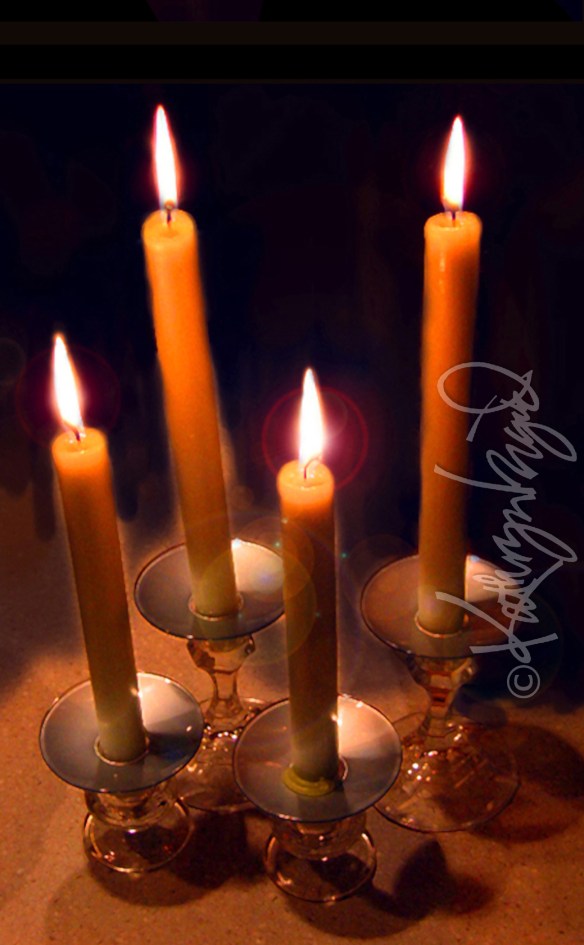
Photo: Science by CandlelightEternal life has always been the masters’ magnificent goal; no wonder that great magister and alchemist Osteodaimon was also determined to solve this elusive mystery himself, to plumb the Stygian depths of knowledge collected by the most piercing minds and intrepid souls ever to walk this dangerous earth. He began with years of reading, apprenticeship, exploration, privation, and experimentation. What Osteodaimon learned most quickly was that the process of becoming immortal was in fact incremental; it was a long series of tiny steps and grand leaps, of fallings-backward and soaring upward, all of which took him through both his long and arduous life of study and also a few strange periods of stasis, in which, all told, he began this mystical transformation of his into one truly able to transcend death. Many and terrifying were the missteps and passages, rites and elixirs, incantations, and the heart-shaking, wrenching feats of bravery and agility required of his profound intellect and the ever-disintegrating body that sought answers from that abyss.

One winter’s night, when he had traversed the grueling routes both between his birth and the ninety-two cycles of the seasons that already marked him as uniquely time-defying by his ancient era’s reckoning, and between the smoothly un-furrowed innocence of youth and his avidly acquired brilliance, he recognized in the ice crystals forming along his lashes the last increment required to complete his journey. Carrying the tinctures and potions that would preserve his last bits of mental and physical strength for the ritual, he set forth in the falling snow and moonlight to go farther into the frozen wilderness than he, or anyone, had ever plunged before. He began to notice as he went forward that the slower he moved, the faster the vastness of ice seemed to recede before him, until it was clear that his pace of progress was directly opposed by the increasingly swift passage of time. He knew that his own final breath was hardly a hairbreadth ahead of him, racing both toward him and away, and that only by letting the speed of it catch up with the glacial slowness he himself was approaching, at exactly the right juncture, and by taking the last dram of his precious medicine at exactly the same instant, could he affect the perfect circumstances for his final transformation.

Osteodaimon finally marked the spot. He lay down on the bottomless swath of blue-black ice, took the last draught of his alchemical magic into his gaunt grey mouth, and stopped. He became fused to the ice there instantly, his eyes made into a pair of wide, dull mirrors for the relentless moon and faded stars of perpetual polar night.

When he returned to himself and forced his eyes to focus again, his vision was oddly fragmented, and he sensed that he had drifted from his last stopping place far more than he had imagined he would have done. But the new place, also moonlit and cold, was pleasant enough, and he knew that soon his vision would clear and the slight buzzing in his ears would pass as he regained his strength. His sense of physical power, indeed, astonished him immediately as it returned; it was not only as though he were young again but as though he had new and exhilarating powers that would easily surpass those of his remembered early years, when he had labored so mightily in his pursuit of conquering death. This new Osteodaimon was a super-being to be reckoned with, and he took off at great speed to see what he could now accomplish in this next passage of his life.

It startled him how quickly he was able to go from place to place, how he seemed now to see things from so many new perspectives and rarely wearied of dashing about, looking, stopping to sup cold water or wine, or have a little food when he chose, but endlessly pursuing the delights of his renewed life. We cannot be sure, for history has failed to record all of the details perfectly, but it may be that it was only a matter of days, or at most weeks, before he realized that he could no longer read.

This proved a surprising disappointment that he would attempt to address soon enough. Not quite soon enough, perhaps, that he was ever able to learn the story of how, in A.D. 1867, a small group of botanists on the steppe discovered a perfectly preserved man encased in ice at the edge of a receding glacier. How the intrepid scientists chiseled their magnificent find out of his tomb in a manageable block and labored to drag it back to their fledgling university by sledge and wagon and train. How they built an ice-house museum room for the express purpose of preserving and examining this amazingly lifelike ancient man. How, one awful night in 1871, the city and that little-known museum in it were consumed by fire. How the ice-entombed mystery man had been spared cremation himself only because the conflagration had taken so long to melt his ice block that he remained weirdly, wonderfully intact, his eyes dully mirroring the moon once again.

Surely Osteodaimon could not have learned how to read again even in time to make sense of the tale that followed, of the chaos after the city’s destruction that prevented anyone from having further sightings of this miraculous time-traveler that had so clearly been the earthly form of the great magister and alchemist himself. Even if he had been able to read again, there would be no document to explain that his ultimate disappearance meant neither that he had finally ceased to exist nor that his old ideas of perpetual life being possible were entirely incorrect, for in the days and weeks immediately following the Great Fire, there was far more concern for removal of dangerous debris and rescue of injured and homeless known victims than for tidying up the remnants of an obscure museum. Had there been a witness to record it, there might have been something that Osteodaimon could hope to learn to read, something telling him that his thawed remains had rotted in the post-apocalyptic drear of an abandoned building, showing no more activity than the usual decay and natural recycling would show.

He might also, of course—had he been able to read it—thought that perhaps the early philosophers and proto-scientists were not entirely wrong but only slightly misdirected in their belief in spontaneous generation. For he would have found in the documentation of the ice-man’s progress that feeding on his mortal remains had been the usual generation or two of avid creatures that led to his emergence, eventually, as revivified carbon in the form of a blowfly. Once alive, always alive, but not, perhaps in precisely the way he had long imagined it.Digital illustration from photos: From Here to Eternity. Maybe.

Foodie Tuesday: A Balanced Diet

Photo montage: Fun with Fruit & VegetablesI appreciate good health and all of the dietary elements that can determine whether I’m healthy, and if so, just how healthy I am. I know that diet includes not only the things I eat but how I combine them, when I eat, how much I eat, and many more factors that interact to create the ever-changing state of good health I seek. I realize, too, that nutritionists and scientists and other dietary mavens are always learning new things, and nearly always getting new ideas, too, some of which they can prove and others, not so much. That doesn’t stop tons of people, including me, from becoming obsessed, however temporarily, with the latest dietary trends and tweaking our diets without always considering whether those new, however ingenious seeming, ideas have anything to do with how our own bodies operate best.

Huh.

Yeah, I’m always thinking of new and better ways to make my diet more seemingly ideal for me, and I have some goofy thoughts on the subject at the best of times, and that’s the truth. What I can say in my defense is that among the relatively few things I have managed to learn in my lifetime thus far is that there is a whole lot more involved in my health and well-being than food.

I love when I can find the balance I need in any day by eating when I’m hungry, stopping when I’m no longer hungry, and focusing on getting not only a reasonable apportionment between protein and fat and carbs and vitamins and minerals and all of that dandy stuff. I love when it’s satisfying to my taste buds as well. Most of all, I love when that’s all fitted into a balanced diet of being with loved ones, going wonderful places, learning new fun things, and not least of all, of making art. There are always going to be theories, guides, charts, Rules and expectations about what constitutes the ideal way to eat, from the old spa cures that had people eating nothing but blandness or drinking rather large quantities of vinegary-dry white wine to the FDA-approved Food Pyramid, to the various independent dietary regimes from Scarsdale to South Beach, from Paleo to the Perfect Health Diet. I’ll outlive some of them, and many more will follow me. My budget and schedule, my taste preferences of the moment, and the company I keep, will continue to change my dietary wants and needs as well.

As long as I can keep listening to music, writing and drawing, and surrounding myself with great and interesting people, I will feel well fed.

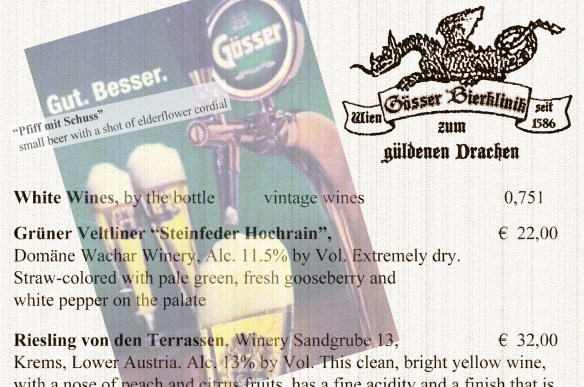
Photo montage: Another Balanced DietI need to tell you that there’s one sure way to have just the right diet, at least if you happen to be me and visiting Vienna. You just wend your way down a couple of funny little narrow byways and find the welcome that waits for you behind the door of the Gösser Bierklinik. That’s right: a clinic dedicated to beer. If that doesn’t make you feel better, you don’t know a healthy diet at all, wink-wink. Hail, Austria! It’s really a lovely old, old restaurant—don’t miss the neatly labeled Türkenkugel, the cannonball reputed to have been shot into the place in 1683 and still enjoying the pride of place where it sticks out of, or into, the wall.Digital illustration: Bierklinik Highlights

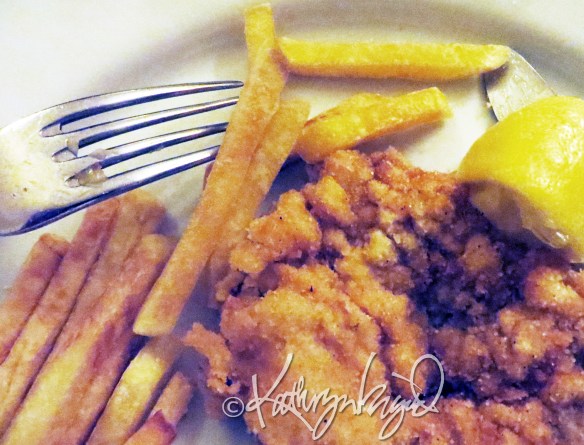
But don’t get hung up on ancient history too much, or you will miss out on one of the best Wienerschnitzeln I’ve had anywhere, and I am a fan, so I’ve enjoyed a few. The Bierklinik’s is tender inside, lightly seasoned, crispy on the outside, and unadulterated with anything other than the requisite lemon wedge for squeezing a drop or two of extra sunshine on it. Fabulous. Combine that with some ordinary but blazing hot fries and a bracing drink of anything from water to the titular beer, to what our server assured me was the ‘ladylike’ way to have a beer, a Pfiff mit Schuss, or beer spiked with elderflower cordial—I can’t speak to the waiter’s assertion, not being so incredibly ladylike myself, but it was a light and sprightly accompaniment to the Schnitzel, and given the perfectly convivial group with whom we were dining on the evening I tried it out (my husband and I were with three delightful friends, but also joined eventually in conversation with the marvelous German couple and his parents who were sitting at the next table), it was no more, and no less, effervescent than the conversation. Schnitzel, fries, a good drink and excellent company. Sounds like a perfectly balanced diet to me!Photo: Gösser's Schnitzel


Don’t Pass Me; I’m Going as Fast as I Can!

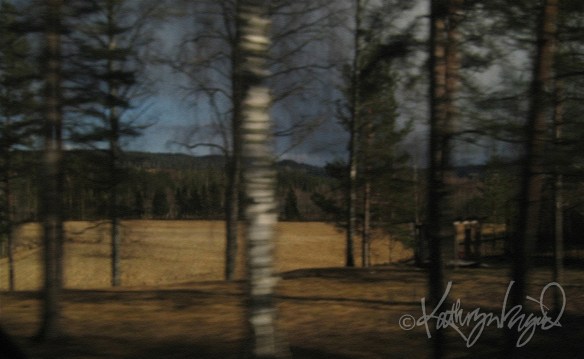
Photo: Seen from a  TrainHigh Speed Chase

The world, my friends, is a fleeting thing, and life, swift passing by

Like silent film outside the train, blurred trees against the sky

And birds, small flecks, shot from the grass to pepper clouds with black,

Yet nothing would I change a whit to veer from on this track;

If hurtling time should slow its pace in this great journey’s run,

There’d be no more such tales to tell, no news under the sun,

No destinations to explore, adventures to be had,

And not one bit of joy that’s new, and wouldn’t that be sad!

So I’ll hang on and buckle up, and hope what’s speeding past

Won’t leave me in a cloud of dust. I’ll get there, too, at last.

I am Ancient History

I know, I know. You already knew that.

But I’m thinking just now of how little I fit into the here and now.

There’s so much that was part of my everyday milieu right up to today that Those Young People I see around now have never even heard of, unless they’re youthful fans of archaeology. Stuff that I thought was hip and cool and fabulous is not only dated, it’s just plain unknown anymore.

I think I might be a science project. It’s just possible that I am being studied by aliens, or at least by the vast numbers of people so much smarter and also younger than me. And they are doomed to be disappointed. Those who study me and my life will plumb the depths of my personal history, kicking up heaps of mouldering dust and struggling with seemingly endless minutiae that could lead to important and fascinating factoids about existentially important stuff, or at least about me, only to wash up, time and again, on an equally dim and arid shore of obsolescence and insignificance.

It’s not that I mind, really. I assume this must be the case, in fact, for most people of every generation. Most of us must feel something like this, whether it’s true or not. We’ll all find there’s a great deal that’s very quickly forgotten as soon as we’ve lived it. If anyone ever delves into my little history, there will be a whole lot that looks, yes, alien to them in its unfamiliar antiquity, even if it is rather recently past in real time. I may not be at the peak of what was hip and cool and fabulous any more than I once was, but I can pretty well rock the role of living dinosaur.

Digital illustration: Artifacts

I am the sole artifact in my own little segment of history.

While I was Sleeping (It Off)…

I’ve only twice thus far in my happy, healthy life been under anesthesia, at least when I was old enough to remember it. The first was during college, when I had my third molars removed, an act that I consider was more about wisdom on my part than on the molars’, despite their being commonly named “wisdom teeth”. It was good preventive medicine in my case, being the only invasive procedure I’ve ever had to have a dentist do and as a bonus, keeping me from getting them infected or impacted or, quelle horreur!, having them come in by shoving my naturally straight other teeth askew. I must have had a terrific anesthesiologist, because I don’t remember any particular suffering during or after the event, other than an unpleasant reaction to the first and only pain pill I took upon waking, and I was well enough after a day of devoted ice-packing by my mom to venture out to the mall the next day with the family, and dine comfortably on crisp green salad and toast.

The second time was when I underwent that happy coming-of-age ritual, the half-century tune-up of my chassis when I was given what felt like a really delightful extra night’s sleep so as to while away the time during which I had my colonoscopy. I, unlike other people, have no interest whatsoever in watching myself on TV in the process of receiving medical attention of any sort. Despite that potential glamor and entertainment of that approach, I felt myself cheerily fortunate in having a splendid nap instead, not to mention getting the desired clean bill of health in the bargain.

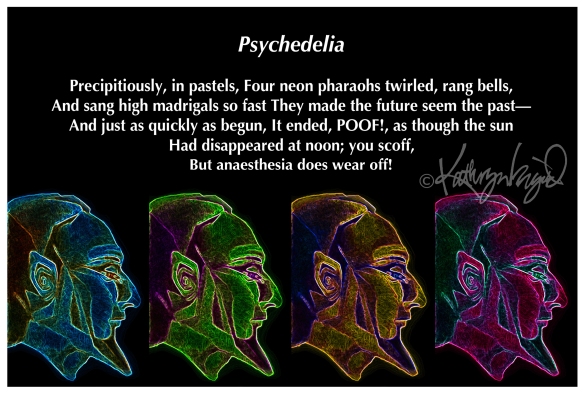
Though I’ve had limited personal experience with going under anesthetic, I certainly know plenty of people who’ve had all sorts of adventures with it, both good and bad. And I am all the more pleased, on knowing some of the tales of hallucinatory glory, that I have nothing to show for my own such trips but a gleaming set of straight choppers in my healthy jaws and an equally pristine stretch of plumbing in my abdominal regions. And I plan to have no further need of being anesthetized any time again soon, pretty please. Though I truly appreciate good medicine, I appreciate even more not needing any.Digital illustration + text: Psychedelia

Here’s News: Shoes Lose

It’s probably nigh unto heretical to say so, but despite my stereotypical feminine admiration for shoes and my not-so-secret desire to own a zillion pairs of pretty ones, I seldom bend so far as to wear any that aren’t mighty comfortable in real life. Why, I have been known to fall right off of them and skin my precious knees whenever there was a handy hole in the pavement to snag my heel in for such purposes. But I hate pain, even the relatively minor pain of standing upright in high heels, so I really don’t often put myself in such danger.

In a similar vein, at times I am willing to go so far as to put on a little eyeliner, or suck in my gut to get a too-tight waistband to zip, or even give myself a semi-polished pedicure when I’m wearing sandals, but if time is pressed or I’m not in the mood, I’ll certainly never be bothered with such efforts. I feel more than a little ridiculous when I’m dolled up very far, and mostly I’m much too cheap and lazy and, well, un-girly, I guess, to enjoy the process, the expense or the artificiality of being ultra-feminine. Plus, there’s the risk of the people who know me best having a heart attack if I go all ruffly and spangly on ’em. That would just be mean and selfish on my part.Drawing + text: Shoes Lose

To Whom Much is Given

For unto whomsoever much is given, of him shall much be required.

That’s a passage from Christian scripture, but it’s a precept that I’ve read, heard and seen in the texts and teachings of other religions, and it’s commonly enough reflected in social policy and proposals for humane and ethical action in all sorts of places that it deserves more general notice and attention, I think. There seems to be an underlying assumption amongst many people of all kinds and cultures that if one of us has more than another and that other is in need, one ought to take some responsibility for her neighbor’s well-being and share the resources. It’s arguably a foundational principle of civility and hospitality everywhere.

Yet it’s practiced so much less often than is possible. For all of my love of time with friends and family, I also crave quiet and reclusive time, shutting out the world and curling into my own self, and that applies to all parts of my life. And I think that’s probably more common than not. Who does not prefer the company of her own self or her very small circle of kin and kind, especially when the workaday world has seemed particularly demanding and rest and retreat as hard to come by as clear water in the swamp? Who doesn’t covet the privileges she feels she’s chosen and earned for herself?

I was reminded of this particularly when we were in Hungary this summer and I had the privilege of going with a number of the touring choir members and my husband to visit the ancestral home of a hereditary Count and his wife the Countess. The Count himself made only a brief appearance at the end of our visit, his wife having participated with staff and supporters in the greeting of our group, speechmaking about their work with orphans and special needs children in the family-sponsored home on the grounds of the residence, and a small but lovely reception in the main public-room of the place, a large parlor filled with art and artifacts passed down through the lineage. The Count was charming and rather cheery when he did appear, but I sensed that he preferred his privacy as well.

The Countess, on the other hand, had a rather regal bearing and while she was generous in hosting us and very willing to share her home and thoughts with the group, I heard some quiet comments aside that she seemed a touch condescending or even a bit put out by our visit. I had been at the back of the room during her parlor commentary about the family history and the work of the orphanage, not able to see her over the number of people in the room, and her tone was very subdued, so I got the gist of the story, but didn’t see any of the expressions that might have influenced the commenters.

What I did hear was probably a fairly common tale among the nobility in Europe during the previous centuries: a privileged kinship, whether by their own efforts or honors conferred upon them by royalty, this family had done as they were both able and expected to do with their wealth, which was to live quite elegantly and surround themselves with art and beautiful landscaping and magnificent homes. At the same time, they saw themselves very much as caretakers of the larger community, responsible for the well-being not only of the people who staffed their private holdings but those living in proximity as well. This is of course the story of noblesse oblige, a practice of good that may have been at its core a defensive move but served the purpose in any event. Like many noble families, the one we visited had essentially founded a town around themselves over the generations, supporting educational or healthcare or other needed resources and, in this instance, building a magnificent basilica where the town could worship and where, not coincidentally, the touring choir were performing on the evening of our visit in a benefit concert for the children’s home.

Also like so many other noble families, this one had gradually seen its fortunes decline in the years between the World Wars, and on advent of German action in the region in World War II, was ousted from their land and holdings and fled for safer places. Their palatial home first became military headquarters during that war (in which the Hungarians quickly and brutally learned that their alliance with Germany was a general pretext for annexation and Nazi rule), and then was used for Communist offices in the years after. It wasn’t until just a few decades ago that the Count and Countess were able to return to his family property and renew their residence in the place. The good news was that there had been no interest on the occupying military’s part in redesigning the buildings, nor any money for the Communists to do so, so the architecture remained for the most part intact. The bad news was born of the same circumstances, though: the military’s disinterest in redesign and the Communists’ lack of funds extended to any concern for maintenance. Naturally, the park in which the palace stood, the palace and outbuildings all fell into a state that even in their heyday the real owners could probably have scarce afforded to mend, and it all added to the sorrow that the art and fabulous book collections had been heavily looted.

This is a long way of saying so, but on the day we visited there, I stayed after the others had left that once-elegant parlor, pausing to thank the Countess and to ask her a couple of questions about what I understood were the Count’s and her attempts to resurrect some of the property, if only for the appreciation of the locals and the young wards and their caregivers now living in closer quarters with these two owners. Her tone, perhaps because she was no longer addressing a whole roomful of people, or maybe because she felt she didn’t have to represent her husband’s whole heritage anymore, not acting in any official capacity at the moment, softened greatly, and I sensed mostly melancholy. There was sorrow for what had been lost, yes, but after we spoke about that and the enormity of the restoration needs for a moment or two, I simply asked her in the middle of that once-glamorous hall if she had a personal favorite artwork in there.

It was almost as if she became for a moment the young bride who had come there with the Count before the war, a little in awe of his family and the wealth that surrounded them, the power and the weight of the name upon her shoulders seeming rather immense even in the midst of her happiness. I can’t say she became suddenly shy, though it seemed to me that there was the slightest hint of it as she walked across the room and, instead of choosing one of the showy ancestral treasures or superb museum-quality portraits but this moderate-sized, unrestored and slightly bleary, painting of peasant girls dancing around in an Impressionistic meadow, and said simply, “This one.” I asked her what made it so, and she did little more than offer a soft comment that it was pretty and it made her happy.

Digital artwork from a photo: The Countess's Favorite

This is my digitally painted version of the Countess’s beloved artwork, which besides being in great need of restoration was under glass and hard to see without much maneuvering. But even in its retouched state here, I think you can catch a glimpse of what filled her with such longing: a sense of sweetly carefree innocence that must seem now like a distant, faded dream.

And I thought that perhaps what had been asked of her, she who had had quite a lot at one time and might even be seen in town nowadays as a bit of a remnant of things past, was her innocence. It must have been a long, sorrowful journey from being a young lady inducted into the nobility by marriage and impressed, if not overwhelmed, by the lavish life and the heavy weight of what was expected of her in her new role, to the life she knows now. However she and her husband might work to regain a place in the community through their labor and largesse, the world has changed, and they with it.

What must it have been like, as she moved through the war and later years in exile, knowing that everything tangible she had known at home might well be gone? On returning long after, though she saw that it wasn’t demolished, her happy ease was clearly broken and irretrievably changed. Finally, settling into her new role as figurehead of a still somewhat nebulous but ambitious attempt to find a way to make all that was left have real meaning again, looking into that painting must have become rather like looking into a mirror at her past self, not as a dancing peasant girl but as a naïf who thought the world was simple and clean and kindly and that all she had to do was make the best of what had been given to her in order to be happy in it.
But What of the Camel?

Ha! Once again, I seem to have failed to press the Publish button yesterday. I just noticed that this post was still queued up and not yet available on the blog, so I guess it’s a two-fer day today. Appropriately enough, it’s a post on my natural gift for failing to blend in with the herd. Make of that what you will!Digital illustration: Camel CompanionI think I may have mentioned before that there is a ranch only a short distance from where I live that raises bison, a herd whose distinctive companion is a camel. When my spouse and I were out on a little expedition in the area recently, the bison were even nearer the road than usual, and to my delight there were among them many calves of the season. We are generations away from the time when bison covered the American plains in masses that blackened the grasslands from one edge of the horizon to another, so it’s a pleasure to see even modest groups of them thriving and growing as they do in protected places like this one anymore.

But where was the camel?

It’s possible that the two times we passed the pasture that day, the camel was on its dromedary coffee break in some less visible spot toward the back of the fields. Maybe there is more to the bison herd than I know, and the camel was on duty, keeping the other bovine bunch company elsewhere. A little part of me couldn’t help but puzzle and worry over it, though. Camels can grow old and die like the rest of us, I assume. What a pity if this one camel should have died. I would be sad if I knew that to be the case.

It’s surprising, perhaps, that I find myself thinking about a camel and wondering about its welfare. It’s only partly made clearer by recognizing the seeming strangeness of a camel being at home in north Texas in the first place and the further oddity of said camel being companion and guardian to a herd of American buffalo.

Then again, not so surprising. I am, after all, something like a cousin to this unique camel. As a native Northwesterner who has always lived well north of the Mason-Dixon Line until moving to Texas five years ago, I am by definition a foreign body, an alien, in Texas, no matter how at home I find myself among the locals. As the perpetual listener at the back of  choir rehearsals, unable to make my vocal folds cooperate dependably enough to sing along, I am affiliated with the herd in a way that is very meaningful to me and that I take seriously not only as a source of pleasure but as support for my singing, conducting, and accompanying friends, but I am still not a part of the herd myself.

So it matters to me to know that all is well with that mysterious and slightly humorously incongruous camel. And I’ll keep you posted on the bison-loving camel that is me.