Blowing through the Wild Grasses

Weed or wildflower? Messy or naturalized? Everyone has an opinion, and they often differ distinctly on the same little plant or plot. Part of the pleasure of good company will always be in its variety and the interest that it brings to life. Gardening tastes are very much in that vein.

Digital illustration: Wild Grasses

As a sometime gardener, however amateur, I can think of few styles of landscaping that I don’t find appealing and attractive in their own ways. I admire the near-perfection of elaborate, formal palace gardens and magnificent, fountain-filled parks with their follies and allees. I am fond of a rustic campfire-side bramble patch, punctuated by straggly hydrangeas run wild, down by the lakeside. There is both soul refreshment and eye appeal for me in a delicate Zen garden with bonsai, laceleaf maples and a barely rippling koi pond.

When it comes to my own gardens, I tend to walk just a little farther on the wild side. I hate to fiddle and fuss at length with the hard labor of a garden. I greatly prefer the genteel pleasures of the design of the garden, and perhaps the occasional artistic pruning to shape a rhododendron or sapling tree. But I’m not so wild about back-breaking rock picking and digging; I moved from incredibly rich but equally rocky volcanic glacial till of western Washington to the cement-like red clay of Texas, both places where putting a one-gallon root ball into the ground requires a pickaxe.

My first garden was an exploration of the beauties of cottage style gardening. Washington, temperate and moist, was ideal for a grand assortment of bulbs, flowering shrubs and cutting flowers, so I had profuse blooms and constant green with little effort. The traditional cottage style allowed me to squeeze a massive amount of lively growth into a normal city house lot, and the more I wedged into the ground, the less room there was for volunteer and invasive plants. Weeds had a tough go of it there, so it wasn’t especially hard to keep ahead of them.

There are plants I don’t invite to my parties. Much as I enjoy and admire most, I’m no friend of those pest plants that choke out others, cause massive allergies, or stab at me with cruel thorns, or those that threaten entire ecosystems, mine or others’. Good riddance to misplaced English Ivy, kudzu, poison oak and wild blackberry canes. Conversely, one of my particular favorite garden options is to find ways to encourage native plants to thrive. The more a plant is suited and accustomed to its environs, the more it will grow and be healthy and attractive and weed-proof.

Texas has reinforced that love in my aggressively. It’s a harsher climate than the Pacific Northwest’s in which I now garden, so what I plant and tend must needs be up to surviving and flourishing in those more demanding circumstances—or die. Even desert plants don’t necessarily have what it takes, since north Texas can still get true freezes in winter, and occasional snow, hail and ice. This last winter, a relatively mild one, still killed off a lot of specimen agaves and prickly pears and even cut some mighty oaks down to size.

I’m finding that the area’s status as an extension of the country’s central prairies may be the key to what will survive and grow here long term. When anything will grow, that is. I’m tending to my little wildflower meadow out back, to see if I can’t reintroduce something a little more self-sustaining than those long cultivated but seldom successful hard turf lawns that were popular in our area and surrounded our house when we bought it. Even better than the wildflowers, I’m finding, will be the ‘amber waves of grain’ I seeded in  among the wildflowers, the native prairie grasses.

Prairie grasses have some of the deepest, toughest and most tenacious root systems of any type of plants, and along with the leaves that sway in every breeze, often creating symphonies of susurration, they go to seed in many attractive ways. So I really am enjoying ‘sowing my wild oats.’ And Little Bluestem, Fountain Grass, Weeping Lovegrass, and many more. My backyard creatures will enjoy them, and their varicolored, many-textured attractions will beat any struggling, forced lawn that ever tried to eke out a living where its native cousins once roamed free.

We were So Civilized

Digital collage: We were So CivilizedNo matter where I am on the Fourth of July I am likely to think about the country in which I was born and have lived all of my life thus far: the United States of America. The Fourth is the official birthday of the nation, though many of the current states joined the union long, long after that July in 1776 when it was established by its founders. Like so many nations around the world, this country and its history are a tremendously complicated and varied patchwork of fact and fiction, hope and fear, two steps forward and one step back. Over and over and over again.

Imagine this: a pack of refugees from religious persecution left their homeland and sailed into the unknown across an ocean of which they also knew very little except that their passage across it was dangerous and miserable and killed plenty of them before they hit the new shore. When they landed, to their surprise there were already plenty of other people living on that new turf, and did that stop the interlopers from moving in, too? Of course not. I don’t expect it ever occurred to them, to be honest, that there wasn’t room for everybody or that if they took a ton of the resources around them that might just mean there were fewer for the previous residents of the land, folk who had, indeed, already long established a very different relationship with the continent.

That the illnesses and diseases the newcomers brought with them from Home would endanger and kill many of their new unwitting and unwilling neighbors could never have entered these interlopers’ minds, when they were so preoccupied with not only their current survival but their escape from the hardships and sorrows back in their own homeland. That they themselves would suffer privation, fear, danger, loneliness, and the loss of their lifetime homes, belongings, families and friends across the vast ocean they had crossed was a stark enough reality that perhaps they willed themselves not to think too hard about all that they faced next also affecting the long-tenured native peoples across whose lands they moved like human bulldozers.

The establishment of this new home was far from smooth and easy too, as anyone could probably guess, though I wonder if any of them really considered that the goal as much as simple escape from what they’d known before. Still, none of those inhabitants of North America—invaders or original denizens—could possibly imagine at the time, I suspect, quite how vast the whole continent was and what that meant in terms of creating new colonies within it, let alone new nations. In the years that followed, the westward migration confirmed the existence of innumerable tribes and clans of people not before known to the new arrivals, but also of wild creatures unimagined, of terrain unlike any they had dreamed possible, of climates that had been the stuff of legend until then.

In those many decades of carving out new paths and territories, it was inevitable that, just as it had been with the foregoing generations of various indigenous peoples, there would be struggles over who had access to what, who could live where, and who belonged together with or as far as possible away from whom. No surprise that this led not only to separated towns and enclaves and ethnic, religious, political or philosophical communities but also, in turn, to a wild array of accents and ideas that might as well have been different languages and different species altogether.

Amazing that all of this could remotely possibly coalesce into what is known as the United States of America. Today’s states are still so diverse, even sometimes from county to county or one side of the railroad tracks to another, that it’s nearly laughable to call them United. We fight like pesky siblings with each other all the time; it’s a miracle, in my book, that the so-called Civil War, one of the most uncivilized events in the country’s history, hasn’t simply continued from its beginning to the present day. It does, perhaps, at subtler levels. Just because the invasion of the continent by a bunch of frightened Pilgrims who only thought themselves seeking freedom from tyranny didn’t destroy the whole land and kill every one of them off outright, and because the various internal skirmishes that led to, but were far from limited to, the Civil War didn’t complete that annihilation doesn’t mean we’re not still perfectly capable of incredible incivility at every turn. We try, we fail.

On the Fourth of July, I think of how astounding and—generally—good it is that this messy nation has managed to survive this long without self-destructing. But I can’t help also thinking this of most of the rest of the world. Humans just plain are messy. We form and break alliances; we argue over being Right instead of being compassionate or practical, let alone pursuing justice. We blunder around, hog resources, ascribe privileges and powers to ourselves and our chosen comrades that we willfully deny others, or just pretend the others don’t exist, and thanks to our weirdly, wonderfully diverse array of accents, when we do get around to discussing the least of these things, even those who ostensibly share a language can’t understand each other half of the time anyhow.

Just possibly, our life form may have been civilized at a few choice moments. There is plenty of potential in this odd species of ours, I like to think. Even we Americans aren’t entirely irredeemable; we keep bothering and beating up on each other like so many brothers and sisters, and yet most of us still manage eventually to just agree to disagree and, in moments of precious lucidity, even to see each other’s point of view and operate in an environment of respect and hope. As rotten as we can be to each other, we care enough to wrestle it out and try to find ways to go forward. Together, even. If that isn’t a family worth saving, I guess I don’t know what one is. Happy birthday, USA. Go forth and get a little more civilized, if you can.

Spaceships, Time Machines, Bicycles

Photo: One for the RoadWhen I think about it, I’m amazed at how many modes of transport exist. Contrary to the fantasies popular in the middle of the past century, we’re not all traveling in levitating cars and being atomized and reassembled on opposite sides of the world. But it’s still fiction-worthy stuff that emerges when I realize we’re within reach of fully self-driven cars and can already travel at light speed, drive under the sea, and fly to the moon and, yes—more importantly—back again.

Fiction, however, has always outstripped real-world progress, as well it should. If we don’t imagine it first, how can we build it? If we didn’t travel thus in dreams, what chance would there be of our ever doing so in life?

I have invented an item or two in my time, but my ingenious machinations have never yet been realized in concrete form, at least those unrelated to my art. Still, I hold dear the idea that ideation is the necessary precedent of exciting discoveries and meaningful inventions. As silly as they may seem, then, I’m unlikely to quit developing my odd creations of the imaginary sort.

Who knows what journeys might someday spring from them?Digital illustration from photos: Time Machines

From the Highest Towers

Digital illustration from a watercolor: Summer Stained GlassRinging In

Every time I hear them, I remember that first morning,

That moment in a narrow street when brightly, without warning,

The bells loosened their tongues to sing and raised their clarion voices

In that wild hymnody of joy at which my heart rejoices,

And now, wherever I may be, whatever is the weather

Or the occasion driving me, those voices joined together

Stop me, and make me raise my eyes while all the bells are ringing,

And search the gladness of the skies where Carillon is singing.Digital illustration from a watercolor: Springtime Stained Glass

Eating Thistles

Photo: The Big ThistleCardoons and artichokes are every bit as admirable as their strictly-for-visual-admiration wild growing thistle cousins. But as any avid eater should know, the aforementioned relatives are terrific dining companions as well as being attractive plants. Sure, I love the silvery magnificence of a shapely cardoon leaf accenting the garden border, but if I can admire its beauty and then eat it as well isn’t that just so much the better?Digital illustration from a photo: Antique Artichoke

And artichokes, well, we all know those are as worthy of battling past their thorny armor as it was ever worth storming a castle’s battlements and portcullises to get to the treasury inside.Digital illustration from a photo: Artichoke Arrangement

The wonderful earthiness of the artichoke is an outstanding companion to the similarly strong-yet-subtle virtues of asparagus, mushrooms or root vegetables. All of these, in turn, play nicely with the denser, meatier varieties of fish—roasted monkfish or grilled salmon, for example—or a roast or stew of wild game, if one has access to, say, boar or venison. Or, if meat or fish is simply not right for the moment, some boiled, steamed or poached eggs.

How about this for a tasty Collage of Earthy Vegetables:

Blanch some cleaned asparagus, small to medium-sized artichokes, halved and trimmed, and russet potatoes, skin on and cut into modest wedges. When they’re all blanched, stem and clean some Portobello mushrooms, toss everything with a little avocado oil, kosher salt & cracked black pepper, and grill or roast until tender.

Serve with any or all of the following as a finger food, small-plate meal or as a side to the main entree (fish or meat or eggs):

Toasted hazelnuts, small wedges of Manchego or Parmigiano-Reggiano cheese, brown butter Hollandaise, and/or rosemary sherried green olives.

This compilation seems to me almost a vegetable representation of terroir. At the least, it’s very down to earth!

Communal Keeping

Digital Collage: What Light is ThisWhat Light

What gleaming and pellucid light is this

That dances from the darkness into view,

As gently kind and tender as a kiss,

Drawing the violet warmth out of the blue—

What is this gracious, guiding, welcome light

That, numinous, its blessing shines on me

And bids me then, so warmed and kindled bright,

In turn to shine? ‘Tis Hospitality.

What, then, the lantern lighted as we part

To guide and keep us as we wander on,

No longer cold and dark as at the start,

Though time find us all yet asunder, gone—

What is the lamp that makes each soul a sun

And lights the path to gather us anew

From ends of earth, that beckons everyone

Back home? It’s Love that lights the whole way through.

There’s comfort in the midst of darkest night

Where Love and Hospitality alight.

Well, Blow Me Down!

Digital illustration: Blow Me Down!The old expression in my title here—close cousin of ‘you could knock me over with a feather‘—is a colloquialism for great surprise. It’s also, was so many colloquial phrases are, comically colorful and exaggerated. Hyperbole and humor grow out of genuine life experiences and events. They are anchored in recognizably real sensations and situations as much as in silly imagination.

After all, when in shock, don’t I feel my knees suddenly go uncomfortably loose and slack, and go all light-headed as though not only my hat but the whole top of my head might just fly off at the slightest whiff of a breeze?

The appeal of the idiomatic phrase, regional quirks of language, colloquial expressions and other ‘decorative’ forms of description is that they can often communicate far more about the situation than mere facts can do. They share more of our personality and character and our own experience of the moment than the dry recitation of what can be scientifically charted could ever be able to convey. And they amuse and entertain, which gives much more impact to any statement than simple and bald recitation, and what has such verve is more likely to stick in the memory as well.

Also, it’s kind of hard to make a little illustrative sketch that conveys the astonishment with which an unforeseen hat-snatching or similar surprise nearly so well as one that says, Well, Blow Me Down! If you know what I mean.

Keeping My Eyes Open

Let’s not quibble about why I’m here; just show some respect for my dedication. I keep watch, I am the guardian, I stand undaunted at attention. I am a tireless protector. Never mind that I’m protecting what I hope might be my lunch, or at the least, my plaything for the while. I am a cat, and that is what the best of us cats do. It is nature and vocation.Digital illustration: In the Catbird Seat

The mouse living in there, well, he might have a slightly different point of view. But let’s be honest: his place in the natural scheme of things is as a cat’s toy or treat, isn’t it just. So I shall perch here and keep my patience, and never you mind criticizing my ways. That would be too—well, human of you. And you didn’t want to share your house with a mouse, now, did you! Just look away. I’m busy here.

Meeting the New Kid

Did you know that there are creatures you didn’t know you knew? Of course you knew it. After all, there’s the whole race of super-characters, multiple species like the Yeti and the Loch Ness Monster, Dracula and Tinkerbell, Wonder Woman and Wolverine peopling our universe, or at least some parallel ones, so we’re pretty well surrounded by fantastic fellow creatures if we’re willing and able to recognize them.
Digital illustration: Bumblesaurus

I think that perhaps part of the reason I’ve so long loved living so deeply in my imagination is that, having the social anxiety I’ve always dealt with when it comes to human-type people, I find I’m fond of fictional company and its many quirks and quizzical qualities. Not that I would necessarily be more masterful or even less shy in the midst of make-believe characters: I’m perfectly capable of being intimidated by the magnificence of pretend persons or frightened by the nastiness of the wicked ones just as easily as by real folk.

So you’ll forgive me if, despite his appearance of being slow-moving, benign, and perhaps a touch dim-witted yet perfectly friendly, I take my time getting to know the Bumblesaurus. He just wandered into the backyard when I wasn’t looking and made himself at home under a mulberry seedling. Yes, you got that right: he’s four centimeters long. Did I mention that I’m a nervous type? I mean, you only have to be the size of a flea to spread the plague all over Europe and kill off hordes of humans, right? I really do have to remind myself to give everyone, not least of all the Bumblesaurus, the benefit of the doubt. As they probably all do me.

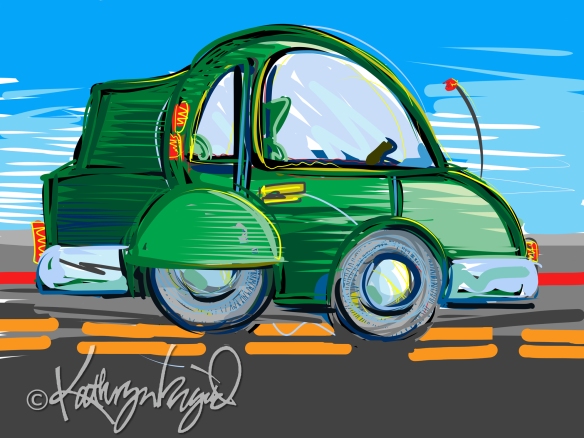
Slow-Moving Cars & Shiny Objects

Distractions abound. One split second of inattention can lead to disaster, whether it’s the roadside wildflowers that make me fail to notice the brake lights ahead of me or the glittery wings of a metallic beetle that keep me from realizing that everybody in my promenading party has walked on ahead without me and I don’t quite know where. Not such great and significant dramas in the grand scheme of things, these, but small indicators to remind me that things could have been so much worse if I hadn’t been so fortunate, and might be yet if I don’t learn from the nudges.Digital illustration: Tripping along the Road

The best fortune in them is, of course, that I’m cautioned before the crack of doom. How much better to be alerted by noticing the swerve I had to make to avoid plowing into the slowed traffic, or by realizing I have to catch up with my strolling companions than that I actually caused a crash or hiked right off the trail into uncharted wilderness alone. A little jolt is an occasion for large thankfulness.Digital illustration: Dyslexic Map

That’s how I travel through life, bumbling along its unmapped corridors with my faulty personal GPS and my avid, easily attracted magpie eye. I bump into life as much as I take a route through it. I’m just relieved to have lived this long without disappearing down any of an infinite number of rabbit holes and being lost forever in the warrens, tripping in them obliviously only because I was too mesmerized by nonessential Other Things along the way.