To Whom Much is Given

For unto whomsoever much is given, of him shall much be required.

That’s a passage from Christian scripture, but it’s a precept that I’ve read, heard and seen in the texts and teachings of other religions, and it’s commonly enough reflected in social policy and proposals for humane and ethical action in all sorts of places that it deserves more general notice and attention, I think. There seems to be an underlying assumption amongst many people of all kinds and cultures that if one of us has more than another and that other is in need, one ought to take some responsibility for her neighbor’s well-being and share the resources. It’s arguably a foundational principle of civility and hospitality everywhere.

Yet it’s practiced so much less often than is possible. For all of my love of time with friends and family, I also crave quiet and reclusive time, shutting out the world and curling into my own self, and that applies to all parts of my life. And I think that’s probably more common than not. Who does not prefer the company of her own self or her very small circle of kin and kind, especially when the workaday world has seemed particularly demanding and rest and retreat as hard to come by as clear water in the swamp? Who doesn’t covet the privileges she feels she’s chosen and earned for herself?

I was reminded of this particularly when we were in Hungary this summer and I had the privilege of going with a number of the touring choir members and my husband to visit the ancestral home of a hereditary Count and his wife the Countess. The Count himself made only a brief appearance at the end of our visit, his wife having participated with staff and supporters in the greeting of our group, speechmaking about their work with orphans and special needs children in the family-sponsored home on the grounds of the residence, and a small but lovely reception in the main public-room of the place, a large parlor filled with art and artifacts passed down through the lineage. The Count was charming and rather cheery when he did appear, but I sensed that he preferred his privacy as well.

The Countess, on the other hand, had a rather regal bearing and while she was generous in hosting us and very willing to share her home and thoughts with the group, I heard some quiet comments aside that she seemed a touch condescending or even a bit put out by our visit. I had been at the back of the room during her parlor commentary about the family history and the work of the orphanage, not able to see her over the number of people in the room, and her tone was very subdued, so I got the gist of the story, but didn’t see any of the expressions that might have influenced the commenters.

What I did hear was probably a fairly common tale among the nobility in Europe during the previous centuries: a privileged kinship, whether by their own efforts or honors conferred upon them by royalty, this family had done as they were both able and expected to do with their wealth, which was to live quite elegantly and surround themselves with art and beautiful landscaping and magnificent homes. At the same time, they saw themselves very much as caretakers of the larger community, responsible for the well-being not only of the people who staffed their private holdings but those living in proximity as well. This is of course the story of noblesse oblige, a practice of good that may have been at its core a defensive move but served the purpose in any event. Like many noble families, the one we visited had essentially founded a town around themselves over the generations, supporting educational or healthcare or other needed resources and, in this instance, building a magnificent basilica where the town could worship and where, not coincidentally, the touring choir were performing on the evening of our visit in a benefit concert for the children’s home.

Also like so many other noble families, this one had gradually seen its fortunes decline in the years between the World Wars, and on advent of German action in the region in World War II, was ousted from their land and holdings and fled for safer places. Their palatial home first became military headquarters during that war (in which the Hungarians quickly and brutally learned that their alliance with Germany was a general pretext for annexation and Nazi rule), and then was used for Communist offices in the years after. It wasn’t until just a few decades ago that the Count and Countess were able to return to his family property and renew their residence in the place. The good news was that there had been no interest on the occupying military’s part in redesigning the buildings, nor any money for the Communists to do so, so the architecture remained for the most part intact. The bad news was born of the same circumstances, though: the military’s disinterest in redesign and the Communists’ lack of funds extended to any concern for maintenance. Naturally, the park in which the palace stood, the palace and outbuildings all fell into a state that even in their heyday the real owners could probably have scarce afforded to mend, and it all added to the sorrow that the art and fabulous book collections had been heavily looted.

This is a long way of saying so, but on the day we visited there, I stayed after the others had left that once-elegant parlor, pausing to thank the Countess and to ask her a couple of questions about what I understood were the Count’s and her attempts to resurrect some of the property, if only for the appreciation of the locals and the young wards and their caregivers now living in closer quarters with these two owners. Her tone, perhaps because she was no longer addressing a whole roomful of people, or maybe because she felt she didn’t have to represent her husband’s whole heritage anymore, not acting in any official capacity at the moment, softened greatly, and I sensed mostly melancholy. There was sorrow for what had been lost, yes, but after we spoke about that and the enormity of the restoration needs for a moment or two, I simply asked her in the middle of that once-glamorous hall if she had a personal favorite artwork in there.

It was almost as if she became for a moment the young bride who had come there with the Count before the war, a little in awe of his family and the wealth that surrounded them, the power and the weight of the name upon her shoulders seeming rather immense even in the midst of her happiness. I can’t say she became suddenly shy, though it seemed to me that there was the slightest hint of it as she walked across the room and, instead of choosing one of the showy ancestral treasures or superb museum-quality portraits but this moderate-sized, unrestored and slightly bleary, painting of peasant girls dancing around in an Impressionistic meadow, and said simply, “This one.” I asked her what made it so, and she did little more than offer a soft comment that it was pretty and it made her happy.

Digital artwork from a photo: The Countess's Favorite

This is my digitally painted version of the Countess’s beloved artwork, which besides being in great need of restoration was under glass and hard to see without much maneuvering. But even in its retouched state here, I think you can catch a glimpse of what filled her with such longing: a sense of sweetly carefree innocence that must seem now like a distant, faded dream.

And I thought that perhaps what had been asked of her, she who had had quite a lot at one time and might even be seen in town nowadays as a bit of a remnant of things past, was her innocence. It must have been a long, sorrowful journey from being a young lady inducted into the nobility by marriage and impressed, if not overwhelmed, by the lavish life and the heavy weight of what was expected of her in her new role, to the life she knows now. However she and her husband might work to regain a place in the community through their labor and largesse, the world has changed, and they with it.

What must it have been like, as she moved through the war and later years in exile, knowing that everything tangible she had known at home might well be gone? On returning long after, though she saw that it wasn’t demolished, her happy ease was clearly broken and irretrievably changed. Finally, settling into her new role as figurehead of a still somewhat nebulous but ambitious attempt to find a way to make all that was left have real meaning again, looking into that painting must have become rather like looking into a mirror at her past self, not as a dancing peasant girl but as a naïf who thought the world was simple and clean and kindly and that all she had to do was make the best of what had been given to her in order to be happy in it.

But What of the Camel?

Ha! Once again, I seem to have failed to press the Publish button yesterday. I just noticed that this post was still queued up and not yet available on the blog, so I guess it’s a two-fer day today. Appropriately enough, it’s a post on my natural gift for failing to blend in with the herd. Make of that what you will!Digital illustration: Camel CompanionI think I may have mentioned before that there is a ranch only a short distance from where I live that raises bison, a herd whose distinctive companion is a camel. When my spouse and I were out on a little expedition in the area recently, the bison were even nearer the road than usual, and to my delight there were among them many calves of the season. We are generations away from the time when bison covered the American plains in masses that blackened the grasslands from one edge of the horizon to another, so it’s a pleasure to see even modest groups of them thriving and growing as they do in protected places like this one anymore.

But where was the camel?

It’s possible that the two times we passed the pasture that day, the camel was on its dromedary coffee break in some less visible spot toward the back of the fields. Maybe there is more to the bison herd than I know, and the camel was on duty, keeping the other bovine bunch company elsewhere. A little part of me couldn’t help but puzzle and worry over it, though. Camels can grow old and die like the rest of us, I assume. What a pity if this one camel should have died. I would be sad if I knew that to be the case.

It’s surprising, perhaps, that I find myself thinking about a camel and wondering about its welfare. It’s only partly made clearer by recognizing the seeming strangeness of a camel being at home in north Texas in the first place and the further oddity of said camel being companion and guardian to a herd of American buffalo.

Then again, not so surprising. I am, after all, something like a cousin to this unique camel. As a native Northwesterner who has always lived well north of the Mason-Dixon Line until moving to Texas five years ago, I am by definition a foreign body, an alien, in Texas, no matter how at home I find myself among the locals. As the perpetual listener at the back of  choir rehearsals, unable to make my vocal folds cooperate dependably enough to sing along, I am affiliated with the herd in a way that is very meaningful to me and that I take seriously not only as a source of pleasure but as support for my singing, conducting, and accompanying friends, but I am still not a part of the herd myself.

So it matters to me to know that all is well with that mysterious and slightly humorously incongruous camel. And I’ll keep you posted on the bison-loving camel that is me.

Foodie Tuesday: What’s *Not* in My Kitchen

I don’t mind simple foods, simply prepared, and I’ve had plenty of pit-roasted and wood-stove cooking that was far better than merely edible. Sometimes there is nothing more delicious than the freshly caught fish grilled over an open fire or fried at lakeside in a worn and well-seasoned cast iron skillet. The smoky goodness of things cooked with live coals is sometimes so far superior to what I could conjure out of a high-tech kitchen with the pallid assistance of bottled liquid smoke (no matter how genuine and unprocessed that might be) that I would rather wait months for the proper weather and occasion to arise.
Photo: Chuckwagon Cookery

But I ain’t no chuckwagon Cookie, if you know what I mean. I was never fond of ‘roughing it’ in the sense of being outdoorsy and happy to labor over the building of my kitchen kit before I can even bother to lug buckets of water up from the stream to have on hand for stifling the coals at need. I haven’t the skills or the desire to do my own butchering, and I barely know a chanterelle from an Amanita, if left to forage anywhere wilder than my own pantry and the grocery aisles.
Photo: Chuckwagon Cookery 2

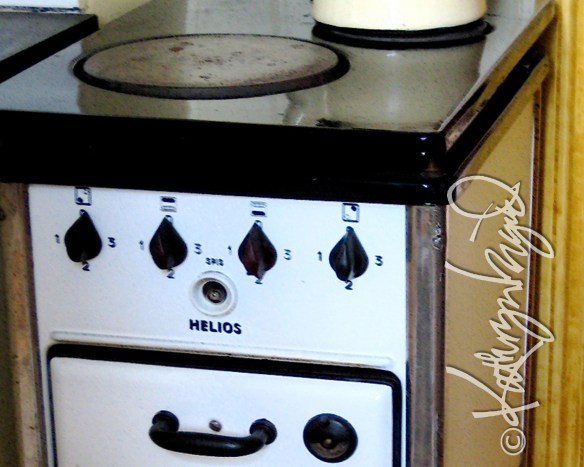
So my kitchen doesn’t sport the assortment of enameled camp cookware and the range of well-weathered cast iron pots and dutch ovens required for real down-to-earth preparation of meals. I don’t even have a clue what I’d do, short of going out in the backyard and having a go at such prairie wizardry, if I were faced with any of the old-school stoves and ovens that my ancestors and predecessors considered modern conveniences in their day. To cook with a wood stove, no matter how much I may have admired others’ mastery of it and the fantastic foods they’ve produced from such contraptions, is beyond my ken and requires subtleties of understanding how recipes and food science converge that I never learned. Even the electric ranges of earlier days have mystical mystery about them that would scare me right off to the local fast food joint for succor. And yes, I’d want fries with that.
Digital illustration from a photo: The Old Swedish Stove

In truth, I am a very limited and unskilled preparer of foods. I have a small palette of familiar ingredients upon which I rely, because I don’t have a clue what to do with many others that will make them safe for human consumption, let alone palatable. I have little patience for the suave or the grandiose in recipes, those techniques and tricks that require grace and keen senses and molecular understanding of the ingredients at play. I’m a reasonably willing eater of new foods and preparations, but not much for trying to make them myself, especially if I think anyone smarter and more experienced is available and willing to fix said dishes in my stead. The exception is mainly to be found in instances when real cooks let me play at being their sous chef without requiring better brains, knowledge of ingredients, or knife skills than I can offer.
Photo: Vintage Cooker

What I do have in my kitchen, most of the time, is fun, and enough decent eating to keep me (and anyone else on hand) from going hungry for long. Thankfully, I do live in a place with good grocery stores close at hand, family and friends to share meals and their preparation, and a kitchen full of my idea of modern conveniences. And if the ovens I got with the purchase of the house have outlived their peak performance by a fair distance and the only mixer I’ve owned for the last couple of decades is a wire whisk or fork, it sure isn’t the same as having to shovel up hard Texas clay to make room for my hand-split mesquite hardwood or having to figure out if those fruits gleaming at me from over there are the euphoniously named Farkleberry or are the similar looking but highly toxic Chinese Privet, so I don’t have to dig a privy, too, in a hurry.

Water Babies Athirst

There was a whopper of a rainstorm in Dallas recently. We were at our friends’ home, enjoying a little birthday party, and heard a few low growls of thunder in pauses between the chatting and laughter but had no great confidence rain would follow. It’s been overcast or cloudy often enough lately without granting so much of the hoped-for watering as it seems to promise, so we never take it as a given that we’ll be watered nicely. Not, in this instance at least, until the front door smashed open under the force of sideways gales and blasts of firehose rain. Bashed open once, and closed; then, a second time. And latched tight; the neighborhood was pelted well and truly until just a little before we left for home.
Photo: Drinking-Fountain Fountain

At home, it appears, no rain had come at all. Our gardens and spirits remained thirsty. I’m quite certain that a coastal-born person of my Washington upbringing and Scandinavian roots is a little more water-conscious, if not obsessed, than average. But the hints of rain that do arrive here, whether in sky-splitting gouts that last but an afternoon or in a steady series of lightly sprinkling days as we are sometimes blessed to see, are a fairly universally admired gift. And I find that north Texas is hardly alone in this.
Photo: Swan Like

The traveling we did this summer in Europe had very few rainy days among the many sun-soaked ones, and while we neither regretted the warmth and light of the sunshine nor bemoaned the drizzling times, we saw plenty of people in Budapest, Vienna, Prague, Stockholm, Port Angeles and Seattle who relished their rain-baths and their waterfront or fountain-side relaxation every bit as much as we did. Even the swans, geese, ducks and waterfowl seemed all the more pleased with their daily peregrinations on the days of and after the rains.
Digital illustration from a photo: Falling, Falling

I think that there might be in all of us a certain kind of thirst that mere water only reinforces and reminds us is different from the sense of desire and hope that can fill our spirits. River or fountain, a strong and cleansing rain, ocean or streaming tears of joy, the only water that can quite slake our longing for wholeness and growth and hope is the remembrance that we are primarily made of water ourselves, and as such, will always seek a way to the well or the shore that reassures us we belong.

The Last Rose of Summer

The Thomas Moore poem that gives this post its name has lent its melancholia to many a song and story to follow it in the years since Moore first honed the image into such an iconic form in 1805. He wasn’t the first to recognize the symbolic substance of decaying, wilting blossoms at the end of the growing season, or to apply it to tales of longing and sorrow, not by many long and mournful years. And the idea is so ready and apt that I can only assume there will be endless instances of such fading bloom representing the grief and sadness of life.

When I see real roses at the end of summer, though, I tend to see another kind of meaning in them myself. For what could stand better as an emblem of perseverance and strength than a fragile, delicate tissue of a flower that clings boldly to life when all of its companions have given up the ghost, when the elements conspire to kill it, when all of the art of Nature dictates that it should not be able to survive? Is there an image more fitting for resilience and bravery and the hope of beating all odds? Certainly there are few representatives more perfectly suited that appear in as beautiful a guise as the rose.

The idea of being that kind of a last rose of summer appeals to me. I would like to defy the expectations of the world that I should cower in the face of death and its precedent cruel disintegration, and instead age gracefully into an ever stronger, wiser and more beautiful being. This is impossible if I depend wholly on myself and my own resources. But having chosen to surround myself with the generous gardeners whose kind tending can nourish and enrich me along the way, I think I might have a chance of flowering over time, too.Rose in Bloom

A Beautiful Day in the Neighborhood

I didn’t know if I should tell this secret, since it wasn’t entirely mine to tell, but now that I see she posted about it too, I can brag that I will have a fabulous family of new neighbors in just a few months! This is the second time I’ve gotten to meet blogging friends in the real world, and the second time it’s happened because they moved to the same town where I live, a double bonus in my experience. First, it was the estimable man and marvelous photographer/artist Ted Griffith who arrived with his lovely wife and landed in this place that’s turning into a tiny hotbed of blogging, apparently. I got to tell you about that happy crossing of paths earlier.

Now I’ve also had a fantastic visit from the fabulous Marie and her charming and delightful husband and granddaughter, who will move into this same town, just down the pike from us, along with another two members of the family and brighten the north Texas landscape yet further. What a superb and unexpected benefit of blogging. Life is so full of happy surprises!

I suggest you have a nice visit to both of their blogs, tout de suite—Ted’s very inspiring photography and photo-based artworks can be found at Ted Griffith’s Blog and Marie’s world of wonders resides at (for now, anyway) her own little corner of Rhode Island. I’m just guessing there may be a quick little change of blog title somewhere in Miss Marie’s future, if you know what I mean.

The more important purpose of my post today, of course, is to celebrate that serendipitous joy of worlds colliding in the happiest of ways. I have been the blessed and blissful beneficiary of many of the marvels of this ever-smaller world’s confluences and connections. There’s such joy to be found in the miraculous meetings of the wildly interconnected world, and it’s amazing how often the seemingly unrelated threads and paths of our existence meet. What’s not to like about finding the commonalities and happy relationships between us by having our separate and distinct journeys intersect in unpredicted and wonderful ways!

Digital illustration: Confetti

Let’s throw a little confetti and a ticker tape parade in honor of serendipitous connections, my friends!

Foreshadowed

There we were in our hotel room in Prague—much more sophisticated and glamorous than the sort we’d have booked for ourselves, to be sure, thanks to the tour organizers—and I looked up and saw this through the curtains on our window:
Photo: Through the Curtains

Isn’t it amazing how just the hint of an image, a fluttering silhouette in the afternoon sun, can promise so much romance and adventure?
Digital illustration from a photo: Shades of Dusk

You know, naturally, that since we were in Prague, any promise of romance and adventure was bound to be fulfilled and, indeed, surpassed. A holiday of any sort is not to be shunned, generally speaking. But when I find myself in a city so marvelously compounded of history, mystery, drama and delight as Prague, I feel from the first glimpse of its thousand towers that frisson, that lovely shiver, presaging wonderful things not yet imagined even by me in my most vivid dreams.

Another Wild Hare

When we revisited the lovely Bellevue Botanical Gardens with Mom and Dad Sparks this summer, there were some excellent new elements to enjoy throughout the park. As always, the plantings were bursting with color and perfume and native beauty, but in addition there was a handsome new educational and administrative building complex in the entrance of the place, a splendid new suspension footbridge spanned the ravine in the most thoroughly naturalized section of the gardens, and the progress in that segment toward fuller removal of the invasive plants is more impressive than ever.

One new addition we enjoyed on this visit to the Botanical Gardens was not listed anywhere in the visitors’ pamphlets, as far as I could see, but no less delightful, welcome, natural and local: a pert little wild rabbit who sat nibbling the grass next to the biggest flowerbed in the middle of that pretty afternoon. Never let it be said that there’s nothing new under the sun.
Photo: Funny Bunny

Cat & Rabbit Go to Town

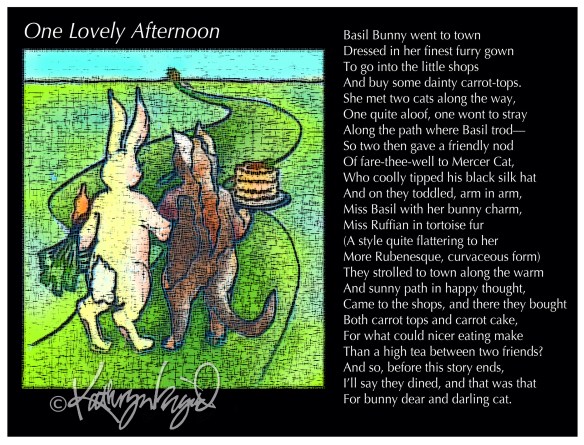
My sister’s cat Mercer has been sick and suffering for a while lately with some mystery malady, and his symptoms have thus far refused to explain themselves to his faithful veterinarian, so we’re in a watching, waiting and hoping phase. It’s sad and frustrating, and poor Mercer needs some serious respite from his ailments. I’m afraid I haven’t the skill to give him anything more palliative than the occasional pettings he allowed me to give him while we shared living quarters this summer. So I send out this little ditty to bring him good vibes of well-wishing long distance, as it stars the two most faithful fellow fur-babies who live or visit in his home, Ruffian the cat and Basil bunny.

Digital illustration + text: One Lovely Afternoon

I Love You Like Crazy

Acrylic mural: Tongue-in-Cheek, after Élisabeth Vigée-Lebrun It’s probably inaccurate in more than just the politically correct sense to say that I love my husband like crazy, because it would imply that my affections are only similar to complete madness, and we all know I’m much closer than that in reality. While I flatter myself that I maintain a reasonably plausible façade of normalcy, everybody knows that I’m pretty nutty about my spouse. And those who know him don’t blame me.

He really is a lovable guy.

But aside from the stuff that is evident to the general public, that part about him being a thoughtful colleague, a committed and skilled teacher, a nuanced and inspired conductor of singers and instrumentalists, and all that other excellent and admirable kind of thing, he is smart and curious and kind as a person. I know that when we are together, I matter as much to him as he does to me; that he is a safe retreat from both the minor perturbations of the day and the greater dangers of the wide world when I am in need. And I have in him the great friend with whom I would rather while away the hours either in intensive work or fully at play than with anyone else on earth.

Most of all, I know he not only understands my particular brand of craziness but shares in it as well. Each day, each year, is a surprise package of a kind, and every one of them is somehow richer than all of the foregoing ones as more than the sum of their many parts. Love and admiration and respect and support are all well and good, but if they don’t have the kind of holy hilarity that life with my partner has, they can never be enough.

With that, I wish my beloved the happiest of birthdays, and many more of them yet to come, each in succession with new and astonishing delights.