Foodie Tuesday: Freshness, with a Hint of Asia

For cold-weather refreshment, try a composed salad of roasted beets, fresh pears and sugar snap peas, dried apricots, ginger, rice vinegar, macadamia or avocado oil, elderflower syrup, chopped roasted salted peanuts or almonds, mint, and black pepper.

Served over Pad Thai noodles seasoned with a little tamari, it becomes a more filling meal. When you add a lovely piece of grilled or poached salmon (how about poaching it in—mmm—coconut milk?) or a succulent roasted duck breast to the plate, it becomes more elegant and yet more satisfying to a hungry guest.

Sake on the side might be a dandy tipple, or perhaps some apple cider (still, sparkling, unfermented or hard) is more to your taste.

Photo: A Hint of AsiaAnother version:

Salad of carrot-shred “noodles” dressed simply with lime juice, ginger syrup and a little avocado oil and sprinkled with plain sesame seeds.

A half-and-half mixture of Pad Thai rice noodles and bean threads, cooked in broth (my homemade chicken broth, in this instance) and dressed with a sauce of blended peanut butter (no additives but salt, please), fresh mint, Thai basil, and cilantro leaves, minced fresh ginger and a sparking of red chile pepper flakes. A little fresh lime juice squeezed over the top, and there you have it, a meal ready to eat that’s a fair sight fresher and zestier than, say, the MRE goodness our military friends get served. This combination works fine on its own as a light meal, or can have quickly cooked prawns or roasted chicken or fried tofu added for a boost in flavor, texture and protein as well.Photo: Fried Rice & Wasabi Eggs

Of course, there’s the old standby as well: fried rice is always easy and tasty. In the photo above, it had toasted almond slices and (barely visible) tiny shrimp, along with soy sauce and sliced water chestnuts, honey and shallots, and peas as tiny as the shrimps. It might be accompanied by something unique each time just to shake things up a tad and keep that sense of freshness humming. Wasabi-deviled eggs are a simple and welcome textural and flavoring pizzazz, along with the ubiquitous garnish we love, sushi ginger. As always, the ingredients I keep on hand may not vary widely, since we have our household favorites and limitations just like anyone else does, but it’s amazing how many variations can be made from different groupings and proportions of them and techniques for the dishes’ and meals’ preparations. Some things never really change!

2014 will soon be So Yesterday!

Digital illustration from photos: Pedaling Furiously

Here we go again, pedaling furiously into the next year. Wow! So much hustling and hurtling. So many fireworks going off in every direction! So many possibilities.

First, a little bit of a kindly sendoff for the year-that-was. A tasty dinner together with my beloved, a refreshing glass of brut champagne for an early toast, just in case we don’t care about staying up until midnight. We’re not fussy about holidays and parties and when they get celebrated, and yeah, we’re kind of old geezers about a whole lot of things, and have been since way before we were technically old, or geezers. In any event, as ordinary as we are in most ways, we’re not necessarily conventional in many of them, either, so we sip our champagne at 7:30 pm and wash down our steak and roasted potatoes with it. The apple crostata didn’t set up, so it was better served as applesauce (with the few little bits of the crust that toasted up properly) for dessert, and washed down with homemade eggnog. No big deal; the day when a crostata doesn’t crisp up fully before the filling tries to scorch is neither a new thing nor the end of the world.Photo: Meat & Potatoes are Nothing New

And the eggnog was spiked, after all.

Happy New Year’s Eve!

Morning and Evening

Digital illustration: Happy New Year

Year In, Year Out

The year begins with ice and fire at dawn

As January draws the curtain high,

Revealing what is written on the sky

To turn our vision forward and move on—

Into the year ahead, awake, renewed,

To see what can be done, what holds the key

That everything required of you and me

Will help fulfill the prophecy we viewed—

Move us with hope and joy through dark and light,

Through time that tests us as it passes by

Until we see another evening sky

Leading the way to that December night—

When once again we’ll come to gather here

And mark the changing to another year.

Digital illustration: Happy New Year Again

The Changing of the Guard

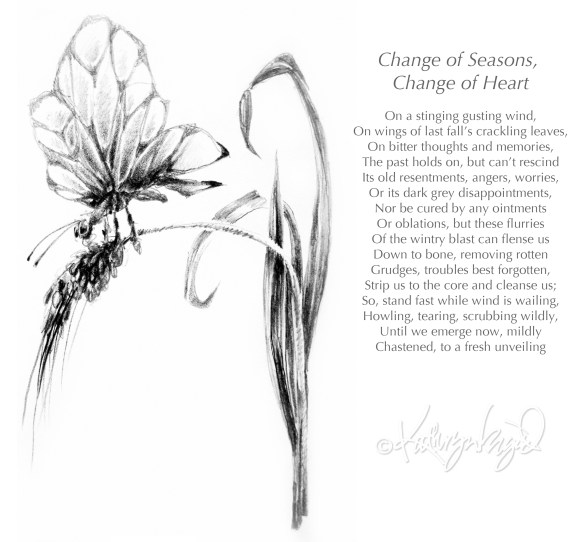
As December draws toward its end and a new calendar year lies just over the horizon and out of sight, there is always a sense of anticipation. It’s a many-layered thing, too, this look forward, carrying my constant consternation at all of the possibly awful unknowns like some sort of a scratchy underlayment to the innocent eagerness to discover great and wonderful things ahead. My own small history has taught me that both will hold true to one degree or another in 2015, just as they have for every day, season, year, and chapter in my life, little speck that it is in the equally fearful and fantastic unseeable future of the whole of existence. Knowing that these things will come to be regardless of any worry or wondering on my part never stops me from either of those things.Graphite drawing + text: Change of Heart

The one very best aspect of all of this is that I find every modification does move me to grow and change. I, along with the days, seasons, years, and chapters of my storyline, can be made better by their passage if I choose to keep my mind and heart engaged. Newness ahead can mean new life ahead. Today is a day when the beautiful potential of the best kinds of change should shine most brightly on the horizon of anyone who longs for it.

Tiger Time

If you remember anything about primary school (and I do, if little) you hopefully have a few memories of one or more of the fantastic sort of teachers who were the virtual equivalent of extra aunties and uncles and grandparents, but neatly spun into the form of educators whose wise teaching made you learn things without even knowing you’d worked at it, and want to learn things you hadn’t even known you wanted to know just because they were such fine pedagogues that they made it seem possible, if not easy.

You undoubtedly also have a memory or two of teachers who were quite the opposite. My personal least-fave was the third grade teacher who had no compunction about excoriating and humiliating a student in front of the rest of the class regardless of the infraction or any of their previous achievements or behavior, even cracking a yardstick onto desktops to make a point when she was het up, regardless of whether there might be some small knuckles in the way of the stick. At the very same time, she apparently thought it perfectly logical and beneficial to ‘level the playing field‘ and make all students feel they could accomplish something in her class, lest the PTA or school board think her not supportive and informative enough, and this she would do by sitting and doing the weakest students’ homework for them.

I knew nothing of this until one time when I was the unlucky receptacle for her ire, having failed a penmanship test in the first weeks of school because that school required students to learn cursive writing in the end of the second grade and the one in another state where I had spent my second grade did not. Had she asked us all to sing a song in Spanish, I might have been the star of the class, because my second grade teacher Mrs. Mosqueta let us learn a little elementary Spanish from one Señor Ybarra, who taught by the ultra-newfangled medium of televised classes, and I don’t think my new classmates in Illinois had yet had access to such magicks themselves. But there I was, little miss Goody Two-Shoes, who had never gotten anything but perfect scores because I was too prim and much too afraid to not do my homework to the nth degree—if I had any actual training or homework to prepare in the event—flunking my attempt to make Pretend Cursive when that mean lady in her sausage-casing dress didn’t even ask whether I’d ever been trained to write that way. If you think I still sound remarkably bitter about such a small thing from so long ago, well, I probably ought to let it go but I tend to enjoy my little revenge fantasies more than is entirely good for me.Digital illustrations + text: Tiger TimeThis is all in jest, of course. I wouldn’t be so cruel as to want to give any poor innocent tigers indigestion.


Foodie Tuesday: Chili with a Chance of Quesadillas

Photo: Slowpoke ChiliIn the cooler parts of the year, my fancy often turns to chili. It’s hot and hearty, filling and lightly (my versions) spicy, and it can be made in big batches and frozen in smaller ones for later ease of meal preparation. And I am quite open-minded when it comes to chili. I say this with full knowledge that as a Texas immigrant I risk censure, if not being thrown bodily into someone’s smoker. But of course, one has only to do a quick online search for Texas Chili to discover that while there are certain characteristics generally accepted as required for any chili to qualify for the Texas stamp of approval, the variety of actual recipes is just as broad and full of little surprises as the flat and arid plains of West Texas. And trust me, that’s going some.

The central tenet of Texan chili religion, as far as I can tell, is that it is meat-centric and it contains no beans. Northerners and other heathens are quite accustomed to thinking of meat as just another potentially wonderful addendum to a stew-like, tomato-y dish characterized by its spices rather than its more concrete contents, and I confess that I find it a little surprising and somewhat confusing to see “chili con carne” listed on a Texan menu, under the circumstances, but meat does seem to be the universally assumed Truth about good Texas chili. I am happy to make or eat all-meat chili, but I’ve nothing against chili with beans, with or without meat, or even a lot of other sorts of chile spiced vegetarian dishes. The latter are rarely what I would consider chili, myself, but if the texture and flavor profile of the concoction suggests that identity, I’m not going to waste valuable eating time on arguing the point.

You notice that I do differentiate between chili and chile, but that’s a simple linguistic issue in which the tongue plays only a minor role, not the happier and more significant one of tasting: chili is the dish seasoned with chiles, the spicy peppers or capsicums. Many use the spellings interchangeably, and there is no problem with that in my mind, either; I am always more interested in how these things play out on my palate than on my linguistic palette. In any case, it is the flavor of these deviously delicious capsicums, combined with a few other characteristic tastes, that most readily identifies a dish as chili to me.

I have nothing against making what I call ‘instant chili’* when time is short and the appetite yearns for that warming food. Since it’s the spice blend that carries the main weight of the dish’s identity, as long as I have that handy I can make what I think is a pretty fine facsimile of the long-cooked treat. So what are the flavors that I most want my chili to have?

Chiles. My favorite ways to introduce them to my cooking include, at various times, a number of possible dried, crushed, and/or powdered versions of capsicums, sold by spice companies as Chili Powder or Red Pepper Flakes or, simply, as individually named ground peppers or whole dried pods. While the pods of dried capsicums can certainly be made into a nice dusty powder in a good mortar, or can be rehydrated and pulverized to a paste (with a stick blender or food processor is most efficient), they are easier to keep whole and ground to powder in a dedicated spice grinder, like my tiny and cheap old electric coffee grinder that has never even met a coffee bean. I always have my go-to chipotle-spiked salsa in the kitchen, and that’s an easy ingredient to use as well. My favorite, though, is to mash or blend chipotles canned en adobo. I find San Marcos brand delicious even though they have never deemed it worthwhile to change their misspelled label. See? I’m not that picky about linguistics.

The other spices and flavors that I most care about putting in my chili are cumin, smoked paprika, a bit of black pepper, garlic powder, freeze-dried minced shallots, and usually a bit of oregano (Mexican oregano, if I have it). Cumin is the second-most characteristic spice flavor in this and many other Tex-Mex or Mexican foods, and having a kitchen bereft of that spice would leave me feeling like half a person. So make sure there’s plenty of warming, soul feeding, earthy cumin in my chili. And salt! But I don’t add much of that during the process, because of course one of the other secrets to chili is its long, slow melding of flavors, and if I’m making ‘instant chili’ it’s going straight to the bowls of individuals who will choose how salty they like it.

What is this ‘instant’ chili*, you ask? Just a quick fry-up of ground meat (usually beef, but whatever minced meat I have on hand, mixed or singly) with the aforementioned spices, dosed with enough tomato sauces (salsa, tinned tomato sauce/puree/pieces/paste) to make a nice thick stew, and if I want them, tinned beans—black beans, kidney beans, pintos or black-eyed peas or (a little White Trash favorite of mine) field peas, whatever shelled, cooked beans I’ve got on hand. When one is hankering, one makes do.Photo: Slowpoke Chili

When one has oodles of time, one makes the real, slow-cooked stuff in quantity. You could call it a name I think appropriate enough:

Slowpoke Chili

I start mine with a batch of homemade bone broth. Then, after preparing dried beans (I like to mix black beans, pintos, and small kidney beans for a fun range of colors and textures), I cook them in some of that good broth. Meanwhile, the meat chili is essentially a separate preparation: I like to put a batch of beef in my slow cooker, well covered in more of the same broth and seasoned with the spices and peppers I choose for the occasion. I use a mixture of coarsely ground beef and cubes (about 2 cm or 1 inch) of stew beef, and the amount of fat in even high-percentage ground meat is generally balanced out by the lean toughness of stew cuts, so I don’t need to skim the cooked meat-broth combination at all. If I’m putting any vegetables into my chili, those will almost always be mirepoix and sometimes, sweet capsicums. I’m less of a fan of green capsicums (bell peppers) than of the milder, less burp-inducing red, orange and yellow ones, but if bodily noises were really a serious issue, I’d hardly be making chili at all, would I. Wink-wink. Preparing the beans properly, if they’re included in the mix, does make a difference in that regard, anyway.

When I have vegetables to add to my chili, I pre-cook them with a slow sauté in butter, both enjoying the bit of caramelization and the butter itself as added flavor elements, and then they can jump in the pool with the meat. Whether with vegetables or without, the meat is likely to cook at a very low heat for at least 24 hours, if not more. I enjoy the freedom to potter around and do other household tasks while sniffing that great perfume for a long time, as it builds the appetite while infusing the flavor. Somewhere in that day or three, the meat (and veg) will have absorbed most of the broth, and I’ll add my tomato elements. While the spice blend is perhaps the identifying signature of chili, it’s no chili to me without good tomato flavor, so again, I add about enough to make a fairly soupy spaghetti sauce consistency, knowing that eventually the cooked beans will be added, or in the absence of beans, the meat and veg will soak up yet more of that tomato goodness.

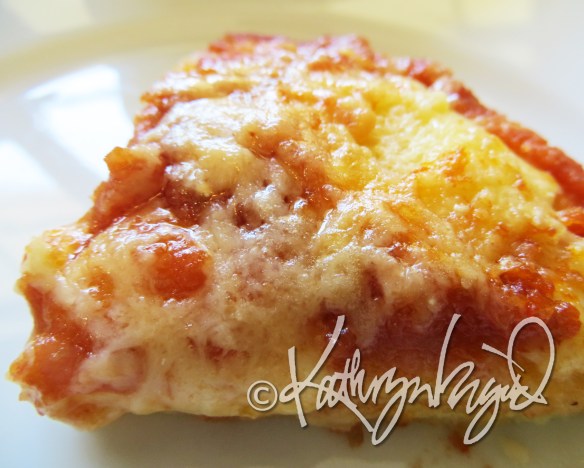
This is less of a recipe, as you know is pretty typical of my approach in the kitchen, than a guide to possible combinations that will please me. The proportions are different every time, and whether I add beans, or even vegetables, is a matter of mood and company more than a matter of Texan patriotism; I am, after all, a Northern invader. But I can tell you, it’s generally pretty darn good stuff. Add a few tender corn tortillas that have been layered with salsa or tinned enchilada sauce, plus cheese: cheddar, Monterey Jack, Cotija, Queso Blanco, or any such blend or substitution of similar types of mild and sharp, melting and melt-resistant chewy cheeses that suit your fancy and then heated through. If that meal doesn’t fulfill your chili dreams, there are always a multitude of cooks around here who have what they will assure you is the one, true, Texan article.Photo: Quesadilla or Enchilada?
FutuRetro

One of the things I so love about travel and touring is getting a much more powerful sense of history; standing in and on the places where events and lives long past have happened, whether grand or insignificant, utterly changes my understanding of those people and occurrences. My first trip overseas, that Grand Tour I was so privileged to take in college with my older sister, was an awakening I never expected. I hoped the trip would be a cure for my sophomore blues, and indeed it was, beyond anything I could have planned or dreamt before, but more than that I was startled by how connected I felt to history.

The drizzly and cold autumn day when we visited Canterbury Cathedral was atmospheric enough in its way, but I remember standing on stone steps worn into a soft bowl by the thousands of footsteps that had passed over them in the centuries of its existence, looking up into a palely gold ray from a lamp, seeing the motes of dust whirling in it, and feeling that time itself was floating down around me in delicate pieces, that the spirit of every person who had ever set foot on that same smooth hollow in the stone was present there with me in that very moment. It was almost as though I could hear their voices and see the scenes of the past play out in the faint gloom around me, all overlapping and yet perfectly present. I felt my own place in the whole of the human timeline in an entirely different way than I ever expected, tinier than ever, yet surprisingly more concrete and tangible.

This was reinforced later in the same journey many times, as we passed through or visited (not necessarily in this order) England, Italy, France, the Netherlands, Switzerland, Austria, Germany, Denmark, Sweden, Norway, Wales, Scotland, and Ireland and stood in the very footprints of many a person, going down the winding passages and cobbled side-streets that had seen multitudes of significant moments long since fled. As this was the first time I visited Norway, the rooting ground of my ancestors from every branch of my family tree, it is no surprise in retrospect that many of those potent realizations came to me in that place—but as usual, hindsight is ever so much clearer than was my youthful wisdom in those days. It was moving, more meaningful than I can express, to get to know the relatives in Norway with whom my family had maintained contact: my maternal grandfather’s sisters and brother-in-law, nieces and nephew. These were days before cheap telephonic long distance, let alone email and internet communiqués, so we had only briefly even met most of these people when they visited America once in my younger years, yet they not only took us in as visitors, Tante Anna and Onkel Alf kept my sister and me with them for a full month and took us to see the family’s two longtime farms, the graves where many of our ancestors were sleeping underfoot. This was incredibly touching, a genealogical history lesson, but the more so because it was taught by the eldest of our remaining family there.

What moved me the most, in fact, was when on arriving in Oslo at our mother’s cousin’s home before we even came down south to be with his parents, we explored the great city a little on our own during the days, while he was at work and his wife and children off having their own day of adventures. It was all so humbling and so magical to feel for the first time that I understood a tiny bit more of my own family lineage and how our people fit into the larger world. We did visit many of the obligatory and famous tourist sites, knowing that there was no direct link to our ancestors, only cultural ones. So I was quite stunned when we visited the Viking Ship Museum and, standing before these ancient vessels, I was absolutely electrified with a sense of shared history coursing through my veins. My forebears were undoubtedly humble subsistence farmers, not the bold and violent and adventurous Viking strain we know through film and television, never mind through the great Sagas—but I felt for the first time something connecting me to those long-gone people all the same.
Photo: Enter the Time Machine

By now I have traveled a fair amount more. I have been on this planet more than twice as long, and I think I might even be a little bit wiser through my experiences in that life than I was back then. But I approach every narrow stone passageway, every weathered door, every window with its rippling antique panes presenting everything that’s beyond them like a warped post-impressionist fiction of itself, I expect to learn something not only about what is there in front of me and around me, but what is inside me. And I know that I will learn something, too, about how I fit into that larger, and ever so mysterious, world if I am wise and patient and alert enough to notice it. So much has gone by. So much remains ahead, yet unknown.

Through Winter’s Window, Dimly

Photo: Light Looks In

Change of Season

Between the rain spells, when the sun is glinting onto rose and road
The youthful smells of spring are hinting that ahead the broken code
Winter left in seed and scion will reveal its inner life,
Where what had appeared as dying wakes again with newness rife.
Open eyes and open windows! Let indoors the fresh new air,
Breathing in what melts the snows and pushes out all winter’s cares.
So renew the self and senses and embrace the growth and light
Breaking down all old defenses, setting earth again aright.

The Great-Greats

Naming things is an endlessly fascinating and complicated way of creating and better understanding our relationships with them. Different cultures have even devised quite distinct ways of classifying and identifying the kinships within them, to the extent that families and relations in the different cultures affect the very ways people interact and consider themselves connected, responsible for each other, and much more.Photo: Great Great Grandparents

One of the appealing (or appalling) quirks, depending upon one’s view, of the American traditions of familial identification and the names given them in English is the way we use the word Great to specify layers of distance from ourselves. This photo, for example, is of one of my sets of great- and/or great-great grandparents (my maternal grandfather’s forebears), if I am not mistaken, and there is much to pique my curiosity in this image.

First, of course, is the question of whether I have identified them correctly at all. But then, in what ways—besides the nominal—were they great? Clearly, being among my ancestors is an easy in to that category. [Ba-dum-tsssssssshhhhhh!]*

Seriously, though, what distinguished these people? Safe to assume, from what little I do know of my relatives in Norway, these two lived on a small farm, and they worked hard. I mean, incredibly hard, by my standards. I’m inclined, actually, to think that the gent is my great grandpa and the lady next to him is his mummified mum, but having seen many a portrait from that era whose subject I was shocked to discover was eons younger than I’d have imagined, I can’t be sure. If this is a couple, I am extra, extra glad I have such a lazy and comfortable life. I may be no spring chicken, but I like to think that people will be able to tell whether or not I’ve already died, and when it does occur, won’t be able to make work boots out of my hide without tanning it further.

This could be the great-grandfather who was a tinsmith. A pretty skilled one, at that. The hands I see here could easily be tough enough to have put metal in its place. As for the farming, what little I’ve gleaned [enough with the shtick! I’ll try to behave myself]* from the various family stories and photos indicates that my family were subsistence farmers, growing what produce would feed their own households or be swapped with neighbors for  further goods, and raising enough sheep and goats, chickens and cattle to keep them in meat, eggs, hides and bones as needed. Agrarian life, until more recent decades, was generally a far more solitary and jack of all trades kind of existence. My grandmothers, great and otherwise (and I can only assume all of the neighbor women of this ancestress’ approximate vintage) did such work as probably made them all look equally leathery.

I would like to think that the sober, if not condemnatory, expressions in the photo sprang from the typical problem of holding still for the interminable exposure time a photograph required in those days, not to mention doing so while squinting in the sunlight. But I also suspect that a combination of that hardscrabble life of theirs and the grimly perdition-obsessed brand of religion to which many of my relatives have subscribed means that these two generally took life mighty seriously as well. They probably didn’t see so much to joke about or room for fun and games in their daily lives.

What I can safely assume about my relatives still gives me some hope. Obviously, they knew enough about how to survive and yes, thankfully, to procreate, that I am here generations later to tell the tale. I consider my existence a fine thing. Although they weren’t either wealthy or showy, they are dressed in well made, tidily kept clothing and lo, my mustachioed male relative even sports a watch chain, so theirs was not, even from the perspective of my privileged and cushy life, a torturous life of pure privation. So I don’t feel enormous existential guilt for their suffering. But I’m not inclined that way like they might have been, anyhow.

My late Norwegian relatives lived and labored in a landscape and climate rather like where I grew up in the American northwest, so I know that even if their daily work was hard they did it surrounded by beauty and nurtured in a mostly benevolent natural environment. They raised children who were able to go out in turn into the wider world and make their ways, eventually finding own their paths, making their own livings, and raising their own families, and eventually crossing many mountains, borders, and seas. I think all of this a fine, if modest, sampler of human existence with [dang it, I just can’t help it!]* relatively little grand tragedy or overblown drama. Most of all, I am glad that the long-gone beings who posed for this rather inscrutable image contributed to the production of a line of pretty good folk, culminating in my immediate family. That’s greatness enough for me, and makes me very thankful indeed. Happy Thanksgiving, my friends.

Uncertainty and Hope

Beloved, let us sit down together in the shadow of the oaks; let us take deep draughts of fresh water from the clear, swift stream. In the scorching heat of the middle of day, let us take refreshment like the dragonflies that skim the water’s edge, and be restored by the caroling of birds in the distant shade.Digital illustration from a photo: By the Cooling Stream

The days are long and our work makes wearying and seemingly infinite demands, and we know that this will not soon change. There is change of many sorts ahead, this we know too, but what it will be is yet beyond our imagining. Thus it has been, and so shall it ever be: we travel our paths, seldom knowing quite where they lead, and we labor in darkness the while. Some days, the destination is sparkling joy, and on others it is marred by sorrow and strife; at times, the mists of uncertainty part and the way ahead becomes clear, and at others it remains quite fully obscure.

Photo montage: Beloved, Let Us Sit

What I know, Beloved, is this—that no matter how hard or easeful is the road and no matter what the destination holds for us, we walk our way together, you and I. We may long for clarity and even for the strength to wait for it, but in the meantime we will take our stops for breath along the way, sitting in shade when we may and drinking deeply from the icy stream, traveling always hand in hand no matter what the journey brings.