PessimOptimism

Graphite drawing: Self-Inflicted“Prepare for the worst but hope for the best.” It’s part of my credo, I guess, and may well have been aided in its development by doing those hilariously futile duck-and-cover atomic bomb drills of the Cold War era. And the air raid drills—we lived in a Ground Zero area near several military bases, strategic coast, and a handful of Nike missile sites in those days—fire drills, earthquake drills, tsunami drills, and later when we lived in the midwest, tornado drills. You’d think we’d all have grown up incredibly paranoid after such stuff in childhood. But I think that besides being remarkably resilient, kids use logic on such daily puzzles far better than they remember how to do when they hit adulthood and have been taught their prejudices, and are much more easily distracted and blinded by grey areas.

I don’t remember ever believing that crouching under a flimsy little wood-and-steel desk would save me even from the shrapnel of shattering windows and imploding walls in the event of an attack or large-scale disaster, particularly since I imagined the desk itself would become shrapnel along with everything else in the atomizing roar of a bombing. Little and naïve though we were, we had gleaned hints of the enormity of such things from our beginning school studies of the world history of war (skewed to our own culture’s view, of course); no matter how grownups think they’re shielding kids by sanitizing and limiting the information the wee ones are allowed to see and hear, children are quick to notice the blank spaces where redacted information interrupts the flow of facts, and no adult is more curious than a child to hunt for clues as to what was redacted. Frankly, if there really is any use for an institution like the CIA in this day and age when practically anyone can find out practically anything with the aid of easily accessible tools like the internet, cellular phone, and, apparently, privately owned drones, along with all of the more traditional tools of spy-craft, I suggest that the crew best equipped to uncover any facts not in evidence would probably be a band of children all under the age of about twelve.

Meanwhile, we still have large numbers of people who think it prudent to withhold or skew the information passed along to not only kids but even fellow adults, giving out misguided or even malevolent half-truths or remaining stubbornly silent and in full denial about things considered too dark for others’ knowledge. And what do we gain from this? Are there truly adults among us who still think that even smallish tots can’t quickly discern the differences between a fable or fairytale, no matter how brutish and gory it may be, and the dangers and trials of real-world trouble? Does delusion or deception serve any purpose, in the long run, other than to steer us all off course in search of firmer, more reliable realities?

As I just wrote to my dear friend Desi, it seems to me that the majority of humans always assume a fight-or-flight stance in new or unfamiliar circumstances before allowing that these might be mere puzzles to decipher, and more importantly, we assume the obvious solution to be that whatever is most quickly discernible as different from self IS the problem. Therefore, if I’m white, then non-white is the problem; if I’m female, then male. Ad infinitum. And we’re generally not satisfied with identifying differentness as problematic until we define it as threatening or evil. This, of course, only scratches the surface—quite literally, as the moment we get past visible differences we hunt for the non-visible ones like sexual orientation, religious or political beliefs, and so on.

Unless and until we can change this horribly wrongheaded approach on a large scale, we’ll always have these awful problems, from petty playground scuffles right into the middle of the final mushroom cloud. The so-called justice systems of the world are set up and operated by the same flawed humans who make individual judgements, so the cycle is reinforced at all levels. Sometimes it truly makes me wonder how we’ve lasted this long.

Can we learn from kids? The younger the person, the more likely to blurt out the truth, whether it’s welcome or not. The subtleties of subterfuge are mostly wasted on children, who unless they’re engaged in happy storytelling for purposes of amusement and amazement, would rather be actively puzzling out the wonders of life than mucking about in search of evasive answers and duck-and-cover maneuvers. We might gain a great deal by reverting a little to a more innocent and simplistic view of the universe, one that blithely assumes that others are not always out to get us, that direness and doom aren’t lying open-jawed around every blind corner, and that the great powers of the internet and cell phones might just as well bear cheery tidings of goodness and kindness, and drones be removed from deployment as spies and weapons to work instead at delivering birthday presents to friends and packets of food to hungry strangers.

I’m not fooled into thinking any of this is easy to do, any more than any savvy kid would be, but I’m willing to believe it’s possible if more and more of us will commit to such ideals.
Sailing Ahead, Wherever That May Be

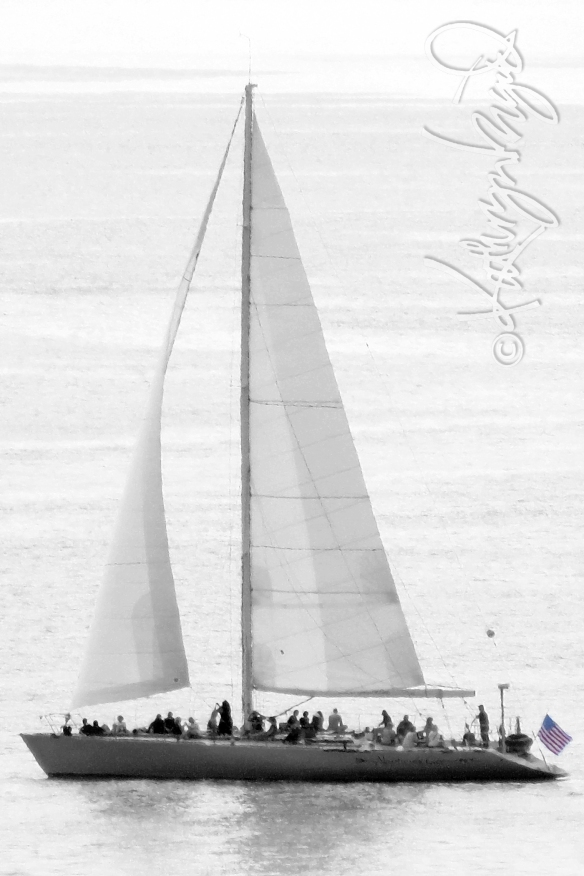
The only time I’ve ever been on a sailboat was to sleep. There’s a great Tall Ship converted into a youth hostel in Stockholm where my sister and I bunked for a couple of nights on our college gallivant across western Europe. [Which hostel appears to have been recently renovated, and very nicely, if any of you should be interested.] While there may have been the faintest of motion rocking us to sleep in our on-board berths, I doubt it replicated very accurately the sensation of actual sailing. My next opportunity was during graduate school when I got a fan letter (one of the very few in my life, as you can imagine!) from a stranger who’d liked a gallery art installation I made so much that he offered to take me out sailing to the nearby islands. I don’t think there was anything predatory about him, but besides my still having a grandiose case of social anxiety in those days, there is the fact that the art show in question was entirely a walk-through, life-sized illustration of an espionage thriller; while I am doubtful that was his inspiration, I didn’t take him up on the offer.
Photo: Adrift on the High Seas

But whenever I see a sailboat, I do think it’s a beautiful representation of a genteel form of freedom that captivates my imagination all the same. Yes, I know plenty of tales of grueling trials on the high seas, no matter the size of the craft; even some of my close friends and relatives have such stories to tell, thankfully, having survived them. And I know, too, the old joke about testing one’s real interest in boat ownership by dressing up in a rain slicker and standing under an ice-cold shower for a couple of hours while flushing hundred-dollar bills down the toilet. But I also know that a vast number of people who could jolly well choose to spend their money and time on less demanding, safer, and far less expensive pastimes still choose boating. There’s clearly a strong pull to counterbalance any such negatives.

I, too, have spent some happy times on boats, just not sailboats. As a coastal kid, after all, I grew up thinking time spent on the ferries was as much pleasure and sightseeing as it was commuting or transport. I have been fairly miserable on a North Sea ferry in stormy seas while I was recovering from the stomach flu, but it did not so permanently scar either my psyche or my stomach lining that I didn’t look forward to the next time I got to be on a slow boat cruising along the shore, or perhaps best of all, in a rowboat or canoe, dipping the oars or paddle in with the rhythmic soft splashing that accompanies my reveries.
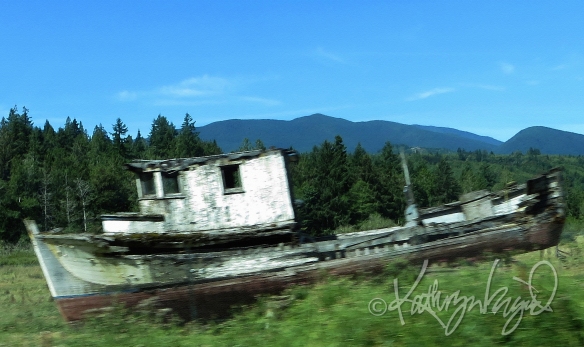
Photo: All Ashore

Living far from any natural body of water as I do these days, I am beached like an old craft whose hull is no longer seaworthy. But like those old boats I see, dry-docked on the beach or alongside the tumbledown barn or in a weedy field, I keep in my soul a firm and loving memory of every good time spent with the waves rocking me softly from below, telling me stories of their own and inviting me forward, ever forward, wherever that might take me.

Crashing through the Snow

Few things are as visibly expressive of joy as a dog bounding excitedly through deep snow. Except, possibly, a whole bunch of dogs, plus a whole cadre of little kids, leaping, tunneling, floundering, grinning, and generally exploding their way through the same drifts.
Digital illustration: Snowflake

The problem with being an adult human is that we become so conscious of our creakiness and increasingly inflexible bodies, so obsessed with the dangers of having an infarction while shoveling or being speared in the forehead by a forty-pound icicle from the eaves, so hung up on our supposed decorum and dignity, that we stop risking not only true dangers but the possibility of gleefully tipping arse-over-teakettle into a billowing heap of powdery snow. It’s really too bad, because an occasional tumble from the pedestals we prop ourselves on, a momentary reminder of our own foolish frailty, and a smart whack on the overly fixed sense of reality is well worth a little bruising on ego and elbow. It might just teach us a renewed appreciation for the beauties of snow and nature. Why, if one were to be exceedingly incautious in the event, it might even turn out to be fun.

Tiger Time

If you remember anything about primary school (and I do, if little) you hopefully have a few memories of one or more of the fantastic sort of teachers who were the virtual equivalent of extra aunties and uncles and grandparents, but neatly spun into the form of educators whose wise teaching made you learn things without even knowing you’d worked at it, and want to learn things you hadn’t even known you wanted to know just because they were such fine pedagogues that they made it seem possible, if not easy.

You undoubtedly also have a memory or two of teachers who were quite the opposite. My personal least-fave was the third grade teacher who had no compunction about excoriating and humiliating a student in front of the rest of the class regardless of the infraction or any of their previous achievements or behavior, even cracking a yardstick onto desktops to make a point when she was het up, regardless of whether there might be some small knuckles in the way of the stick. At the very same time, she apparently thought it perfectly logical and beneficial to ‘level the playing field‘ and make all students feel they could accomplish something in her class, lest the PTA or school board think her not supportive and informative enough, and this she would do by sitting and doing the weakest students’ homework for them.

I knew nothing of this until one time when I was the unlucky receptacle for her ire, having failed a penmanship test in the first weeks of school because that school required students to learn cursive writing in the end of the second grade and the one in another state where I had spent my second grade did not. Had she asked us all to sing a song in Spanish, I might have been the star of the class, because my second grade teacher Mrs. Mosqueta let us learn a little elementary Spanish from one Señor Ybarra, who taught by the ultra-newfangled medium of televised classes, and I don’t think my new classmates in Illinois had yet had access to such magicks themselves. But there I was, little miss Goody Two-Shoes, who had never gotten anything but perfect scores because I was too prim and much too afraid to not do my homework to the nth degree—if I had any actual training or homework to prepare in the event—flunking my attempt to make Pretend Cursive when that mean lady in her sausage-casing dress didn’t even ask whether I’d ever been trained to write that way. If you think I still sound remarkably bitter about such a small thing from so long ago, well, I probably ought to let it go but I tend to enjoy my little revenge fantasies more than is entirely good for me.Digital illustrations + text: Tiger TimeThis is all in jest, of course. I wouldn’t be so cruel as to want to give any poor innocent tigers indigestion.


The Love that Dare Not Bark Its Name

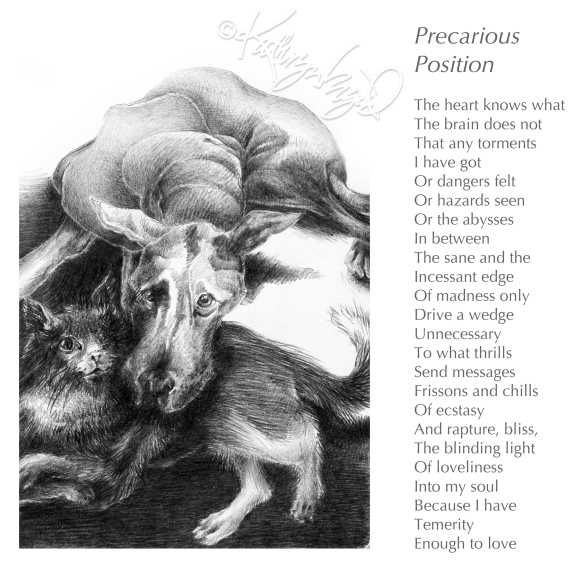
We all know that there are certain kinds of thrills that are worth the risk, that the forbidden fruit can taste sweetest when it’s a chocolate sneaked from Mom’s birthday gift selection (not that I would know anything about any such thing from my youth!), the extra hour out past curfew when one thinks one’s parents are out of the house, the bouquet picked from a neighbor’s flowerbed en route home from grade school. And there’s no doubt that some are drawn to romance most powerfully when it is risky, when it defies convention, when it defies logic. Is anyone really immune to the lure of breaking with tradition, just a little?Graphite Drawing + Text: Precarious Position

Foodie Tuesday: Chili with a Chance of Quesadillas

Photo: Slowpoke ChiliIn the cooler parts of the year, my fancy often turns to chili. It’s hot and hearty, filling and lightly (my versions) spicy, and it can be made in big batches and frozen in smaller ones for later ease of meal preparation. And I am quite open-minded when it comes to chili. I say this with full knowledge that as a Texas immigrant I risk censure, if not being thrown bodily into someone’s smoker. But of course, one has only to do a quick online search for Texas Chili to discover that while there are certain characteristics generally accepted as required for any chili to qualify for the Texas stamp of approval, the variety of actual recipes is just as broad and full of little surprises as the flat and arid plains of West Texas. And trust me, that’s going some.

The central tenet of Texan chili religion, as far as I can tell, is that it is meat-centric and it contains no beans. Northerners and other heathens are quite accustomed to thinking of meat as just another potentially wonderful addendum to a stew-like, tomato-y dish characterized by its spices rather than its more concrete contents, and I confess that I find it a little surprising and somewhat confusing to see “chili con carne” listed on a Texan menu, under the circumstances, but meat does seem to be the universally assumed Truth about good Texas chili. I am happy to make or eat all-meat chili, but I’ve nothing against chili with beans, with or without meat, or even a lot of other sorts of chile spiced vegetarian dishes. The latter are rarely what I would consider chili, myself, but if the texture and flavor profile of the concoction suggests that identity, I’m not going to waste valuable eating time on arguing the point.

You notice that I do differentiate between chili and chile, but that’s a simple linguistic issue in which the tongue plays only a minor role, not the happier and more significant one of tasting: chili is the dish seasoned with chiles, the spicy peppers or capsicums. Many use the spellings interchangeably, and there is no problem with that in my mind, either; I am always more interested in how these things play out on my palate than on my linguistic palette. In any case, it is the flavor of these deviously delicious capsicums, combined with a few other characteristic tastes, that most readily identifies a dish as chili to me.

I have nothing against making what I call ‘instant chili’* when time is short and the appetite yearns for that warming food. Since it’s the spice blend that carries the main weight of the dish’s identity, as long as I have that handy I can make what I think is a pretty fine facsimile of the long-cooked treat. So what are the flavors that I most want my chili to have?

Chiles. My favorite ways to introduce them to my cooking include, at various times, a number of possible dried, crushed, and/or powdered versions of capsicums, sold by spice companies as Chili Powder or Red Pepper Flakes or, simply, as individually named ground peppers or whole dried pods. While the pods of dried capsicums can certainly be made into a nice dusty powder in a good mortar, or can be rehydrated and pulverized to a paste (with a stick blender or food processor is most efficient), they are easier to keep whole and ground to powder in a dedicated spice grinder, like my tiny and cheap old electric coffee grinder that has never even met a coffee bean. I always have my go-to chipotle-spiked salsa in the kitchen, and that’s an easy ingredient to use as well. My favorite, though, is to mash or blend chipotles canned en adobo. I find San Marcos brand delicious even though they have never deemed it worthwhile to change their misspelled label. See? I’m not that picky about linguistics.

The other spices and flavors that I most care about putting in my chili are cumin, smoked paprika, a bit of black pepper, garlic powder, freeze-dried minced shallots, and usually a bit of oregano (Mexican oregano, if I have it). Cumin is the second-most characteristic spice flavor in this and many other Tex-Mex or Mexican foods, and having a kitchen bereft of that spice would leave me feeling like half a person. So make sure there’s plenty of warming, soul feeding, earthy cumin in my chili. And salt! But I don’t add much of that during the process, because of course one of the other secrets to chili is its long, slow melding of flavors, and if I’m making ‘instant chili’ it’s going straight to the bowls of individuals who will choose how salty they like it.

What is this ‘instant’ chili*, you ask? Just a quick fry-up of ground meat (usually beef, but whatever minced meat I have on hand, mixed or singly) with the aforementioned spices, dosed with enough tomato sauces (salsa, tinned tomato sauce/puree/pieces/paste) to make a nice thick stew, and if I want them, tinned beans—black beans, kidney beans, pintos or black-eyed peas or (a little White Trash favorite of mine) field peas, whatever shelled, cooked beans I’ve got on hand. When one is hankering, one makes do.Photo: Slowpoke Chili

When one has oodles of time, one makes the real, slow-cooked stuff in quantity. You could call it a name I think appropriate enough:

Slowpoke Chili

I start mine with a batch of homemade bone broth. Then, after preparing dried beans (I like to mix black beans, pintos, and small kidney beans for a fun range of colors and textures), I cook them in some of that good broth. Meanwhile, the meat chili is essentially a separate preparation: I like to put a batch of beef in my slow cooker, well covered in more of the same broth and seasoned with the spices and peppers I choose for the occasion. I use a mixture of coarsely ground beef and cubes (about 2 cm or 1 inch) of stew beef, and the amount of fat in even high-percentage ground meat is generally balanced out by the lean toughness of stew cuts, so I don’t need to skim the cooked meat-broth combination at all. If I’m putting any vegetables into my chili, those will almost always be mirepoix and sometimes, sweet capsicums. I’m less of a fan of green capsicums (bell peppers) than of the milder, less burp-inducing red, orange and yellow ones, but if bodily noises were really a serious issue, I’d hardly be making chili at all, would I. Wink-wink. Preparing the beans properly, if they’re included in the mix, does make a difference in that regard, anyway.

When I have vegetables to add to my chili, I pre-cook them with a slow sauté in butter, both enjoying the bit of caramelization and the butter itself as added flavor elements, and then they can jump in the pool with the meat. Whether with vegetables or without, the meat is likely to cook at a very low heat for at least 24 hours, if not more. I enjoy the freedom to potter around and do other household tasks while sniffing that great perfume for a long time, as it builds the appetite while infusing the flavor. Somewhere in that day or three, the meat (and veg) will have absorbed most of the broth, and I’ll add my tomato elements. While the spice blend is perhaps the identifying signature of chili, it’s no chili to me without good tomato flavor, so again, I add about enough to make a fairly soupy spaghetti sauce consistency, knowing that eventually the cooked beans will be added, or in the absence of beans, the meat and veg will soak up yet more of that tomato goodness.

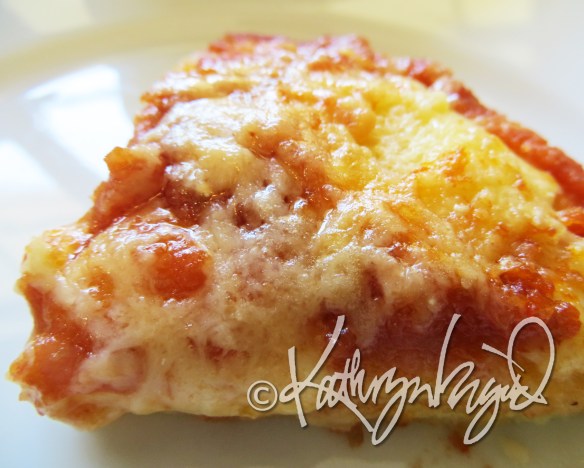
This is less of a recipe, as you know is pretty typical of my approach in the kitchen, than a guide to possible combinations that will please me. The proportions are different every time, and whether I add beans, or even vegetables, is a matter of mood and company more than a matter of Texan patriotism; I am, after all, a Northern invader. But I can tell you, it’s generally pretty darn good stuff. Add a few tender corn tortillas that have been layered with salsa or tinned enchilada sauce, plus cheese: cheddar, Monterey Jack, Cotija, Queso Blanco, or any such blend or substitution of similar types of mild and sharp, melting and melt-resistant chewy cheeses that suit your fancy and then heated through. If that meal doesn’t fulfill your chili dreams, there are always a multitude of cooks around here who have what they will assure you is the one, true, Texan article.Photo: Quesadilla or Enchilada?

FutuRetro

One of the things I so love about travel and touring is getting a much more powerful sense of history; standing in and on the places where events and lives long past have happened, whether grand or insignificant, utterly changes my understanding of those people and occurrences. My first trip overseas, that Grand Tour I was so privileged to take in college with my older sister, was an awakening I never expected. I hoped the trip would be a cure for my sophomore blues, and indeed it was, beyond anything I could have planned or dreamt before, but more than that I was startled by how connected I felt to history.

The drizzly and cold autumn day when we visited Canterbury Cathedral was atmospheric enough in its way, but I remember standing on stone steps worn into a soft bowl by the thousands of footsteps that had passed over them in the centuries of its existence, looking up into a palely gold ray from a lamp, seeing the motes of dust whirling in it, and feeling that time itself was floating down around me in delicate pieces, that the spirit of every person who had ever set foot on that same smooth hollow in the stone was present there with me in that very moment. It was almost as though I could hear their voices and see the scenes of the past play out in the faint gloom around me, all overlapping and yet perfectly present. I felt my own place in the whole of the human timeline in an entirely different way than I ever expected, tinier than ever, yet surprisingly more concrete and tangible.

This was reinforced later in the same journey many times, as we passed through or visited (not necessarily in this order) England, Italy, France, the Netherlands, Switzerland, Austria, Germany, Denmark, Sweden, Norway, Wales, Scotland, and Ireland and stood in the very footprints of many a person, going down the winding passages and cobbled side-streets that had seen multitudes of significant moments long since fled. As this was the first time I visited Norway, the rooting ground of my ancestors from every branch of my family tree, it is no surprise in retrospect that many of those potent realizations came to me in that place—but as usual, hindsight is ever so much clearer than was my youthful wisdom in those days. It was moving, more meaningful than I can express, to get to know the relatives in Norway with whom my family had maintained contact: my maternal grandfather’s sisters and brother-in-law, nieces and nephew. These were days before cheap telephonic long distance, let alone email and internet communiqués, so we had only briefly even met most of these people when they visited America once in my younger years, yet they not only took us in as visitors, Tante Anna and Onkel Alf kept my sister and me with them for a full month and took us to see the family’s two longtime farms, the graves where many of our ancestors were sleeping underfoot. This was incredibly touching, a genealogical history lesson, but the more so because it was taught by the eldest of our remaining family there.

What moved me the most, in fact, was when on arriving in Oslo at our mother’s cousin’s home before we even came down south to be with his parents, we explored the great city a little on our own during the days, while he was at work and his wife and children off having their own day of adventures. It was all so humbling and so magical to feel for the first time that I understood a tiny bit more of my own family lineage and how our people fit into the larger world. We did visit many of the obligatory and famous tourist sites, knowing that there was no direct link to our ancestors, only cultural ones. So I was quite stunned when we visited the Viking Ship Museum and, standing before these ancient vessels, I was absolutely electrified with a sense of shared history coursing through my veins. My forebears were undoubtedly humble subsistence farmers, not the bold and violent and adventurous Viking strain we know through film and television, never mind through the great Sagas—but I felt for the first time something connecting me to those long-gone people all the same.
Photo: Enter the Time Machine

By now I have traveled a fair amount more. I have been on this planet more than twice as long, and I think I might even be a little bit wiser through my experiences in that life than I was back then. But I approach every narrow stone passageway, every weathered door, every window with its rippling antique panes presenting everything that’s beyond them like a warped post-impressionist fiction of itself, I expect to learn something not only about what is there in front of me and around me, but what is inside me. And I know that I will learn something, too, about how I fit into that larger, and ever so mysterious, world if I am wise and patient and alert enough to notice it. So much has gone by. So much remains ahead, yet unknown.

Empathy over Courage

Bravery is a rare commodity. Many people who think they’re being brave only dare to do so from within a like-minded group, however small in number, and when they are genuinely in the minority spend more energy on protesting that the majority from which they’re excluded is unfair and unjust than on doing anything useful to change it. It may be true—knowing human nature, often probably is true—that one’s opposition is no exemplar of justice and fair-mindedness. But we’re seldom willing or able, ourselves, to make a cleanly balanced assessment and especially, to act wisely and compassionately on it either. We’re generally convinced that anyone else having anything good means less goodness for ourselves, and that that is a terrible thing.

What impresses me more than bravery, real or imagined, is seeing anyone express real empathy for others through their own beliefs, lives, and actions. I tend to doubt that we’re capable of doing or even wanting very lofty things, but I also think that small doses of empathy will go ever so much further than any amount of derring-do and action-figure heroics in bettering the world and the human condition within it. Daring to let another person be richer or more privileged than me or to have the last word, even when I’m fairly sure I’m smarter, closer to correct, or more deserving requires quite a different sort of courage than running into danger in anyone’s defense or their stead.

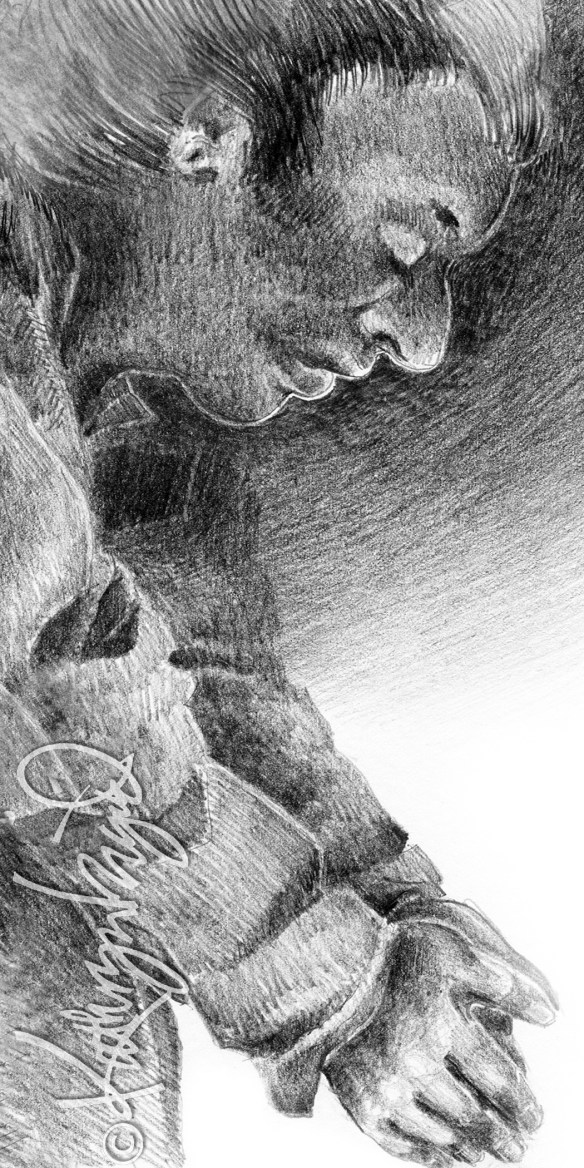
But treating others with such respect seems to me far more likely than argument and defensiveness, self-protection and fear, to get anyone to trust and respect me in turn. So shines a good deed. The unselfish willingness to accept another person’s reality as valid even when it might cost me something significant is a kind of courage I dream of having, hope to learn.Graphite drawing: Reach Down to Raise Up

Contagion vs. Compassion

“One bad apple spoils the lot.” That creaky aphorism is based on equally venerable experience. Rot is contagious.

Bad company makes bad behavior seem the norm, and we adjust our own standards ever lower accordingly. One or two disheveled houses bring down the values of the others in the neighborhood, and those, in turn, fall into neglect and decay as their owners lose the courage and determination to resist the incredible pull of entropy. What isn’t growth is death.

What leads otherwise good and sane people to fall apart like that? Doubt; fear; despair. These are the hallmarks of contagion: the plague succeeds in felling us not only through its own virulence but because rather than seek its cure with full courage and determination we flee with it hot pursuit, and when it eventually catches up with us, we topple, curl up in the fetal position, and succumb.

The fall of one member of the world community—like Mr. Duncan, who was felled by Ebola in Texas—is a very real and terrible loss for all. The loss of thousands—those dying in West Africa—is indeed a plague and a thousand-fold grief we all must recognize and bear. The response, though, cannot be equally contagious doubt, fear, and despair. That can only make us choose unconstructive, even destructive, responses like blame, xenophobia, retreat, and the neglect of our fellow citizens of the earth. Then, no matter how many or few have been overtaken by disease and disaster, the contagion will have won.Photo: Snakebit

Who’s the Wisest?

I give myself credit for being smarter than I am. I suspect, given what I see around me in this wild and woolly world, that I am far from alone in the practice. Even owls, a favorite symbol of wisdom, are not likely as perfectly ingenious as we imagine them, but they might still be more intelligent than the half of us.
Digital illustration: The Owl King

The Search Continues

Parsing paragraphs to find

The author’s complete state of mind

Is no more useful than to ask

A Word how it performs its task,

If we assume we’ve read aright

What’s only there in black and white.


The Long and the Short of It

How quickly pass the hours and days

and weeks and months and years,

And yet, how slowly pass our worries,

paranoiac fears;

This is the great conundrum that

presents in mortal time,

And quite enough of food for thought

in one quick, measly rhyme.