Foodie Tuesday: Some Useful Rules for Desserts

Our recent trip in Hungary, Austria and the Czech Republic served as a fine reminder that Europeans have some special talents when it comes to taking advantage of the fun factor of making and enjoying desserts. A cafe many of us from the choir tour group found on our stop just before crossing the Hungarian-Austrian border had a menu loaded not only with bright, shiny pictures but dessert items guaranteed to put any dedicated diner into a happy but instantaneous snacking coma.

Photo: Dessert Rules 1

You really have to admire any dessert that is not only as substantial as this but has booze or some effectively delicious substitute for it in the mix.

Photo: Rules of Dessert 2

Switch a few of the ingredients and keep the sugary deliciousness quotient (and possibly, the eaters) high, and the menu begins to expand. As do waistbands on both sides of the international border.

Photo: Rules of Dessert 3

Something with a typically European liquor flair keeps the menu distinctly local, perhaps. Even if your typography can’t keep up with your recipe tinkering, good taste will abound.

Photo: Rules of Dessert 4

Hot raspberry sauce = Heisse Liebe (Hot Love, a traditional romantic dish) when served over rich vanilla ice cream. A great dessert for honeymooners (I just happen to know), and another way to brighten up the sweetness of a giant sundae.

Photo: Rules of Dessert 5

No reason to limit the brightness of either color or flavor to raspberries and ice cream; why not add yogurt and kiwi fruit for some jazz?

Photo: Rules of Dessert 6

But really, if you’re going to get splashy with the colors and textures and flavors, why not get more elaborate yet?

Photo: Rules of Dessert 7

Or make some kid-crazy concoction that will invite the most stoic and stalwart child of any age to play with his food?

Photo: Rules of Dessert 8

Heck, why not just make the dessert as *big* as a kid. No point in being shy or subtle if you’re serious about making desserts that compel attention and ravenous attacks on the dish.

Photo: Rules of Dessert 9

Of course, if you’re planning to entice the larger, older variety of child to eat, you might consider making some semblance of slightly more grownup-sounding dishes. How about a nice spaghetti-style sundae?

Photo: Rules of Dessert 10

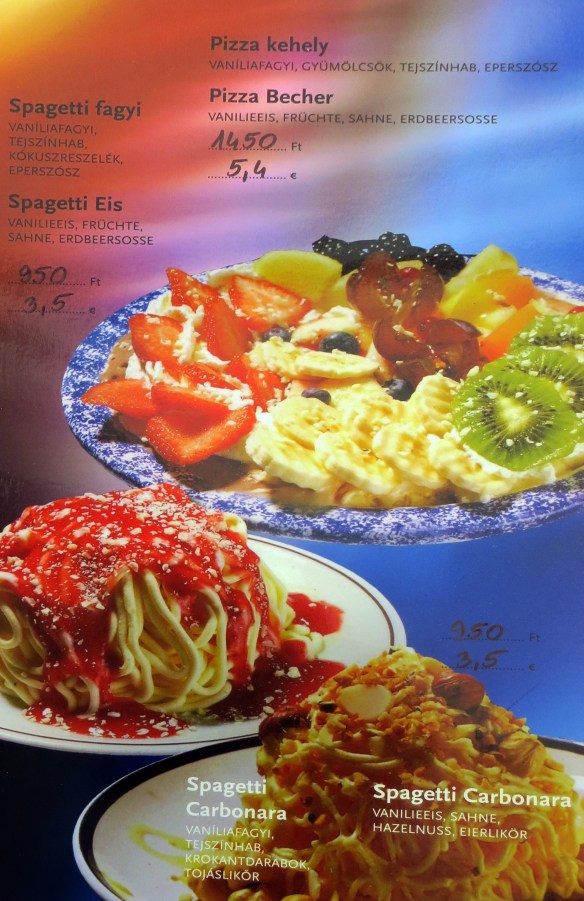
What, that wasn’t flashy enough for you? Try a Pizza sundae. Not surreal enough in the spaghetti imitation department? Make some rich, red strawberry sauce to pour over the ice cream spaghetti. Or for the more soigné palate, perhaps a Carbonara version.

Photo: Rules of Dessert 11

Still, I have to admit that perhaps my favorite from this elaborate collection was the skillet-with-eggs doppelgänger, which in its simple ingredients would likely be a very yummy, creamy dream of an apricot cooler for a hot afternoon and also take a good run at pretending to be much better for me than piles of whipped cream and sweetened fruit.

All of this enticement aside—and I did, however reluctantly, lay it all aside despite the strong temptations, having already eaten a pretty substantial and dairy-laden traditional European meal of ‘fried cheese’ (crisply crumb-coated slow-melt cheese served with a sweet tartar dipping sauce)—there are other dessert paths to my heart, even in the heart of dessert-magical Europe. So I waited a moderate amount of time for my digestion, stroll aided, to recover from lunch before I opted for a much smaller and less elaborate dessert. elsewhere. It was only a single scoop of Stracciatella gelato, but it was cold, creamy, rich and delectable all the same. I’m not made of stone, you know.


It Speaks to Me

What attracts us to certain artworks? Whether book or stage production, painting or photograph, dancing or theatre, singing or instrumental music, there has to be something with which we can connect for the work to have any meaning for us as individuals.Photo: Book of Languages

Some of those connections are obvious: an author with whose philosophy or politics I tend to agree is more likely to produce a book or script I enjoy than one whose beliefs are wildly different from mine; if I favor a specific style or period or medium, I’ll probably always find the works within them resonating in my heart more often than those from unfamiliar or less loved types.Photo: Familiar Passages

Other attractions might be more tenuous or less overt. I read a whole lot online nowadays, both factual and fictional, but I still enjoy reading magazines and books, and there is no digital substitute quite yet for the fine roughness of antique paper pages in my hands and the musty scent of old books.

Unbalanced

Love always makes us a little nutty, and that’s not a complaint.

Digital Illustration: A Little Off Kilter

After all, it’s the only explanation for how I’ve managed to be so loved all of my life!Digital Illustration from a Photo: Longing Ladies

One could do a whole lot worse than beginning and ending with love.

Tick Talk

Photo: Shoulda

Photo: Tick Talk

When You Come to a Fork in the Road…

…as the old joke goes, ‘take it!’ Silly and facetious, yes, but that’s about as close to decision-making as most of us can get when it comes to choosing between two or more equally excellent, terrible and/or unknown paths. We often dither so long before even reaching an intersection, just worrying about when and what it might be, that by the time we’re there we’re no closer to real and reasoned decisions and end up tripping all over ourselves while we fumble onto one branch of the road or another, sometimes even going so far as to get scared enough to back up to the fork and try another route instead. Which rarely tells us any more than utterly random movement what would’ve been the genuinely best choice. Just another of life’s unfair conundrums, after all.

Mixed media: So Many Forks in the Road, So Little Time

So Many Forks in the Road, So Little Time. Detail from a mixed media sculpted window valance in a vaguely neo-Baroque style. Fun, pointless, and well worth the making.

In art-making, thankfully, the results of such choices needn’t be either so clear-cut or so exclusive. Art is one of the environments most hospitable to a constantly changing mind or, barring the ability to decide at all, a good mash-up where the chosen option is ‘All of the Above.’ So I happily pot around making mixed media works, assemblages and a veritable multitude of artworks that are nothing in the least like what I thought I was planning to make when I started them. I love being allowed to not make up my mind, or sometimes to let my art make my mine up for me. This is undoubtedly a contributing factor in my perpetual inability to make anything remotely resembling a commercial success with any of my art, this indecisive character of mine. But it sure makes for fun playtime in the studio, and that at least is a sure distraction from any unpleasant paths life threatens to lead me down, so I guess I can’t really complain.

My One and Only

Despite its title, this post isn’t about my marvelous spouse. But it could be. After all, like the actual topic of the day, marrying him is one of the most meaningful, fun and satisfying achievements in my life, and an act I intend to perform exactly one time ever.

But don’t we all have those? There are certain life experiences that we are so glad happened or are so pleased we did, yet there’s no intention whatsoever of our repeating the episode. Whether it, like my marriage, simply cannot be replicated in all of its fabulous fantastic-ositude-inous-ness, or it’s too expensive or difficult or ephemeral to do more than once in a lifetime, there are just things that will only occur once in our lives.

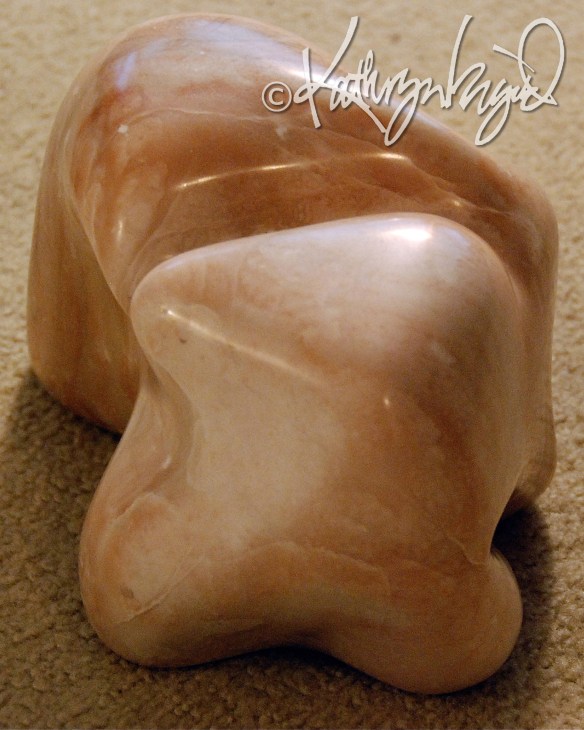
Making a stone sculpture is one such thing, for me. It was a required project somewhere along the course of my art studies, and I am glad it was required, because I doubt I’d ever have attempted it if the materials hadn’t been put right into my hands, the techniques taught to me on the spot, and the work necessary for me to fulfill the requirements of the class. I’m old enough by now to have figured out that there are a whole lot of activities and things in life I’d never have dared try, let alone figured out how happy I was to pursue them, if I hadn’t had to do them. Stone sculpting is one of those things that fell into the been-there-done-that category, finally, but besides having a decent little piece of art to show for it I am glad there was that one chance in the beginning.

Photo: Alabaster Sculpture

My very own [Untitled] alabaster sculpture, the one and only. Approximately 7.5″ (19 cm) H x 8″ (20.5 cm) W x 11″ (28 cm) W.

Luck and happenstance, of course, have their own parts to play in the determination of whether any new experience becomes a one-off or a lifelong passion. Or, like my marriage, a one-time event that turns into a lifelong passion.

In the case of the rock sculpting, there were a few particulars that [ahem] shaped my attitude about the experience. One was that when the pile of alabaster hunks appeared on the table in front of my sculpture class, I chose a piece, lone among the heap as far as I remember, that had no major, unavoidable fissures in it. This allowed me to make a piece that was not a lot smaller than the original stone without having large parts of it crack and fall off. And my bit of alabaster had some nice coloration, attractive pale veining, and a natural overall shape that guided my sculpting choices. So all I did was refine the existing form and exaggerated it, and that led to the abstraction I made in the end. I just aimed for a sort of rounded Henry Moore-ish sculptural curvaceousness to showcase the silky, milky beauty of the alabaster as best I could. It was a slow and fussy process to chisel out an alabaster sculpture, and it made me ever so much more appreciative of and awestruck regarding the accomplishments of all real stone sculptors throughout the ages. Also, glad not to put my perpetual laziness into extended servitude to stone carving.

So, yeah. I made an alabaster sculpture, and I kind of like the result. And I’m happy that I did it, that I had the experience and learned a deeper appreciation of that art form. And yes, I am also pleased that I don’t ever have to make another alabaster sculpture, with the possible exception of the if-and-when instance of my deciding someday to have another go at it. Meanwhile, I have a decent memento of the experience. And if I get tired of it as a decorative object, it’s big and heavy enough to make a decent doorstop. If not beauty, then utility: that’s kind of how those once-or-more decisions can go.

Sometimes It’s Hard to Tell Who’s Giving the Gift and Who’s the Recipient

I have been taught that it’s polite to accept generosity with good grace: say Thank You, show proper appreciation, and humbly know that even when you think you don’t need or want the gift, it is your turn to show kindness by recognizing its significance to the giver. That doesn’t mean I’m terribly shy about ‘re-gifting,’ or passing the gifts along to someone I think will better appreciate and use them, eventually. It also doesn’t guarantee that I’m entirely alert to when I’m being presented with something valuable and meaningful. Even when I’m fully aware of my undeserving, I’m not exactly a genius at generosity myself, let alone fully attuned to how much I am given and how often.

Take the times when I am being thanked with gifts for doing things that I should have done as a matter of course, and often have done very grudgingly at that. I have always been a poor excuse for a visitor, supporter and caregiver, being intimidated and squeamish and easily unnerved by others’ needs and ailments and trials. I was terrified of visiting my own grandparents when they were old and shut-in, unable to be the people I had known in their healthier and more mobile and cogent days, and could rarely face the strangers that they had become, let alone the alien and frightened person I was myself in their presence.

Long before those times, even, I was both younger and less experienced or brave, if you can imagine anything yet more craven. My parents had always taught me by example that care and compassion, generosity and hospitality and respect, all of these were essential life skills and characteristics that should be nurtured and cultivated through consistent use. And I never got good at any of that.

Once, when Dad was making a hospital call on a parishioner who was dying of cancer, it happened to be when Mom and I needed to be along with him for something later in the day and it wasn’t convenient for anyone to be shuttling back and forth multiple times, so Mom and I rode along. Somewhere on the trip I realized or was persuaded that I should join both of them in visiting this man who was a stranger to me, rather than sitting and waiting in the car on a cold, damp day in the first week of December. I’m quite certain that I was both reluctant and frightened to make this visit, parental support notwithstanding. I’d never seen a person so near to death, and his being unknown to me did nothing to ease my fears; if anything, my perpetual social anxiety probably spiked to all-time highs at the thought of meeting someone new just when he was about to die. I’m quite sure that I wasn’t mature enough to recognize that this was a clear instance of the occasion being ‘about’ him, and not about me at all.

I remember rather little of the actual visit, only little bits. I had met this man’s wife once or twice, so I suppose we exchanged some small talk about that acquaintance. He asked me about my interest in art and shared that, while he’d had some entirely different sort of day job, he’d always had a creative urge and had made many small stained glass pieces as a fond hobby, something I gathered he sold to make a little pocket-money at times. His inquiry about what was happening in my own life just about then eventually revealed that the anniversary of my birth was approaching just as the end of his life was to come.

He was a pale, yellowish creature after cancer had defeated most of his bodily systems and all of his treatments, bloated but in an empty way; an airy husk of the man that had been, now nearly ready to blow away. His hospital room smelled just like hospital rooms have always smelled, overlaid with the added imaginary pall of looming mortality. I wasn’t a baby—I understood well enough that his sort of death wasn’t contagious—but I couldn’t help itching to escape all the same.

When this pallid wraith offered me his dry, cool hand I took it in mine and held it for a while as he and my parents continued to talk softly about more needful things. I did my best to give the appearance of better bravery than I had, if not compassion, and still he showed me more sympathy than I expect I did him. He thanked us all quietly for the visit as we left, and I was too immersed in trying to console myself over the sadness and discomfort of it all to realize that it was he who had done the kindness.

I heard in just a few days of his death and thought with some melancholy of how sorrowful it must have been for him to face it, and for his loved ones to cope with its eventual, if expected, arrival. Only a couple of days later, I thought of him again.

It was my birthday, and among the presents I received was one small package that was not from a family member. My parents told me that my acquaintance had asked his family to see that I be given this gift as a token of his gratitude for my visit. It was a table-top stained glass flower he had crafted sometime back when he still had the strength and skill to make such things. The little blue flower bowed gently on its wire stem, and I was abashed and moved by it.

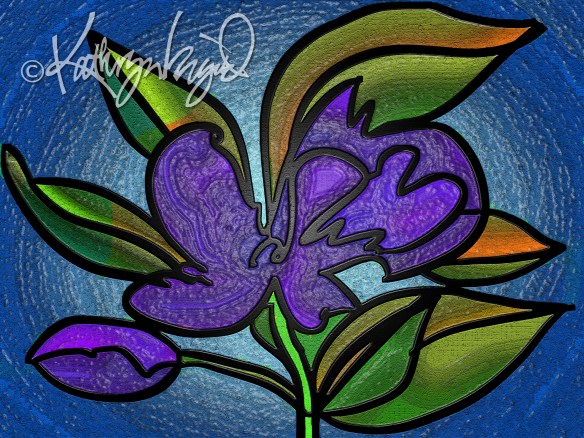
This was a delicate token of real grace. It made a fine representation of that goodness, its glass petals and leaves letting light filter through, its slender stem so fine, yet resilient enough to spring back upward when pressed. It was a flower that stubbornly refused to wilt, even when it was a post-mortem gift from a virtual stranger. I don’t know, after all of these years, precisely what happened to it or when and where it disappeared, but I kept it for a very long time indeed and found in its simplicity a constant reminder that the little things even a reluctant and weak person might do in the name of duty or expedience or, however hesitantly and ineptly, for kindness’ sake, might in the end have some power. That this power is not our own matters less than that it can change the course of the moment, or sometimes, perhaps, even make a difference in matters of life and death.Digital illustration: Stained Glass Flower

Foodie Tuesday: A Toast to Skagen

I have not yet been to Skagen, that Danish destiny so alluring to international tourists, fishermen and art lovers, but I have long since had an imaginary affair of the heart with it, thanks to the popular Swedish concoction known as Toast Skagen. It’s quite a simple thing, really, just toast points with a light shrimp salad on them, but when the shrimp are just-jumped-out-of-the-sea fresh and sweet and the preparation of them done with a delicate hand, it’s just about as good as seafood can get. So between visits to Sweden, I pine for the treat. It’s not that I couldn’t make my own facsimile of that assemblage, for even in the heart of north Texas there are places where one can lay hands on pretty good shrimp (at a price), but since the presence of briny air and piercingly radiant northern light and the lilt of Swedish conversation all around are also key ingredients regardless of their absence from the written instructions one might find for the preparation of it, Toast Skagen is still best savored in Scandinavia, and worth the protracted longings between visits.

That is why, if it appears on an even moderately trustworthy menu in Stockholm and its environs, I am likely to order Toast Skagen without even giving much of the rest of the menu a fair study. On the visit that just ended a few days ago, I did just that. Several times. And I was not disappointed—unless you count each time I ate the last bite.

The simplicity of the combination is key, because it must showcase the freshness of the shrimp, but there is room for subtle difference just as there is in any classic food recipe or combination that has survived the twin tests of time and chefs’ egos. The best preparation of Toast Skagen begins with fresh, perfectly cooked cold shrimp, is seasoned with nothing more noticeable than fresh lemon juice and fresh dill, lest the delicate salty sweetness of the shrimp be overpowered, and is bound with mayonnaise and served with or on bread. That’s about it. The subtleties come in with the proportions in the combination, the type of bread or toast, the presentation, and a few possible additional flavors and garnishes that won’t attempt to compete with the simple perfection of the concept.Photo: Toast Skagen 1

On this visit, I managed to taste three slightly different, all delicious, versions within the bounds of our ten days. I’m sure I’d have done more, but I did have to leave room for other favorites, and despite having eaten extensively and often, I did have to accept the finitude of hours in the day. Even though with midsummer daylight, those were admittedly impressive. The version of my shrimp-laden toasty dream that I’d been contemplating for the longest before our recent trip was had on our last day in Stockholm, for we had plenty of other places to go and people to see before then, but we did finally go to Sturehof, a venerable restaurant in a swanky but not stuffy neighborhood only a hop, skip and short T-bana (subway) ride from where we stayed. At Sturehof, I was greeted by lightly toasted points of white bread and a copious hillock of shrimp shaped with the help of a very light coating of mayonnaise. A toss of snipped dill, a mild dash of perhaps Dijon mustard to undergird the squeeze of lemon I’d give it, and a spoonful of Kalix Löjrom (caviar) to give a little snappy texture and sea flavor boosting, and it was a filling but refreshing luncheon to give our last day of play in Sweden a far less melancholy tinge.Photo: Toast Skagen 2
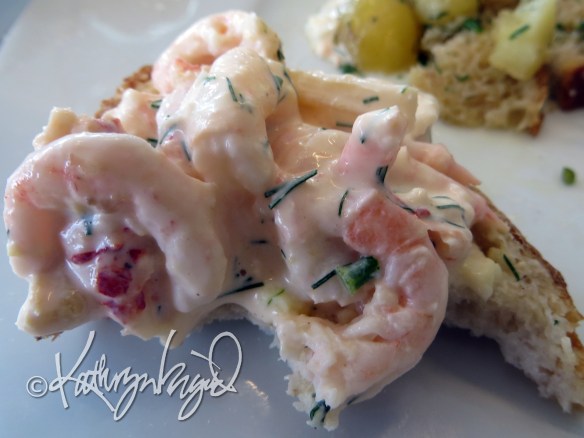
The second version of Toast Skagen was almost an afterthought in the middle of our visit, but far from negligible in the eating. My husband and I went with a dear friend to visit the fantastic Artipelag, part seaside park, part eco-tourist experiment, part art museum and all Swedish brainchild of the inventor of the BabyBjörn line of child care products. Unlike many museum cafes, this place’s eateries are worthy of a visit entirely unrelated to the call to check out all of the other wonders of Artipelag. We didn’t even bother to go up and dine in the restaurant upstairs after having a quick look at the buffet in the less fussy main level. It was an extravaganza of delicious and beautifully prepared traditional Swedish foods and their contemporary companions, and reasonably priced for such a grand meal at that. Among the attractions for me was an early spotting of other visitors parading their plates to the table with enticing spoonfuls of Toast Skagen in their midst, but when I arrived to select my foods at the board, the Skagen bowls were empty. Empty! Thank goodness I noticed that the staff continued to keep most of the dishes there overflowing with fresh batches of food, so I pulled up my fainting spirit and managed to down great quantities of other delectables before going back to find the missing delight replenished.

It was worth the wait, which, given the quantity and quality of everything else I’d been eating quite happily in the meantime, was no small feat. This version of Toast Skagen was either the plainest or the most complex of all, depending upon how one chose to dish it, dress it up, and/or accompany it when choosing from the fabulous array of salmon with baby peas, lovely cool salads, savory sausages, buttery tiny roasted potatoes, and so much more. I opted to keep it somewhat unfussy since it was really the dessert after I’d consumed so much other tasty food. There was splendid chewy, crusty peasant bread to be freshly sliced by my own hand from a warm loaf, so it seemed the obvious thing to merely take a slice or two, give it a slick of good cold butter, because to ignore good cold Swedish butter is very nearly a cardinal sin, and put a fat spoonful of shrimp on top. This variation had the mayonnaise and dill and very little else, but because the shrimp and bread and butter were so fresh and delicious, it was as close to perfect as need be.Photo: Toast Skagen 3

The first, and not least, helping of this craved creation that I had on the journey was on a tour boat that we took with other great local friends, while cruising leisurely through the archipelago‘s canals to have a short walking tour in Sandhamn before boarding for a leisurely dinner cruise back to town. The dinner onboard was a very pleasant, well-prepared selection of Swedish favorites, like the Artipelag buffet, but at this sit-down meal one had the choice of two fixed menus, with or without drinks and dessert, and ours had an option for my object of Swedish shellfish lust on it, so that was a foregone conclusion. This was the prettiest plating of the three, and had a couple of good signature tweaks worth mentioning. Besides the creamy, dill-speckled shrimp salad and a scoop of Löjrom for that snappy seaside pizzazz, there was a small stroke of Balsamic reduction brushed onto the plate and its piquancy gave a sweeter buzz to the usual lemon spritz, the latter still perfect in its way. And the garnishing lettuce and cucumber on the plate were so bracingly fresh that I only barely resisted turning Toast Skagen into Vietnamese-style salad rolls for the occasion. I munched the greens as a mini side salad, instead. Great textural contrast in one uncomplicated gesture.

Now, should you think I was so obsessed with this specific dish and with All Things Swedish All of the Time, I can assure you that my euphoric revisitation of beloved Stockholm and environs was filled with beloved friends, too, and yes, lots and lots of non-shrimp-toast-related food. More on that later. For now, be content that you know a plain yet elegant dish worthy of single-minded pursuit, and go forth in search of it yourself.
Changing Directions

Digital illustration: Changing Directions

Do I move at the whim of the slightest breeze? Often enough, I suppose. But what really changes my direction in life? Chance? Passion? Accident? Will?

I’d say it’s been one or another of all of those at various times, and perhaps occasionally a combination of elements. What I would say most definitely and commonly is that I have rarely known very far in advance what direction my life would be taking, let alone exactly when. Living with uncertainty is at the heart of the human condition. We can’t know (nor would I wish to know) much of what lies ahead for us. Being an artist, and married to an artist, I have made some choices that guaranteed perhaps an even deeper and more frequent susceptibility to wondering what comes next. While both of us have taught at times, an occupation that has a degree of predictability and dependability absent in most other employment that involves our artistic skills and training, it never prevented the question from arising in other ways.

For me, as a longtime adjunct at the university, it meant that though I’d been there for nearly seventeen years (most of those, full-time) before I stopped teaching, I never had a contract in hand for more than a year at a time, nor was my class load or schedule in any way predestined; I taught what I was asked to teach, when I was asked to teach it. For my spouse, a tenured full professor and director of his division, he still had questions about how he might change and grow as a teacher, never mind whether to apply for or take any of the other positions on offer at other places from time to time.

We are, I think, pretty much the ordinary pair when it comes to that sort of thing. Even now, after many years of doing particular kinds of work at specific places and getting plenty of satisfaction from those various tasks, it doesn’t in any way stop us from asking, What next? Will we continue on the present path exactly as we are just now? Do we opt to  make any kinds of transitions, either changing the way we do what we do or the venue for doing it, or does something entirely new entice and draw our interest? If it does, is it attainable? Is there some utterly unimagined thing lurking just around an unsuspected corner, waiting to draw us in?

At times, it can make me feel as though I can never quite catch my breath or my balance. I tire of asking myself all of these whys, hows and what-ifs, yet I can’t resist scratching at the questions the minute I thought I’d put them to rest for a while. Even when I’m most happy and fulfilled and contented, I always wonder what lies ahead.

And that, of course, is the very heart of that human condition. We know that change is inevitable. We know that some of it will be by our choice, and much of it will be thrust upon us or sneak up subtly and surprise us all the same. And we know that, in some ways, the only guarantee we have is that we will all die wondering. It’s what we do, and it’s who we are.

Shadowy Façade

digitally doctored photo

There are endless supplies of guides on How To do something-or-anything; I’m more concerned with How Not to Do It. Much of the how-to tutorials seem aimed more at giving us a gloss of respectability in the subject, a sort of facade of excellence, than actual, practical depth. Expertise is, obviously, a relative thing, after all. It’s not all that hard to be considered an expert in or at something that is very rare or an extremely new discovery or invention: lack of exposure guarantees that few can have mastery. A whole lot more, however, is skill or knowledge that takes a dedicated effort to master to any level of real expertise.

My greatest expertise, if I can be said to have any, is probably in the category of performing ‘filler’ duties in most of the activities I try. Work as I may, I’m not likely to become great at most, and I seldom find learning anything all that easily or swiftly done. Being naturally lazy, I’m even less often found pursuing new knowledge and skills with great rigor and vigor just for their own sakes. So at best, I tend to end somewhere in the middle of the pack. I like to think of myself as the necessary delineator between the great and the mediocre.

All silliness aside, this seems to me an age in which we, collectively, have lost our appreciation for true expertise. Maybe it’s my imagination, but I get the sense that somewhere between the assumption that a speedy dash through Wikipedia will provide all the wisdom we need on any topic and our fascination with outliers—finding the novelty of savants and overnight sensations far more exciting than hardworking earned-doctorate intelligence—and the sense of entitlement our privileged modern existence gives us, we lose touch with the value of elbow grease and passion.

I wasn’t born either brilliant or extraordinarily gifted, and I’m not ashamed of that. But it’d be a pity to go to my grave without having tried to improve on what few bits of intelligence and invention I do have. If I manage to do my best in the present and keep moving toward an elevated horizon, I may not change the world for the better by a single degree, but I will certainly have bettered myself and I might have the slightest chance of shedding a little light around me as I go.

Looks like I’d better get moving!