The Menace Above

digital illustration

The Bird Gets the Last Word

You stay down there, and I’ll just sit

Up on my perch, whistle and chirp

And warble ’til you throw a fit

Because I’m being such a twerp—

I’ll flap and flutter, cheep and caw

And drive you right out of your tree

Until you want to break the law

And take a shot or two at me—

But I, no matter how you squirm,

Won’t quit my pestering; so far,

I’m winning, you poor lowly worm,

And soon I’ll also strafe your car.
digital illustration


If You don’t Like the Weather, Wait a Minute

photoHave you ever seen a pigeon flying backward? I did today. This phenomenal occurrence was not because I spotted a mutant genius helicopter pigeon; that really might be a matter for tales of magic and fantasy, given the modern pigeon’s brain.

It was that windy. The pigeon was making a valiant effort to take off from the edge of a roof and, blown instead straight backward, finally saw the same edge directly under him and came right back in for a landing. What’re you gonna do?

The wind is giving us a good whack here in north Texas today. Two days ago, it was over 80°F/27°C, brilliantly sunny, and calm as a sleeping cat. Tonight, we’re told, we can expect freezing temperatures and should cover all of our tender plants in the garden. A couple of days before our balmy pseudo-summer day, we had a storm pass through. Parts of our town had a little thunder and lightning and a fair amount of rain with a little bit of hail mixed in it, but nothing extravagant by local standards. Our house was in that lucky sector, and so was our car while we drove home in The Weather. Just across town, others were not so fortunate: some had hail the size of golf balls or larger, and tornado-like gusts, and among the downed trees and limbs there were homes where the roofs were destroyed or caved in, cars were damaged or totaled by metal-dimpling all over and glass smashed through, and interiors soaked with the rain and debris thrown in through the broken windows.

We’re torn, in more ways than strictly the physical, around here.

We crave every drop of H2O that we can squeeze out of the sky; even after a relatively mild number of months, our lake levels continue to be well below their norms, some still fully in drought status. It’s not considered a plus if you can drive directly to where your boat is moored, in case anyone wondered. All the same, if the moisture is dumped all at once as though shot through giant firehoses, it doesn’t always stay where it’s needed but instead causes flash floods, undermines foundations, uproots vegetation and breaks down buildings and roads left and right.

Doesn’t matter what you call it—climate change, global warming, a thirty-year cycle, or evil pixies run amok—the weather all around this wonderful, messy planet is more extreme than it had been for much of recent history. The extremes are more extreme, the heat and cold, the wind and dead stillness, the flooding and droughts. Only the inconsistency of the weather seems to be more, well, consistent.

All somewhat amusing, if the worst one experiences is the occasional sighting of a pigeon flying backward. But of course, that’s the least of it. Ask our neighbors who sustained major damage to house, car and property all at once last week. Ask the people—the peoples—displaced by tornado and typhoon, those who have lost home and family to the floods and famines that massacre everyone in their paths throughout whole regions.

I don’t much care about whether we’re partly to blame for the seeming extra intensity of nature’s capriciousness and fury at this point. It’s not all that different, in my mind, from all of the displacements, distortions and destruction in history that we can absolutely attribute to human invasion, conquest, greed, prejudice, ignorance and evil. As horrible as that stuff all, genuinely, is, it is: it exists, already. What matters is what we do now in order not to perpetuate the ills, and better yet, to mitigate them as best we can. We can’t undo history, and we can’t control nature. But we can and should change our attitudes, practices and beliefs (and the governing processes needed to support those societal improvements appropriately) in whatever ways will support a far better world, one where wars, rape, murder, slavery, thievery, violence and all sorts of other horrible human actions are not only universally condemned but undesirable to enact.

And, since we expect that we, and those generations who succeed us, will continue to need to live on this specific planet and its resources, hadn’t we better think up some less selfish and more practical ways of easing the effects of nature just as much as our effects on it? We won’t likely figure out how to stop the wind from blowing with great intensity, floods from filling valleys, hail from pelting like rocks out of the sky, or lightning from searing and exploding whatever it can lay its fiery fingertip on, but if we put our minds to it, maybe we can think up some reasonable ways to protect more people, and care for those who are affected, better.

I didn’t really start out with the intent of rambling on about this stuff, but it’s on my mind. Probably not so different from the pigeon’s reaction when he discovered his original flight plan wasn’t viable. Can I fly backward? I don’t know. But I’ll bet it’s worth trying, if I find myself needing to make an emergency landing. No matter how the wind is blowing.photo

Memories are Migratory

A flock of American Robins passing the area through may not seem especially worthy of note to some people. But if, like me, you remember them as one of the prevalent birds around you when you were growing up, you might notice it with a certain eager delight when several dozen of them descend on your holly tree and Indian Hawthorn hedge all of a sudden and dive on the berries like divas on diamonds. I noticed.photo

I had been seeing the signs of the early northward migration already, as the grackles that never entirely leave north-central Texas no matter what the season or weather were in ever larger clouds that swept from field to field and perched in growing masses at those points on the trees, hedges, bridges, billboards and power lines where we come to expect them to collect at dusk. It seems to me as though the sheer volume of grackles in the region means some have to migrate, however slightly, just to stay on the fringes of their preferred climate, so when the seasons change I do see even more than the typical congregation of those whistling, flitting avians hanging about on every corner and post.photo

But the robins, well, they are not so often seen in my own back garden. To be sitting at my desk and hear that familiar liquid warbling is to be transported to when I was climbing the backyard apple trees of my childhood. I looked up on that more recent afternoon from the predictable digital ‘pile’ of email and saw the unexpected flash of russet on a bird’s breast as it streaked by my window, then another and another, and suddenly felt I was in the midst of a happy storm of robins as they dashed and dove, a modest flock perhaps but enough in number to nearly strip the hedge and the little tree before retreating to the woods of the ravine behind for the evening. By next morning, there were fewer that came back for a final pit stop before the whole collective took wing to continue north. They came and went so fast, and moved so quickly and stealthily in the shrubbery in the meantime that I had no moment to grab a camera and commemorate the welcome moment.

The moment will, however, remain, just as the childhood pleasures were revived in the first chirruping calls and those quick glimpses of rosy feathers: robins will stay in my heart as long as the memories remain.

All Gardens should be Herb Gardens

photoI am prejudiced. It seems logical to me that any garden grown for beauty should be grown for utility as well, and any garden grown for use ought to be pretty to look at and full of great sensory experiences well before it gets put to work. Why shouldn’t gloriously pretty edible and functional plants be shown off in all parts of the landscape, and why shouldn’t we take better advantage of what we have growing around us anyway?photo
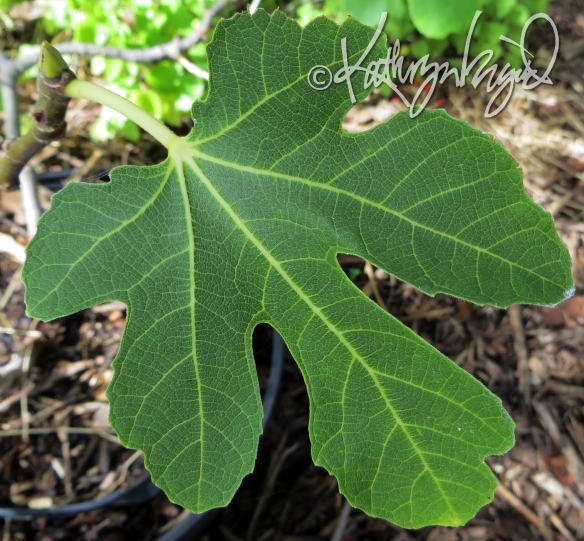
Thankfully, these biases of mine are becoming more widely put into practice all the time. While kitchen gardens have a grand tradition of being ornamental and landscape design has long had its elements of utility inserted, those approaches have tended to be rather exceptional than the norm. So I’m thrilled to see such a proliferation, a flowering, if you will, of the whole concept that these belong as integrated into a delightful whole.photo
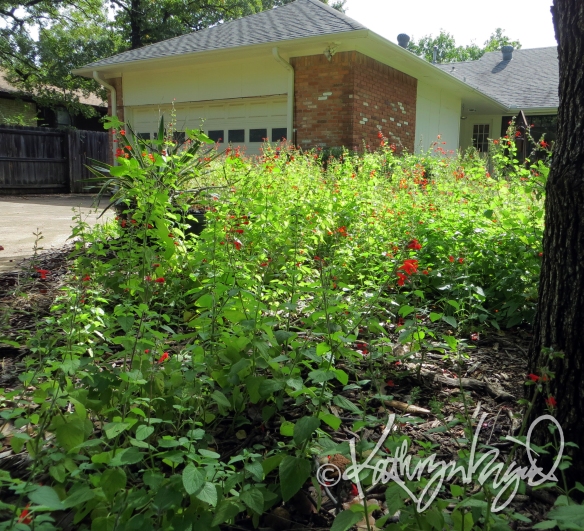
My friend Christopher’s interest in starting the garden personalization of his next home with herbal inclusions and infusions (not to mention his appreciation of adventuring in the kitchen) got me thinking about my own past and present herbal operations. What do I consider a good framework for inserting my own preferences, herbally speaking, into the garden nowadays? And what, in turn, is actually happening in that way here? Not surprisingly at all, this thinking turned into a lengthy exercise in list-making. Herewith, my mental inventory of herbal ideas. Foremost among them: that I plant every and anything in my garden where I think it will thrive best, then opt for where it will provide the most splash and panache in complement with the nearby plants, and finally, tuck in some elements of surprise wherever I think they can inspire even the casual visitor to the place. Herbs, fruit, vegetables, common or exotic. So long as I’m not trying to subvert the laws of nature too far, let alone encourage an invasive alien species anywhere, it’s all fun.

For the moment, though, I’m focused mainly on herbs and a few similar animal (human or otherwise) friendly options.photo montage

Easiest to keep as perennials or self-sowing annuals are some of the best kitchen basic herbs and also some of the prettiest flowering or border texture plants, so they’re what I’d call genuine bargains in the herb dept:

Parsley (curled and flat-leaf); both can get pretty large over time, but are also pretty easy to cut back if necessary. Be prepared for gigantism, since parsley can easily top two meters in height when it’s stretched out in bloom.
Chives (common and so-called Garlic Chives); both give that nice light oniony flavor, and of course the ‘garlic’ variety has a hint of garlic in it as well. The purple pompom-like head of the common chive is attractive in the garden or as garnish and also edible, but I’m especially fond of garlic chives as a garden plant–they don’t look at all like the common chive, having a flattened stem and clusters of tiny white lily-like flowers in place of the purple variety’s.
Rosemary comes in a wide variety of shapes, sizes and leaf lengths, most tasting similar. It’s a woody, shrubby plant in general, but some are upright, some trailing. The blooms vary: white, pink, lavender, purple, even quite blue, depending on the variety. Pretty and fragrant even while still in the yard, and bees and butterflies tend to like it too.
Thyme also comes in a ton of forms. Its types vary slightly in the pink-to-violet bloom range (quite tiny flowers) and quite a bit in the leaf type: white- or yellow-edged green, solid green, silvery; some, like Lemon Thyme, have mildly differing flavors as well, and some, like Woolly Thyme, are more strictly ornamental. Me, I’m quite happy with common thyme (Thymus vulgaris); it’s really quite easy to grow, even as a sort of ground-cover plant in borders, easy to control, has those cute little blooms, and is a very versatile herb for cookery. My favorite with chicken.
Sage is pretty easygoing, too, and also has numerous colors. I like growing the purple-leaf and variegated yellow- or lime-and-green varieties for what they bring to the flowerbeds. They can get big and leggy and woody, so sometimes sage plants require some good pruning, but it’s not hard to do with them, and sage is so lovely with poultry and winter vegetables, not to mention that their fried leaves are fabulous with lots of dishes!photo montage
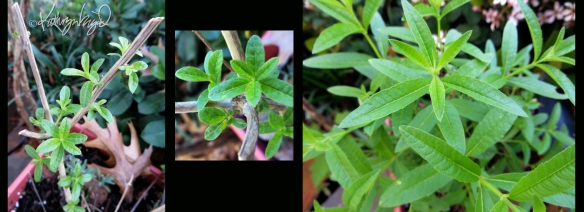
Some of the less common ones I love are well worth mentioning, too:

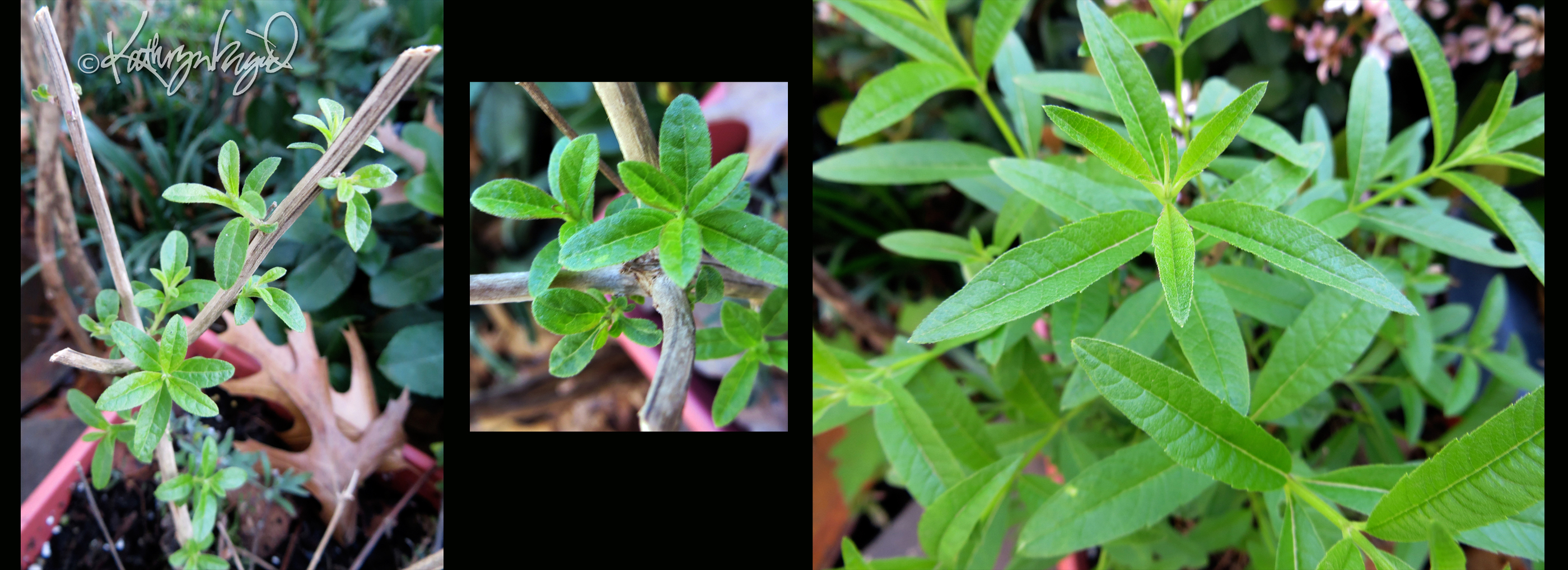
Lemon Verbena is better started from a live plant than seed and is fragile. I suspect it could work as a kitchen-window dweller for longer life, though I’ve not tried it indoors. I got lucky with it wintering over last year! As I said, great to add to tea (hot or iced), and would be dandy in anything where you want a less astringent lemony, kind of perfumy, flavor. There’s a lemon verbena ice cream recipe on epicurious.com that is sheer HEAVEN.
Borage is an annual, but I got lucky last year and it self-sowed from the previous season. It’s a kind of straggly and tall plant and has hairy, even lightly spiny, leaves and stems, but the hairs actually look kind of pretty in daylight, adding a lacy aura to the plant, and they don’t outright hurt when you touch them at all. Both leaves and flowers have a lightly cucumber-like flavor that’s nice in salads or cold drinks (chop the leaves finely or smash ’em to keep the fuzziness from being an off-putting texture in food), and the blooms are gorgeous, starry, true-blue dainties.

&    Sweet Bay, if you have the room for an actual tree, is a pretty one and exudes a faint resinous perfume on a windy day as well as providing bay leaves for all sorts of cookery. In a former home I had a 4 foot tall lollipop shaped semi-bonsai one I grew in a big galvanized tub and wish I could’ve taken it with me.
&    Saffron is both useful and a glorious choice for the garden, being the dried stigmas of a very pretty kind of crocus. These bulbs don’t naturalize readily like some crocus, but are of course worth the effort and expense if you can get them.
&    Sorrel‘s bright acidity makes it a welcome herb with which to spike a salad, my favorite use for it. The zippy sourness comes from oxalic acid, so it’s not something you want to eat by the bale, but it’s not so potent you can’t safely make soup or just eat it raw in small amounts. The flower stalk is slightly weedily aggressive, and the leaves are very popular with munching insects, but since it’s not a virulent spreader the flowering isn’t hard to nip, literally, in the bud, and those insects are often butterflies and moths, so I’m happy to share with them.

Some herbs are big on flavor but not worth trying to grow in the wrong climate or simply too short-lived for my lazy wishes:

&    Cilantro: I love it, but it bolts (goes to seed) so fast that unless I grew a huge patch of it for one-time harvest and freezing or kept planting it repeatedly through the season, it’d be sprouted and dead in no time, so I’m happy to pay farmers to grow it for me.
&    Kaffir lime leaves and lemongrass and ginger (okay, that’s a rhizome, not an herb) are exceedingly delish in all kinds of Asian foods but require more tropical conditions than I’ve lived in for their happiness!photo montage

Some annual herbs are worth the effort, even if they don’t tend to self-sow:

&    Basil is one that I have been known to plant in a couple of varieties a season for different purposes: the purple leafed types are pretty as well as decent tasting; Thai Basil gives a specific and welcome familiar spice to Thai and Vietnamese cookery; Sweet Basil is the most versatile flavor king among them. They all have nice blooms, though not showy; if you let them bloom, though, they tend to wind down as their work is done, so you want to keep beheading at least some if you plan to keep using it through the whole growing season. Then basil tends to keep proliferating. Cruelty pays! 😉
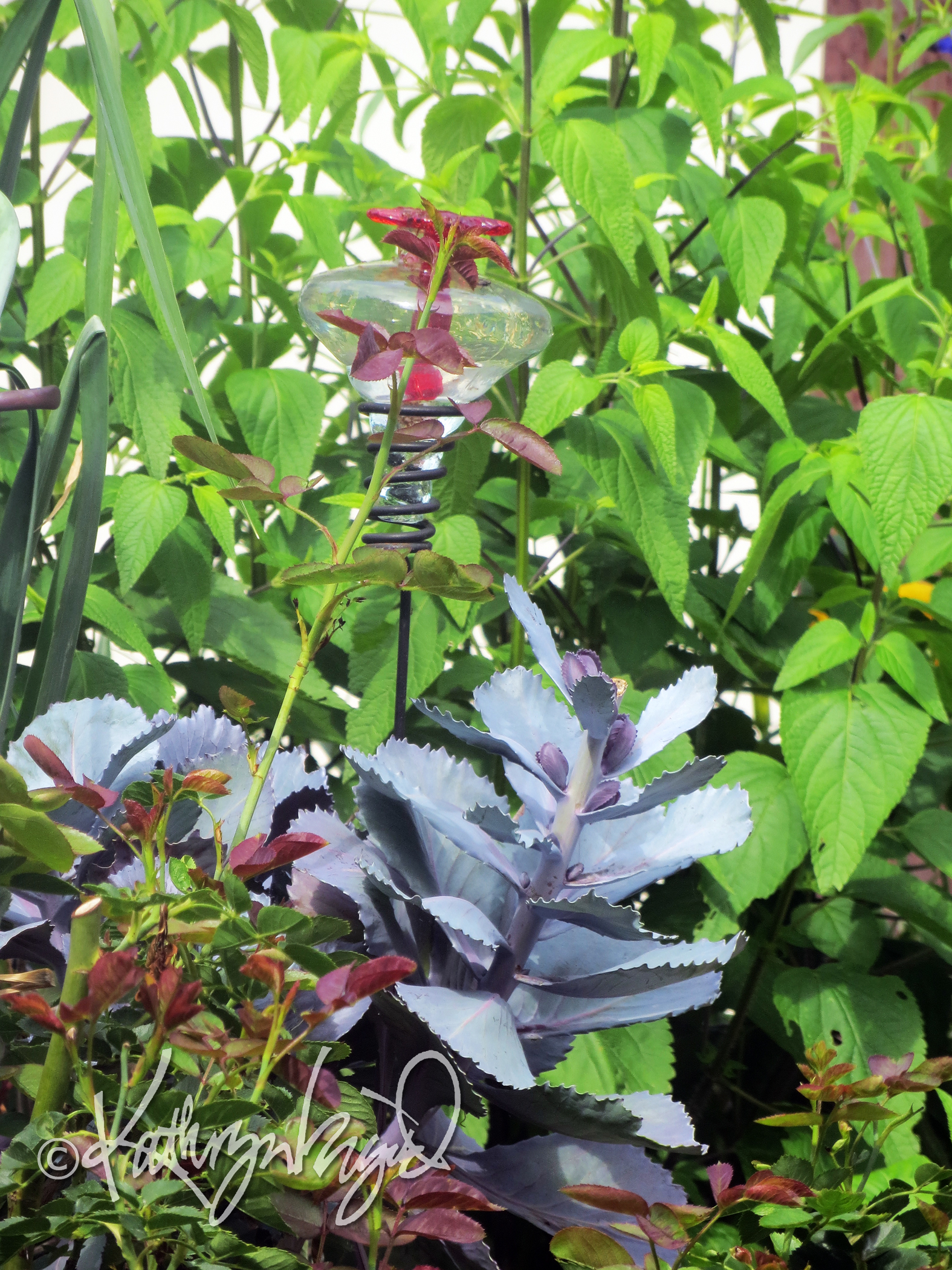
&    Lettuces are of course lovely, but cabbages too are often forgotten as ornamentals, but as you know, I like planting them for their leaf color and texture, can cut occasional leaves for food or garnish, and when I leave the rest to do so, they bloom in very hummingbird-friendly ways and are a fun novelty in the flowerbed as well. Another lettuce cousin I like a lot is chard (silverbeet), whose leaves are tasty spinach imitators (raw or cooked) and whose varieties include some with great colorful stems that make them look like rhubarb or Pop Art versions of it in yellow and orange. Mine wintered over this year in the front flowerbed, surprisingly. Radicchio is a great member of this whole group, too: edible and showy burgundy colored leaves, and if you let some or all of them go to flower, they’re tall blue daisy-like things. Quite delightful.
&    Shiso, or Perilla, is a less commonly used leafy herb in the US, but the popular Japanese treat comes in a number of often quite attractive leaf shapes, textures and colors. I grew a gorgeous one some years ago that had a slight scallop on the leaf edges, a gracefully veined texture, glorious purple and green-black hues, and a spectacular metallic sheen. I confess I didn’t use it much for food because I couldn’t bear to snip it.
&    Garlic and Onions, on the other hand, have distinctive and fun flora, and can survive longer term if you don’t choose to dig all of them up to eat.

Some herbs are potentially invasive pests but I still like them for their beauty and/or culinary gifts, so I’m willing to keep massacring them occasionally to keep them in check:

&    Oregano spreads fairly easily but is a pretty bloomer as well as a tasty leafy herb, and not awful to control.
&    Mint is a genuine monster that wants to take over the world, especially my favorite commonly named ‘apple mint’ (huh??? I’ve never figured out what’s apple-y about it) that’s so incredibly versatile, but I try to plant it in places where it can spread without turning into square-stemmed kudzu. There are a number of interesting and fun varieties of mint ‘flavors’ available, but I stick with my old reliable despite the allure of Chocolate Mint, Orange Mint, and even true Peppermint and Spearmint, since one aggressive invader variety is enough for me. Wintergreen is a beautiful plant but, besides not being a mint variety at all, is pretty hard to find. It’s a broad-leafed evergreen with small white flowers and big pinky-red berries, and the crushed leaf is wonderfully fragrant, but it’s not commonly found, isn’t a snap to prepare for edible uses like most of these others, and has a picky attitude in climate and growth requirements. Still, I did grow it once in Washington because of its peculiar attractions. Maybe I feel an affinity with it by virtue of my husband’s having chosen me for my peculiar attractions. Ha.
&    Dill is sometimes known as Dill Weed for good reason, as it can run rampant in friendly climates and it’s a large, blowsy plant despite its delicate thread-like leaves. But its starburst flora and subsequent seed heads are pretty among the leafy lace, and it’s so danged delicious in so many meals that even if your climate is conducive to such running amok it’s worth the trouble. Besides, in that case you can at least put in some of the dwarfish kinds of dill. Pretty unbeatable with fish, and indispensable in deli pickling!
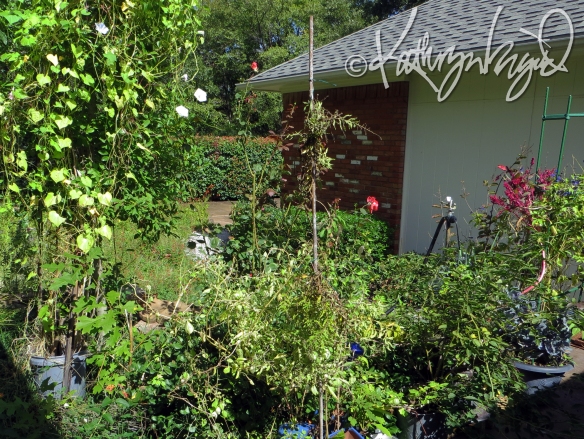
&    Fennel is similarly a member of the uncontrollable-toddler plant type, moving aimlessly but at speed all over the garden and being a big showoff of a thing, but even if you’re a little hesitant about the licorice-y hints it gives food, it too has a nicely delicate look for such a tall plant, and you can bring some nice color into the beds by planting bronze fennel. Just chop it ruthlessly when it wants to flower to keep it in check. I’ve never tried growing bulb fennel myself since as rarely as I use it, it’s easier to buy it and give the garden space to something else.photoClearly, I could wander on like this for ages. My experimental wildflower mini-meadow out back has behaved modestly well in its first half-season last year and appears to be letting a few sprouts emerge for a good beginning again now. I will go out in the next few days and give it a thorough haircut with the weed-cutter so that it has its own mulch through the remaining unreliable chills of late winter and early spring, and have been feeding it a kind of pre-compost over the winter by tossing the chopped and blended remains of the kitchen’s dregs in and letting them freeze and decay gradually as they would have in a regular garden, and will add to that with some other treats as the patch begins to revive. I am very curious to see what of the multitudinous kinds of seed I’ve planted out there now makes an appearance and what will take hold for the long term, as much of what I put in was intended to be naturalizing perennial feed for the birds and insects as well as soothing wildflower beauty. The bonus, if all goes well, will be lots of herbal fun for my dining companions and me. Only time and Mother Nature will tell.
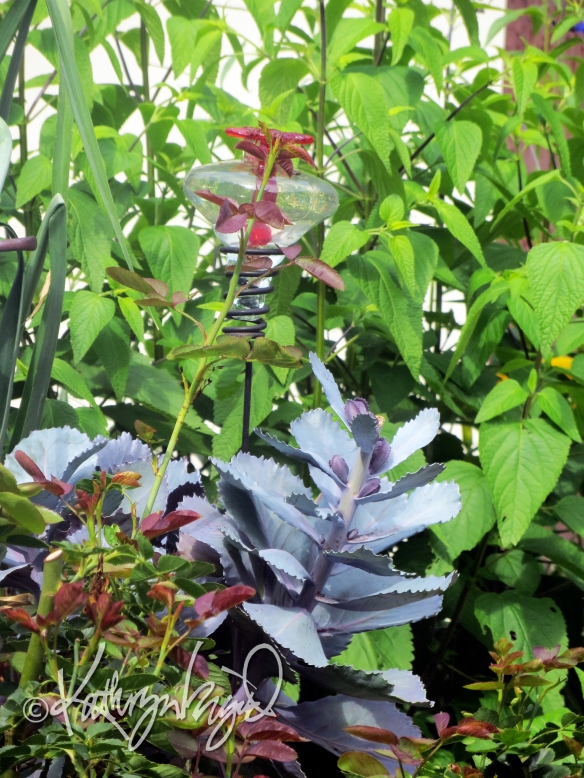
photo

A Lovely Lass & Her Longing Lads

Ginger Bred

Once upon a ginger lock, I made a little wish

That every bird in yonder flock and every silvery fish

In yonder stream should stop to see how lovely and, alas,

Aloof from my sweet would-be love was yonder ginger lass,digital illustrationFor she was sweet as mead and mint and lilies in the glen,

And many were the lads who looked on her, as I did then,

With wishful hearts and hopeful souls, yet Queen of bees was she,

To sting our hopes, who wished and dreamt and loved her gingerly.

For my good friend Jim and his merry band at gingerfightback.

Keen Eyes do Not a Keen Mind Make

For most of my life I’ve had outstanding vision. I had a little interlude in grade school and junior high school when I wore fairly weak glasses to correct my slight farsightedness, but it was indeed correctable, and after about three years I was once again glasses-free, and this state of uncorrected bliss lasted until I was a whole half-century old. During my external-lens-less heyday I could see all sorts of things with great crispness and clarity and in glorious detail. Unfortunately for you, this did not extend to my seeing the truth more clearly than others could or to my understanding anything more clearly than anyone else did.photoHaving sharp eyes doesn’t, it turns out, equal having a sharp intellect. Dang.

It’s as if the universe didn’t care whether I’m a blithering idiot, no matter how excellent my eyesight. Come to think of it, a convenient combination in a person wishing to be an artist and writer and having no particular need or wish to do so in a reality-based universe. So here I am, all of those years post-first-spectacles, once again enhanced in my ability to see things by artificial means, and yet no smarter or better able to clarify the meaning of existence or even an itty bitty little part of it than I was with no glasses near my peepers. Go figure.photoMy appreciation and admiration for genuine intelligence may have increased over the years, to be sure, but the need for such things seems, if anything, to decline steadily and in perhaps directly proportionate amounts. What this says about me I will leave to your imaginations. At the same time, I needn’t leave everything to your imaginations, because as my goofy insight into things utterly fictional remains entirely intact no matter what happens to my eyebulbs, I can assure you that I will continue to produce all sorts of whimsical, bizarre and deeply educational items for your perusal here at my blog. It’s what I do.

Imitation Flamingo

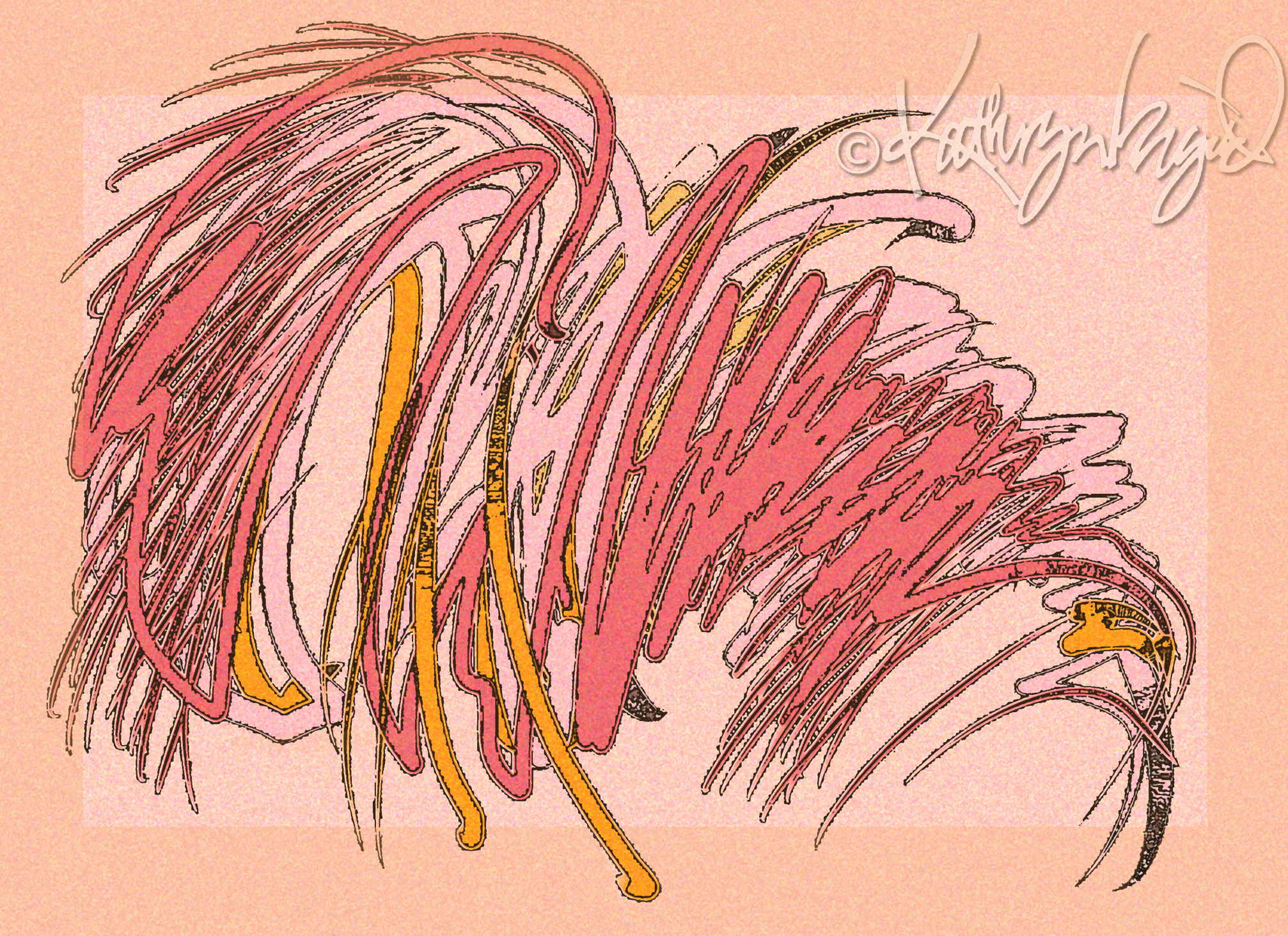
digital illustrationHere’s the thing about flamingos: they’re living contradictions. They’re some of the least altered descendants of the dinosaurs, yet in the twentieth century they became icons of modernism in art and design in large part for the very strangeness that ties them so closely to their ancestors. In the span of that surge of popularity, they also had both the high-cultural cachet of favored subjects in Art Deco’s glamorous creations and the lowbrow delights of trailer park plastic lawn decorations. The elegant long necks, graceful broad wings, and that magical coral hue of their plankton-painted plumage are counterbalanced by rather gawky squawking voices and oh, my, what an unattractive smell.

Here’s another thing: we human-types tend to have a certain ambivalence about many things in our lives and appreciate that the world is far from simple. So it’s not surprising that many of us should find flamingos fairly intriguing and compelling. They’re kind of weird. They’re sort of good metaphorical stand-ins for us.

I’m fond of and amazed by birds. I’m particularly drawn to raptors and songbirds, but truth be told, I wasn’t so taken by flamingos, and when I got to spend a tiny bit of quality time in their presence in zoos or parks, I was amused by their seeming clumsiness and more than a little taken aback by their stink and noise. Guess you won’t be surprised, then, to know that when I had a little time to reflect on it–well, it was my own reflection I saw. I’m still thankful I’m not an actual flamingo, since people mostly don’t laugh openly at my foibles when in my presence, and hardly ever tell me to my face that I’m stinky. All the same, having that little picture stored in my mind is useful. I may still be slightly ridiculous, in my stumbling, silly way and with my imperfect voice and showy but eccentric ways, but I guess if flamingos can be such wonderful and iconic beings with all of their oddities, why shouldn’t I, too? Flawed and goofy I may be, but I’m an amazing creature of my own kind.

Country Comforts

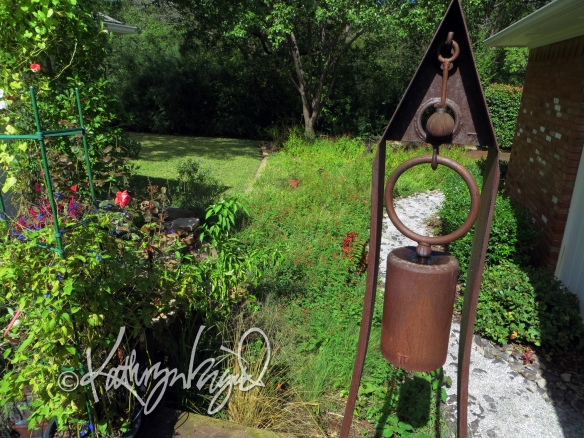
It’s easy to indulge my love of the bucolic and pastoral when I live where I do in north Texas. This county is full, as it has been for generations, of farms and ranches of all sorts that intermingle freely with the towns, cities and suburbs of the area. Whenever we take a drive or go running errands, we’re just as likely to see fields full of sorghum or corn, red or black Angus cattle, or sleek tobiano horses as we are shops and schools and natural gas pumping derricks.photo montagePlenty of relics and remnants still stand that tell me it’s been this way for a very, very long time. The little bronze school bell and windmill that remain standing right next to the old Ponder schoolhouse’s clapboard walls seem perfectly ready to go back to work (with just a tiny bit of functional renovation first, of course)–or to transport me instantly backward into the nineteenth century. A small private herd of longhorns spends its days in a cozy paddock that sits directly next door to a modern brick housing development, and on the other side of it is a stretch of fields full of wildflowers and prickly pear, punctuated by the occasional gas well and electrical tower, the latter often populated by small flocks of turkey vultures.photoAll of this makes an atmosphere highly conducive to my happiness: the conveniences and riches of contemporary urban existence, conveniently interspersed with spirit-soothing farmland or ranch and historic pleasures. If I play it right, I can feel like I’m on vacation no matter which world I happen to be in at the moment.

Hey! Over Here!

photo

My skills of salesmanship are nothing to crow about. If I try to show off too much I’m far more likely to end up eating crow.

Self promotion is a gift. Some people are born wheeling and dealing or have inborn salesmanship, and others are born artists. Okay, that’s an unfair generalization, to be sure, but as an artist myself, and one admittedly devoid of any sort of business acumen or PR skills, I also know a ton of other artists of all stripes who, left to their own devices, would or will forever work, then die, in obscurity. I am glad and relieved that there are people for whom the promotion of others is an interest, skill set and/or gift.

If it weren’t for the practitioners of good business, whether as active promoters of artists’ work or more indirectly as patrons (buyers or spouses, for example), lots of us in the arts would either have to give up our artistic vocations or starve in the legendary garrets of the unsuccessful, regardless of talent or commitment.

There’s no obvious solution to this perennial artists’ dilemma, since being self-promotion-challenged so often includes being confused and intimidated by even knowing how to find and secure an able and supportive agent to carry the weight. What a conundrum.

This post, as you would naturally guess, is not a how-to. If I had the answers, any of them, I probably wouldn’t be here talking to you or even cognizant of this puzzle at all. This is, instead, a note on my own perpetual wrestling with the questions of what to do with my creative impulses besides rambling around with them towing me by the heartstrings. I may forever stand in mystified awe and envy of those who know how to crow.photo

Feed the Birds

I loved the movie Mary Poppins when I was small, and surely will still love it whenever I see it again. The charm of the story combined with such a well-cast ensemble and the magic of cinematic technology are hard to surpass. I loved the sweetness and buoyancy of the tale and its jolly playfulness and the marvelous escapism of it all. Those were surely the characteristics the filmmakers intended to capture children’s hearts and attentions.

But perhaps more than any other thing about that movie, I think, I loved the song Feed the Birds. It seemed such a small thing in the scope and scale of the whole production, but that, in fact, may be precisely what makes it still stand out in my mind. That, of course, must have been part of the grand plan as well. Clearly, it worked on me. As little and secondary as it may have appeared in the grand scheme of the cinematic version of the story, that song’s piquant minor melody and, especially, its very allusion to the importance of the seemingly insignificant stay with me and move me even when little else of the film’s specifics remain in my memory. I’ve read that this was precisely the intent of the piece and its inclusion in the film. Clever, that Mr Disney and his professional storytelling cohort.

Clever, and they weren’t wrong either.

The beggar urging passersby to trade their tuppence for her packets of bird seed, as well as the birds hungering for it in the hardscape of the city are both easily avoided, neglected or despised by the better fed citizens who might rather brush them off than admit to their existence. That little vignette reminds us, and rightly so, just how much those persons, creatures and events we’d often prefer to ignore or deny really mean.

Their loss or abandonment creates a much more profound emptiness than their seemingly small stature could possibly imply. It’s the barrenness of spirit, of humaneness and hospitality, of compassion and grace in the rest of us, that is the real cost of failing to tend to the weak and small. And it can be the smallest gesture, tiny as a handful of bird seed, that opens the way for healing and humanity and hope.photo