A Choral Symphony

Listening in on rehearsals for the new Jake Heggie Ahab Symphony a companion to his opera Moby-Dick), I wrote. Tonight (24 April 2013), if you’re not able to attend in person, you can watch and listen to the live streamed performance of the world premiere at 8 pm CST at this link, featuring tenor Richard Croft, the University of North Texas Symphony Orchestra and Grand Chorus and conductor David Itkin: http://recording.music.unt.edu/live. In the meantime, from me:digital artworkCharacteristic Frequencies

Light, to begin, as though it were the dawn,

And whispered voices breathed themselves awake,

And sentience would rise and fall and make

A storm, turn faint again, scarce moving on–

On lyric waves these messages were sent,

Foretelling danger and the pangs of grief,

Then, gentler, sing of comfort and relief,

Follow each graceful passage where it went–

This, while the song comes lapping up at me,

Comes pulling like the most insistent tide,

Whether the sound grows deep or thin and wide,

Draws me on deeper in this sonic sea–

Seek me no more, but let me run aground,

My soul sunk in these waves, and listening, drowned.digital artwork

A Pearl Dropping into a Well

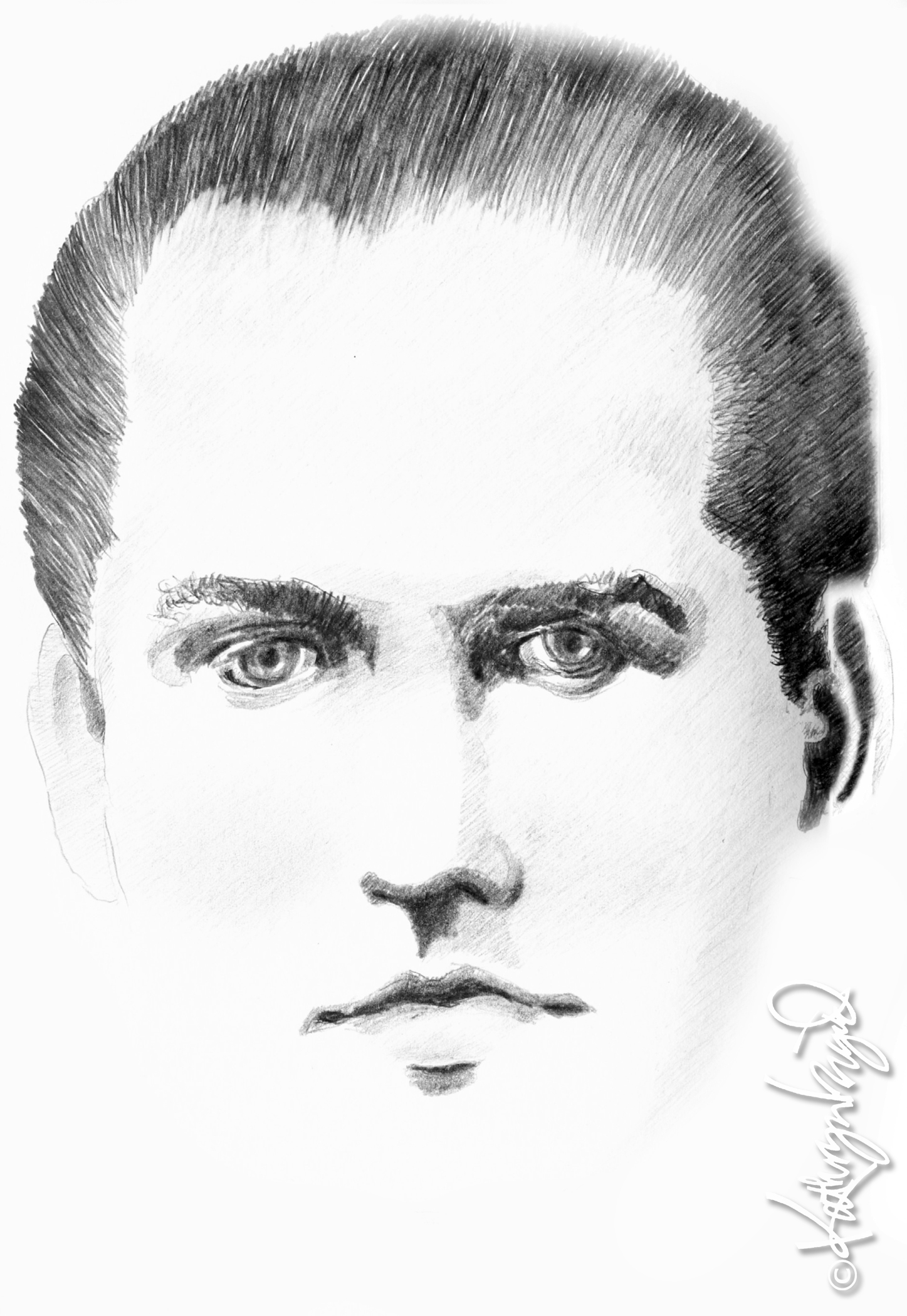
graphite drawingWhen the singing is sublime, it’s as though everything else stops. The air ceases to move. Thought stills. Time ripples ever more slowly and delicately, and only beauty exists.

When a singer’s voice takes hold and sways me, I imagine a pearl dropping into a deep, deep well. Its subtly rich sheen and its smooth look of perfection rolls at speed through the air yet seems to flow through it with an attenuated grace as though purity and love buoyed it up delicately and cradled it gently downward. At last, reaching the depths, the note, the pearl, begins its plunge–the fulness of the water embraces its fall–the ear draws in the note and pulls it soul-ward.

When the choir breathes out in flawless song, I am lost in the jeweled depths. Gorgeous and welcoming, the magnificent impossibility of such beautiful sound carries me, too, in its cradling care. And I fall–in darkness, in love, in joy.

Good Conduct Medal

graphite sketchesEvery season of music has its marvels, masters and moments. In my life of following a conductor and his fellow artists around, I am privileged to be on hand for more such fine pleasures than most, and I never forget that this is a great bit of good fortune indeed.

Still, not every instant is guaranteed to be a glowing example of the highest and best of the musical arts. After all, there is all of the practice that must come first, and to be fair, no amount of practice can assure us of perfection. Mistakes happen; if  we’re lucky, learning happens as a result. But the distance between first-try and performance may be a long one indeed, and sometimes the distance isn’t quite long enough.

So I am grateful all the more when I attend a performance and hear something magical and meaningful and magnificent. I know that it took the performers a lot of concerted effort to come from wherever they started the process to this peak, and I am all the happier and richer for it. I know and appreciate, too, that it takes massive amounts of effort and energy and other resources on the part of organizers, managers, fans, logistics handlers, boards, angels, financiers, educators, ushers, ticket dealers, audience members, and all of those other assorted friends of the arts needed to make this work pay off in any way beyond the artists’ own satisfaction in the process, and that’s yet another level, another realm of generosity entirely that makes my little spot in the aural universe fuller.graphite sketches

Most of all I give my fervent thanks to all of the singers, players and conductors who strive to make this miracle happen again and again. Without your dedicated pursuit of the musical muse, there would be no such happy task for all of the friends of music who are not musicians ourselves. And unquestionably, the world would be a far less beautiful place.graphite drawing

Musick has Charms

The charms of music can, indeed, soothe the savage breast–and it can bring the terrible savage right out of the calm breast just as well. It’s a power that few can resist, love the music or not; it gets under the skin and slides on into the soul. The marvels of music are not, as you know, unknown to me and yes, I have been both incited and soothed at various times by it.

But I haven’t lived the life of total immersion. That is, as are most fully engulfing passions, left to the titans of the art. Not necessarily people known and celebrated by a large and laudatory world, indeed, but those who, whether in that pop-culture celebrity way or from deep in the dark of the behind-scenes action or somewhere in between have shaped history in whatever bold or subtle way their particular art could do.

I said I was going to be a bit dark and Halloween-ish these days, but I was reminded that this day deserves a different kind of recognition, being a memorable date of another kind altogether: the birthday of one of those titans of musical arts aforementioned. So you get a break from my grimmer humors while I bow to a great musician and a lovely man.pen & ink drawing

My husband, you ask? No, I would surely call him both as well, but I refer just now to one of the musicians who helped pave the way for my spouse, inspires him in his work, and befriended him both professionally and personally in ways that made it more possible for my partner to be quite the accomplished musician and artist that he himself is. I’m talking about the man sometimes known as the godfather of Swedish choral music, Eric Ericson.

He is celebrated by far more than just his family and friends, more even than his numerous choirs’ members and his almost countless students, because he stood at the center of an almost unbelievable burst of musical art flowering in the little Scandinavian nation of his birth and spreading throughout and beyond Europe quite immediately after World War II, sooner than it should have happened by rights except that his own country remained neutral and mainly untouched by the physical depredations of the war, and enough so that a number of outstanding leaders in culture took refuge there during and after the war, creating a remarkable hothouse where those fertile minds could put their restless art to work, and often did so together.

He is celebrated also because, as one of the central figures in this new bloom of music, he helped to shape the whole modern state of choral music, both in the church and in secular circles, in Sweden and to foster its wide spread via his own work and travels, via that of his artistic and intellectual partners and rivals and colleagues, and especially via the many, many young musicians that between them they all trained and sent off into the wide world. Their collective influence, expanding at the virtual rate of plant cell division and sending tendrils around the globe, is a rich and vital gift that will long outlive them all.pen & ink drawing

Thankfully, Eric Ericson, for one, is going to give that theory a run for it, as he has attained more than ninety years already himself. And his artistic offspring will undoubtedly keep the music sounding and growing for a very long time too, and for that I am happy and grateful indeed. We who love choral music today owe him thanks.

With that, I will say that the gracious and generous kindness that he and his dear wife have shown on a personal level to both my husband and me makes me as glad as anything to think of him on this day with great admiration and fondness. I hope that every note I have seen him conduct, heard him play on the piano while conducting and discussing the finer points of music or listened to him hum under his breath as he recollected another bit of his own fascinating and incredibly complex history as a musician will linger in the atmosphere for many years yet to come, and that in turn, no matter where on that spectrum of artistic or intellectual accomplishment any one of the rest of us happens to perch, we too will make our own kind of music echo happily in the hearts of all those whose lives we touch.

Happy birthday, Eric Ericson, may the music you hear always soothe and delight you.pen & ink drawing

May I Suggest . . .

photo

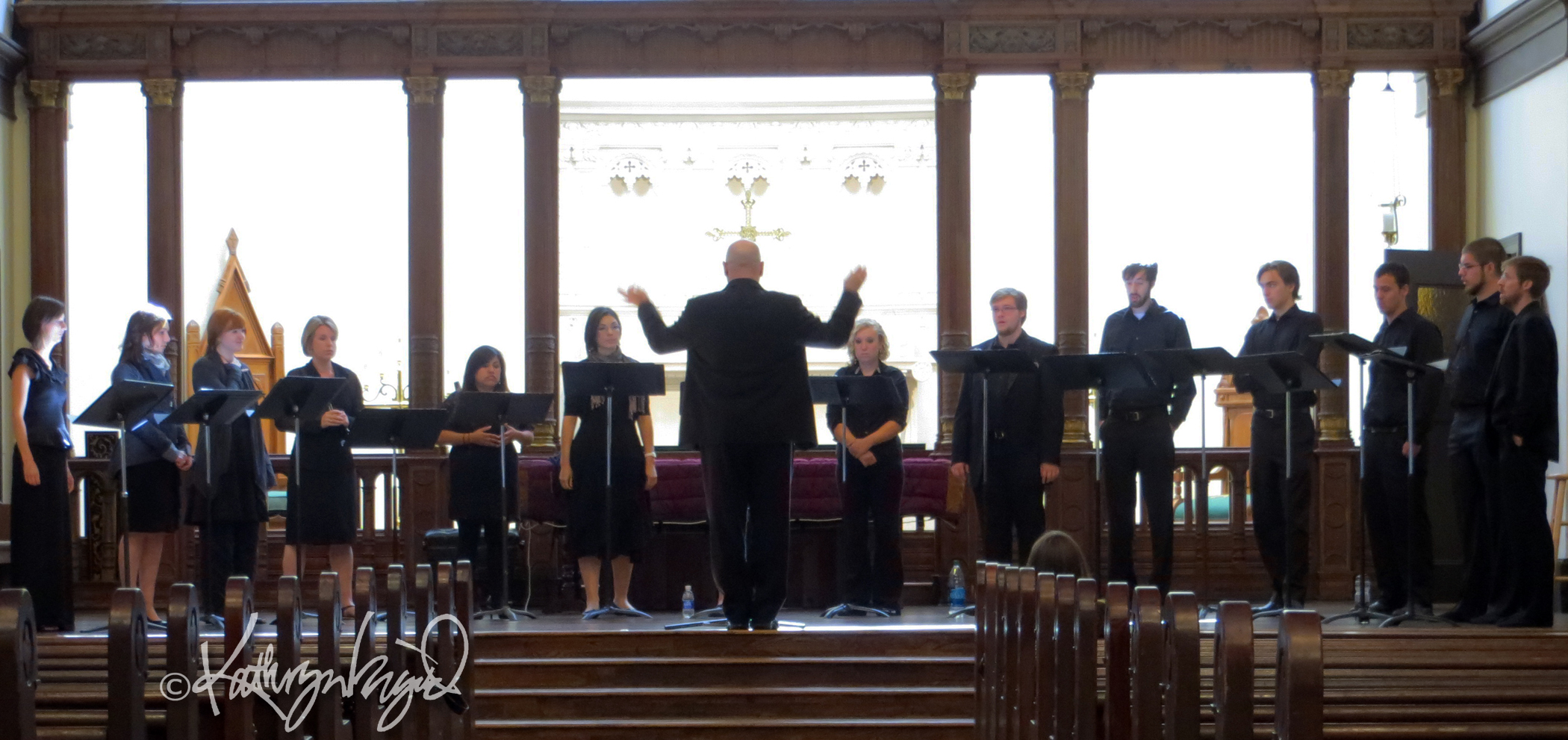
The University of North Texas Collegium Singers in dress rehearsal for their performance at the Berkeley Festival of early music, June 2012, Dr. Richard Sparks conducting. Yes, *that* Richard Sparks.

MUSIC.

Having had my senses immersed in the bath of fall season-opener concerts of all sorts lately, to the literal tune of hundreds of voices and instruments in symphonies, marches, art songs, musical theater melodies, electronica, motets, chaconnes, folk songs, choral masses, lullabies and all sorts of other lovely music, I am reminded as always at this time of year that such an intense schedule of events, however fabulous and rich they are, can be exhausting. More importantly, though, I am reminded that it’s also invigorating, inspiring and often utterly thrilling.

It’s also the time of year when the European choral magazine for which I proofread and text-check translations goes back into full production for the year. The articles and news items are all full of reviews of the summer season’s festivals and conferences and the amazing machinery that underlies these productions, from choosing and ordering music scores through civic action, political efforts, fundraising, singer scholarships, educational programs for participants and audiences, performers’ uniform shipping, young composers’ symposia, etc, and right on down to whether ‘civilian’ supporters of the group are allowed to arrange the music stands or chairs onstage if the local symphony hall union members are on strike. At the heart of it all is such a profound passion for music that millions of people worldwide, including those from countries and cultures one might be surprised to find even having the time or energy amid their economic, social or yes, war-related battles to sing and to listen to singers. If there’s a genuinely possible force for world peace, my friends, it may well be in music.

More personally, it’s music that is a central force for my own happiness, for a large number of reasons. Every one of those listed above comes into my own life and being regularly. But as you know, I am partnered for said life with a musician, and so the whole topic comes that much more sharply into focus. Music has been a glue for us two from the very beginning of ‘us’. Ask our mutual dear friend, a fellow musician, if I were single and might therefore be ‘available’? Check. Collaborate over a large-scale music performance and its visual presentation as a way to get to know each other a bit, hovering around each other during rehearsals and preparation? Check. Go on a first date to a Mark Morris Dido and Aeneas dance performance [yes, truly spectacular, by the way] for which my suitor had prepared the singers? Check!
photo

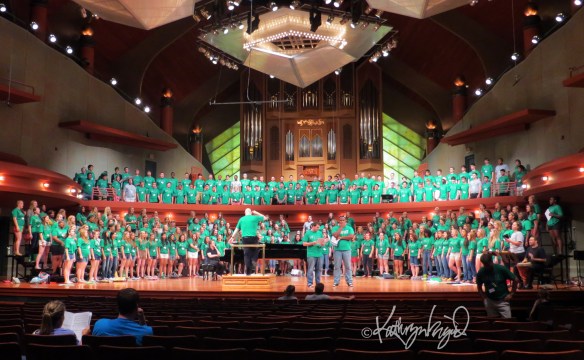
Since thousands vie for the dozens of positions in the final selected groups, high school students in Texas undergo a rigorous preparation for All-State Choir auditions, studying the literature in workshops and camps across the state each summer to compete in their local and regional trials before the year of All-State even arrives. This is the UNT group working in the summer of 2012, rehearsing in the camp organized and run by Dr. Alan McClung, assisted by UNT students and graduates and conducted each year by a different guest conductor–this year, by my spouse. What can I say, it’s what he does. And what I love to hear and see.

What followed is, was and ever shall be musicocentric. Our honeymoon (more about that in a future post) was built, in fact, around my fiance’s conducting gig–a gig including, naturally, our aforementioned Dual BFF as accompanist–at a choral festival in Veszprém, Hungary, arranged under the auspices of the parent organization that spawned the magazine for which I still do editorial duties, if you can follow that sprawling, meandering melody line. One might say that it all began with music and went racing straight downhill from there. Or, if one feels as I do, that music has brought uncountable joys into my life from earliest memory to the present, and will sustain me until the end. In any case, one of the clear high points of musical pleasure has been attending the myriad concerts, events, conferences, performances, and festivals that bring musicians and music lovers together all over the world. A huge number of our favorite people are those whom we’ve met in and through all of this music-related stuff. We have deeply loved ‘family’ literally around the world whom we’ve met and with whom we’ve bonded through musical acquaintance.

If you haven’t done so yet, or not recently enough, may I suggest that you ‘get thee to’ the nearest conference, symposium or festival involving music as soon as you’re able. If, like me, you aren’t an active participant, know that every artist needs his or her cheerleaders and fans and supporters, and that your mutual love of the art will mean more than that you stood onstage during the work or the bows. Yes, even non-musicians can and should pitch in–even those with no sense of pitch can fold programs, stuff envelopes, recruit audience members and donors and board members and political supporters, can drive the shuttle that carries the singers and their accompanists from venue to venue at the festival, and can buy tickets and bask in the glorious sounds from town square to church nave to school ‘cafetorium’ to symphony hall and shout a resounding Bravissimi! to all and sundry.

Beyond that, though, the immersion of being in a place where a huge number of people, participants and supporters and happy observers alike, have come together from a wide range of territory for an extended period of days solely for love of music–that is a wholly different and magical experience everyone should have the opportunity to enjoy at least once. So I commend them to you, the small-scale community events offered by your local affiliated high schools and the international events hosted by long-lived organizations in exotic places and every variation on the theme you can find. I promise you will leave with a song in your heart and memories to last you to when all of your other memories have faded to dust and perhaps beyond. If music be the food of love, play on! For though in this line opening his play ‘Twelfth Night‘ Shakespeare exposed the Duke of Orsino’s conviction that being surfeited with love (in this instance, via its musical surrogate) would cure him of his hunger for it, I think that quite the opposite is true: if they are excellent, the more we experience them and are filled with them, the more we crave both love and music.

Food of that sort for thought: visit first the websites and then the events offered by your local choirs, bands, orchestras, theaters, and performance companies. My own favorites are hosted by professional organizations of music educators, conductors and performers simply because those are the ones I’ve naturally had the privilege to attend, as consort to my musical prince charming, and these all offer performances by top artists that are open to the public, sometimes even with free admission. Explore them! The organization that ‘sponsored’, or inspired and was the jumping-off point for, our honeymoon with its Singing Week in Veszprém–with its half-dozen ateliers conducted by musicians from Europe and North America and singers and whole choirs from all over as well–was what is now called the European Choral Association-Europa Cantat and it hosts a wide variety of such choral events throughout each year, with a focal youth choir festival occurring triennially in places like Passau, Leicestershire, Barcelona, Utrecht, Torino (2012), and Pécs, Hungary (a locale to be repeated in 2015).

photo

Just this month, the newly minted University Singers at UNT performed their first concert of the season with my spouse at the helm. If you live in or near a college town, you’ll find endless opportunities for attending all sorts of musical events, many of them free and most of them truly outstanding–after all, these people are all here gaining expertise for what may be their whole life’s passion, and performers need great audiences too.

Pop, folk, jazz, rock, blues, punk, bluegrass, Early Music, all flavors and kinds of music and individual organizations from the Oldtime Fiddlers [I once got to run the stage lighting for their competition in Washington state–fabulous fiddling, huge fun and even some fantastic yodeling!] to the Verona Opera [I can say from my one experience there that genuine opera under the stars is something not to be missed, even if it’s still 40°C when the singing ends in the middle of the night]: there is something for practically any musical taste out there, and many of them that I enjoy immensely are included among these. My personal pet organizations among the professional gang also include many others: IFCM (International Federation for Choral Music), ACDA (American Choral Directors Association), ACCC (Association of Canadian Choral Communities), TMEA (Texas Music Educators Association), Chorus America, the Boston (odd-numbered years in June), Berkeley (even-numbered years in June), and Vancouver (annually in August) Early Music festivals, and ever so much more.

The Way It Ought to Be

graphite drawing + textI’m not what you might think of as a big traditionalist in the ways of romance–at least, if you think of those things packaged in the way that American commercial enterprise would have us think the norm or the appropriate mode. It may be that I’m a little too tomboy at heart and in physique to wear either the girly or the sexy look with any credible panache. There’s more than a small chance that I’m too lazy and cheap to buy cards and flowers for my nearest and dearest with any regularity. Chocolates, yes, but you know that I’m going to expect to share in their consumption. I’m far from selfless enough to be a true romantic either, I guess. Otherwise, around our place the romantic expressions are more often found in filling an empty gas tank, caulking the shower door, making lunch, washing socks. All of that sort of glamorous stuff.

I’m so unromantic in the popular sense, in fact, that despite being both shy and kind of prudish, I moved in with my intended life partner before I married him–yes, before I even warned him of my intent to marry him. Or to stick to him like glue for the rest of my life if he was shy of the whole getting-married thing, having done that before. Despite my love of pomp and circumstance and ritual, I was prepared to forgo the whole dress-up extravaganza and either commit to the partnership in heart and hand only or just keep the legal transactions simple and stand in front of a Justice of the Peace somewhere and then party later with family and friends. (Because, let’s face it, any excuse for a good and love-filled party is not entirely to be passed by, wishes for simplicity aside.)

As it turned out, we had a pretty spectacular wedding day, but it was really icing on the proverbial cake. One of the central beauties of that day was an anthem composed for us by our dear friend, with a text my intended chose from the enigmatic and marvelous Song of Songs that includes the phrase ‘love is as strong as death’–this accompanied by other close friends playing organ and horn and a superb choir of yet more friends (also conducted by the composer). Hard to get more romantic than that. But that was all well after I’d realized that a big spectacle wasn’t necessary to validate the spectacular thing that had already happened within.

All of this because at some point pretty early in our relationship, I knew with complete and unshakeable conviction that when I was with this person I was where I ought to be. It was so clearly and plainly the place and state in which I was meant to exist that I felt it in my bones. I was at home in his house the first time I stopped by for a visit–even though you all know full well that I reinvented that physical space from Day One around the two of us. The music that I heard was not just the glorious sound of his choirs welling up around me but was also a new rhythm in my heartbeat that was more confident, more joyful, and more purely contented than it had ever felt before, in those days before I even knew it could feel this lovely new way. A new sense of the world skewing into proper perspective that suffused my brain.

And that, to me, is how true romance ought to be. Genuinely loving and playful and silly and passionate and supportive and all of that, yes, but most of all, merely having the recognizable quality of a homecoming, every single time we come together. Flowers and candy and frills and thrills are all very welcome in their own right, but they have nothing on a sense of wholeness that only grows with time and no matter how it evolves and changes iterations over the years, will not go away. It is both transcendent and, when it’s so well ingrained and incorporated in the truest sense, also wonderfully, perfectly ordinary.

Today, on my beloved‘s birthday, I have another reason to remember all of the reasons why I am grateful for him and his place in my life and my love–and I in his.

Beloved Mysterious

Beloved Mysterious, if you could see

The blood-dark river hid inside of me

With longing deep as chasms unexplored

Through which, from which, in which that love is poured

In endless flood of hope and of desire

As hot and wild and dangerous as fire

Then you would know the depth, the liquid breath

That carries love for you beyond my death.

With a Full Heart

graphite drawingA Song of Farewell
Ends Only the Beginning

A fond farewell should only end the start
Of what emerged from nothing to become
Much greater than its origins, a home
For all that’s good and gracious in the heart–

What had begun in silence has grown deep
And richer than imagining could guess,
A tapestry of joy and tenderness,
A score of blended notes that time will keep–

Whose voices came together first in this
True confluence of sound and sweet accord
Cannot again move aught but closer toward
Such harmony as, now it’s found, is bliss–

For in love’s benedictory refrain
Awakens what all hearts must sing again.

graphite drawing

With gratitude to all at the Episcopal Church of the Incarnation, Dallas, Texas,
and especially to the choir, for welcoming us so kindly during this past year.

Kathryn Sparks
August 2012

The Large and the Small of It

The depths of Space carry miraculous sparks of inspiration at a seeming infinity of levels.digital collage

A couple of years ago my husband was conducting a concert of choral works all, in one way or another, exploring the idea of Space, and he asked me to provide projected images that would act as a visual companion to the music. Since the centerpiece of the concert was to be a selection of movements from Estonian composer/astronomer Urmas Sisask’s ‘Gloria Patri‘–wonderfully meditative, somewhat minimalistic yet still quite melodic music which was to be accompanied by photographs taken through the Hubble telescope, I was given a clear starting point for the collection of visual images. The good people of NASA willingly agreed to let us use any Hubble images we liked, without any constraints and at no charge, so my task was to find the images I thought best suited the music at all points, edit them (some extensively, some less so) in order to fit the format of the projections, and collate all of it into a pre-arranged program that I could manually ‘play’ as the concert was performed. Looking for, and then through, hundreds of Hubble images was a bit of a project in itself; reformatting and resizing, digitally ‘cleaning’ and grouping and ordering them proved to be a little more weighty. But it was a pleasurable and energizing project all the same, staring at the stars and constellations in all of their miraculously varied glory. ‘Gloria Patri’ indeed!digital collageGoing forward to work out images for the rest of the pieces on the docket for this program, I was moved by both the enormity of the Hubble’s scope and our own galaxy’s tininess within the vastness of space to think that it would be wonderful to explore those strange dissonances and harmonies that occur in the known world, microscopic to massive, blurred by our limited vision and knowledge and delicately detailed by our constant finding of new facts and ideas in all of it. So for the other pieces in the concert’s repertoire, I sought out images that would complement each other yet emphasize the astounding range of contrasts in our spatial existence, from the granular to the grand. Pollen and planets might in fact have more in common than we can imagine, if we stretch our thinking just a little. Snowflakes and stars might be merely opposite ends of a spectrum that transcends dimensions, scale and vision.digital collageI was reminded throughout this process not only of my minuteness in the great spectacle of existence, but also of how fantastically treasure-filled that existence is, from the level of the subatomic to things and thoughts so massive that the Hubble telescope and all of its exponentially larger generations of offspring may never quite be able to encompass the enormity of it all. If I ever think I’m running out of ideas, I only need to remember this one exercise in humility and happiness, and I should be able to break out of my stasis as a flood of newly sparked inspirations stream like comets out of me.

Magical Night & Mystic Day

photoEnchantments

One night I stood upon the green

And every nightingale a-wing

Stopped in the linden trees to sing,

A perfect choir though all unseen,

Encircling in the meadow’s crown—

Night-blooming flowers ‘round my feet

Reflected moonglow, and their sweet,

Sweet breath rose up as stars fell down

In meteor showers to earth because

Its beauty was so great, so dear,

They longed to draw the night sky near

To all this peacefulness that was—

And while I stood upon that lawn,

Aching with joy, with ecstasy

As sharp as ice and flame in me,

I woke full wide, and it was dawn.photo

The day that came up in that place

Made all the green-wood hum and quake

With quivering for pleasure’s sake,

At seeing the full sun’s clear face,

Yet, basking in the softest fall

Of constant rain, as mist, to fly

In colored arcs across the sky

And shower prisms on us all—

The birds of day joined in that hymn

And coaxed the foxes to the green,

Contented beasts not often seen

In sun, and as I stood, a slim

Grey foal came, too, and nine or ten

Of rabbits, and the beasts all danced,

And I stood still, transfixed—entranced—

And blinked my eyes, and it was night.digitally painted photo

Lullabies and Parallel Universes

photoI have said that music transports me to Other Places. Indeed, all art has that potential for me, for internal travel. It’s one of the great joys of art. As I write this, I’m listening to a live broadcast of this evening’s concert from the Swedish Radio Choir‘s (Radiokören, or RK) concert, one that travels particularly far and wide–and deep–in my heart and mind for a whole lot of reasons.

The note from chief conductor Peter Dijkstra:

Tonight at 1930h I’m doing a concert, live on Swedish radio SVT2 and on Webradio (http://sverigesradio.se/sida/default.aspx?programid=3989, at least in the US) , with the Swedish Radio Choir and Orchestra with an ‘alternative Passionprogram’:
Ligeti – Lux Aeterna
Bach – BWV 12 Weinen, Klagen, Sorgen, Zagen
Poulenc – Stabat Mater
Highly recommended!!!!

Right at this moment, the radio host is interviewing Maestro Dijkstra, and hearing both of their voices, I feel almost as though I’m in the concert hall watching them chat onstage, myself. I’m quite sure I recognize the lady’s voice as that of the same well-spoken broadcaster who interviewed my husband when he was conducting on that same stage at Berwaldhallen at this time of year a few years ago for RK’s Vårkonsert, or Spring Concert. Peter Dijkstra had fairly recently signed on as RK’s chief conductor at the time, and was in town part of the time rehearsing the choir; it’s amazing how quickly the miles disappear when we hear familiar voices or sounds–and the Radio Choir’s distinctive choral sonorities are certainly a part of that equation for me, as well. Their recordings have been for decades among those most widely recognized worldwide for consistently outstanding quality and depth in an incredible range of literature.photo

So here I sit, listening to music sung by a beloved choir and conducted by a truly fine, familiar conductor, and despite being at my desk in my own house, I am traveling to worlds and galaxies far beyond the view of my window. The György Ligeti piece is a perfect vehicle. It’s best known for being that magical, eerie and ethereal sound heard in the famous scene of approach to the monolith in Stanley Kubrick‘s seminal film 2001: A Space Odyssey, and on a personal level is memorable and imaginatively inspiring even more directly because I have heard a couple of groups conducted by my spouse, in both rehearsal and concert, of this famously difficult piece. Each time, the piece itself transforms the performers as they work to ‘get inside’ and master it, and in turn is transformed by their performances, by the acoustic and atmosphere of the place where it’s being sung, and by the expectant and electric energy of audiences who are constantly challenged and awakened by its dramatics, both distinctive and subtle.

Johann Sebastian Bach and a great many of his works are widely familiar to audiences all around as well, and both in spite and because of their very familiarity bring us to an array of places remembered and imagined each time we hear them sung or played. The more famous and oft-played a composer’s works, the more variants we’re likely to come across in style and interpretation, in levels of technical expertise and period accuracy, and especially in the performances’ potential for transportation. I find it profoundly intriguing to see and hear how deeply performers can immerse themselves in the math and mystery, the dancing joy and bottomless grief and resounding laughter and historical drama of Bach, and to experience the accompanying journeys offered to me as a listener. I go to places of Biblical and Apocryphal history, yes, but also to more abstract aspects of the music and the texts: to dark forests and sunless night, and to soaring starry space; to drought-quenching fountains and streams; to realms of green and warm and welcoming respite and meditation.photoThe Stabat Mater of Francis Poulenc, in his characteristic tonalities and performed here with exquisite power and emotional richness (and with a supernal soprano soloist’s voice soaring over the top of the intense and wildly beautiful waves of the choral singing) pulls us into a specific story, but is nonetheless large enough in its musical generosity to allow visions of many other places and states of being. This, too, is a strength of music and of outstanding moments of swimming in it–that it allows us to transcend what is and see, hear and feel what may be.

Music can fill me with passion, and it can also empty me so completely of passion that it lulls me into the abyss of restful peace where I feel nothing can touch me at all.

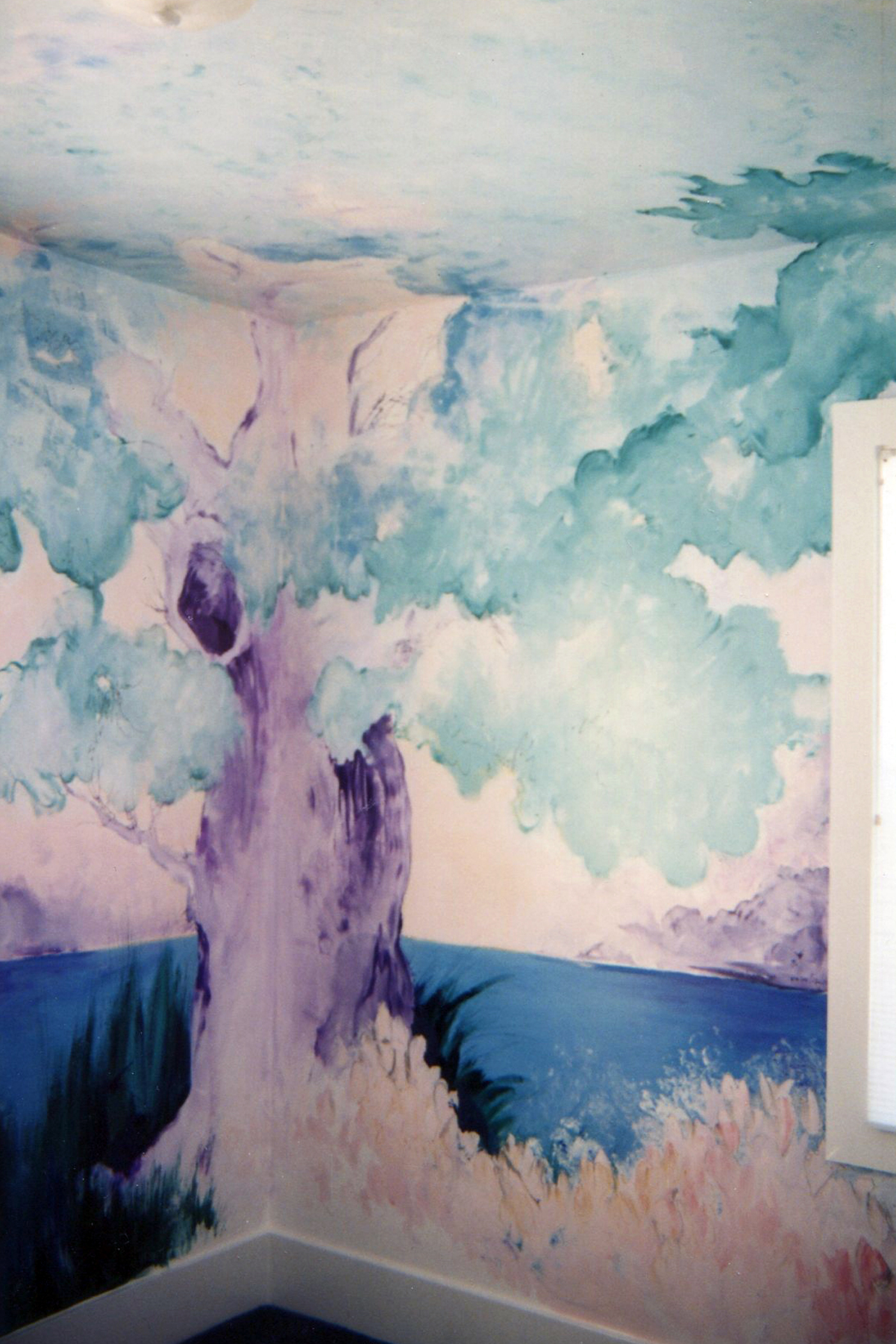
The images in this post are not based on any of the music in this program at all but rather are documentation of one of the small worlds I myself created a little while (well, a teenager’s lifetime) ago. I wanted to make a place that would act as a safe haven, fantasyland, and visual lullaby for the baby boy my sister was carrying. More than seventeen years later, our younger nephew his brother still has the same little woodland clearing in what’s now his room and seems not to be overly anxious to erase it under a more sophisticated or grown-up paint scheme and decor. So I suppose that perhaps it still offers for him adequately what I myself will never grow too old or mature to want: transportation to other places and planes, times, spaces, moods, hauntings and hopes and happiness. I hope that the luminous-paint stars that I sprinkled on that bedroom ceiling still light up after the lamps are turned off at night.photo