Transitory or Transitional

Pen & ink drawing: Transitory or TransitionalMy spouse, in his combined capacities as a natural-born teacher and a lifelong curious learner himself, is constantly reading, studying, talking shop with others both in and out of his field of music, and cogitating inwardly and through his writing about ways to grow and improve. I am neither a born teacher nor as dedicated and skillful a learner as he is, but I have, I think, grown a fair amount in my appreciation of what quantities and depth of effort it takes to improve oneself, let alone help others to improve themselves, in any chosen course of study. One of the things that intrigues me is that, as in so many areas of life’s experiences, the macro and the micro aspects of learning and, in turn, teaching, always ebb and flow: it takes a multitude of tiny pieces of knowledge and/or effort to make any significant larger ones, and the large ones must generally be reduced to smaller and more manageable parts in order to be changed, eliminated, or simply learned, as well.

In a day’s rehearsal for an upcoming concert, it’s marvelous to see and hear what occurs as a major composition is broken down into its component parts and those parts studied and practiced and rehearsed in detail, bit by bit, but also to realize that the individual parts have no beauty or meaning unless also studied in the context of the whole. Fixing one small phrase or chord at a time can be a portion of the improvement process, but if that’s all that happens, then the performance will never have any cohesion or sense of drama but will forever remain a collation of essentially separate and unrelated atoms that happened to be sounded in the same room on the same night. Playing or singing through transitions—the places where one phrase or larger idea in a composition ends and the next begins—is a way in which my conductor husband helps his choirs, orchestras, and other performers to experience and express the whole of the story more convincingly themselves, and thus bring an audience into the flow of the work as well.

Music is a wonderful vehicle for individual experience of the aesthetic, emotional, artistic, and ephemeral aspects of existence, and as such is a grand gift. But when it becomes a communal, communicative experience rather than only an isolated solo, it has incredible power for building relationships between people, ideas, cultures, lives. When it is a bit of a song, hummed or played on the street, in the car, at work in the kitchen, it can cheer or soothe, feed or please; when it is a performance of a major musical work in concert, in a musical or opera, an oratorio or a middle school end-of-year concert that has many participants and has been labored over with passion by all of them through a string of intense rehearsals, its power is magnified and resonates for a long, long time to come. It’s as though the practice of singing or playing through the transitions from one passage to another of that single composition has expanded into life, letting the dissonances and harmonies, the threads of meaning and the ecstatic shimmer of aural beauty, all remain in the air and in our spirits long after the last notes have gone silent, carrying us through the transition from art into life with renewed depth and purpose.

It’s All Rehearsal, Really

Blog.08-30-2013.all-rehearsalWe may look like we’re all geared up and doing important stuff, but mostly, we spend all of our lives practicing, learning and getting ready for one thing or another. Some of those things happen in due course and many more of them either never quite come to fruition, or far more often, change along the way and we end up following along and seeing where it all takes us. All of this is quite normal and perfectly valid.

As a privileged observer and listener in many musical rehearsals long after the years when I was an active amateur participant, I can tell you that I think these more explicit practice sessions can have much the same sorts of both trajectories and outcomes. What anyone not privy to the backstage view of any sort of practice may easily forget, even if they once knew it, is that whether the moment is strictly obligatory, is amateur in the finer sense, or is wholly professional, it can have the same range of characteristics, studious, soulful, playful, predictable, heartrending or hilarious–or some grand combination of them all.

The experience of listening in on the preparations for musical performances is distinct from the performances themselves in a multitude of ways, but perhaps the most striking to a non-participant is arriving at a high-level rehearsal and seeing all and sundry set up camp for it in their work clothes. The star soloist is wearing old jeans. The conductor, who no matter how rigorously the singers and players enact their parts will likely move around and sweat the most, is wearing shorts and a short-sleeved, thin shirt. The players have open cases near their chairs with spare instrument pieces and alternate score parts strewn across them, and the singers, no matter what the temperature, are wearing neck scarves and lugging big containers of fluids to protect their own precious instruments. The rehearsal accompanist at the beat-up old piano is wearing glasses both on the bridge of the nose and the crown of the head, one for the easier to read individual parts and one for the microscopically reduced full score. All of this in a sort of ordered chaos the shows they are all there to Do Things. It’s work. It’s fun. It’s messy, like life.

Our Big Summer Road Trip, a driving circuit of over 6000 miles this July and August, was a multipurpose travel package designed to accomplish a number of ends, not least of them to attend and study and enjoy music-related adventures with friends, colleagues and other musicians and music lovers in several disparate events. First, we went to the Oregon Bach Festival to see the newly anointed Artistic Director make his debut interview marking the occasion, and more importantly to see maestro Helmuth Rilling conduct his grand finale performance as AD in this season when he officially passed the baton to his successor after 44 outstanding years at the Festival’s helm. The Festival is a fine one, Rilling a justly revered conductor and teacher, and many of the singers and players who participate, along with many regular OBF attendees, are longtime friends and colleagues, so it’s always a joy and privilege to go to the Festival ourselves, but particularly meaningful to see Rilling lead the B Minor Mass on his way to Conductor Emeritus status, since my husband Richard had the good fortune to sing the same piece under Rilling during the maestro’s second year at OBF. A great deal of water has gone under the bridge, and though a lot has changed in that flow of time, many things remain the same. Rehearsals and performances, practice and action go on as ever.

I had been reminded of all of this, of course, by the opportunity to attend the Boston Early Music Festival and see my spouse conduct and his Collegium Singers and the university’s Baroque Orchestra in June, along with admiring all of the other marvelous artists and events at BEMF. So many wonderful concerts and recitals; so much hard and happy work to prepare them! And how quickly June disappears into the mists of memory as the summer rolls forward. Thus, a long road trip seemingly becomes an amazingly fresh outing to experience more variations on this theme.

The second of the trio of musical events we attended on the road trip was the regional gathering of choral conductors in our former home area, a great opportunity to renew ties with longtime fellow conductors, teachers and friends over grilled wild salmon and to revisit musical literature options, audition processes, mull over the usual academic topics, share hints about favorite new compositions and gossip about who is the up-and-coming hottest new choir or conductor in anyone’s neighborhood. Driving up to the chapel that serves as the main conference space, whom should we see sitting visiting on the porch but a man who was the excellent recording engineer serving in that artistic task for many of my husband’s choirs’ recordings over the years, and with him, the teacher-conductor-mentor who led Richard to music as a vocation and profession in the first place and so became not only his ‘choral father’ but a lifelong dear friend. To follow this greeting with collegial renewal among many other fellow musical artists, from colleagues and collaborators to singers and students, composers and coordinators of conferences and musical programs at all levels, and then to have dinner a week later with both of those two first friends we’d spotted, was rich beyond words.

Third on our list and rounding out the road trip with our stop in Vancouver, BC, was the Vancouver Early Music Festival. A perfect bookend to starting the trip with OBF in Eugene, VEMF attendance had much the same purpose for us as the Oregon visit: see and hear good friends and other artists at work, and attend the events honoring the longtime AD’s retirement. While Jose Verstappen has served a mere 34 years in Vancouver, he has had as much impact of his own on the Festival there as Rilling has in Oregon, just a very different sort. Jose is a modest and self-effacing man, but as warm and as hardworking and dedicated, and certainly as hard for donors and supporters to say No to, as Rilling, and so both have created environments of commitment and excellence that will thrive long after both have abdicated their thrones. Matthew Halls, Rilling’s successor, and Matthew White, Verstappen’s, are both bright, gifted and able men and I expect to enjoy attending both festivals with as much outstanding artistry on display as ever in years to come.

While in Vancouver, besides the great fun of attending Verstappen’s farewell party, seeing many dear friends, meeting Bruce Dickey–the leading light of cornettists nowadays, he will be playing in the production of the Monteverdi Vespers Richard’s conducting in October–and hearing some terrific music of various kinds in concert, the highlight was sitting in during rehearsals for Händel’s ‘Israel in Egypt’. It was there that I was most struck by this lovely interweaving of labor and lightness that can happen when the people at practice are fully engaged in their work and love what they do. The piece itself is a marvel, full of potent and piquant and even picaresque melodies and moments, and those singing and playing it made the most of these riches. When Tyler Duncan and Sumner Thompson started singing the bass duet ‘The Lord is a Man of War‘, not only was the music and text mesmerizing (never mind my personal feelings about the story’s theology) but their obvious pleasure in exploring the expressive potential in the piece together with the players and conductor (the impressively sensitive and dramatic Alexander Weimann) moved me to pay special attention to this juxtaposition of the remarkable and the workaday, the plain and the powerful. So to all of you out there who sing, play, work, rehearse, prepare and perform, and especially to the players, singers, composers, conductors, administrators and Artistic Directors encountered on this summer tour of ours, I dedicate this poem.digital illustrationNumber Thirty-Eight

Strike, then carry on, and so the sound

Belies in beauty such a martial start,

When ragtag troops in everyday are found

To sing and play at battle from the heart–

Who seemed so simply destined for the soil

As laborers in neither art nor war

But some plebeian, plodding sort of toil,

Then strike, and decimate what came before–

Show the illusion is not acted out

Through violence or merely artifice,

But rather, note by note dispelling doubt

That mystery’s all quite undone by this–

Where love and war are mingled in their way

By songs more eloquent than words can say.

DIY Weddings are Easy When . . .

. . . you have a world of friendly resources at your beck and call. So, technically, it’s not DIY at all of course but rather Così fan tutte. [Ed: roughly translated, ‘Everybody’s doing it’.] It’s not, even then, for the faint of heart, because let’s face it, unless you’re having the always admirable super short, informal adventure of standing in front of a Justice of the Peace or of surprising your immediate family in the middle of dessert one weekend with a five-minute ceremony, there are a host of details that might need to be given eventual consideration. Beyond simply making sure that the two people who are getting married actually show up at the same time in the same place, there are a handful of legal elements that generally should be taken care of before the event, if it’s to have any official standing. And from there, the possibilities expand exponentially. I suppose it’s not wholly shocking that the process might lead to the development of a few dysfunctional bumps and bruises among family, friends and support staff along the way.photoBut I hate confrontation and stress, and the very idea of becoming such a parody-inspiring Marriage Monster appalls me. And when we decided to marry, I don’t doubt it occurred to me that my intended, Richard, might equally abhor the idea of a painful process and wedding day. So we were both very happy to treat the whole thing something like an elaborate concert performance, perhaps a cheery semi-staged operetta, and to act as artistic directors and performers, yes, but also to let a great slew of friends, relatives and acquaintances carry out as much of the heavy lifting as possible along the way. After all, though we intended to have a good time and hoped everyone else would too, the real point of the occasion was that at the end of the day we would be more married than we were at the beginning of it.

Being a visual artist, I had no shortage of ideas about how I wanted various things to look, from invitations and service bulletins and guest books to the floral arrangements, wedding party dress and church decor, to the tables and food at the reception. And I had pretty extravagant ideas, at that. But I didn’t have a huge quantity of money to invest in it (nor did my parents) and I deeply dislike the idea of spending ghastly sums on a single event that, while important and hopefully happily memorable, is still only one actual day of life. What, I should spend my life savings on a single party?

That’s where one’s personal fortune in community has so much more than monetary value, though I’ll readily grant you that ours, in sharing their talents and efforts with us for the occasion, saved us a ton of money. We married in the church across the street from the university where we both worked, since not only were we members there but it was so handily located for so many of our friends, students and colleagues who were also part of the university community. I had a fairly easy time imagining how to use and decorate the church, since a few years previously, I’d served on the committee that oversaw a massive renovation of the space, taking part in all elements of the design from seating arrangement to finishes, and designing the new altar, font, pulpit, rail, crosses and incidental furnishings that were built for it.photoSo I opted to fill the space with a different kind of design, making a couple dozen banners to hang on walls, fly from the light boxes in the ceilings, display on stands in the narthex and chancel, and be carried in procession by fine young friends strolling in en route (to light candles) and out (to the reception hall) along with the wedding party. Already a banner maker for church and event commissions, I had lots of material and experience, so I sewed, painted and otherwise assembled the banners myself (from the flying ones at about 36 inches in length to the main chancel banner that was about 26 feet), and I got good help with putting together the stands and hanging mechanisms and installing them all at the last minute when we could get into the nave to do the work.photo montageThat’s a constant with weddings and parties in all sorts of venues other than Home: no access for prep and installation and other setup work until the last minute. So because I am a control freak, a design nut and also someone who really wanted to just have fun and enjoy my actual wedding day, I plotted and planned and prepped everything I could, along with my Intended and a slew of family, friends and other helpful conspirators. First, of course, it was essential to get all the actors on board and ‘synchronize our watches’, since it’s a busy crew and driven by a multitude of crazy calendar iterations. Once that was established, the work of service and reception planning commenced.

The earliest necessity, since I didn’t want predictable or expensive floral arrangements but love flowers, was to plant and tend flowers in Mom’s garden and that of our good friend Claudia, next door to her. By the time our July wedding rolled around, I had gathered the ribbon and wire and other essentials and been offered by the lovely Linda, a friend who was chief florist for the university’s official events, that if I handed over the materials she would provide us with her gorgeous bouquets and boutonnieres and corsages for all and sundry, so all I needed to do at the last minute was go a-gathering in their yards with my two beloved garden-gnome ladies and then give buckets full of fresh beauty to Linda on the day.

Meanwhile, much brainstorming and list-making was underway with the able assistance of others, so that everything essential would be pre-arranged too and not worrisome. All of the print materials derived from a combination of my photos of iris leaves, text typeset by one of my sisters in fonts I’d chosen, getting printing done by the local quick printers (with whom I’d done many work projects) on their green ink printing day of the week and then doing all of the black ink stuff on copiers and folding/collating things myself while I was calligraphing the invitation envelopes, closing them with an inexpensive gold seal and a swash of purply interference paint and a rubber stamp message noting that the music would begin a full half hour before the service. We did, after all, know that there would be lots of my fiance’s fellow musicians both participating and attending.

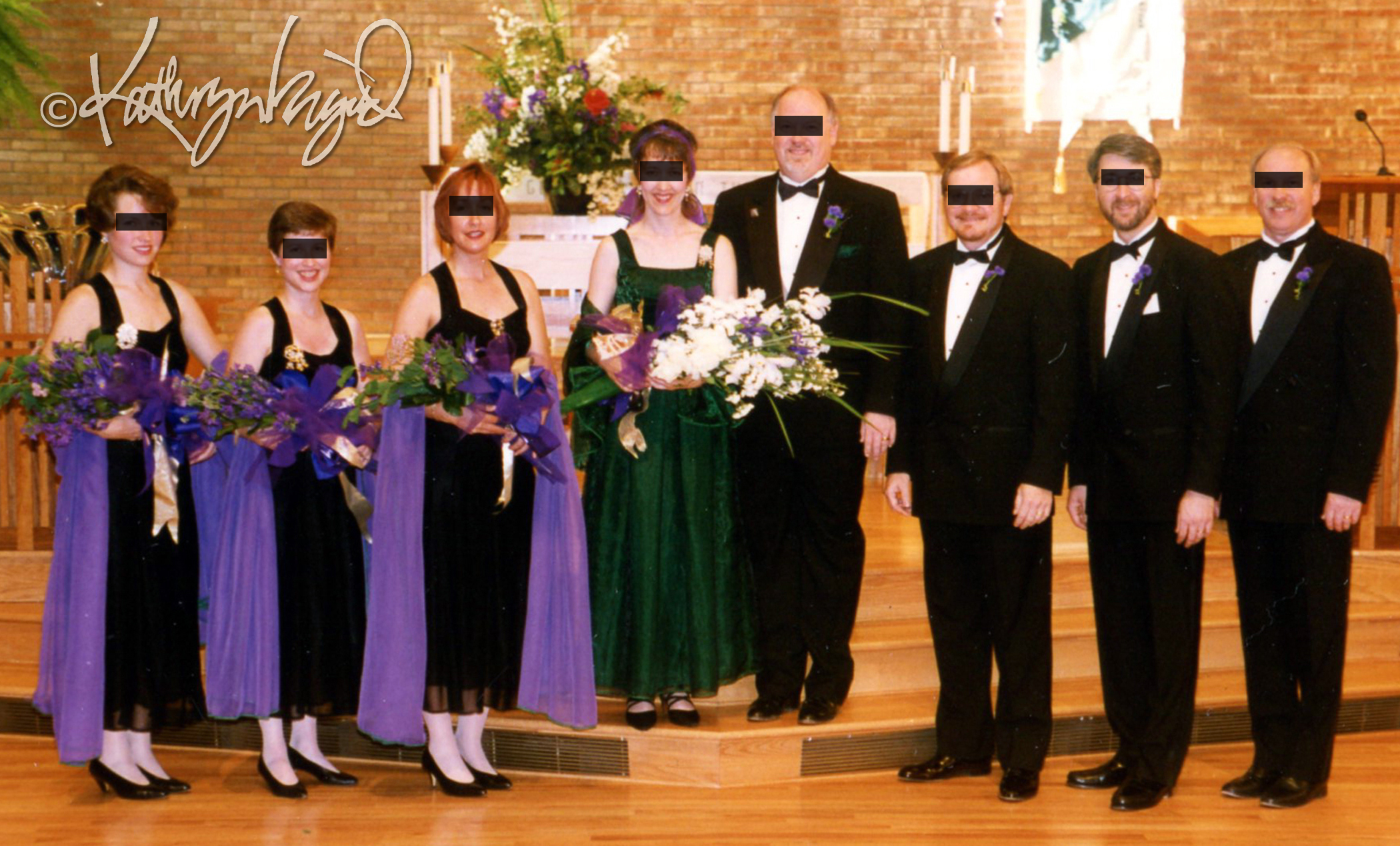
Clergy? That was about the easiest part to decide, since as a cleric’s daughter I could just tap Dad. So the church’s lead pastor presided, Dad officiated, and a sweet retired pastor friend served as lector. Since Dad was robing up for the pastoral gig, I decided to have one of my uncles sashay down the aisle with me, and he kindly acquiesced to my request for an escort. Our organist, our great friend Jim, was also standing up for us, so he did a bit of trotting up and down the aisle, but in great Jim style. As one of four sisters, I had the easiest time choosing three attendants, but it was simple for my groom to line up the perfect support team, too, between his one brother and Jim and another of our close friends who happened to be Richard’s choral conducting partner at the university as well. Friends from various places rounded out the team, serving as greeters, acolytes, and our wonderfully hospitable reception hosts. One of our brothers in law was chief photographer, taking a batch of group wedding party photos just before the church began to fill, and all of the rest of the pictures came from a combination of photos friends sent us and the box full of disposable cameras we’d distributed on the reception tables and collected for development at the end of the day. This proved a serendipity because it both gave us some fun candids from the kids’ point of view and kept some of the younger partiers entertained during the reception as well.

photo

I designed and made stoles for Dad and the presiding minister, too.

My sisters readily agreed to help pick out simple black dresses they’d actually have a hope of wanting to wear again later, and we managed to find a great deal on them and choose a design that, happily, was made of a very stretchy fabric, since it turned out that one sister was curvaceously pregnant by the time our wedding day rolled around (no pun intended). I sewed a violet voile shawl edged in emerald green for each of them, and a scarf of the same to tie back my hair rather than having a veil, something that would anyway have looked a bit odd since I didn’t want to wear a white gown. Besides that I tend to look a little too much like a corpse when wearing white, I too wanted to have a dress with reuse potential, especially if I was investing a couple hundred dollars in all of the fabrics, so I made my shawl from iridescent emerald voile, the same fabric that I lined with dark emerald taffeta for the body of my skirt and bodice. The bodice, made in a sort of weskit shape, I stitched with self-colored silk soutache. While I cut and serged all of the pieces of my layered fabric for the dress and made my underskirt, my mother generously did all of the finish sewing on the top and skirt. Designing and sewing just the soutache provided enough adventure for this semi-skilled seamstress. I did, however, go dress shopping with both of our moms, and we found one a perfect-condition consignment dress for a great price and the other, a clearance two piece dress/jacket combination for $10. The guys wore rented tuxes, mainly because the groom owned a white tie and tails conducting getup and nothing like a plain black suit, and I figured if I was going to have a wedding more formal than a zippy elopement, I still did want to get all spiffed up. Not averse to having fun, and all that jazz.

photo

photo

[Ed: No, we weren’t all pretending to be The Dread Pirate Roberts–I’m just providing a dash of privacy for family and friends.]

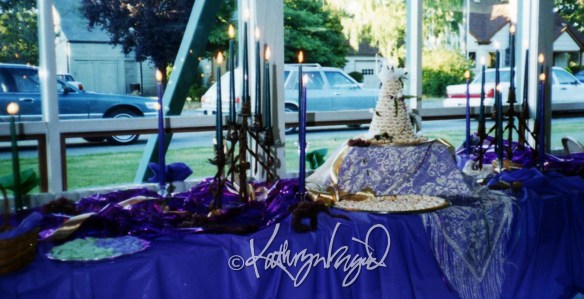
The fabrics and ribbons left over from manufacturing banners and dresses and shawls got trimmed and saved up for dressing the reception tables, along with a multitude of candlesticks from home that I loaded up and lit. To keep reception food fuss to a relative minimum, we opted to have the party in the fellowship hall at the church. That way, also, there was no monkeying around with additional travel, hall-finding and parking issues, party setup in a separate venue, or the time required for all of those add-ons. And we figured the social aspect was the primary reason for having a reception at all, not fussy edibles meant mostly to impress people, so we went to our favorite farmers’ market and bought a bunch of lovely fresh fruits to complement the array of nuts, chocolates and home-baked cookies that were the main bites. Friends and relatives gifted us with many of the cookies, and the baked centerpiece was a traditional Norwegian kransekake (more a stack of crisp-chewy almond meringue biscuit rings than cake) made by our Norwegian brother-in-law and my mother. As it turned out, yet another set of friends surprised us with a second lovely kransekake, so we were all in cookie heaven. A very fine place, indeed, and not only on a wedding day.photo

May I Suggest . . .

photo

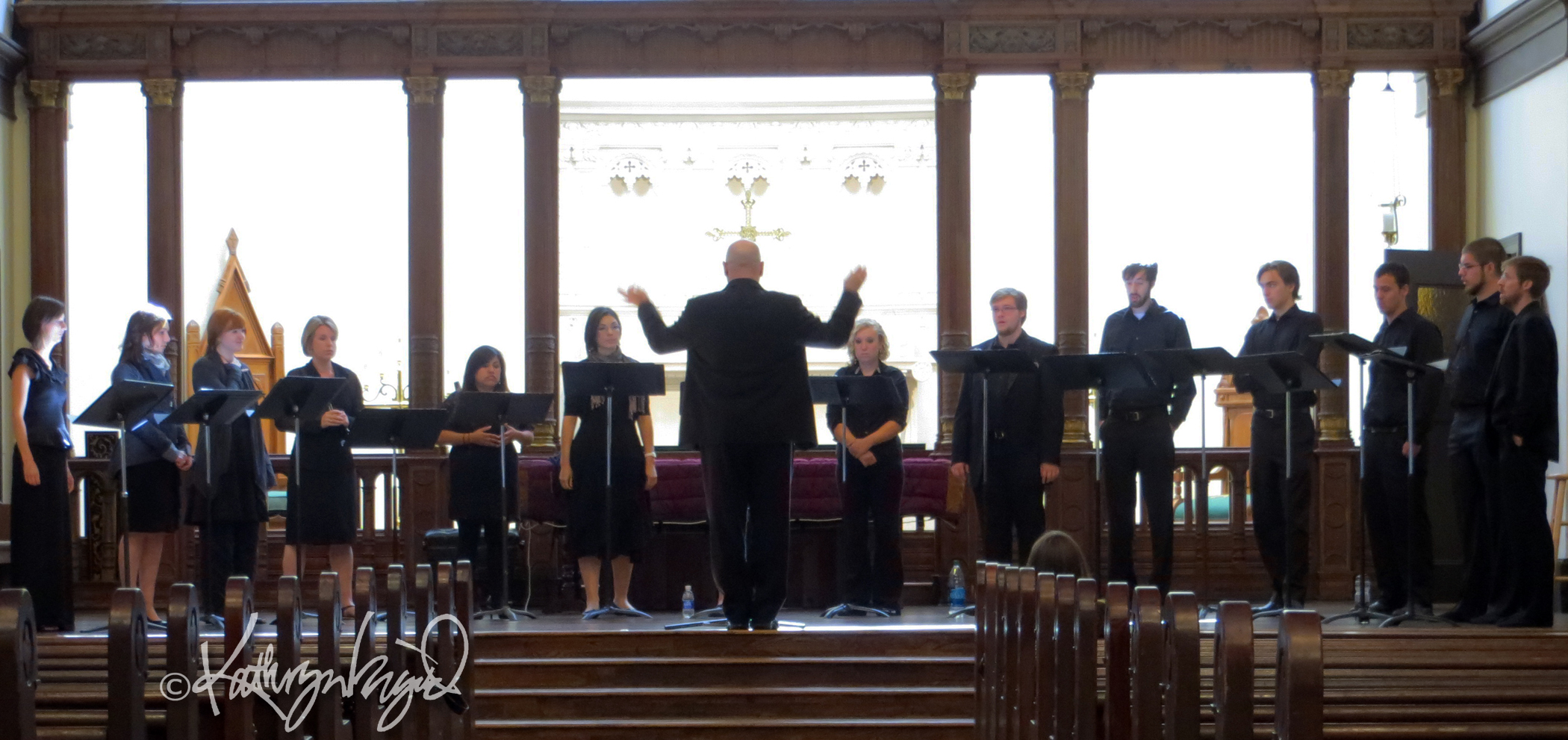
The University of North Texas Collegium Singers in dress rehearsal for their performance at the Berkeley Festival of early music, June 2012, Dr. Richard Sparks conducting. Yes, *that* Richard Sparks.

MUSIC.

Having had my senses immersed in the bath of fall season-opener concerts of all sorts lately, to the literal tune of hundreds of voices and instruments in symphonies, marches, art songs, musical theater melodies, electronica, motets, chaconnes, folk songs, choral masses, lullabies and all sorts of other lovely music, I am reminded as always at this time of year that such an intense schedule of events, however fabulous and rich they are, can be exhausting. More importantly, though, I am reminded that it’s also invigorating, inspiring and often utterly thrilling.

It’s also the time of year when the European choral magazine for which I proofread and text-check translations goes back into full production for the year. The articles and news items are all full of reviews of the summer season’s festivals and conferences and the amazing machinery that underlies these productions, from choosing and ordering music scores through civic action, political efforts, fundraising, singer scholarships, educational programs for participants and audiences, performers’ uniform shipping, young composers’ symposia, etc, and right on down to whether ‘civilian’ supporters of the group are allowed to arrange the music stands or chairs onstage if the local symphony hall union members are on strike. At the heart of it all is such a profound passion for music that millions of people worldwide, including those from countries and cultures one might be surprised to find even having the time or energy amid their economic, social or yes, war-related battles to sing and to listen to singers. If there’s a genuinely possible force for world peace, my friends, it may well be in music.

More personally, it’s music that is a central force for my own happiness, for a large number of reasons. Every one of those listed above comes into my own life and being regularly. But as you know, I am partnered for said life with a musician, and so the whole topic comes that much more sharply into focus. Music has been a glue for us two from the very beginning of ‘us’. Ask our mutual dear friend, a fellow musician, if I were single and might therefore be ‘available’? Check. Collaborate over a large-scale music performance and its visual presentation as a way to get to know each other a bit, hovering around each other during rehearsals and preparation? Check. Go on a first date to a Mark Morris Dido and Aeneas dance performance [yes, truly spectacular, by the way] for which my suitor had prepared the singers? Check!

photo

Since thousands vie for the dozens of positions in the final selected groups, high school students in Texas undergo a rigorous preparation for All-State Choir auditions, studying the literature in workshops and camps across the state each summer to compete in their local and regional trials before the year of All-State even arrives. This is the UNT group working in the summer of 2012, rehearsing in the camp organized and run by Dr. Alan McClung, assisted by UNT students and graduates and conducted each year by a different guest conductor–this year, by my spouse. What can I say, it’s what he does. And what I love to hear and see.

What followed is, was and ever shall be musicocentric. Our honeymoon (more about that in a future post) was built, in fact, around my fiance’s conducting gig–a gig including, naturally, our aforementioned Dual BFF as accompanist–at a choral festival in Veszprém, Hungary, arranged under the auspices of the parent organization that spawned the magazine for which I still do editorial duties, if you can follow that sprawling, meandering melody line. One might say that it all began with music and went racing straight downhill from there. Or, if one feels as I do, that music has brought uncountable joys into my life from earliest memory to the present, and will sustain me until the end. In any case, one of the clear high points of musical pleasure has been attending the myriad concerts, events, conferences, performances, and festivals that bring musicians and music lovers together all over the world. A huge number of our favorite people are those whom we’ve met in and through all of this music-related stuff. We have deeply loved ‘family’ literally around the world whom we’ve met and with whom we’ve bonded through musical acquaintance.

If you haven’t done so yet, or not recently enough, may I suggest that you ‘get thee to’ the nearest conference, symposium or festival involving music as soon as you’re able. If, like me, you aren’t an active participant, know that every artist needs his or her cheerleaders and fans and supporters, and that your mutual love of the art will mean more than that you stood onstage during the work or the bows. Yes, even non-musicians can and should pitch in–even those with no sense of pitch can fold programs, stuff envelopes, recruit audience members and donors and board members and political supporters, can drive the shuttle that carries the singers and their accompanists from venue to venue at the festival, and can buy tickets and bask in the glorious sounds from town square to church nave to school ‘cafetorium’ to symphony hall and shout a resounding Bravissimi! to all and sundry.

Beyond that, though, the immersion of being in a place where a huge number of people, participants and supporters and happy observers alike, have come together from a wide range of territory for an extended period of days solely for love of music–that is a wholly different and magical experience everyone should have the opportunity to enjoy at least once. So I commend them to you, the small-scale community events offered by your local affiliated high schools and the international events hosted by long-lived organizations in exotic places and every variation on the theme you can find. I promise you will leave with a song in your heart and memories to last you to when all of your other memories have faded to dust and perhaps beyond. If music be the food of love, play on! For though in this line opening his play ‘Twelfth Night‘ Shakespeare exposed the Duke of Orsino’s conviction that being surfeited with love (in this instance, via its musical surrogate) would cure him of his hunger for it, I think that quite the opposite is true: if they are excellent, the more we experience them and are filled with them, the more we crave both love and music.

Food of that sort for thought: visit first the websites and then the events offered by your local choirs, bands, orchestras, theaters, and performance companies. My own favorites are hosted by professional organizations of music educators, conductors and performers simply because those are the ones I’ve naturally had the privilege to attend, as consort to my musical prince charming, and these all offer performances by top artists that are open to the public, sometimes even with free admission. Explore them! The organization that ‘sponsored’, or inspired and was the jumping-off point for, our honeymoon with its Singing Week in Veszprém–with its half-dozen ateliers conducted by musicians from Europe and North America and singers and whole choirs from all over as well–was what is now called the European Choral Association-Europa Cantat and it hosts a wide variety of such choral events throughout each year, with a focal youth choir festival occurring triennially in places like Passau, Leicestershire, Barcelona, Utrecht, Torino (2012), and Pécs, Hungary (a locale to be repeated in 2015).

photo

Just this month, the newly minted University Singers at UNT performed their first concert of the season with my spouse at the helm. If you live in or near a college town, you’ll find endless opportunities for attending all sorts of musical events, many of them free and most of them truly outstanding–after all, these people are all here gaining expertise for what may be their whole life’s passion, and performers need great audiences too.

Pop, folk, jazz, rock, blues, punk, bluegrass, Early Music, all flavors and kinds of music and individual organizations from the Oldtime Fiddlers [I once got to run the stage lighting for their competition in Washington state–fabulous fiddling, huge fun and even some fantastic yodeling!] to the Verona Opera [I can say from my one experience there that genuine opera under the stars is something not to be missed, even if it’s still 40°C when the singing ends in the middle of the night]: there is something for practically any musical taste out there, and many of them that I enjoy immensely are included among these. My personal pet organizations among the professional gang also include many others: IFCM (International Federation for Choral Music), ACDA (American Choral Directors Association), ACCC (Association of Canadian Choral Communities), TMEA (Texas Music Educators Association), Chorus America, the Boston (odd-numbered years in June), Berkeley (even-numbered years in June), and Vancouver (annually in August) Early Music festivals, and ever so much more.

Into Tomorrow, Endlessly Singing

You all know by now that I am not a singer. I get asked all the time, since I’m married to a choral conductor (who happens to also be a lovely singer himself) and I hang out with an enormous cadre of the vocally talented. When I demur, I get asked what kind of musician I am, then, because after all, so many denizens populating the rest of our joint life are outstanding composers, instrumentalists, conductors, and all of the rest that, well, it just seems so obvious. In truth, I did take the obligatory childhood music lessons–about five years at the piano, if you remember–ending with a certain rueful amusement on my teachers’ part but no great skill on mine, plus a brief period of voice lessons from a well-meaning coach who’d heard my sisters and me sing and gave the elder two of us a go. Where again, my failure to learn to read music with any ease was further complicated by my inability to understand and make use of the very important concept of singing with a head voice. Having become accustomed over my earlier years to being mistaken for Dad on the phone, or for an older girl because I was extremely shy and therefore more reserved than many kids my age plus having a relatively deep voice for a girl, or for a more skilled singer than I really was because I was willing to sing any part–and did, at one point, sing in all four choral sections because that was how the need was distributed in my various school and church choirs–well, it all probably let me learn a whole array of bad vocal habits that pretty much put the kibosh on my becoming an actual skilled singer. The likely absence of a notable native vocal “instrument” wouldn’t’ve helped either, had I tried to force the issue, but by the time that I hit high school and time management demanded that I narrow down my interests a bit, choir fell off the list other than occasional singing at church. Who knew I’d end up partnered with this guy!

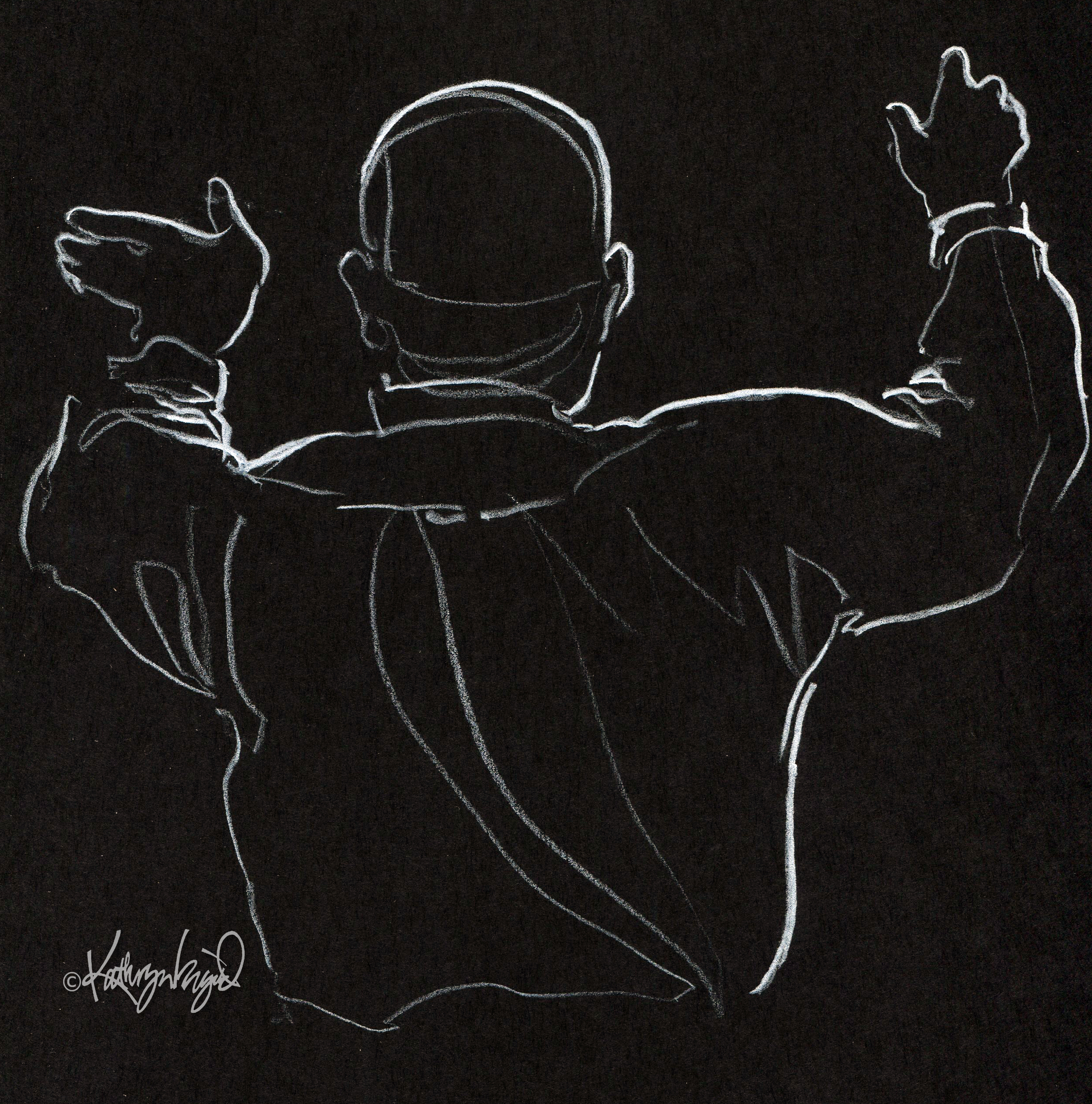
white pencil on black paper

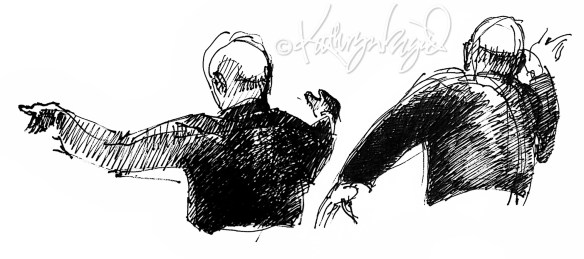
Sketches from a Swedish Radio Choir rehearsal, my husband conducting (if you've seen him conduct enough, you can recognize even the rough sketch of his hand positions) . . .

But as I also pointed out some time ago, the influence of music and of singing remained large and happy in my life, even if I was not destined to be a producer of them. I continued to love listening, cultivated many musical friends who provided the sonic tapestry that was the backdrop of my happiness, and even collaborated with musicians on projects where they provided the aural elements of a performance and I the visual imagery to accompany it. For a few years, I served on the Concert Committee that produced a reasonably ambitious season of musical offerings at our church, which was conveniently located just across a university campus from the music department where many of my fine-musician friends happened to work. It must be added, in fairness, that the draw of being on said Committee was not purely musical but also deeply social, what with all of the musicians and music-lovers therein, and also exceedingly delicious, because most of the musicians I’ve known are committed eaters if not foodies and so the Committee’s meetings quickly evolved into elaborate gustatory events as well.

And that’s precisely why music has remained so largely writ in my life, if not burgeoned and positively exploded, over the years since: music is so intertwined with so many parts of what I love in life that I can’t separate one happiness from another. If music be the food of love, play on! What hasn’t followed for me is what followed for Duke Orsino, because I never found either that I became surfeited by listening to good music or that I became surfeited with love by loving life with musicians–one in particular. Tough luck, your Grace! So I am not dutifully following, wagging my tail obsequiously, as I go to a rehearsal and sit in the darkened hall while choirs work their repertoire into their voices and souls to prepare for performance; I am both absorbing the inner workings of music that don’t exist in me innately or by scholarly wisdom, so to appreciate and bathe in the final production all the more, and also having the beauty of the practice itself wash over me in waves that can inspire me to write, to draw or paint, to design my better garden bed or concoct a more delectable dish for dinner. Waves that, at their best, lift me out of myself and let me feel the singing pass through me as though I, non-musician-non-singer that I am, with spasmodic dysphonia that presumably means even if I ever figure out my head voice and/or learn to read music, I won’t become a great singer–as though I myself were singing.

So, though I may struggle to sing a simple ditty nowadays, I have this magnificent vicarious experience available to me that few are privileged to share, and in this rather out-of-body experiential way expect to sing my way through the rest of my very happy future. As I do the usual end of the year assessments and look ahead to what I imagine and hope for the year soon to come, the imagery is suffused in every possible way with music. I am immersed in song. I write lyrics because I cannot sing them. I listen to rehearsals because I cannot read music well and don’t know the inner workings of music preparation the way performers and conductors do. I attend concerts because the kinds of beauty and grief, daring and humor, poignancy and brilliance that come through well made music embrace, interweave and transcend all of the other parts of my life so that I feel transported, changed to a better self. As though I too am singing in a song that may never have to end.

white pencil on black paper

Conducting another Sparkling performance . . .