One in a Million

digital illustration

Homage to Popularity

My Distinction

If I should need some camouflage, should want to truly blend,

I’d better watch my persiflage and learn not to offend

By wearing last week’s trendy style, my hair too short or long,

Or failing, yet, to reconcile which Party’s Right (or wrong)

To run the government; which church is favored most by God,

How not to leave you in the lurch when I have been a clod,

Appalling with my social gaffes, faux pas and frightful fouls;

I may accept I’m built for laughs, but using the wrong towels

Or forks or traffic lanes, That Word in company unfit—

I hope I don’t seem too absurd as-is, but that’s just it:

My imperfections, my unique design as Me, are such

As might make me appear a freak if I am Me too much.

But, truth be told, while I may work to fit in with the rest,

I hope you won’t think me a jerk for liking myself best!

I will blend in, keep pace, behave, up to a point, to please,

But lest you think me fashion’s slave, I think it a dis-ease

To seek conformity and bow to other people’s rules

When I’m quite nifty anyhow, and others may be fools.

digital illustration

Fingerprint Beats Homage

Building Dreams

Dollhouses were for other girls. I preferred to design my fantasy floor plans and build them out of cardboard and found objects in the built-in bookshelves in the upstairs bedroom. I built them for dolls if those happened to be handy, but since I wasn’t ever a huge fan of dolls except as handy models for my model homes or as fashion models for my clothing and costume designs, my time and energy were more happily spent on the architectural fantasies and the drawings that led to them.

There was never any hope of building the real-world, full-scale versions of any of these, since I started as a young squirt whose whole bankroll comprised a few allowance installments, then grew up (a little) into an arty type, yet another iteration of the sort never meant to have large hunks of cash lying around. I never stopped loving buildings and the magnificent, marvelous pleasures of dreaming up all of the different ways to make interior and exterior spaces work beautifully for all of the different people and purposes I imagine in them. As I grew, my methods leaned less toward bookshelf usurpation and more toward drawings and particularly, toward inner design: one of the ways to soothe myself to sleep when my brain is too hyper for relaxation is to choose a specific kind of building, close my eyes, and try to work out every tiny detail of it in my mind. Eventually, that usually leads to the perfect combination of dozing off and waking up with some new inspirations, often enough ones that can be applied to other things than mere mental building construction.

Just because I’m realist enough to know how unlikely it is that I’ll ever afford to build a dream house in reality doesn’t mean that there’s nothing purposeful in my fantasizing. I’ve invented all sorts of dandy details that would make the constructions more ecologically sound, longer lasting, easier to change and update over time, simpler to construct, more affordable, energy-efficient, attractive in a number of styles, and flexible for multiple users’ needs. All in my head, with the exception of a few on paper and a few in the old bookshelves in Mt. Prospect.

Anybody who has a pile of money just sitting around all unloved and unused and wants to contribute to the construction of my living-&-arts community complex should feel free to give me a jingle. Barring that, I will happily continue sharpening my mental prowess as a developer of mental real estate. Come on inside, if you can figure out how to join me here.photo

Brilliance Then and Now and Yet to Come

digital illustrationIris, in her long-legged elegance, has been for many years, a queenly inspiration among the flowers for me. Iris played a starring role in both the print materials and the floral arrangements gracing our wedding, being a great favorite of both my partner’s and mine. Not surprisingly, we cultivated irises in our own garden; my mother and a good friend living on my parents’ street also had many lovely varieties of iris growing at home. Our choice to use flowers only from those three gardens for the day of our nuptials meant we could still embrace our love of these tall violet beauties and their gracefully graphic long leaves as much as we liked.

Part of my desire for my physical leftovers to be cremated after my death is, admittedly, driven too by this love, since I know that iris plants often enjoy a little taste of ash to amend their beds. If it turns out that human ashes aren’t the kind they like, please refrain from filling me in on that and I’ll just let my survivors figure out where to surreptitiously and inoffensively dump mine and meanwhile go forth to my death happy in the thought that I’ll enhance some floral glory in my own little way.

I’d like to live a meaningful and purposeful life before dying anyway, to be sure. I’d be happy to know that my time on this plane is a good thing for more than just my own pleasure, but since I am not endowed with any mythic powers I know that my impact, for good or ill, will be modest. And that’s quite all right; it’s the path of nearly all mortals’ lives, and we who make up the chorus are necessary support for the brilliance of the marquee stars, the soloists, those few who make their mark with art or invention or discovery or any of those kinds of shining accomplishments. But I live in hope, too, that even if my shining moment doesn’t come in my years on earth, it might be achieved when I am back in the earth. So look kindly, when you see them, upon irises, for one day I hope to be smiling back at you from in their midst.

Ruined by Love—and That’s Not a Bad Thing

Image

digital illustration from a photomontage + text

Leave It that Way

How irksome that constant tension between the urge to grow, move and change and the undoubtedly more natural desire for stasis! Isn’t good-enough good enough? Can’t the ol’ universe cut me a break a little more often? I like it when I get something done, especially something I’ve really wanted or needed to finish, and most especially when it turns out well. But I can’t say I’m crazy about the long slog from here to there. Most of the time it’s just work. Drudgery. Laborious, effortful, tiresome and irritating, endless to-do lists of work.digital illustrationThat, as you know, is the unwarranted whingeing of a privileged, well padded and wilfully late-sleeping creature. I am the human equivalent of a Slow Loris, desiring fervently that the world would slow down to my own pace and let me seem to catch up with it—that is, if anyone as lacking in will and momentum as I am could be called fervent. But like the Loris, I am masking with my ever-so-slow progress through life a fair quantity of deliberation, because I do indeed have wishes and plans. They tend to be so vague and changeable that it’s useful to move at the slowest possible pace in order that my ideas will catch up with my motion before I need to act or make any significant alterations in my trajectory.digital illustrationThat’s how a person with seemingly no ambition or energy or intention of doing anything whatsoever that is not forced upon me can have, in quiet reserve, a fair treasury of plots and plans, ideas and inspirations all waiting for the right moment when I decide to take them up in the public view. Like seeds and bulbs, these unfold into leaf and then, as leaves, transform from season to season. Like artworks, they begin as the meeting of a barely formed thought with a pencil mark or two and gradually evolve into drawings that in their turn can change to other kinds of drawings or paintings or parts of collages. That’s how a little book that took about a decade to get from the slightest inkling at its inception to publication can have in its wake another ten books or so that will seem to spring fully formed from the printing press in relatively short shrift because they too were being built and tended, ever so stealthily and quietly and ever so slowly, all the while I’ve been creeping and plodding along.

It may not look like anything’s happening yet, but don’t worry; unless I’ve stopped breathing, I’m still moving imperceptibly and you can safely leave it that way for now.

Steaming along Toward the Holidays

I’m sure anyone can easily analyze me to bits for it, but my message today is simple. I made a wreath and I hung it up on the front door to send the message to you, one and all. It’s a holiday message that I think is worth decorating for, regardless of which is your own particular holiday or what the specific date on which it falls.photoThe medium for my message may be a little offbeat. Not everybody puts up a holiday wreath made under a hint of Steampunk influence, but that was my angle at the moment, mostly because I really like all the typical mad-scientist found-object quirky-mechanical fantasy junk that fills the Steampunk world. And I made a wreath because it was fun to do.photo montageAnd I did it all to say, in my own funny-yet-utterly-serious little way, that holidays of a great multitude of kinds please me. More than that, I wanted to say that I wish such sweet happiness to all of you who more properly ‘own’ these holidays. And today, what with the 25th of December being the biggest holiday I grew up knowing in my modest corner of the universe, I think it’s exactly the right time to wish all of you as much joy, contentment, hope and peace as you can possibly contain. Well, more–so there will be plenty to spill out onto all the others around you.

Urbanity

There is a huge difference between the merely impressive and the expressive when it comes to modern cities. Rotterdam, once one of the glories in the European architectural crown, was bombed to dust in WWII and, given the poverty of post-war resources, was rebuilt in the following decades as a horrifyingly soulless, boxy blot of concrete on the face of the Netherlands. There is no comfort in knowing that the firestorm that destroyed the city was probably not planned as it happened but resulted from a perfect storm of another kind in miscommunications; the horrors of war are a long testimony to the potential for such devastation. In any even, it took Rotterdam ages to be revitalized into the place of energy and beauty that it is today. Why? What made it such a heart-stopping graveyard of a place when it had once been full of life and loveliness, and how could it ever come back to be something gracious and potent again?

There is no obvious single word that can express the massive destructive toll the bombing took on that city; annihilation is perhaps a close approximation, since it’s clear even from faded photos that the thoroughness of the attacks left very little evidence there had ever been a Rotterdam. I find it nearly impossible to imagine even when staring at proof. When my spouse and I visited the city for a conference even less than fifteen years ago it was still a sad shadow of its former glory, still dominated by 1950s-vintage blocks of affordable and utilitarian harshness that made me want to scream when I saw them in juxtaposition to the few tiny remnants of the beautiful architecture that had once filled the place.

The main reason that Rotterdam is beautiful once again, and that many other cities have, and some have never lost, such beauty is simple: architectural thought and distinction. Building what is cheapest and easiest to construct is a poor solution to lack of structure anywhere. Places that have never experienced the ravages of war, urban decay and other forms of damage and neglect in such extremes can retain the beauty and patina of urbane culture in their urban settings far more easily. Take Boston, Massachusetts, a city that has seen its share of ups and downs over time, but as one of the older cities in a young and generally untouched-by-war country, still has many of its older–even oldest–and most prized, elegant, distinctive buildings. Despite the expected problems of social unrest, economic up- and downturns, spots of urban blight and misdirected city planning that Boston has faced like any modern city, the knowledge that the architectural strengths it does have are worthy of protecting and preserving means that it was built as more than mere indoor space in the first place and that the character of the structures has as much value in shaping the city’s identity as do its great denizens.photoIt should be obvious to those of us wishing to see all of the world housed and sheltered in humane and useful structures and towns and cities that simply throwing up whatever is cheapest and most readily available is hardly more useful, in the long term, than just plain, well, throwing up on people. If we want others to live educated, healthy and therefore productive and admirable lives, we can’t stuff them into trash bins of buildings that, even if they don’t collapse under their own flawed ugliness, will never encourage their occupants and users to flourish. If we don’t intend to fill others’ lives with the vomitous garbage we ourselves would reject and flee, we must find ways to make good, practical, appealing design a mandate and not an afterthought or an unaffordable dream.

That approach not only makes living and working in tolerable shelter possible but nurtures the human spirit and pushes us all to better ourselves, our cities and our world. photo

Fashion Simplified? Forget the Frills, Get a Guy Guide

digital illustration

What’s good for women to know about clothes is not really all that different from what men ought to know. First, of course, *wear* some! Unless you’re in a nudist colony. That’s a different topic for a different day, no?

Never has anyone suggested I was especially stylish, let alone a fashion maven. I wear dresses or skirts, and have even been known to kick up a pair of high heels from time to time voluntarily. In fact, I’ll admit to being so stereotypically girly as to like jewelry and shoes just a little more than it strictly healthy for my wallet.

Frilly, however, I am not. I feel ridiculous, conspicuous even trying on stuff with too much twinkle and ruffle, and am compelled to do a quick Coco Chanel obeisance and remove an item or two from my ensemble if I feel over-decorated. Sometimes, in truth, nothing beats slipping into the most user-friendly jeans, those worked almost to death and not pre-aged by some corporate design slave, until they are softer than bunnies’ ears and they conform precisely to my every nook and cranny, however unflattering that may be. By the time any clothes achieve this magical status, of course, they are generally worn so thin despite any and all repairs that even a ghost would put her knees and elbows right through them. Pity, that.

In any case, I suppose for the most part what would best serve me as style advice is what would do for most men. The males I know are more willing to admit, most of them, that the primary goal is comfort and all else had best conform to it. But even the least conformist among my male compatriots also recognize a need to appear appropriate for business and social occasions, if only to get along smoothly.

My solutions, for the guys and me both, are simple and few. Stay unfussy. Basic, classic shapes, relatively few or subtle patterns, and not too much extravagantly showy stuff. Strong, comfortable, easy care materials. For me, and for lots of people, it’s great to have clothes that are wonderfully packable, so it’s as easy to travel as to hang at home.

Though I love heels and feminine looking shoes, I’ve gotten older–and, I hope, smarter–enough to prioritize health and comfort very highly and now am willing to save up longer and invest more to get better quality low heels and, hurray, flats that will still please my taste preferences. This, it turns out, is becoming a larger theme in my wardrobe: comfort still reigns, and I’m still a determined bargain hunter who is never happier than in finding a good item of clothing for under ten US dollars, but certain things are absolutely worth the extra effort and expense of genuine investment.

That category, for me, includes staple or foundation clothes like shoes and other most often worn items. My grandfather, the most serious clotheshorse in my lineage, said that you could read a lot of a person’s character in his or her shoes and the care given them. I’m not entirely focused on shoes, despite my love of them, but I tend to agree with the sentiment that well-tended classic clothes of the sort best suited (no pun intended) to the occasion make a good impression. Good shoes. Just a couple of pairs of slacks and/or skirts (or a Utilikilt!) and/or a dress or two. Pieces that are sturdily made and perfectly fitted to form will flatter your best features and cover your sins, and they won’t need to be replaced often for either getting too worn out or dated. You’re good to go for work and generally common events without worry about making the correct choice and getting by with both comfort and class.

Accessories–socks, vests, scarves, hats and watches and all of that sort of thing–can certainly change the character of a strong basic outfit and personalize it as little or much as one likes. And sometimes, these are the easiest wardrobe items to find at spectacular bargain prices, so it’s easier to vary an outfit with them than to have multiple expensive, high maintenance ensembles cluttering choice and storage.

The foundational elements of design give plenty of clues how to make the most of what clothes you have, whatever they are and whatever your personal style. On a person, monochromatic sets of pants, socks and shoes give the appearance of longer legs than the broken-line look of wearing those three in different colors. Skin toned (whatever your skin tone) shoes on a woman in a skirt or shorts make the shoes look like an extension of her legs rather than an eye stopping different color, and again, they create ‘longer’ legs. A fitted torso (shirt, dress or jacket) is narrower in proportion to its top-to-hem length and so will tend to make the man or woman wearing it seem slimmer than a loose, baggy garment. And so it goes. All of the design basics in the world, however, will not guarantee you feel comfortable or that your clothes express your personality, so while I think it’s both practical and attractive to pay attention to smart details–and ask for help if you’re not so knowledgeable about them–clothes only indicate the man, they don’t make him.

Since I long ago conceded that my philosophy of housekeeping is to make everything as easy as possible for an inveterate lazy-pants, no-iron shirts are a gift from the gods, and packable knits the virtual equivalent of wearing jammies to work. So I’m likely to break rules, if there are any, in favor of what pleases me. But you know, sometimes it really is enjoyable, if not de rigueur, to wear something tailored and crisp and beautifully fitted.

This, my friends, is one of those places where I have actually learned a few useful items over time. Behold, in this my era of crepitation, I can still learn a thing or two. Thing One: professional tailoring can make the ordinary extraordinary for less than buying custom. Wearing extraordinary things doesn’t hurt your image, unless you’re cultivating a scuzzy vibe. I won’t judge you. Thing two (and also not recommended for those polishing their grunge-meister cred): dry cleaning. While it can be pricy and is pretty ecologically objectionable, is the only way to make some tailored clothes look, and stay, the way they should. Invest in these two and, more significant even than that you will love your clothes more, your clothes will love you more, and for a longer time. That is a good investment.

But enough of this. I’m going off to find my jeans and T-shirt. My work here is done.

digital illustration

Multiplication tables.

A Concert with a Wedding Attached

Seventeen years ago today I got married. And as all of you who have visited this blog with any regularity know, when I got together with the man who became my husband, spouse, best friend, partner and daily companion, I gained a world of music. Of course, music was a big part of my life already and distinctly a contributing factor in our getting together in the first place; I worked in the university art building, right next door to the music building, and spent plenty of quality time there going to concerts, meeting with friends and all of that sort of happy thing, and when the nice Director of Choral Activities asked me if I’d be willing to help spiff up the aging auditorium for the annual Christmas concert festivities I gladly said yes. That was only the first time I made banners for an occasion of collaborative fun with that nice DCA man. Less than eight months later I was making bunches of banners to fill up a church nave for our wedding.scanNo surprise that, since under friendly pressure from them we gave up on the attractive idea of eloping and just having a party with our family and friends on our return, we decided that the best alternative was to have a celebration with lots of music and just party all the way through the event. Turned out it was easy to do so.scanAssembling our wedding’s participants was easy-peasy. Relatives and friends from work, home life and church lined up and pitched in as planners, greeters, acolytes, reception hosts and much more. Clergy? Well, as the daughter of a bishop I didn’t have far to go to hunt up someone to marry us. The church’s lead pastor presided and Dad officiated, and a dear sweet retired pastor friend served as lector. Witnesses? Having three sisters, I had no problem lining up a team; Richard’s backup was easy to arrange as well: his sole brother, our mutual beloved friend Jim, and Richard’s colleague and partner in choral crime, also named Richard (Nance). Musicians were easiest of all for us to arrange, unsurprisingly.scanWe had an outstanding pickup choir of students and members of Richard’s choirs, past and present, and friend-colleagues playing horn and singing the processional solo. Jim, getting in some exercise during the service, was organist as well as standing up for us. That, as well as having helped us plan the whole service and choose its music, and set one of my texts to music for our congregational hymn. Richard N, besides joining the altar party, pitched in (no pun intended) musically as well, conducting the choir for us in a lovely collection of pieces capped by the premiere of the exquisite anthem he composed for the occasion (now a best seller for Walton Music!).scanYes, this is a brag post. Happily, all true.photoHappy Anniversary, my Love.

DIY Weddings are Easy When . . .

. . . you have a world of friendly resources at your beck and call. So, technically, it’s not DIY at all of course but rather Così fan tutte. [Ed: roughly translated, ‘Everybody’s doing it’.] It’s not, even then, for the faint of heart, because let’s face it, unless you’re having the always admirable super short, informal adventure of standing in front of a Justice of the Peace or of surprising your immediate family in the middle of dessert one weekend with a five-minute ceremony, there are a host of details that might need to be given eventual consideration. Beyond simply making sure that the two people who are getting married actually show up at the same time in the same place, there are a handful of legal elements that generally should be taken care of before the event, if it’s to have any official standing. And from there, the possibilities expand exponentially. I suppose it’s not wholly shocking that the process might lead to the development of a few dysfunctional bumps and bruises among family, friends and support staff along the way.photoBut I hate confrontation and stress, and the very idea of becoming such a parody-inspiring Marriage Monster appalls me. And when we decided to marry, I don’t doubt it occurred to me that my intended, Richard, might equally abhor the idea of a painful process and wedding day. So we were both very happy to treat the whole thing something like an elaborate concert performance, perhaps a cheery semi-staged operetta, and to act as artistic directors and performers, yes, but also to let a great slew of friends, relatives and acquaintances carry out as much of the heavy lifting as possible along the way. After all, though we intended to have a good time and hoped everyone else would too, the real point of the occasion was that at the end of the day we would be more married than we were at the beginning of it.

Being a visual artist, I had no shortage of ideas about how I wanted various things to look, from invitations and service bulletins and guest books to the floral arrangements, wedding party dress and church decor, to the tables and food at the reception. And I had pretty extravagant ideas, at that. But I didn’t have a huge quantity of money to invest in it (nor did my parents) and I deeply dislike the idea of spending ghastly sums on a single event that, while important and hopefully happily memorable, is still only one actual day of life. What, I should spend my life savings on a single party?

That’s where one’s personal fortune in community has so much more than monetary value, though I’ll readily grant you that ours, in sharing their talents and efforts with us for the occasion, saved us a ton of money. We married in the church across the street from the university where we both worked, since not only were we members there but it was so handily located for so many of our friends, students and colleagues who were also part of the university community. I had a fairly easy time imagining how to use and decorate the church, since a few years previously, I’d served on the committee that oversaw a massive renovation of the space, taking part in all elements of the design from seating arrangement to finishes, and designing the new altar, font, pulpit, rail, crosses and incidental furnishings that were built for it.photoSo I opted to fill the space with a different kind of design, making a couple dozen banners to hang on walls, fly from the light boxes in the ceilings, display on stands in the narthex and chancel, and be carried in procession by fine young friends strolling in en route (to light candles) and out (to the reception hall) along with the wedding party. Already a banner maker for church and event commissions, I had lots of material and experience, so I sewed, painted and otherwise assembled the banners myself (from the flying ones at about 36 inches in length to the main chancel banner that was about 26 feet), and I got good help with putting together the stands and hanging mechanisms and installing them all at the last minute when we could get into the nave to do the work.photo montageThat’s a constant with weddings and parties in all sorts of venues other than Home: no access for prep and installation and other setup work until the last minute. So because I am a control freak, a design nut and also someone who really wanted to just have fun and enjoy my actual wedding day, I plotted and planned and prepped everything I could, along with my Intended and a slew of family, friends and other helpful conspirators. First, of course, it was essential to get all the actors on board and ‘synchronize our watches’, since it’s a busy crew and driven by a multitude of crazy calendar iterations. Once that was established, the work of service and reception planning commenced.

The earliest necessity, since I didn’t want predictable or expensive floral arrangements but love flowers, was to plant and tend flowers in Mom’s garden and that of our good friend Claudia, next door to her. By the time our July wedding rolled around, I had gathered the ribbon and wire and other essentials and been offered by the lovely Linda, a friend who was chief florist for the university’s official events, that if I handed over the materials she would provide us with her gorgeous bouquets and boutonnieres and corsages for all and sundry, so all I needed to do at the last minute was go a-gathering in their yards with my two beloved garden-gnome ladies and then give buckets full of fresh beauty to Linda on the day.

Meanwhile, much brainstorming and list-making was underway with the able assistance of others, so that everything essential would be pre-arranged too and not worrisome. All of the print materials derived from a combination of my photos of iris leaves, text typeset by one of my sisters in fonts I’d chosen, getting printing done by the local quick printers (with whom I’d done many work projects) on their green ink printing day of the week and then doing all of the black ink stuff on copiers and folding/collating things myself while I was calligraphing the invitation envelopes, closing them with an inexpensive gold seal and a swash of purply interference paint and a rubber stamp message noting that the music would begin a full half hour before the service. We did, after all, know that there would be lots of my fiance’s fellow musicians both participating and attending.

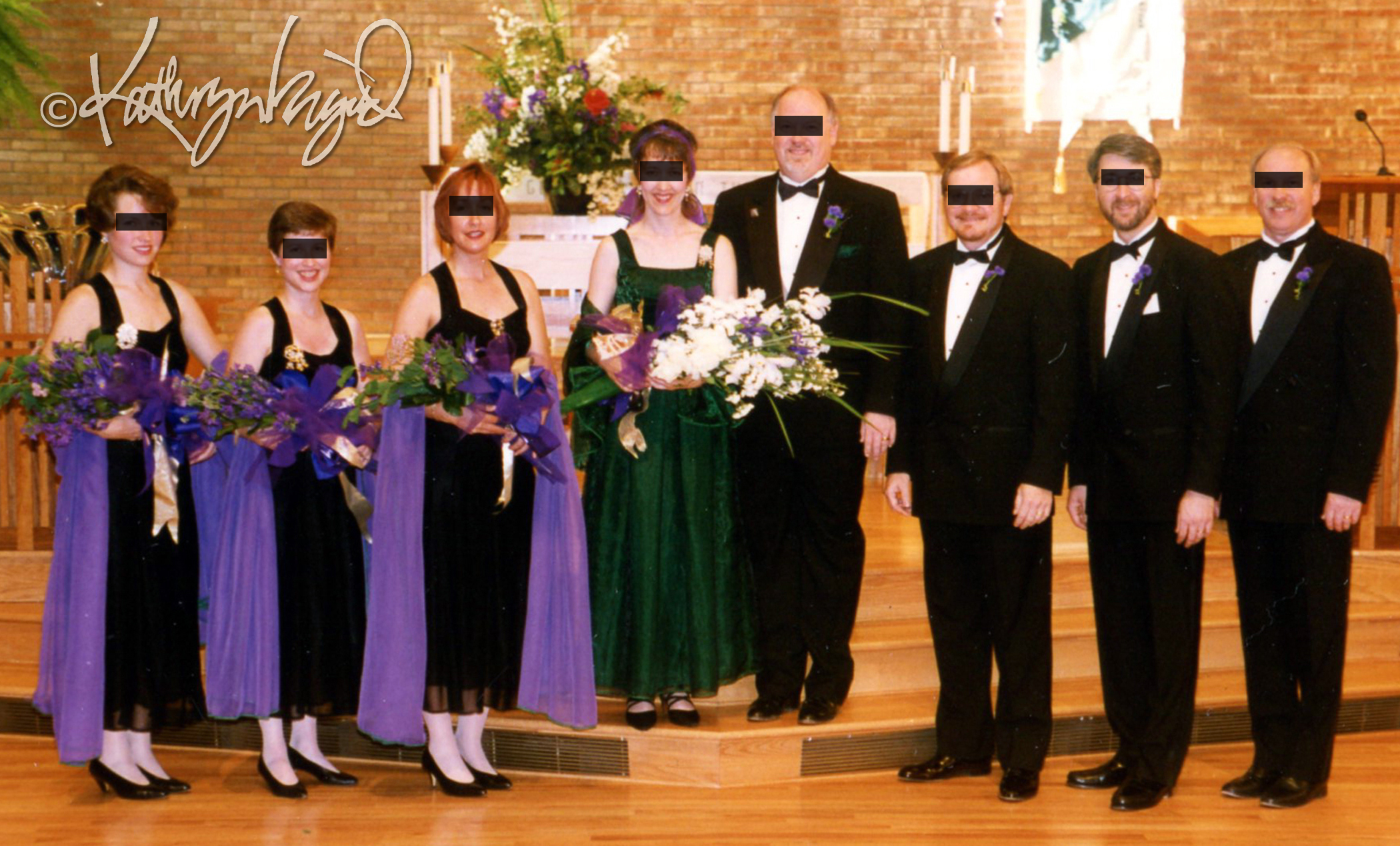
Clergy? That was about the easiest part to decide, since as a cleric’s daughter I could just tap Dad. So the church’s lead pastor presided, Dad officiated, and a sweet retired pastor friend served as lector. Since Dad was robing up for the pastoral gig, I decided to have one of my uncles sashay down the aisle with me, and he kindly acquiesced to my request for an escort. Our organist, our great friend Jim, was also standing up for us, so he did a bit of trotting up and down the aisle, but in great Jim style. As one of four sisters, I had the easiest time choosing three attendants, but it was simple for my groom to line up the perfect support team, too, between his one brother and Jim and another of our close friends who happened to be Richard’s choral conducting partner at the university as well. Friends from various places rounded out the team, serving as greeters, acolytes, and our wonderfully hospitable reception hosts. One of our brothers in law was chief photographer, taking a batch of group wedding party photos just before the church began to fill, and all of the rest of the pictures came from a combination of photos friends sent us and the box full of disposable cameras we’d distributed on the reception tables and collected for development at the end of the day. This proved a serendipity because it both gave us some fun candids from the kids’ point of view and kept some of the younger partiers entertained during the reception as well.

photo

I designed and made stoles for Dad and the presiding minister, too.

My sisters readily agreed to help pick out simple black dresses they’d actually have a hope of wanting to wear again later, and we managed to find a great deal on them and choose a design that, happily, was made of a very stretchy fabric, since it turned out that one sister was curvaceously pregnant by the time our wedding day rolled around (no pun intended). I sewed a violet voile shawl edged in emerald green for each of them, and a scarf of the same to tie back my hair rather than having a veil, something that would anyway have looked a bit odd since I didn’t want to wear a white gown. Besides that I tend to look a little too much like a corpse when wearing white, I too wanted to have a dress with reuse potential, especially if I was investing a couple hundred dollars in all of the fabrics, so I made my shawl from iridescent emerald voile, the same fabric that I lined with dark emerald taffeta for the body of my skirt and bodice. The bodice, made in a sort of weskit shape, I stitched with self-colored silk soutache. While I cut and serged all of the pieces of my layered fabric for the dress and made my underskirt, my mother generously did all of the finish sewing on the top and skirt. Designing and sewing just the soutache provided enough adventure for this semi-skilled seamstress. I did, however, go dress shopping with both of our moms, and we found one a perfect-condition consignment dress for a great price and the other, a clearance two piece dress/jacket combination for $10. The guys wore rented tuxes, mainly because the groom owned a white tie and tails conducting getup and nothing like a plain black suit, and I figured if I was going to have a wedding more formal than a zippy elopement, I still did want to get all spiffed up. Not averse to having fun, and all that jazz.

photo

photo

[Ed: No, we weren’t all pretending to be The Dread Pirate Roberts–I’m just providing a dash of privacy for family and friends.]

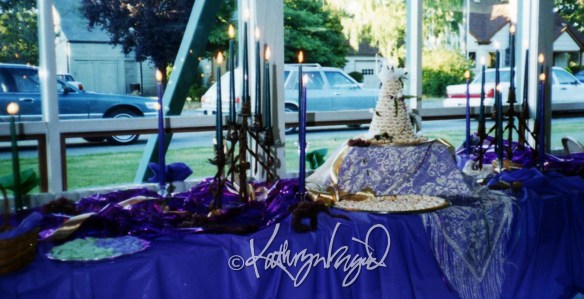
The fabrics and ribbons left over from manufacturing banners and dresses and shawls got trimmed and saved up for dressing the reception tables, along with a multitude of candlesticks from home that I loaded up and lit. To keep reception food fuss to a relative minimum, we opted to have the party in the fellowship hall at the church. That way, also, there was no monkeying around with additional travel, hall-finding and parking issues, party setup in a separate venue, or the time required for all of those add-ons. And we figured the social aspect was the primary reason for having a reception at all, not fussy edibles meant mostly to impress people, so we went to our favorite farmers’ market and bought a bunch of lovely fresh fruits to complement the array of nuts, chocolates and home-baked cookies that were the main bites. Friends and relatives gifted us with many of the cookies, and the baked centerpiece was a traditional Norwegian kransekake (more a stack of crisp-chewy almond meringue biscuit rings than cake) made by our Norwegian brother-in-law and my mother. As it turned out, yet another set of friends surprised us with a second lovely kransekake, so we were all in cookie heaven. A very fine place, indeed, and not only on a wedding day.photo