Cat & Rabbit Go to Town

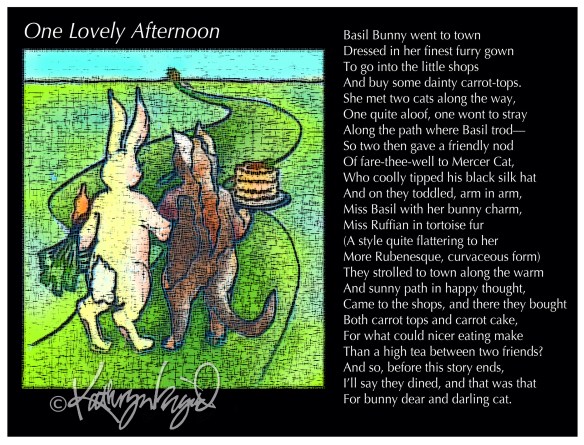
My sister’s cat Mercer has been sick and suffering for a while lately with some mystery malady, and his symptoms have thus far refused to explain themselves to his faithful veterinarian, so we’re in a watching, waiting and hoping phase. It’s sad and frustrating, and poor Mercer needs some serious respite from his ailments. I’m afraid I haven’t the skill to give him anything more palliative than the occasional pettings he allowed me to give him while we shared living quarters this summer. So I send out this little ditty to bring him good vibes of well-wishing long distance, as it stars the two most faithful fellow fur-babies who live or visit in his home, Ruffian the cat and Basil bunny.

Digital illustration + text: One Lovely Afternoon

The Miniaturist’s Challenge

When my family and friends were conscripted to help install the artwork for my master’s thesis exhibition, they could not help but note that it would have been a kindness on my part to specialize in something a little more manageable, say, postage stamp illustration. Hanging murals of up to nine by thirty feet in dimensions is admittedly more unwieldy than mounting a bunch of tidy little framed life-sized insect portraits or installing a series of elfin sculptures made from shirt buttons and walnut shells. Alas, though I did segue into much more portable forms in later years, it was not soon enough for my loved ones’ sakes.

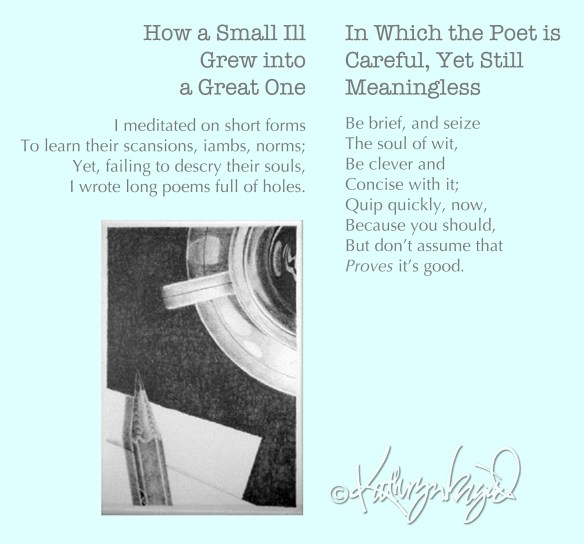
My verbosity is a similar burden on my circle of acquaintance, as I am not famous for knowing when to shut up any more than I am known for limiting my opinion to those who have actually asked for it. But just as I have learned to appreciate and work at smaller and less physically demanding visual media along with my enjoyment of massive and messy kinds of art, I have a fondness for smaller and less epic essays and poems, too, and have been known to craft these with similar avidity. While scale in no way guarantees quality or lack thereof in any medium I know, it is sometimes a relief to me as much as to my friendly audiences when I get my kicks by producing petite expressions of my inventive urges.Graphite drawing + text: Movements in Miniature

Sing Comfort to Me

Digital illustration: Wild Daisies 1Sweet is the Song

However cold and sharp the wind may be,

As wild and deep as darkness ever falls,

From utmost edges of the storm still calls

A song that stills, that draws and comforts me—

Though battles rage, the world in sorrow drowns,

And trials threaten life and hope and light,

That gracious call still guides me through the night

As long as I will listen to its sounds—

No danger is so great, no ill so dire,

Nor pestilence and terror so extreme,

That it cannot be mended by the stream

Of melody from that angelic choir—

Now when amid the depths of dark and pain,

I’ll listen for that heavenly refrain.Digital illustration: Wild Daisies 2

Desire! & Creature Comforts

I got to cuddle a couple of babies lately. I’m a sucker for cute babies and even when they’re a little weepy or unhappy, I’m generally glad to get to play grandma for a little while in exchange for the warmth of a wriggly tiny person’s presence in my arms. I didn’t have either the instinct or the timing to be a mother myself, but I’ve been gifted with siblings, in-laws, and friends whose babies have been the delight of my Auntie and pseudo-Granny life. In the last couple of weeks, I got to hold and cherish one of my great-nieces for the first time. What a joy!

Of course, I admit I can’t help but feel a teensy bit of envy when I hold a sweet, curled up baby, whether she’s awake or asleep. The brief part of life when you’re still consistently the most adorable person in the room, even when you’ve just spewed copious quantities of used milk on everyone in the vicinity, is surpassed only by the preceding months of cushy luxury spent doing the backstroke in the protective amniotic pool, and I think it would be lovely if I could just get hooked up to that kind of spa service on a longer-term basis.Drawing + text: Umbilical

An Origin Story in Red & Black

Image

Drawing + text: Rubies & Ebony

Discretionary Fun

Digital illustration/drawings: Mood & 'TudeI get the impression that some people treat non-work times as the only times when they’re allowed to be happy. I do understand the need for income that can drive one to spend time in a job that doesn’t fulfill any other need or desire in life, and many of those are in the least-compensated positions at low-paying employers’ as it is. Been there, done that.

But I can say, too, that the greatest misery in my work life was attitudinal, and the more I did to discover and avoid the things that made me unhappy in my work, the less miserable I was. The more I sought to learn what I enjoyed in work and chose ways to magnify that, the closer I got to contentment both at and out of the workplace.

I grew more cognizant, at the same time, of not wanting to waste precious time on work that challenged my inner playfulness or threatened my general sense of joy and purpose. I was given a great gift in being able recognize the longing and accept and pursue it by choosing a much lower-paying job (on paper, at least) with a great happiness-quotient. I’ve seen, over the years, that many of us are easily misled when we try to calculate what we think we need for our daily expenses, and how much it costs us to earn that. Yes, we get those paychecks, but if the job requires, say, clothes that we wouldn’t wear other than at work, child care, transportation, professional training and memberships, and that sort of thing, how much pay on an annual or monthly or hourly basis does it really cost to go beyond paying for those, at least far enough to keep a roof overhead and food on the table as well?

Nobody knows this awful kind of math better than the working poor. I’ve been in that category more than once in my life, but have always had safeguards others lacked—like friends or relatives from whom I could rent living space more cheaply than I could even a minuscule, run-down apartment in a scary part of town—so I also know that I am luckier than most. Now, when I am married to a person who is not only able to make enough income to support both of us but is willing to do so, I am among the most privileged and fortunate of creatures, and I know that, too.

But one of the best things I learned along the way when I was living on a very slender, sometimes sporadic, income, remains valuable to this day: if I spend so much time and energy on just ‘getting by’ in life and don’t put forth equal effort to enjoy, live, and love my life along the way, all of the pennies I earn are of little value at all. And while I can’t always afford the most thrilling and glamorous ways of keeping myself amused, especially when I do need to be working at any task or job, I had better find the simpler and cheaper ways and the most reliable ones to fill my life with happiness and contentment, I know by now that surrounding myself with people I love, admire, enjoy and respect is the very best solution. And if my job doesn’t allow for that kind of happiness and contentment, then it is costing me more than it pays, in the end.

Little Things

The tiniest detail can determine the depth and intensity of a memory. It’s that faint fragrance wafting from the corner of the flowerbed at my first home that I remember most about playing in its front yard, and that in turn, reminds me—every time I get a whiff of the same scent—of living in that cozy brick house with its backyard apple trees to climb, the slope from fence to sidewalk where we slid down the grass on a cardboard magic carpet, and the narrow muddy track behind the back wall where we played at exploration.

My grandmother gave me a little locket, once, that had been her father’s watch fob, and I made a little drawing of the monogram on its front, HDB for Hans Daniel Bolstad. When I look at the drawing now, the locket itself long gone somewhere else after multiple moves of residence, I remember the small weight of it in my hand, the warm burnished shine of its pale yellow metal, and the feel of the engraved curves in the monogram bitten well into the gold-plated finish on it. I also remember, thanks to the tiny little hole where the drawing is black at the bottom center of the drawing, hearing the story of how the space between the engraved lines there were caved in by a different kind of bite, that of Great-Grandpa’s tiny daughter when she teethed on the locket a little fiercely.Drawing: Memento

What will I remember when my memory is further faded by time and age? Impossible to know. But my guess is that it’ll be seemingly insignificant, minute motes, and not the grand arc of history, that’ll remain intact and prod me to recall unexpected things from time to time. I may not hang onto much of importance, but some dust-sized fleck of a sensory clue that will likely trigger a cascade of reminiscence when the moment comes.

Better Put the Best Face I Can on It

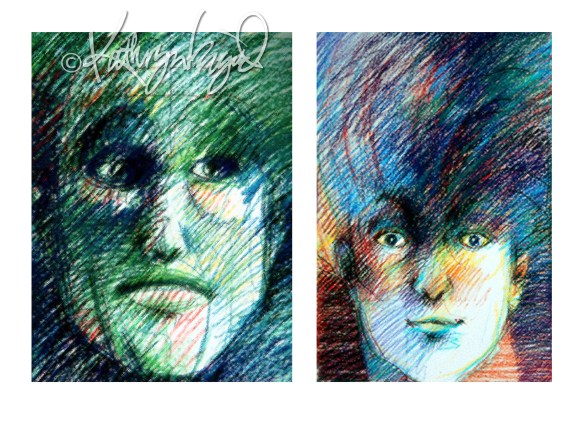
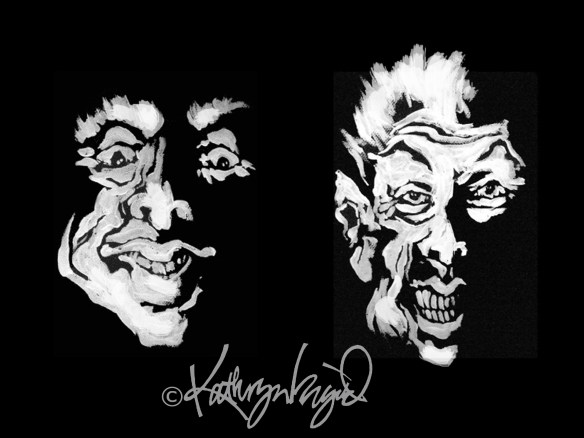
Acrylic on paper: Silliness as Substitute BeautyComing up empty? Never! Well, okay: sometimes. That’s closer to the truth. I’ve managed to put up three years’ worth of daily blog posts thus far without missing too many beats, but do I have the occasional day of blanking on what I think would be of interest for me to write about, draw or photograph, and post. Outright brilliance would be a stretch for me on the best of days, and on many, it’s just good old showing-up-and-working that gets the job done.

Pretty much the way life works everywhere, isn’t it.

I get up and brush my teeth and take a shower and get dressed, and there’s no guarantee I’ll look less like a goofy, sleepy person than I did a half hour earlier. Some days, it’s flat-out worse, especially if I have to be up before about 9:30 in the morning. But I’m still me. I’m still going on to have a day, to do my writing and picture-making, do my household tasks, go to events, whatever the calendar demands. I’m always planning to have a really good day, if at all possible.

So whatever the agenda, I choose to give it my best, pretend (if I have to) that all is swell in the world, and see if I can’t do something myself to make it as good a day as I’m wanting. We can’t all be pretty all of the time, so I like to let my imagination offer me some fun alternatives to perfection and prettiness, and then the day has a better chance of hitting the happy mark.Acrylic on paper: Sneaking Up on Greatness

Sometimes It’s Hard to Tell Who’s Giving the Gift and Who’s the Recipient

I have been taught that it’s polite to accept generosity with good grace: say Thank You, show proper appreciation, and humbly know that even when you think you don’t need or want the gift, it is your turn to show kindness by recognizing its significance to the giver. That doesn’t mean I’m terribly shy about ‘re-gifting,’ or passing the gifts along to someone I think will better appreciate and use them, eventually. It also doesn’t guarantee that I’m entirely alert to when I’m being presented with something valuable and meaningful. Even when I’m fully aware of my undeserving, I’m not exactly a genius at generosity myself, let alone fully attuned to how much I am given and how often.

Take the times when I am being thanked with gifts for doing things that I should have done as a matter of course, and often have done very grudgingly at that. I have always been a poor excuse for a visitor, supporter and caregiver, being intimidated and squeamish and easily unnerved by others’ needs and ailments and trials. I was terrified of visiting my own grandparents when they were old and shut-in, unable to be the people I had known in their healthier and more mobile and cogent days, and could rarely face the strangers that they had become, let alone the alien and frightened person I was myself in their presence.

Long before those times, even, I was both younger and less experienced or brave, if you can imagine anything yet more craven. My parents had always taught me by example that care and compassion, generosity and hospitality and respect, all of these were essential life skills and characteristics that should be nurtured and cultivated through consistent use. And I never got good at any of that.

Once, when Dad was making a hospital call on a parishioner who was dying of cancer, it happened to be when Mom and I needed to be along with him for something later in the day and it wasn’t convenient for anyone to be shuttling back and forth multiple times, so Mom and I rode along. Somewhere on the trip I realized or was persuaded that I should join both of them in visiting this man who was a stranger to me, rather than sitting and waiting in the car on a cold, damp day in the first week of December. I’m quite certain that I was both reluctant and frightened to make this visit, parental support notwithstanding. I’d never seen a person so near to death, and his being unknown to me did nothing to ease my fears; if anything, my perpetual social anxiety probably spiked to all-time highs at the thought of meeting someone new just when he was about to die. I’m quite sure that I wasn’t mature enough to recognize that this was a clear instance of the occasion being ‘about’ him, and not about me at all.

I remember rather little of the actual visit, only little bits. I had met this man’s wife once or twice, so I suppose we exchanged some small talk about that acquaintance. He asked me about my interest in art and shared that, while he’d had some entirely different sort of day job, he’d always had a creative urge and had made many small stained glass pieces as a fond hobby, something I gathered he sold to make a little pocket-money at times. His inquiry about what was happening in my own life just about then eventually revealed that the anniversary of my birth was approaching just as the end of his life was to come.

He was a pale, yellowish creature after cancer had defeated most of his bodily systems and all of his treatments, bloated but in an empty way; an airy husk of the man that had been, now nearly ready to blow away. His hospital room smelled just like hospital rooms have always smelled, overlaid with the added imaginary pall of looming mortality. I wasn’t a baby—I understood well enough that his sort of death wasn’t contagious—but I couldn’t help itching to escape all the same.

When this pallid wraith offered me his dry, cool hand I took it in mine and held it for a while as he and my parents continued to talk softly about more needful things. I did my best to give the appearance of better bravery than I had, if not compassion, and still he showed me more sympathy than I expect I did him. He thanked us all quietly for the visit as we left, and I was too immersed in trying to console myself over the sadness and discomfort of it all to realize that it was he who had done the kindness.

I heard in just a few days of his death and thought with some melancholy of how sorrowful it must have been for him to face it, and for his loved ones to cope with its eventual, if expected, arrival. Only a couple of days later, I thought of him again.

It was my birthday, and among the presents I received was one small package that was not from a family member. My parents told me that my acquaintance had asked his family to see that I be given this gift as a token of his gratitude for my visit. It was a table-top stained glass flower he had crafted sometime back when he still had the strength and skill to make such things. The little blue flower bowed gently on its wire stem, and I was abashed and moved by it.

This was a delicate token of real grace. It made a fine representation of that goodness, its glass petals and leaves letting light filter through, its slender stem so fine, yet resilient enough to spring back upward when pressed. It was a flower that stubbornly refused to wilt, even when it was a post-mortem gift from a virtual stranger. I don’t know, after all of these years, precisely what happened to it or when and where it disappeared, but I kept it for a very long time indeed and found in its simplicity a constant reminder that the little things even a reluctant and weak person might do in the name of duty or expedience or, however hesitantly and ineptly, for kindness’ sake, might in the end have some power. That this power is not our own matters less than that it can change the course of the moment, or sometimes, perhaps, even make a difference in matters of life and death.Digital illustration: Stained Glass Flower
Changing Directions

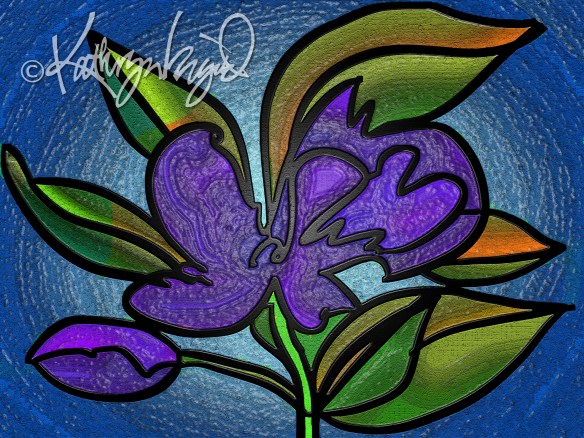
Digital illustration: Changing Directions

Do I move at the whim of the slightest breeze? Often enough, I suppose. But what really changes my direction in life? Chance? Passion? Accident? Will?

I’d say it’s been one or another of all of those at various times, and perhaps occasionally a combination of elements. What I would say most definitely and commonly is that I have rarely known very far in advance what direction my life would be taking, let alone exactly when. Living with uncertainty is at the heart of the human condition. We can’t know (nor would I wish to know) much of what lies ahead for us. Being an artist, and married to an artist, I have made some choices that guaranteed perhaps an even deeper and more frequent susceptibility to wondering what comes next. While both of us have taught at times, an occupation that has a degree of predictability and dependability absent in most other employment that involves our artistic skills and training, it never prevented the question from arising in other ways.

For me, as a longtime adjunct at the university, it meant that though I’d been there for nearly seventeen years (most of those, full-time) before I stopped teaching, I never had a contract in hand for more than a year at a time, nor was my class load or schedule in any way predestined; I taught what I was asked to teach, when I was asked to teach it. For my spouse, a tenured full professor and director of his division, he still had questions about how he might change and grow as a teacher, never mind whether to apply for or take any of the other positions on offer at other places from time to time.

We are, I think, pretty much the ordinary pair when it comes to that sort of thing. Even now, after many years of doing particular kinds of work at specific places and getting plenty of satisfaction from those various tasks, it doesn’t in any way stop us from asking, What next? Will we continue on the present path exactly as we are just now? Do we opt to  make any kinds of transitions, either changing the way we do what we do or the venue for doing it, or does something entirely new entice and draw our interest? If it does, is it attainable? Is there some utterly unimagined thing lurking just around an unsuspected corner, waiting to draw us in?

At times, it can make me feel as though I can never quite catch my breath or my balance. I tire of asking myself all of these whys, hows and what-ifs, yet I can’t resist scratching at the questions the minute I thought I’d put them to rest for a while. Even when I’m most happy and fulfilled and contented, I always wonder what lies ahead.

And that, of course, is the very heart of that human condition. We know that change is inevitable. We know that some of it will be by our choice, and much of it will be thrust upon us or sneak up subtly and surprise us all the same. And we know that, in some ways, the only guarantee we have is that we will all die wondering. It’s what we do, and it’s who we are.