Tiger Time

If you remember anything about primary school (and I do, if little) you hopefully have a few memories of one or more of the fantastic sort of teachers who were the virtual equivalent of extra aunties and uncles and grandparents, but neatly spun into the form of educators whose wise teaching made you learn things without even knowing you’d worked at it, and want to learn things you hadn’t even known you wanted to know just because they were such fine pedagogues that they made it seem possible, if not easy.

You undoubtedly also have a memory or two of teachers who were quite the opposite. My personal least-fave was the third grade teacher who had no compunction about excoriating and humiliating a student in front of the rest of the class regardless of the infraction or any of their previous achievements or behavior, even cracking a yardstick onto desktops to make a point when she was het up, regardless of whether there might be some small knuckles in the way of the stick. At the very same time, she apparently thought it perfectly logical and beneficial to ‘level the playing field‘ and make all students feel they could accomplish something in her class, lest the PTA or school board think her not supportive and informative enough, and this she would do by sitting and doing the weakest students’ homework for them.

I knew nothing of this until one time when I was the unlucky receptacle for her ire, having failed a penmanship test in the first weeks of school because that school required students to learn cursive writing in the end of the second grade and the one in another state where I had spent my second grade did not. Had she asked us all to sing a song in Spanish, I might have been the star of the class, because my second grade teacher Mrs. Mosqueta let us learn a little elementary Spanish from one Señor Ybarra, who taught by the ultra-newfangled medium of televised classes, and I don’t think my new classmates in Illinois had yet had access to such magicks themselves. But there I was, little miss Goody Two-Shoes, who had never gotten anything but perfect scores because I was too prim and much too afraid to not do my homework to the nth degree—if I had any actual training or homework to prepare in the event—flunking my attempt to make Pretend Cursive when that mean lady in her sausage-casing dress didn’t even ask whether I’d ever been trained to write that way. If you think I still sound remarkably bitter about such a small thing from so long ago, well, I probably ought to let it go but I tend to enjoy my little revenge fantasies more than is entirely good for me.Digital illustrations + text: Tiger TimeThis is all in jest, of course. I wouldn’t be so cruel as to want to give any poor innocent tigers indigestion.


A Faraway Look

Daydreaming is amazingly useful. No matter what teachers and bosses and impatient parents may have said over the years (never to me, of course, wink-wink), that pleasant fugue state of seemingly purposeless internal wandering is where a great deal of terrific, very purposeful invention and problem-solving happens. It takes us to inner regions where we are unencumbered by rules, editing, and logic, and can let the what-ifs of experiment and hope play together until, sometimes, they produce brilliant results that endless hours and years of study and labor might never have fostered. How can we expect to engender anything grand if we don’t aim for the seemingly impossible?Photo: Faraway

Consistent study and labor are, of course, quite necessary if we are to be able to even conceive of what exists and how we intend to alter it; to begin with no facts, no tools, no notions of probability or potential will inevitably leave us puzzling fruitlessly for ages before we ever approach a fantastic and outlandish idea, let alone a useful one. But once the seeds have been sown, we can’t assume that there would be no purpose in additional time and imagination spent on divining what to do when they begin to grow as well. The dreamers of the world have nurtured at least as much meaningful and helpful stuff as the mere scientists and scholars and brawny-brained geniuses have done, but with less hoopla, and it seems to me that we should be wary of working too hard to bring fantasists down to earth too soon.Photo: Fruition

Assume, when you see me in an apparently abstracted slide toward the comatose, that I am in fact inwardly journeying toward a dazzling insight or earthshaking invention or two, and leave me in peace. I shall emerge, in due time, bearing the harvest of this grand exploratory trip. Or at least I’ll have had a refreshing nap. I’ll happily leave it to you to determine the value of the difference, if any, between the two eventualities.

Dirty Jobs, but Never Done Dirt Cheap

The world is truly full of overlooked and underpaid laborers.
Photo: Housekeeping Cart

This is a story as old as human community, and yet it’s notable how little it’s changed. The ugliest, dirtiest, the most physically demanding and unpleasant tasks, the ones that no one in his or her right mind would usually choose to do, let alone without any recognition or reasonable pay, these jobs don’t cease to exist because nobody likes them. They simply get done by people who have no other choice. And do we thank them for it? Do we give them public honor and paychecks commensurate with the knowledge and patience and back-breaking effort and yes, specialized skills that are required of them?

You know the answer. In this country, we spend more time and energy on vilifying the working poor as nuisances and a weight around the necks of their higher-taxpaying richer neighbors, at best. At worst, we accuse them of criminality, many of coming into the country illegally—which they may well have done—to snatch bread from the very lips of our own better educated and better protected children through their stealing jobs from the local citizenry. Which, of course, they rarely do, considering that neither we nor said children are willing and able to do without the jobs that the working poor do for us, let alone perform those tasks ourselves. Never mind that those we abhor for daring to come across the nation’s borders unseen are doing precisely what the vast majority of our own ancestors did, and out of the same desperation for survival, but now with the additional barrier of laws designed more out of fear and hatred than out of specific plans to better the safety and welfare of any of the parties involved.

If immigrants could remotely afford the risky business of taking a national day of “working poor flu,” the way that unionized workers go on strike or recognized organizations march in protest, just imagine what that day would look like across the United States. I don’t begin to think that there’s an easy solution to the problems of regulating this country, protecting individuals and the nation from the very real danger of criminal activity and the bane of individualism gone rogue. The latter being, in my opinion, a far larger risk to the rest of us from among native-born citizens who take their American privileges as the right to do as they please, even by force and against US governmental “interference” with their personal sovereignty. But I can’t believe that the draconian and targeted proposals many suggest these days are the right solution, either.

Let our internal renegades, our legal complainants against immigrants, and all foes of the “lazy” or “problematic” working poor themselves take up the labor and care required to ensure that every one of their fellow Americans has enough food to eat, education to navigate life and progress beyond restrictive ignorance, health care to prevent the spread of diseases and unnecessary pain or early death, and a safe, clean place to sleep without fear of exposure to the elements, destruction of their environment, or unfriendly intruders. Then I might start thinking we can narrow the gates to allow in only primly approved new neighbors able to contribute equally to the cause. Or would anybody out there like to see what happens on that imagined Flu Day, when all of the orderlies, cooks, construction workers, landscape maintenance crews, sanitation workers, child- and elder-caregivers, and all of their fellow underpaid workers lay down their tools and lie down on the job for even 24 hours?

I surely don’t know the solution to any, let alone all, of the problems that roll up into this one massive puzzle we have sitting on our doorstep. But I know that I will try to do better at giving proper respect and thanks, and a hand up when possible, to anyone who does what I can’t or won’t do myself. My life depends upon it.

Hot Flash Fiction 13: Eternity Beckons

Photo: Science by CandlelightEternal life has always been the masters’ magnificent goal; no wonder that great magister and alchemist Osteodaimon was also determined to solve this elusive mystery himself, to plumb the Stygian depths of knowledge collected by the most piercing minds and intrepid souls ever to walk this dangerous earth. He began with years of reading, apprenticeship, exploration, privation, and experimentation. What Osteodaimon learned most quickly was that the process of becoming immortal was in fact incremental; it was a long series of tiny steps and grand leaps, of fallings-backward and soaring upward, all of which took him through both his long and arduous life of study and also a few strange periods of stasis, in which, all told, he began this mystical transformation of his into one truly able to transcend death. Many and terrifying were the missteps and passages, rites and elixirs, incantations, and the heart-shaking, wrenching feats of bravery and agility required of his profound intellect and the ever-disintegrating body that sought answers from that abyss.

One winter’s night, when he had traversed the grueling routes both between his birth and the ninety-two cycles of the seasons that already marked him as uniquely time-defying by his ancient era’s reckoning, and between the smoothly un-furrowed innocence of youth and his avidly acquired brilliance, he recognized in the ice crystals forming along his lashes the last increment required to complete his journey. Carrying the tinctures and potions that would preserve his last bits of mental and physical strength for the ritual, he set forth in the falling snow and moonlight to go farther into the frozen wilderness than he, or anyone, had ever plunged before. He began to notice as he went forward that the slower he moved, the faster the vastness of ice seemed to recede before him, until it was clear that his pace of progress was directly opposed by the increasingly swift passage of time. He knew that his own final breath was hardly a hairbreadth ahead of him, racing both toward him and away, and that only by letting the speed of it catch up with the glacial slowness he himself was approaching, at exactly the right juncture, and by taking the last dram of his precious medicine at exactly the same instant, could he affect the perfect circumstances for his final transformation.

Osteodaimon finally marked the spot. He lay down on the bottomless swath of blue-black ice, took the last draught of his alchemical magic into his gaunt grey mouth, and stopped. He became fused to the ice there instantly, his eyes made into a pair of wide, dull mirrors for the relentless moon and faded stars of perpetual polar night.

When he returned to himself and forced his eyes to focus again, his vision was oddly fragmented, and he sensed that he had drifted from his last stopping place far more than he had imagined he would have done. But the new place, also moonlit and cold, was pleasant enough, and he knew that soon his vision would clear and the slight buzzing in his ears would pass as he regained his strength. His sense of physical power, indeed, astonished him immediately as it returned; it was not only as though he were young again but as though he had new and exhilarating powers that would easily surpass those of his remembered early years, when he had labored so mightily in his pursuit of conquering death. This new Osteodaimon was a super-being to be reckoned with, and he took off at great speed to see what he could now accomplish in this next passage of his life.

It startled him how quickly he was able to go from place to place, how he seemed now to see things from so many new perspectives and rarely wearied of dashing about, looking, stopping to sup cold water or wine, or have a little food when he chose, but endlessly pursuing the delights of his renewed life. We cannot be sure, for history has failed to record all of the details perfectly, but it may be that it was only a matter of days, or at most weeks, before he realized that he could no longer read.

This proved a surprising disappointment that he would attempt to address soon enough. Not quite soon enough, perhaps, that he was ever able to learn the story of how, in A.D. 1867, a small group of botanists on the steppe discovered a perfectly preserved man encased in ice at the edge of a receding glacier. How the intrepid scientists chiseled their magnificent find out of his tomb in a manageable block and labored to drag it back to their fledgling university by sledge and wagon and train. How they built an ice-house museum room for the express purpose of preserving and examining this amazingly lifelike ancient man. How, one awful night in 1871, the city and that little-known museum in it were consumed by fire. How the ice-entombed mystery man had been spared cremation himself only because the conflagration had taken so long to melt his ice block that he remained weirdly, wonderfully intact, his eyes dully mirroring the moon once again.

Surely Osteodaimon could not have learned how to read again even in time to make sense of the tale that followed, of the chaos after the city’s destruction that prevented anyone from having further sightings of this miraculous time-traveler that had so clearly been the earthly form of the great magister and alchemist himself. Even if he had been able to read again, there would be no document to explain that his ultimate disappearance meant neither that he had finally ceased to exist nor that his old ideas of perpetual life being possible were entirely incorrect, for in the days and weeks immediately following the Great Fire, there was far more concern for removal of dangerous debris and rescue of injured and homeless known victims than for tidying up the remnants of an obscure museum. Had there been a witness to record it, there might have been something that Osteodaimon could hope to learn to read, something telling him that his thawed remains had rotted in the post-apocalyptic drear of an abandoned building, showing no more activity than the usual decay and natural recycling would show.

He might also, of course—had he been able to read it—thought that perhaps the early philosophers and proto-scientists were not entirely wrong but only slightly misdirected in their belief in spontaneous generation. For he would have found in the documentation of the ice-man’s progress that feeding on his mortal remains had been the usual generation or two of avid creatures that led to his emergence, eventually, as revivified carbon in the form of a blowfly. Once alive, always alive, but not, perhaps in precisely the way he had long imagined it.Digital illustration from photos: From Here to Eternity. Maybe.

Get Me Some Book-Larnin’

Drawing: Samuel ClemensJust because I have had the benefit of a decent education doesn’t mean I am smart. We all know that it’s entirely possible to have any number of degrees and diplomas, plaques and endorsements, letters and titles decorating your name and still be a complete fool. Idiocy is a far less rare condition than the number of high school and university graduates would have us believe.

Indeed, I have read a great quantity of writings during the course of my life, but I would never go so far as to say that I am well read. Among other contradictions to that claim would be my incredible slowness as a reader, both in speed and in comprehension: as a multifaceted dyslexic, able to turn words, letters, numbers, directions and relative spatial placements all inside out and upside down without even trying, I can easily spend four times the amount of energy and hours reading that any decent reader would need to get through the same amount of text. And of course that doesn’t guarantee that I will actually understand what I read in precisely the way the authors intended.

A more important reason that I don’t consider myself well read is that I have managed to conquer only a relatively small segment of the library most scholarly and literate persons would consider to be well written, informative, accurately researched and defended, or just plain must-read, important stuff among books. Long before I knew why it took me so long and so many tries to read a mere paragraph, let alone a book, I was required to tackle a handful of the so-called Classics of literature, and a bit of contemporary contenders for the title as well. It’s just as well I didn’t imagine I had such an anomalous reading style or that it was considered a disability by others, because I might have had yet more frustrations and difficulties in trying to fit the mold of how one was expected to overcome such things, instead of finding that by plodding through in my own backward way, I became attached to some of the books and stories to an equally unexpected depth. Whom should I, as a struggling reader, admire most among authors but those champions of the dense and complicated, say, Charles Dickens and Robertson Davies.

On the other hand, it’s probably less surprising that I also favor the purveyors of the most outlandish and appalling and ridiculous, from Ogden Nash, Evelyn Waugh, and Edgar Allan Poe to Mark Twain, S.J. Perelman and Franz Kafka. This part at least makes some sense, if you tend to believe I’d read writers who reflect something of my own mind’s workings or the weird ways in which I see the world. In any event, this latter crew might explain a little more about my tending to choose the least arduous paths in life, since I find a certain sort of familiarity in the strangest of their inventions and so can perhaps navigate their writings with a surer strength than otherwise.

So while I may not be the sharpest pencil in the drawer or the most edified of readers, I have at least a few pieces of proclamatory paper in my coffers to prove that I did my homework somewhat dutifully if not doggedly. My degrees don’t confer any special wisdom upon me, but they at least excuse my curmudgeonly attitude about how long it takes me to read my own posts, let alone anyone else’s books and articles and poems and proposals, no matter how brilliant and scintillating and clever and beautiful they are. I’m still trying, but give me plenty of time!

Confounded Conversationalists

For all of the talking that we humanoids do, we certainly get very little actual Stuff resolved. Our individual biases and filters make it far too easy to hear things with a skew that makes every verbal interaction less of a conversation and more of a convoluted Baroque dance performance. It’s not just that I often realize, after having haggled at length over any given topic with anybody from my husband on outward to complete strangers, that we are in fact sharing the same view, but stating it so differently that we might as well be talking entirely different languages. It’s also not easily brushed off as a problem specific to age, sex, political or religious affiliations, educational status, culture or any of those other Issues we get hung up on all the time; those can play into the ‘failure to communicate‘ plenty, to be sure, but I think there might be a little something broken or at least unfinished in us that makes us almost preternaturally unable to fully and clearly communicate with each other on a consistent basis.

Photo montage: Grizzolar Talk

Does my commentary seem especially grisly to you, or do you just automatically give it the cold shoulder?

We can do it. If we simply couldn’t, not ever, why then we wouldn’t know the difference. So it’s silly of us not to spend at least as much energy on learning to communicate with each other better as we do on miscommunicating or simply failing to even try. I am past-master at garbling what I meant to say, or saying things in such a way that everybody else on the planet hears something different from what I thought I was expressing—I’ve long since outed myself for having that particular foot-in-mouth gift. I guess that means I had better clean out my ears, open my heart, get my brains in better order, and let other, more skillful communicators do the talking more often, and just sit back and listen and learn. Though of course there’s still the possibility that I’m hearing it fine yet completely misinterpreting the information. It goes that way a lot in my particular part of the planet.

Costume Jewelry & the Genuine Article

Digital illustration: Costume JewelryAs an inveterate magpie, I’m admittedly enchanted by almost anything sparkly and glinting that happens to catch my eye. A flash of reflected sun from a momentary wavelet on a lake at eventide is no better or worse than a shred of tinfoil glimmering from the dark recesses of a trash bin, when it comes to attention-getting power. I wonder at times whether this attitude of mine spills over into accepting cheap substitutes for the real thing in areas of life and knowledge that matter far more than mere visual stimulation does.

Do I pay enough attention to my life and all of its contextual influences?

I do when I remember. But that’s never quite enough, is it? It can become a plain old excuse to say ‘I’m only human.’ So much more power is given us, if we dare to exercise it. No matter what my beliefs and convictions are, if I’m given the capability of questioning and examining them and growing through deeper listening and learning, should I not use that power fully and joyfully? I am reminded often enough by my failures and faults that I can only engage this discernment usefully for myself and have neither the power nor the right to assume my journey will apply to all (or indeed, any) others. This sojourn of learning, questing and listening, and yes, looking at both the shiny objects and those seemingly dull ones presented to me will lead, if I am both fortunate and patient, determined and humble, to a treasury more valuable than all of the scintillations in a world of costume jewelry.

Just Press this Button and Be Amazed!

I’ve told you that I am enamored of digital photography. How could a person who loves taking pictures—but is too confused by the functions and uses of a ‘real’ camera, and far too lazy to do anything like the intensive study required to become skilled with said functions and uses, let alone learn how to process photos afterward—how could I not love digital cameras and photo processing?

One of the bonuses of the ability to revise and improve my photos digitally is the element of surprise that comes when I’ve taken very dark photos (at night or in poorly lit places), open up what looks like an entirely black image in one of my favorite editing programs, brighten it and change the contrast, and voila! there’s that thing I was looking at and had entirely forgotten by then. Sometimes the photo turns out to be something I had no idea I’d shot, too, but even those pictures can be interesting in their own ways.Photo: Gnats 1

Take this particular black rectangle from our recent time in Prague. I knew I’d taken photos on a couple of evenings when we were out and about with our compatriots, but couldn’t necessarily say exactly what the subject of them had been. A little tweaking brought the memory out of the dark.Photo: Element of Surprise 1

Gnats! There was a flurry of gnats flitting around a lamppost and making a tiny but lovely little display of sparkling fireworks, and when I took the photos I had no clue whether they would actually show anything at all, given the intensity of the surrounding darkness. But my hopes were rewarded, if not with a magnificent set of photos, at least with a welcome memory of that beautiful evening that even a clueless picture-taker like me could enjoy.Photo: Element of Surprise 2

My One and Only

Despite its title, this post isn’t about my marvelous spouse. But it could be. After all, like the actual topic of the day, marrying him is one of the most meaningful, fun and satisfying achievements in my life, and an act I intend to perform exactly one time ever.

But don’t we all have those? There are certain life experiences that we are so glad happened or are so pleased we did, yet there’s no intention whatsoever of our repeating the episode. Whether it, like my marriage, simply cannot be replicated in all of its fabulous fantastic-ositude-inous-ness, or it’s too expensive or difficult or ephemeral to do more than once in a lifetime, there are just things that will only occur once in our lives.

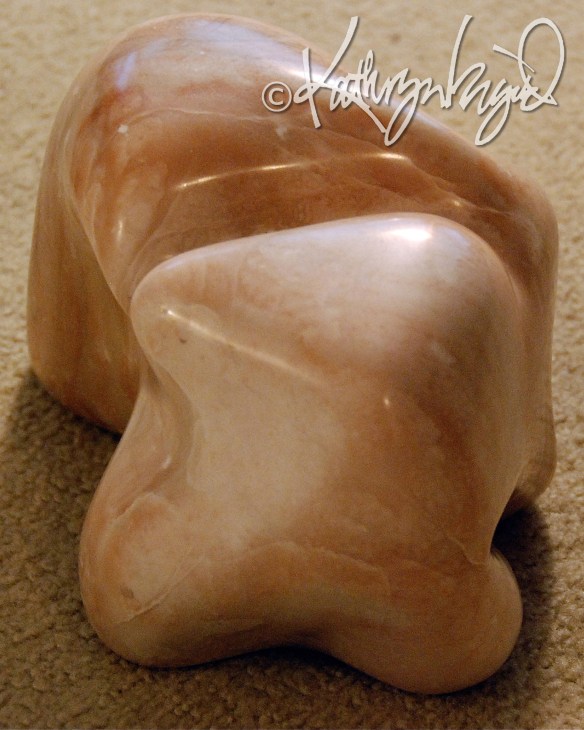
Making a stone sculpture is one such thing, for me. It was a required project somewhere along the course of my art studies, and I am glad it was required, because I doubt I’d ever have attempted it if the materials hadn’t been put right into my hands, the techniques taught to me on the spot, and the work necessary for me to fulfill the requirements of the class. I’m old enough by now to have figured out that there are a whole lot of activities and things in life I’d never have dared try, let alone figured out how happy I was to pursue them, if I hadn’t had to do them. Stone sculpting is one of those things that fell into the been-there-done-that category, finally, but besides having a decent little piece of art to show for it I am glad there was that one chance in the beginning.

Photo: Alabaster Sculpture

My very own [Untitled] alabaster sculpture, the one and only. Approximately 7.5″ (19 cm) H x 8″ (20.5 cm) W x 11″ (28 cm) W.

Luck and happenstance, of course, have their own parts to play in the determination of whether any new experience becomes a one-off or a lifelong passion. Or, like my marriage, a one-time event that turns into a lifelong passion.

In the case of the rock sculpting, there were a few particulars that [ahem] shaped my attitude about the experience. One was that when the pile of alabaster hunks appeared on the table in front of my sculpture class, I chose a piece, lone among the heap as far as I remember, that had no major, unavoidable fissures in it. This allowed me to make a piece that was not a lot smaller than the original stone without having large parts of it crack and fall off. And my bit of alabaster had some nice coloration, attractive pale veining, and a natural overall shape that guided my sculpting choices. So all I did was refine the existing form and exaggerated it, and that led to the abstraction I made in the end. I just aimed for a sort of rounded Henry Moore-ish sculptural curvaceousness to showcase the silky, milky beauty of the alabaster as best I could. It was a slow and fussy process to chisel out an alabaster sculpture, and it made me ever so much more appreciative of and awestruck regarding the accomplishments of all real stone sculptors throughout the ages. Also, glad not to put my perpetual laziness into extended servitude to stone carving.

So, yeah. I made an alabaster sculpture, and I kind of like the result. And I’m happy that I did it, that I had the experience and learned a deeper appreciation of that art form. And yes, I am also pleased that I don’t ever have to make another alabaster sculpture, with the possible exception of the if-and-when instance of my deciding someday to have another go at it. Meanwhile, I have a decent memento of the experience. And if I get tired of it as a decorative object, it’s big and heavy enough to make a decent doorstop. If not beauty, then utility: that’s kind of how those once-or-more decisions can go.

Shadowy Façade

digitally doctored photo

There are endless supplies of guides on How To do something-or-anything; I’m more concerned with How Not to Do It. Much of the how-to tutorials seem aimed more at giving us a gloss of respectability in the subject, a sort of facade of excellence, than actual, practical depth. Expertise is, obviously, a relative thing, after all. It’s not all that hard to be considered an expert in or at something that is very rare or an extremely new discovery or invention: lack of exposure guarantees that few can have mastery. A whole lot more, however, is skill or knowledge that takes a dedicated effort to master to any level of real expertise.

My greatest expertise, if I can be said to have any, is probably in the category of performing ‘filler’ duties in most of the activities I try. Work as I may, I’m not likely to become great at most, and I seldom find learning anything all that easily or swiftly done. Being naturally lazy, I’m even less often found pursuing new knowledge and skills with great rigor and vigor just for their own sakes. So at best, I tend to end somewhere in the middle of the pack. I like to think of myself as the necessary delineator between the great and the mediocre.

All silliness aside, this seems to me an age in which we, collectively, have lost our appreciation for true expertise. Maybe it’s my imagination, but I get the sense that somewhere between the assumption that a speedy dash through Wikipedia will provide all the wisdom we need on any topic and our fascination with outliers—finding the novelty of savants and overnight sensations far more exciting than hardworking earned-doctorate intelligence—and the sense of entitlement our privileged modern existence gives us, we lose touch with the value of elbow grease and passion.

I wasn’t born either brilliant or extraordinarily gifted, and I’m not ashamed of that. But it’d be a pity to go to my grave without having tried to improve on what few bits of intelligence and invention I do have. If I manage to do my best in the present and keep moving toward an elevated horizon, I may not change the world for the better by a single degree, but I will certainly have bettered myself and I might have the slightest chance of shedding a little light around me as I go.

Looks like I’d better get moving!