Fortissimo

photoTime was when I had a record player, a car radio, and a portable radio that all got cranked up pretty loudly. I’m sure my parents and co-workers and friends might have thought I’d gone deaf from listening to my favorite stuff at top volume, and possibly, mad from thinking of doing such a thing with even the most subtle and silky classical music. I think perhaps I did deafen myself a little, but that more likely was [ahem] situational deafness, the kind that causes young persons to lose the ability to hear and understand their parents, co-workers and friends, never mind their bosses. Even at my most ridiculous, I don’t think I managed to blast my records and radio devices as loudly as many of my peers did theirs.

Here I am, antique as I’ve grown, and very glad indeed that after all of that I can still hear the subtle and silky pianissimos of great singers and players, and yet I still do love to get my socks knocked off from time to time. What can be more exciting and energizing than a loud yet magically tuneful phrase belted out by a skillful symphony chorale or fabulous gospel choir when the text demands such dynamics? I can sit in the back of the rehearsal hall and just plain hug myself for happiness when the whole group gets to that gorgeous blastissimo peak of the piece. I love to hear that pulsing, pounding joy when a pianist or organist puts the pedal to the proverbial and actual metal for the topmost moment of a blues riff, a prelude and fugue, a smashing concerto. If it peels back my scalp just a little, who am I to complain when the music is so potent! A few paltry hairs off my head are small sacrifice for the great pleasures of blessedly blasting music.photoAs long as it’s good, well executed, and thrilling, loudness is not such a bad thing. It might even drown out some of the sadder sounds of the day if we let it. Children who have not yet learned the meaning of the phrase ‘indoor voice’ can exhaust us, but at times in their own boisterous ways they can simply fill us up with welling gladness by chirping to test the sound of their own voices in a large empty space, by squealing with amazement at beauties we’ve forgotten to appreciate, by shouting our names too loudly because we are all the way across the room and they love us so. How can we not love, too, the sounds of finely honed music in all of its patterns and rhythms and tones when they spin into vortices of loud celebration!photo

Things I Used to Know

In olden times, when I was young and Apatosaurs snacked on the treetops, I knew stuff. I’ve forgotten more since then than most sentient beings learn in a lifetime, although in fairness to them and to my own addled and limited brain capacity, much of that was only memorized and not really understood or applied. And what little I have learned or known has mostly long since been reduced to dribbles and scribbles and other forms of rubble.

digital illustrationI once knew how to ice skate and roller skate. Not particularly well, mind, but I could stay upright and toddle around a rink or lake without breaking ice or ankles, which for a person of limited grace and less skill is good enough. I could ride a bike, row a boat and climb a tree. I read books intended to make me smarter and ones intended only to amuse me, and a fair bunch that had the possibility of doing both simultaneously. I sang in every section of a choir that would let me in, played the piano poorly but enthusiastically, and learned about four chords on the guitar from Dad.

Much of this is gone, forgotten or so rusty that it would be somewhere between horrifying and laughable, or possibly both, if I were to try my hand at any of it now. And I’m not proud of that. But I’m not too worried about it, either, nor am I ashamed. I’m probably not all that different from most people when it comes to such things. I wouldn’t mind, though, if the opportunity arose to revisit any of those things and I discovered that (a) it’s true what they say about bike riding coming right back as though I’d never left off the practice, and (b) everything else I’d ever once loved doing would come back as easily as zipping around on a long-neglected bike. Before all the rest of me freezes over, as it were.

I also used to know how to leave the house without much thought of what lay outside its doors or worry over what I was to avoid and/or accomplish before returning to its safety. I had a firm grasp of many, many things that didn’t matter in the slightest in keeping the earth rotating properly or making my part of consumerism fully sustainable, let alone in achieving and maintaining world peace. As a supposed grownup, I learned to worry and fuss a great deal over that sort of stuff, even (or especially) when I knew full well I hadn’t any hope of challenging my born impotence in these matters.

But one thing I have learned as an adult that is remarkably useful–assuming I can keep it in mind, an increasingly slippery endeavor as I age–is that no individual human ever did really have any control over anything of this great importance. Occasionally, one of our kind manages to break through the barriers or even simply to fall into a solution by being in the right-or-wrong place at the right-or-wrong moment, but most of us are not able, alone, to learn or do anything much more complicated and meaningful than reading or singing or ice skating. And most wonderful of all, I’ve learned that that’s okay. It’s important to care, and to do and be the best that I can, but it may be equally needful that I grow wise enough to stop banging my head against any brick wall that practice has taught me will never actually budge and, yes, be content that I made the effort, not carry around pointless guilt that I’m not killing myself with further useless striving and angst.

As much as I loved ice skating when I was young and owned skates, and lived near a park where I could use them in winter, I don’t feel terribly cheated that decades later I’m fairly certain I couldn’t even remember how to skate. I’m happy to hang up those old blades and let someone newer and nimbler learn how to ice skate, and finally to get old enough to forget it too, in turn. The world itself will probably continue turning, with or without us.digital illustration

Flantasia

graphite drawingThe Warbling Flantical

Upon a promontory sat the Flantical, in coat and hat,

In curled toupee and beaded gloves (the sort his sort of person loves),

And sang a tune so bold and sweet, a choir gathered at his feet

And joined their voices, fine and strong, to this his pure and sacred song,

Admiring both his vocal fire and handsome mien in that attire,

And so anon, the Flantical and choir closed their canticle

And all dispersed, but all retained the melody that still remained

In head and heart; that is the story born upon that promontory,

And each Flantical now loves to sing it, wearing beaded gloves.digital illustration

A Musical Tradition

The office where my esteemed spouse performs many of the studies and administrative duties comprising his workload outside of the conducting element at the church where he’s now interim chancel choir director hasn’t got a lot of stuff in it other than a big desk, a small piano and a couple of bookshelves. Most of the books that had filled the shelves went away with their owner, the previous director; a few that go with the office itself remain on the shelves, and all by themselves they tell quite a story. That’s the way of books in general, isn’t it.

It’s all the more so in this instance, by virtue of the books’ being vintage hymnals. The history of the United Methodist Church at large is in their pages. The history of this specific congregation within the UMC is there, too. And there’s a great deal of Protestant church history, Wesleyan history, English and American folk music and even larger and older parts of the musical tradition. All right there in the pages of some rather small, rather worn books that just happen to be full of hymns.

There are libraries; there are Protestant theological resources; there are music collections; there are history books. All of them are in this one room, in a handful of little old books. And that, in itself, is the nature and long-lived tradition of printed music in general. So much has been passed down in the oral traditions of so many cultures and religions and peoples, but there’s an enormous amount that lives on and grows and inspires because of those amazing repositories that exist in the written music that survives everyday use, one generation after another. I only hope that all such traditions can be preserved and enjoyed far beyond our lifetimes, whether in temples or towns, religions or regions, families or foundations, schools or individual choirs. Beyond inspiration or even enjoyment, these are great containers of food for thought.digital collage

Under the Arches

I walk into the room after the rehearsal has begun, and the men are working on a slow passage of Handel. Choirs I and II sing the same tenor, baritone and bass parts at this part of the piece, and they have unified their pitch and the round warmth of their Latin vowels so that despite having only ten of them singing a relatively soft phrase, the sonority is beautifully intense and sweeps me into the room on an almost ecstatic wave.photoI sit and finally have a look around. The doctoral student assistant is conducting, and one of the voices raised is my husband’s, from where he’s joined Choir II. I close my eyes for just a moment to listen to the lilt and roll of the men’s voices.

When the women rejoin and the full ensemble begins to move forward, picking up speed and volume as the text becomes more buoyant, I feel myself lifted further on the waves, transported far from this concrete box of a room and its cold fluorescent lights.photoSuddenly I am under the morning light pouring through a cathedral’s oculus, gazing up into the curves of the arched nave and dome. I am pacing sedately through the arcade of a cloister, the afternoon sun warming my heels as it peers into the intervals between the pillars. I am in the garden, watching the sun set on the curled canes of the roses climbing there,the bows of the water leaping in the fountain, the draped arms of the willow as it leans out to embrace the day’s last rays of light.

This is the sweetness of music, and in this wash of light and dark, cool and warmth, joy and meditation I can gladly lie for a thousand years.photo

Graceful Phrasing

digital illustration from photosFrom my privileged perch in the corner of rooms where music is being studied, rehearsed and discussed, I hear all sorts of interesting and enlightening things on the musical topics at hand. Also, plenty of stuff that goes right straight over the top of my pointy head. After all, I’m hanging around with a bunch of scholarly and often exceedingly experienced musicians, and they’re speaking their own language, one that has jargon and concepts far beyond the reach of someone who took five years of childhood piano lessons and a few voice lessons, all without ever actually learning to read music. My poor teachers had no idea how far in over their heads they were in taking me on, but I must assume that most of them figured out my scam of ‘play [or sing] it for me so I can hear how it should be done’ so I could learn it by ear in lieu of figuring out why the notes never seemed to be where they were supposed to be in my fancifully dyslexic internal designs. In any case, I rarely hear musicians talking without getting off course myself a few (million) times along the way.

It’s not all that different, for me, from sitting in on a conversation between those speaking, say, German, Swedish or Norwegian, Spanish, French or Italian: if I already know the theme of the present discussion and a few of the key words, and can suss out the attitudes of the participants to the topic, I may be able to follow the conversation in a vague, generalized way, and nod yes or no on occasion with pseudo-intelligent accuracy. But could I actually participate in the talk? No, don’t make me laugh! Contribute anything meaningful? Not an atom of a chance!

All the same, the musical musings I overhear have a certain advantage as far as I’m concerned, since the discussion of music necessarily entails terminology (not least of all, the Italian words and phrases that are the lingua franca of score study and rehearsals), and to the quickest and clearest way to describe something musical on the fly is often to simply burst into song on the spot.

How one conducts or performs the phrasing in a musical work does a lot to determine not only its flow from beginning to end, but how text, textures, colors, sonorities, melodies and meanings may be enhanced or diminished, heightened or made more subtle. The way one phrases a discussion of music in front of a non-musician can, as I’ve found, affect how much she understands what’s being said, suggested or sung as well. Ultimately, I find that many such opportunities for listening in not only enhance the eventual performance but also my enjoyment of the preparations for it, which can stand alone as entertainment or, who knows, even education.

And if it sounds mellifluous and marvelous along the way, the invitation is almost always accepted, even by this ignorant listener. Just as when I listen to entirely unfamiliar songs and performances and sometimes take quite a while to warm up to them, hearing chatter among real musicians of any level gradually helps me to learn a bit of the way that they approach their work and play and to understand their still-mysterious language. I may not know much, but I know that there’s a lot to learn to like!digital illustration

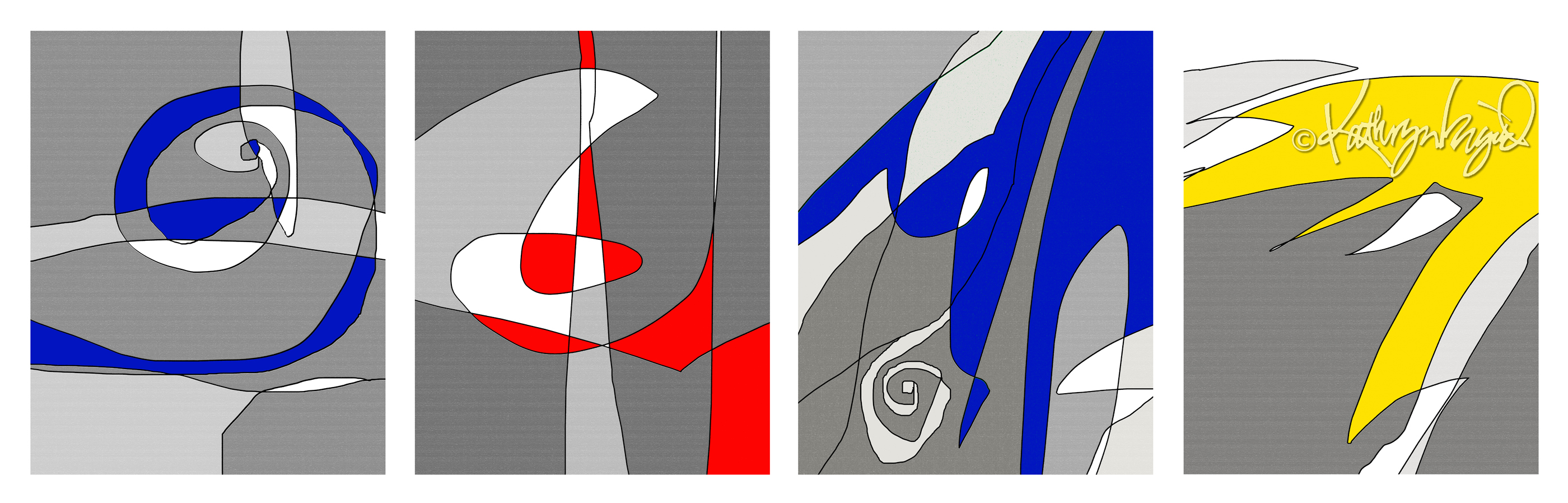
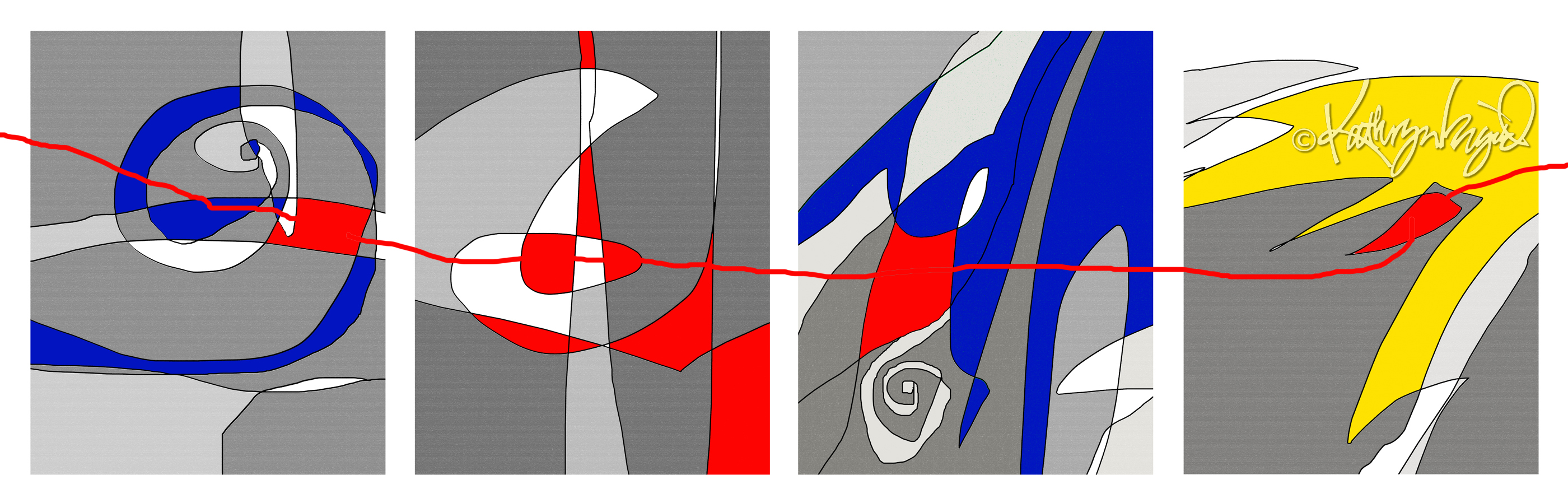
Röda tråden (The Red Thread)

Röda tråden is the Swedish phrase for connectivity. I learned it from my husband, who in turn learned it during his dissertation studies on modern Swedish choral history, and in a way it’s the perfect encapsulation of what his research revealed: that the astonishingly deep and broad influence of such a small country, in such a short time, on such a large field as Western choir singing and music came about primarily because of the remarkable and unique confluence and joining together of a huge number of events, people, ideas and resources in that little land at the end of the Second World War. As unimaginably terrible as war is on any scale, it’s all the more a testament to connectedness that at the end of one of the largest we’ve known, such good and meaningful and positive elements were all drawn into one significant, beautiful growth spurt in the art of singing together.digital illustrationAs a miniature of String Theory in the arts, this surge of the choral art in Sweden is notable (no musical pun intended) not only because it posits a reasonably substantial explanation for the larger choral sector’s modern expansive development amid the general devastation and struggle following the end of WWII, but also because in doing so it illustrates wonderfully how the intertwining of all sorts of seemingly disparate elements such as safe havens from political unrest and postwar reevaluation of norms, personal and professional relationships and experimentation with new media could come into contact and interact to create a new mode of thinking, acting, composing, teaching and singing. In turn, this is a striking model of how people from distinct cultures, educational backgrounds, economic resources and political systems and of widely varying personalities, unified by the one tiny thread of choral music, could be pulled together into a complicated system that, though still colorfully messy and imperfect, led to a potent common end that has had lasting and marvelous influence for long and fruitful decades since.

I am, of course, grateful on a personal level because this Swedish postwar influence on Western choral culture has not only enriched my husband’s professional and artistic endeavors–not to mention was the basis for his award-winning doctoral dissertation that in turn opened a lot of friendly doors to us both in Sweden–but because it produced so much spectacular music and inspiration for so much more.

digital illustration

Röda Tråden is the Swedish version of the idea that–indeed literally–fascinates so many of us: the connecting thread–that which binds one thing to another. I can think of nothing greater than to spend life seeking the Red Thread that shows us our commonalities and binds all people together as well.

Further, though, I am grateful that such an otherwise inexplicable event as the ‘Swedish Choral Miracle‘ seems to me ample proof that all things and people really are connected. And that through recognizing and making good use of those connections, however, odd or tenuous they may appear, there is hope for new and better songs to be sung everywhere.

If I needed further proof of this, last night’s concert gave it amply. My spouse conducted the combined forces of the Chancel Choir of the church where he’s currently interim choirmaster plus their excellent hired pro orchestra in performing Haydn and Dvorak’s two settings of the Te Deum text as the concert opening and closing, respectively, bookending the extraordinarily lovely and moving Missa Brevis of Kodaly. I came in to sit for the concert among strangers and acquaintances from the church and discovered a friend from another parish sitting across the aisle from me, then learned from one of the choir administrators that a friend of hers in attendance turned out to be a long-ago colleague of my husband’s from another state, and finally went up to greet my guy after the concert and found him speaking with a group of ladies in the front row, one of whom was the wife of a former US president. What brought all of us divergent people together in this moment? Music. Beautiful singing and playing. Chance, kismet, divine intervention. Call it what you will, the slender but unbreakable thread that connects us all drew us into one place for a time of basking in the inscrutably beautiful harmony that is beyond craft, beyond art. That is a concert without peer.

Enlightenment

photoGetting smarter is a lifelong thing, in and out of school–for the fortunate and attentive.

Me, I’m sad at the end of every school year. Those students and colleagues of my husband’s who have become such a big part of our lives and are now graduating or moving on to other jobs or retirement are about to disappear from immediate view. Even the ones who remain close with us after relocating are now to be infrequent contacts rather than the people we happily run into in the hall on a casual basis. I get lonesome for them even before anyone leaves.

The lovely inverse of this, happily, is the ingathering of ongoing and new compatriots as the school year is once more underway. New faces, new voices and new personalities are integrated into the weave of the community and once again it becomes the rich underlay of the year, the pleasant buzz of the bass line, the light up ahead growing ever so slightly brighter as the weeks and months pass and we travel through them.

It’s funny that I sort of forget this changing of the guard between times. Between my years as a student myself, the nearly two decades of my own teaching, and the time spent observing my husband and his colleagues at work, you’d think I would be so irrevocably inculcated with the cycles of the academic and concert seasonal years that I would have a sort of song of it playing internally at all times. In real life, though, I am not so consistently observant.

It’s only when I am right in the moment of it that I recognize what is such a piquant part of my emotional life and I mark these transitions. It’s in these times, in fact, that I most benefit from my spouse’s longtime practice of getting his choirs and groups to sing or play through transitions. In music, this helps performers to internalize a multi-movement piece as a whole and not be stuck performing it as a disjointed, choppy conglomeration so that it loses its sense as a unified entity. It helps a song avoid sounding horribly like a bunch of unrelated anecdotal verses interrupted by further disconnected refrains that act more like speed bumps than gateways between the events of the expedition.

In life, I’m working to find the balance between living and operating while fully engaged in the present, letting that part always be led by the best of the past, and moving toward the best of what is yet to come. I know I’m enjoying the present verse immensely even though some of the singers, players, conductors and teachers of the last semester have moved on to other places and joined in other songs, and I expect that the current moment will lead to yet more marvels of music and camaraderie. I just need to pay attention, follow the score, and be ready whenever a bit part is offered, because I keep humming along in the background and every passage tends to be more illuminating than the last.photo

If the Muse Should Come to Visit

Our summer road trip afforded me a few good opportunities for one of my favorite activities: listening during great music rehearsals while drawing and writing. Part of me is fully engaged in the music-making, wanting not to miss a single note or nuance even when it’s truly a working bash through sort of session for the musicians. I learn so much about the pieces in hand, their histories, contexts, technical challenges and all that sort of thing as well as what to expect and what might happen in performance that I always enjoy concerts more deeply after hearing them being developed for the performances. At the same time, if the work in hand is sans text or in a language so unknown to me that I can’t get wrapped up in that aspect beyond whether the ensembles’ vowels and consonants, attacks and diminuendos and cutoffs are, well, ensemble, then I can focus my language centers on writing, sometimes blog post essays and sometimes poetry.

When the text is too enthralling or at least too present in my attentions, I can still indulge in drawing. Either way, it’s not so much dividing my attention as letting one kind of artistry inspire and guide another one. One enriches the other. Especially when the music rolling around me is as rich as, say, that being prepared for performances at the Vancouver Early Music Festival in August. I only wish that the products of my sessions were always as inspired as the music undergirding their inception. But my only chance of getting any better is to keep practicing, isn’t it. And I’m lucky that I like the process more and more as I go along, and yes, the better the music is, the more I enjoy my learning curve. That’s inspiring enough.graphite drawing

It’s All Rehearsal, Really

Blog.08-30-2013.all-rehearsalWe may look like we’re all geared up and doing important stuff, but mostly, we spend all of our lives practicing, learning and getting ready for one thing or another. Some of those things happen in due course and many more of them either never quite come to fruition, or far more often, change along the way and we end up following along and seeing where it all takes us. All of this is quite normal and perfectly valid.

As a privileged observer and listener in many musical rehearsals long after the years when I was an active amateur participant, I can tell you that I think these more explicit practice sessions can have much the same sorts of both trajectories and outcomes. What anyone not privy to the backstage view of any sort of practice may easily forget, even if they once knew it, is that whether the moment is strictly obligatory, is amateur in the finer sense, or is wholly professional, it can have the same range of characteristics, studious, soulful, playful, predictable, heartrending or hilarious–or some grand combination of them all.

The experience of listening in on the preparations for musical performances is distinct from the performances themselves in a multitude of ways, but perhaps the most striking to a non-participant is arriving at a high-level rehearsal and seeing all and sundry set up camp for it in their work clothes. The star soloist is wearing old jeans. The conductor, who no matter how rigorously the singers and players enact their parts will likely move around and sweat the most, is wearing shorts and a short-sleeved, thin shirt. The players have open cases near their chairs with spare instrument pieces and alternate score parts strewn across them, and the singers, no matter what the temperature, are wearing neck scarves and lugging big containers of fluids to protect their own precious instruments. The rehearsal accompanist at the beat-up old piano is wearing glasses both on the bridge of the nose and the crown of the head, one for the easier to read individual parts and one for the microscopically reduced full score. All of this in a sort of ordered chaos the shows they are all there to Do Things. It’s work. It’s fun. It’s messy, like life.

Our Big Summer Road Trip, a driving circuit of over 6000 miles this July and August, was a multipurpose travel package designed to accomplish a number of ends, not least of them to attend and study and enjoy music-related adventures with friends, colleagues and other musicians and music lovers in several disparate events. First, we went to the Oregon Bach Festival to see the newly anointed Artistic Director make his debut interview marking the occasion, and more importantly to see maestro Helmuth Rilling conduct his grand finale performance as AD in this season when he officially passed the baton to his successor after 44 outstanding years at the Festival’s helm. The Festival is a fine one, Rilling a justly revered conductor and teacher, and many of the singers and players who participate, along with many regular OBF attendees, are longtime friends and colleagues, so it’s always a joy and privilege to go to the Festival ourselves, but particularly meaningful to see Rilling lead the B Minor Mass on his way to Conductor Emeritus status, since my husband Richard had the good fortune to sing the same piece under Rilling during the maestro’s second year at OBF. A great deal of water has gone under the bridge, and though a lot has changed in that flow of time, many things remain the same. Rehearsals and performances, practice and action go on as ever.

I had been reminded of all of this, of course, by the opportunity to attend the Boston Early Music Festival and see my spouse conduct and his Collegium Singers and the university’s Baroque Orchestra in June, along with admiring all of the other marvelous artists and events at BEMF. So many wonderful concerts and recitals; so much hard and happy work to prepare them! And how quickly June disappears into the mists of memory as the summer rolls forward. Thus, a long road trip seemingly becomes an amazingly fresh outing to experience more variations on this theme.

The second of the trio of musical events we attended on the road trip was the regional gathering of choral conductors in our former home area, a great opportunity to renew ties with longtime fellow conductors, teachers and friends over grilled wild salmon and to revisit musical literature options, audition processes, mull over the usual academic topics, share hints about favorite new compositions and gossip about who is the up-and-coming hottest new choir or conductor in anyone’s neighborhood. Driving up to the chapel that serves as the main conference space, whom should we see sitting visiting on the porch but a man who was the excellent recording engineer serving in that artistic task for many of my husband’s choirs’ recordings over the years, and with him, the teacher-conductor-mentor who led Richard to music as a vocation and profession in the first place and so became not only his ‘choral father’ but a lifelong dear friend. To follow this greeting with collegial renewal among many other fellow musical artists, from colleagues and collaborators to singers and students, composers and coordinators of conferences and musical programs at all levels, and then to have dinner a week later with both of those two first friends we’d spotted, was rich beyond words.

Third on our list and rounding out the road trip with our stop in Vancouver, BC, was the Vancouver Early Music Festival. A perfect bookend to starting the trip with OBF in Eugene, VEMF attendance had much the same purpose for us as the Oregon visit: see and hear good friends and other artists at work, and attend the events honoring the longtime AD’s retirement. While Jose Verstappen has served a mere 34 years in Vancouver, he has had as much impact of his own on the Festival there as Rilling has in Oregon, just a very different sort. Jose is a modest and self-effacing man, but as warm and as hardworking and dedicated, and certainly as hard for donors and supporters to say No to, as Rilling, and so both have created environments of commitment and excellence that will thrive long after both have abdicated their thrones. Matthew Halls, Rilling’s successor, and Matthew White, Verstappen’s, are both bright, gifted and able men and I expect to enjoy attending both festivals with as much outstanding artistry on display as ever in years to come.

While in Vancouver, besides the great fun of attending Verstappen’s farewell party, seeing many dear friends, meeting Bruce Dickey–the leading light of cornettists nowadays, he will be playing in the production of the Monteverdi Vespers Richard’s conducting in October–and hearing some terrific music of various kinds in concert, the highlight was sitting in during rehearsals for Händel’s ‘Israel in Egypt’. It was there that I was most struck by this lovely interweaving of labor and lightness that can happen when the people at practice are fully engaged in their work and love what they do. The piece itself is a marvel, full of potent and piquant and even picaresque melodies and moments, and those singing and playing it made the most of these riches. When Tyler Duncan and Sumner Thompson started singing the bass duet ‘The Lord is a Man of War‘, not only was the music and text mesmerizing (never mind my personal feelings about the story’s theology) but their obvious pleasure in exploring the expressive potential in the piece together with the players and conductor (the impressively sensitive and dramatic Alexander Weimann) moved me to pay special attention to this juxtaposition of the remarkable and the workaday, the plain and the powerful. So to all of you out there who sing, play, work, rehearse, prepare and perform, and especially to the players, singers, composers, conductors, administrators and Artistic Directors encountered on this summer tour of ours, I dedicate this poem.digital illustrationNumber Thirty-Eight

Strike, then carry on, and so the sound

Belies in beauty such a martial start,

When ragtag troops in everyday are found

To sing and play at battle from the heart–

Who seemed so simply destined for the soil

As laborers in neither art nor war

But some plebeian, plodding sort of toil,

Then strike, and decimate what came before–

Show the illusion is not acted out

Through violence or merely artifice,

But rather, note by note dispelling doubt

That mystery’s all quite undone by this–

Where love and war are mingled in their way

By songs more eloquent than words can say.