It’s All Rehearsal, Really

Blog.08-30-2013.all-rehearsalWe may look like we’re all geared up and doing important stuff, but mostly, we spend all of our lives practicing, learning and getting ready for one thing or another. Some of those things happen in due course and many more of them either never quite come to fruition, or far more often, change along the way and we end up following along and seeing where it all takes us. All of this is quite normal and perfectly valid.

As a privileged observer and listener in many musical rehearsals long after the years when I was an active amateur participant, I can tell you that I think these more explicit practice sessions can have much the same sorts of both trajectories and outcomes. What anyone not privy to the backstage view of any sort of practice may easily forget, even if they once knew it, is that whether the moment is strictly obligatory, is amateur in the finer sense, or is wholly professional, it can have the same range of characteristics, studious, soulful, playful, predictable, heartrending or hilarious–or some grand combination of them all.

The experience of listening in on the preparations for musical performances is distinct from the performances themselves in a multitude of ways, but perhaps the most striking to a non-participant is arriving at a high-level rehearsal and seeing all and sundry set up camp for it in their work clothes. The star soloist is wearing old jeans. The conductor, who no matter how rigorously the singers and players enact their parts will likely move around and sweat the most, is wearing shorts and a short-sleeved, thin shirt. The players have open cases near their chairs with spare instrument pieces and alternate score parts strewn across them, and the singers, no matter what the temperature, are wearing neck scarves and lugging big containers of fluids to protect their own precious instruments. The rehearsal accompanist at the beat-up old piano is wearing glasses both on the bridge of the nose and the crown of the head, one for the easier to read individual parts and one for the microscopically reduced full score. All of this in a sort of ordered chaos the shows they are all there to Do Things. It’s work. It’s fun. It’s messy, like life.

Our Big Summer Road Trip, a driving circuit of over 6000 miles this July and August, was a multipurpose travel package designed to accomplish a number of ends, not least of them to attend and study and enjoy music-related adventures with friends, colleagues and other musicians and music lovers in several disparate events. First, we went to the Oregon Bach Festival to see the newly anointed Artistic Director make his debut interview marking the occasion, and more importantly to see maestro Helmuth Rilling conduct his grand finale performance as AD in this season when he officially passed the baton to his successor after 44 outstanding years at the Festival’s helm. The Festival is a fine one, Rilling a justly revered conductor and teacher, and many of the singers and players who participate, along with many regular OBF attendees, are longtime friends and colleagues, so it’s always a joy and privilege to go to the Festival ourselves, but particularly meaningful to see Rilling lead the B Minor Mass on his way to Conductor Emeritus status, since my husband Richard had the good fortune to sing the same piece under Rilling during the maestro’s second year at OBF. A great deal of water has gone under the bridge, and though a lot has changed in that flow of time, many things remain the same. Rehearsals and performances, practice and action go on as ever.

I had been reminded of all of this, of course, by the opportunity to attend the Boston Early Music Festival and see my spouse conduct and his Collegium Singers and the university’s Baroque Orchestra in June, along with admiring all of the other marvelous artists and events at BEMF. So many wonderful concerts and recitals; so much hard and happy work to prepare them! And how quickly June disappears into the mists of memory as the summer rolls forward. Thus, a long road trip seemingly becomes an amazingly fresh outing to experience more variations on this theme.

The second of the trio of musical events we attended on the road trip was the regional gathering of choral conductors in our former home area, a great opportunity to renew ties with longtime fellow conductors, teachers and friends over grilled wild salmon and to revisit musical literature options, audition processes, mull over the usual academic topics, share hints about favorite new compositions and gossip about who is the up-and-coming hottest new choir or conductor in anyone’s neighborhood. Driving up to the chapel that serves as the main conference space, whom should we see sitting visiting on the porch but a man who was the excellent recording engineer serving in that artistic task for many of my husband’s choirs’ recordings over the years, and with him, the teacher-conductor-mentor who led Richard to music as a vocation and profession in the first place and so became not only his ‘choral father’ but a lifelong dear friend. To follow this greeting with collegial renewal among many other fellow musical artists, from colleagues and collaborators to singers and students, composers and coordinators of conferences and musical programs at all levels, and then to have dinner a week later with both of those two first friends we’d spotted, was rich beyond words.

Third on our list and rounding out the road trip with our stop in Vancouver, BC, was the Vancouver Early Music Festival. A perfect bookend to starting the trip with OBF in Eugene, VEMF attendance had much the same purpose for us as the Oregon visit: see and hear good friends and other artists at work, and attend the events honoring the longtime AD’s retirement. While Jose Verstappen has served a mere 34 years in Vancouver, he has had as much impact of his own on the Festival there as Rilling has in Oregon, just a very different sort. Jose is a modest and self-effacing man, but as warm and as hardworking and dedicated, and certainly as hard for donors and supporters to say No to, as Rilling, and so both have created environments of commitment and excellence that will thrive long after both have abdicated their thrones. Matthew Halls, Rilling’s successor, and Matthew White, Verstappen’s, are both bright, gifted and able men and I expect to enjoy attending both festivals with as much outstanding artistry on display as ever in years to come.

While in Vancouver, besides the great fun of attending Verstappen’s farewell party, seeing many dear friends, meeting Bruce Dickey–the leading light of cornettists nowadays, he will be playing in the production of the Monteverdi Vespers Richard’s conducting in October–and hearing some terrific music of various kinds in concert, the highlight was sitting in during rehearsals for Händel’s ‘Israel in Egypt’. It was there that I was most struck by this lovely interweaving of labor and lightness that can happen when the people at practice are fully engaged in their work and love what they do. The piece itself is a marvel, full of potent and piquant and even picaresque melodies and moments, and those singing and playing it made the most of these riches. When Tyler Duncan and Sumner Thompson started singing the bass duet ‘The Lord is a Man of War‘, not only was the music and text mesmerizing (never mind my personal feelings about the story’s theology) but their obvious pleasure in exploring the expressive potential in the piece together with the players and conductor (the impressively sensitive and dramatic Alexander Weimann) moved me to pay special attention to this juxtaposition of the remarkable and the workaday, the plain and the powerful. So to all of you out there who sing, play, work, rehearse, prepare and perform, and especially to the players, singers, composers, conductors, administrators and Artistic Directors encountered on this summer tour of ours, I dedicate this poem.digital illustrationNumber Thirty-Eight

Strike, then carry on, and so the sound

Belies in beauty such a martial start,

When ragtag troops in everyday are found

To sing and play at battle from the heart–

Who seemed so simply destined for the soil

As laborers in neither art nor war

But some plebeian, plodding sort of toil,

Then strike, and decimate what came before–

Show the illusion is not acted out

Through violence or merely artifice,

But rather, note by note dispelling doubt

That mystery’s all quite undone by this–

Where love and war are mingled in their way

By songs more eloquent than words can say.

Unfinished in Perpetuity

digital artworkWork Forever in Progress

Hundreds of lines later,

I have nothing to show

except if you count

a sense of accomplishment in having

been faithful to a commitment, in having

persisted steadily in the face of the

unseen and unknown, in being

somewhat soothed by the simple

process of having given a little

heart and soul to something

simply because I could.

However I came to exist,

I think I might be a little bit

the same kind of puzzle myself,

imperfect and utterly incomplete,

but nicely so, for all of that–

nicely, because,

after all, I am working my way

toward being something at last,

and whether I have

an encompassing purpose or not,

I have at least

begun to Be . . .digital artwork

Silence may not be Golden, but Control of Noisemaking Keeps Everyone Safer

photoPractice as though Your Life Depended on It

Two singers strolled into a wood, and I

Followed the one less skillful; why?

Starved beasts will flock to an anguished cry,

As they did that day; in the wink of an eye,

I was on the road less traveled by,

And that has made all the difference.

[With sincerest apologies to Robert Frost]photo

This Business of being an Artist

mixed media process montageThere’s been an interesting, if hardly new, thread of conversation taking place in one iteration via LinkedIn, where a Mr. Duane Bronson posed the eternal question thus: “Does an artist have to have a recognizable ‘STYLE’ or a cohesive body of work to be of interest to a gallery and marketable?” My short answer would be a resounding Yes, but I couldn’t resist expanding on what is for me a perpetual problem. I said:

A good, thought-provoking read here! I have experienced much of what is discussed by the various commenters who precede me and think that all have some valid points for our consideration. My own answer to Mr. Bronson’s original question is that I might state it a little differently: to be of interest to a gallery as what it/they would consider marketable. Anything is marketable, if you put the right seller and buyer together under the right circumstances, but galleries, no matter how much they might pride themselves on being ‘in it for the love of art’, are businesses, and (logically enough) are not particularly interested in anything they don’t think is a relatively easy sell. [Commenters] Messrs. Bruland and Moore are absolutely right in recognizing that art does sell–at the confluence of the right forces. Figuring out what those are and how to orchestrate their intersection is the big magic trick that few of us can perform.photo of mural [with artist]I was approached by gallery owners when I was finishing my undergraduate art degree; one of them (the more successful in business, not surprisingly) met with me mainly to encourage me to produce a larger body of the same kind of work so that he could later represent me; the other, being a fledgling in the business, was willing to take what little I had already produced at my young age and give it a go. Of course I was inexperienced and had no concrete plans or prospects, so I opted for the latter, with the predictable result that that gallerist, with such limited experience and connections, was too busy simply trying to work out the logistics of her own business to actually represent any of the artists she hoped to promote. Thankfully, I’d only agreed to half the proposed trial period as part of that ‘stable’ of artists and retrieved my entirely unsold (and as far as I could ascertain, also virtually unseen) work and go forward at the end of it. [And only a year or two before it was also the end of that particular gallery, as far as I could ascertain.]photoIt wasn’t until many years later, after working in construction for a few years to save up for grad school (I suspect I’m of the same vintage as Ms. Senn, having had many similar experiences 30 years ago in that field of work) and then going through the grad program and then teaching for a couple of decades, that I could afford the luxury of devoting real time to focused practice and larger productivity of my own artwork. Along the way, however, I had continued to produce smaller quantities of work. As I’m quite sure many of the artists commenting above have experienced, what pleases me most in my own practice is to do what inspires me at the moment, to experiment, and to follow the serendipitous occurrences that happen along the way, resulting in a recognizable character in the works but not a whole lot of terribly similar subjects, media, and techniques. So I, too, have been told by many a gallerist that he or she thinks my work is terrific but, no thank you, they don’t see how they can possibly ‘package’ and market me.digital collageThe upshot of all this is that I can only echo what others have already said or intimated here: keep doing and being what is right for you, but know that you’ll likely continue to labor in obscurity unless you simply find that combination of luck and resources and persistence coming into perfect confluence. I must assume that all of us are here because making art of whatever sort matters enough that we will do it endlessly, whether it profits us in any way other than inwardly or not. Hurray to being successful, financially of course if we can, but if not that, then as wildly successful in satisfying the artistic urge as we can manage to be.I will add to this that I am no more going to stop making art because I don’t come close to making a living at it than any of the millions of others who can’t ‘get by’ doing what they love best would quit their passions. You might, just possibly, have noticed that I’ve been hanging out here in the blogosphere for some time just churning out art of the visual and written kinds and handing them out daily like free candy. But like many others, I also keep the business side of art on my radar, looking around me to see if there are any connections and opportunities I have overlooked or ways to introduce my work to others who may find something in it that speaks to them as well and (miraculously!) be willing to pay me for it. I guess this is simply my love letter to any other unsung heroes reading this, saying that we’re all in this together and yes indeed, also that I have no plans to leave off pursuing my dreams any more than you have. Might see you at the bar later, though. Everybody needs an outlet, whether it’s on LinkedIn or in the studio or somewhere else entirely. Cheers!graphite drawing

Drawing on Your Beginner’s Luck

The nice blogger from Zara–A Writing Story stopped by recently and her post said she is working at starting to draw. I’m delighted to have another person join the ranks of happy visual artists via drawing–a collection of skills that come in quite handy (no pun intended, especially since there are artists who use their mouths or their feet to make artworks) for far more than strictly a pleasurable activity or visual entertainment. Drawing, a foundational skill in all sorts of visual art, is also a means of communication that differs from and can work in wonderful tandem with writing, singing, signing, and any number of other ways of personal interaction and transmission of information. In addition to the practical application of the end product of the process, the practice of drawing itself has great power as a mnemonic device, a tool for problem-solving, and the training of the brain in such useful skills as eye-hand coordination and (as I know from experience) the correlated motor control of working through tremors to achieve refined movements.

But beyond that, as I said to my blogger colleague, the act of drawing has elements of physical pleasure in the mere action of arm and hand and body that can be worth the pursuit, not to mention the mental and/or emotional pleasures possible. The act of drawing as a form of meditation, even without regard to any possible ‘product’, is quite desirable on its own.

As I said to my correspondent, she needn’t be intimidated in the least even if she’s a rank beginner: By even making the effort to learn, you’re worlds ahead of lots of others! A book I often referenced when teaching my beginner students in college was Betty Edwards’ classic Drawing on the Right Side of the Brain–it has exercises that aren’t too hard even for someone who’s never attempted to draw before, and because her focus is on how the brain works in visual activity, she offers insights into the process and possibilities that few others do. There are, of course, innumerable excellent how-to books for those who want to draw, many of them favorites of mine as well, but because of Dr. Edwards’ [then] ground-breaking work in recognizing the character of right-vs-left brain function and how it played out in drawing, I always found her work particularly helpful.

Because drawing can engage so many diverse cognitive processes like this, it can be complicated and overwhelming to know just where to start learning how to draw. As I remarked in my note to my fellow blogger, All of that aside, simply making marks on a surface is the beginning of drawing. Sometimes the least intimidating way to begin is to take a piece of paper, make some totally random marks on it, and then see where that takes you. Even if all it does is make you comfortable making the arm movements for a start, that’s helpful. If, as with most people, you look at it and think ‘that looks like . . . ‘ or ‘that doesn’t look quite right . . . ‘–well, then, you’re already making editorial decisions that can help you move toward drawing the way you want to draw.

The bottom line, if you will, for me is that I feel more alert, more attuned to potential solutions when everyday problems arise, and generally just plain happier when I draw. It’s not because every drawing turns into something fabulous–far from it–but because the process of drawing opens up my brain and spirits in useful and unexpected ways. Many times, my drawing produces nothing more than scratches that are shorthand for bigger and more complex and, I hope, better things to come. But the exercise itself is valuable to me, and a glance back through my sketches can often kick-start me into drawing a work that is more successful than the twenty previous ones.

line drawing

Exploring pattern in a sketch.

line drawing

Playing around with volume.

line drawing

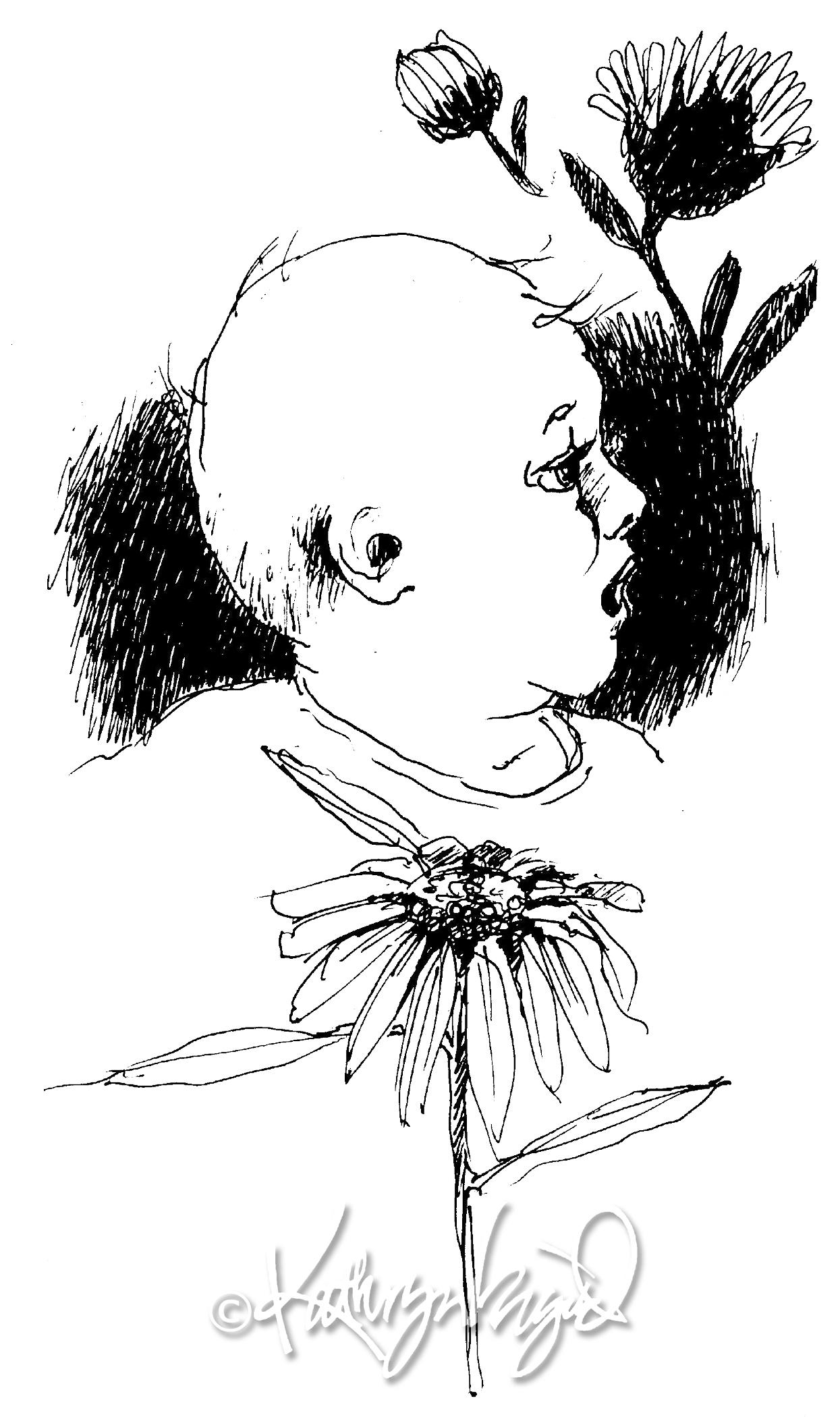
Faces and flowers show up often in my sketchbooks.

line drawing

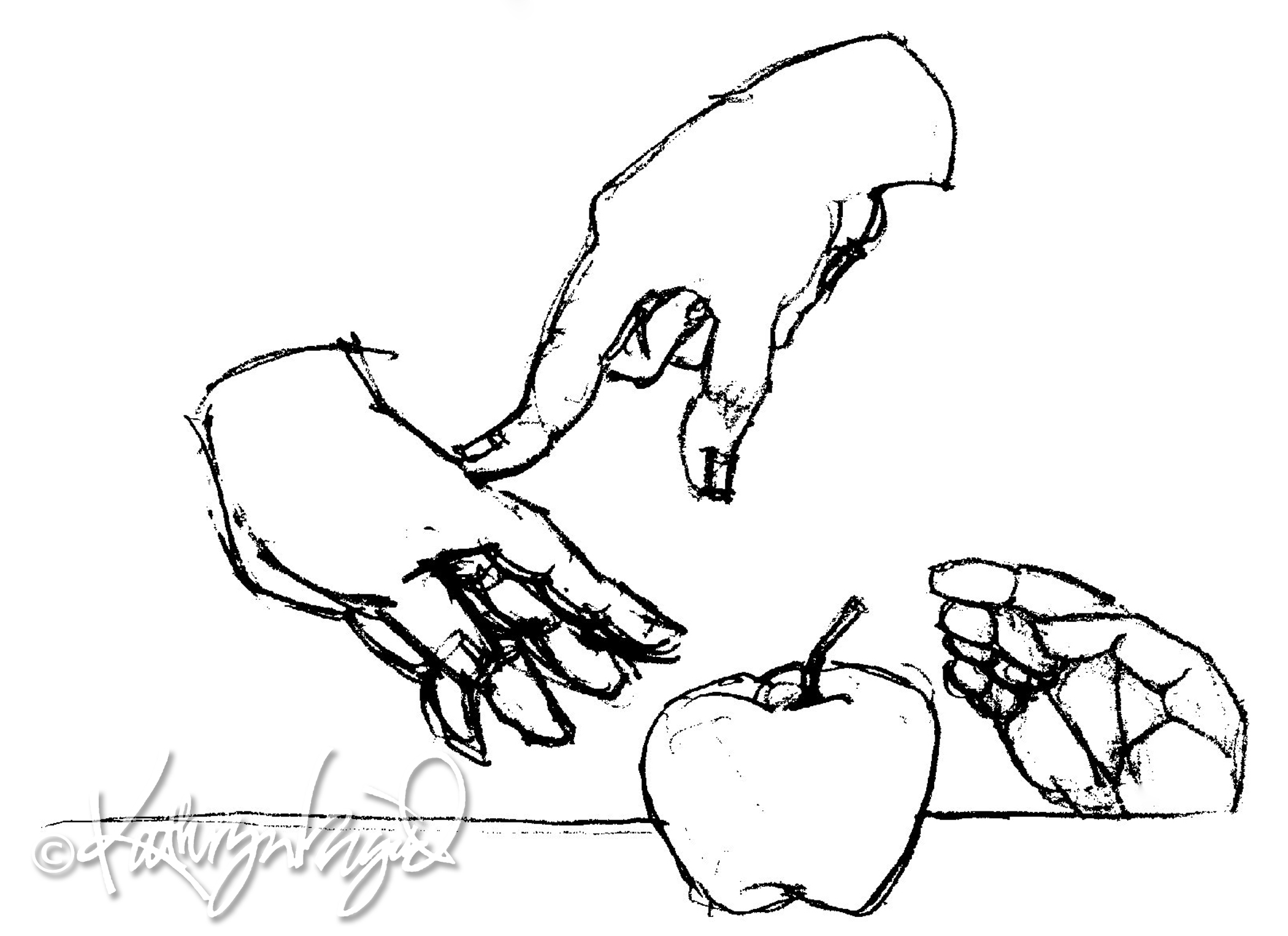
Hands can be pesky subjects, so I play with sketches of them frequently too.

line drawing

Any little vignette that pops into my mind is worth scribbling at least a few times.

Ultimately, whether I’m in gear for serious drawing or just fiddling with a pen or pencil to pass the time, it’s good practice and feels worthwhile. If nothing else happens, at least I have given my brain some thinking-room between the lines and I might figure out what to make for supper, how to cut through the piece of metal that is in the way of my completing a repair in the garage, or who knows–I might even remember where I set down that book I was reading days ago before it ‘disappeared’. It’s doubtful I’ll come up with any Nobel Prize-worthy inspirations while drawing, but then again, if I don’t draw, I’ll never find out!

The Cloche Wins in the Clutch

There mightn’t be any reason to connect the hat known as the cloche with the bell for which it’s named, given the resemblance of their shapes. The similarity may end there.graphite drawing Unless you want to make a silly cheap pun and say that the hat kind of rings a bell for some reason.

More productive, probably, to just work on drawing curves by sketching a figure wearing a cloche and simply exaggerating the resemblance a little bit more by simplifying the shapes to an extreme. Whether it’s quite characteristic of my style of drawing or not, it might be that I tend to like drawing curvy forms just because the arm and hand action that creates them is comfortable and pleasing to me when I draw.

The long and the short of it is that practice may make me better at drawing, but it also makes me happy as an activity in itself and for its own sake, and drawing curved forms feels pleasant and encourages me to draw more. And that, if I’m in the mood to draw curved forms, why then, drawing a cloche hat is a handy way to get into the process.

Shallow, I know. What do you expect from a person who makes cheesy puns in public and draws in a particular style merely because it feels nice!


More Fun with Drawing Toys

Not much needs to be said here. I’m on another of my tangential rambles with my art practice, and what pleases me a great deal about crawling my way into the digital era is that not only can I document my work better than I used to do, I can retain it in numerous, widely varied states and play with it without nearly so much difficulty in changing my mind and erasing or altering things as I like. Talk about a bonus for a mercurial goof-off like me.graphite drawing

digital artwork from a drawing

The Race Well Run

digital illustration from a graphite drawingAthletic prowess of any sort is a mystery and source of amazement to me. One doesn’t have to be an Olympian, by a long stretch, to appear nearly godlike to my unskilled and uninformed eye. While I have had moments of physical fitness in my life, they never amounted to anything notable beyond getting me from Here to There and back again.

I think my attention span tends to favor short bursts of intense action rather than sustained practice, just as my brain has always rebelled against both study and studio time over lengthy stretches. When I’m doing a renovation project, it reflects my past days of art gallery installation, which more often than not veered away from the sensible approach of using a full week for the job in favor of three 18 hour days in a row. When I’d end up at 2 a.m. leaning off the twelve-foot ladder to aim the last few lights properly at the artworks, it’s likely no wonder I avoided spending longer periods acting sensible and instead ended up doing everything in a crazy cram-course style.

I know perfectly well that this approach may be inappropriate for these pursuits and is definitely wrong for athletic pursuits, just as well as I know that attempting to draw only in 18-hour sessions for three days straight and then take a nice six-week holiday before coming back, literally, to the drawing board would be ridiculous. So, considering that I have such a direly miniscule attention span for anything but what I love the most, it’s no shock that something I’m truly lousy at and ill-equipped with the strength, speed or grace to perfect has rarely been (and is unlikely to become) a long-term pursuit of mine.

This–along with the few paltry attempts at athletic activities that I have made over the years–explains quite readily why I both admire great acts of physical prowess and art and find them completely alien, athlete and action alike. Yes, I have pressed a few weights, swum a lap or ten, leapt hurdles, rowed against the current, placekicked the pigskin, arm-wrestled, done pushups and pullups and situps, and run a fair number of miles in my time, among other things. But unless I have to do any of it again to save my life, I’d ever so much rather watch someone who genuinely loves being an Action Figure do all the work, and do it ever so much better than I ever could. After all, though I’m no athlete I am a very skilled and enthusiastic spectator, and all sorts of artists deserve a good audience. That way we all get a chance to rise to the level of our highest potential.

Trading Bouquets All ‘Round

photoI’m rather pleased with myself, but then that’s hardly a new thing, as anybody can tell. At the moment, part of my self-congratulation stems from passing the 500 posts mark on my blog, almost all of those posts at the rate of one a day. Yes, this blog is my multivitamin! I get so much affirmation, yes, but also so much practice writing, drawing, working out topical ideas, cooking, photographing and all sorts of other things that it’s beneficial in more ways than I can count.

I also continue to gain enormous amounts from the fellowship I find here with blogging friends and readers, where we share our thoughts and inspirations, and often, our hearts on a regular basis. This is a world that, considering I didn’t even know of its existence very few years ago and even then, had no idea of its potential influence on my life and others’, has become a remarkably important part of my every day as well as a challenge and quite frequently a great pleasure.

It doesn’t hurt that the kindness of previous strangers in my circle of blogging friends has also included cheering me on in the form of blogging award recognitions, and I would be remiss if I didn’t say, with a deep bow, Thank You to them once again for the gracious support and encouragement that make me feel happy to be here far beyond the initial drive that found purpose merely in enforcing my need to practice and to be accountable for doing so regularly. I am in fact trying rather hard these days to apply the same sort of discipline to getting back some seriousness about both useful physical exercise and some degree of greater mindfulness about my eating, both of which I know from experience serve to make any intellectual and artistic practice more feasible and more enjoyable too.

So to my generous and gracious co-bloggers Subhan Zein (passing along the Sunshine Award, though he himself is one of the brightest rays of light in the blogosphere!), Kate Kresse (she is so amazing she knows how to make me feel Illuminating, Versatile and Lovely whether she’s flying by to grant me awards or not!), and the London Flower Lover (whose land of peace-love-and-joy compels me and delights me at every visit!), I say that however slow my public acknowledgement of their sweet open-handedness is, it is truly sincere and grateful. Along with all of you dear people who have cheered me on with awards and readership and, especially, your constant comments and conversations with me, this has been a richly rewarding place to be for this last year and a half, and I will gladly keep ‘living here’ for the foreseeable future in your marvelous company if you let me! Your popping by this ‘daily diary’ of my thoughts, artworks and adventures makes every second of it a worthwhile treasure, and I thank you all. Bouquets to each and every one of you.photo

The Lens of Revelation

Discovery and learning don’t always have to come at the expense of laborious study and practice. Sometimes they are handed to us by the magician-teachers who simply tell us exactly what they have done, lifting the curtain and letting us see what’s behind it and in the works from beginning to end. That, at least, is how the learning starts for many of us. Certainly for me. I have been gifted, over the many years of my life, in which I was, am and will be a student forever, with a number of such generous teachers.

I can only return the favor as far as my skills and wit allow, but I hope I’m at least skilled and sharp-witted enough to make it worth a few other people’s while. Of course, the plain facts don’t complete the education by a long shot–the study and practice parts have to follow to make it stick and create anything useable out of it. What you do with the information, as they say, is what completes the equation. But isn’t it fun to share our little secrets, to let each other peek at what’s behind the facade of polish and confidence and see what we can make of it?

Herewith, another little set of iterations digitally made to convert a black and white graphite drawing into a full-color digital illustration.

graphite drawing

Once again, I begin with a plain graphite drawing, scanned and very lightly cleaned to remove dust specks and make the scan match the original. I wish I had made the ‘lens’ look more curved or somehow indicated its thickness better so that there was a more logical reason for the eye behind it being moved that far from its expected location, but then I remember that this is, after all, an utterly nonsensical and *not* logical creature-person. Next drawing, perhaps. For now, I’ll play with the cards I dealt myself.

graphite drawing + color test

To begin the digital part of the process, I just did my usual small test of whether injecting color into a black and white original might bring out some useful or interesting aspects of the character (both the humanoid one and the character of the drawing).

graphite drawing + digital color painting

Why not. What if I isolate a larger area and keep the illustration black and white but with the lens area being in full color? Hmmm. That could work. I ‘paint’ in the color, layering it bit by bit and erasing bits to add highlights or even out the application of the colors.

graphite drawing + digital color painting

Strangely, I find that having only the lens area colored flattens out the image a little more than I expected. I think this might be in part because the color has reduced the contrast and visible texture of the graphite strokes. Maybe I’ll just add a bit more color over the other parts of the drawing. No, not quite enough, I’d say. So I add a Photoshop filter of ink lines to emphasize the drawn textures and contrast more deeply with the coloring.

digital illustration from a graphite drawing

Well, here I go again. I can’t resist adding color to the whole image. I think it balances the image better. But I’m married to the idea of letting the part seen through the lens be the only richly ‘full color’ part–the True Self, if you will, seen through this lens. So I decided to keep what wasn’t part of the lens itself or seen through it mainly monochromatic; a sepia tone for the face seemed in keeping with the sort of Steampunk creature’s vintage-yet-otherworldly quality. And then, of course, the face was flattened a bit by the color too, so I added the inky filter to that as well. And here we are. A day of tweaking and monkeying around with the drawing that took me a few days to draw, and here we are. On to the next project, my friends. Hope you find something compelling to do, too, even if as with mine, your projects only lead to more projects. Because that’s what happens when we share our ideas: they proliferate. Granted, some of them grow up to be really weird characters all on their own, but they do proliferate. Revealing, as they do, further parts of *our* character through *their* lens.