Foodie Tuesday: Another Birthday, Another Pie in the Face

Ours is one of those households where pie is held in greater reverence than cake. Don’t get me wrong; I can drool over a fabulous cake just as well as the next person. But given that my husband’s grandmother was the sought-after pie maker in town, both at home and at a restaurant, and his mom carried the pie art into his childhood home, and my own mom’s famed pies were also justifiably the stuff of local legend…well, when it comes time to pick the perfect favorite dessert, either of us clearly has good reason to request pie. And since neither of us is particularly fond of clowns, per se, the pie had better be more impressive than a plateful of whipped cream and the delivery system had better be more sedate than the slinging of it in one’s face.photoFor my guy, as I’ve mentioned before, apple is the number one choice of filling, though he’s fond of nearly any sort of good fruit pie in a fine crust, and other staples like chocolate or pecan or Key Lime never really go amiss either. I’m a bit more likely to wiggle and waver about what is my favorite-du-jour, but still as inclined as he to think pie is eminently birthday- and other- celebration worthy. Since His Eminence was the one with a birthday last week, of course the first part of the birthday meal that came to my mind was apple pie. Dessert first, and all that.photoWe had only three apples in the fridge, and I’m trying not to eat wheat [so far, it seems that avoiding wheat decreases my old-lady hot flashes a bit, and that makes it quite worthy of the effort, in my book], so standard apple pie would be a little bit of a problem. When it comes to food, however, my policy has always been to find as many options as possible and choose the best one for the occasion or to, in short, Improvise. So I added the gorgeous pear from our stash to the apples, and worked on an experimental pastry solution. Here’s what I made:

Apple Pear Pie in an Extremely Freaky Flaky Crust

Pastry: Combine 1-1/2 cups gluten-free flour blend, 1/2 cup almond meal, 1/4 cup tapioca flour and 1/8 cup each masa harina and potato flour in a large mixing bowl; add 2 tablespoons granulated sugar and 1 teaspoon salt and blend it all with a pastry blender or fork. I will confess to you right now that I always liked the wire-style pastry blender better than the blade-style one (Mom used the former, of course) until I realized that I was waaay too aggressive in assessing its capabilities and crushed the wires into useless sculpture one too many times to bend them back. I have since seen the error of my ways, and in this ‘recipe’ it really paid. Because the step of adding the fats (1/2 cup each of pure leaf lard and salted pasture butter) is best done with them cold, cold, cold. And if you’ve refrigerated them thoroughly or even frozen them, that’s going to make them hard, hard, hard. Which is great, assuming you use the right tools; using the sturdiest, studliest pastry blender you can find is far easier for making the old standard ‘pea-sized meal’ out of the mix than two knives, the alternative method I see proposed from time to time. Although I’d give good money to see a sword-juggler version of pie pastry making.

But I digress.

The last step in the dough prep [what a nice little jingle that makes] is the addition of some icy liquid, traditionally, water (6-8 tablespoons). I’ve heard many a recipe in recent times suggesting that vodka is a great substitute for the water, because it creates the proper steam for building flaky pockets in the baking pastry but evaporates more completely, leaving things nice and crispy in its wake. My tiny brain said several things in response to this: 1 – if alcohol is good in it, why not flavored alcohol that might add to the pastry’s taste? 2 – apples are spectacularly good friends with caramel; why not something with a hint of caramel to it? 3 – if I use some dark rum and the pastry experiment is a noble failure, will not a splash from the now-opened rum bottle be far better consolation to the birthday boy and me than a splash of ice water???

Well, that’s settled, then. Of course you with any scientific bent whatsoever know that this ‘recipe’ is/was bound for self-destruction, lacking sufficient glutenous binders, but since I am in no way opposed to a good crumb crust, I didn’t worry overmuch that it would be inedible, only knowing that it would clearly be no competition for any of my gifted predecessors’ work. I dutifully froze the pie crust shell when it was formed and docked, then glossed it with some heavily sugared whole-egg wash shellac before putting it in the oven at a moderate temperature [remember, out there, that my oven is a glass-blowers’ kiln wannabe and incinerates nearly all things at their prescribed temperatures, so you’ll have to do your own research for temperature ideas; after all, what I’m describing here is an unsuccessful attempt at GF pastry anyway. Enough dallying; I shall cut to the chase. The crust still melted into inglorious nothingness, and I took it out in its toasty yet depressively slumping state, thought to add another egg and some flavorings and steam that sucker into a semblance of a Hasty Pudding, a last-ditch attempt at forcibly altering its apparent ennui to an ‘Ah, oui!’, if you will. At least I could get some snacking out of the whole mess. Which, naturellement, I could not do in the least, as it was so powdery in its anti-piecrust form that with additives it was bound to simply become cement. Yes, this might have made a fine doorstop, but really, who needs the aggravation.

Though I’d shed any delusions that this pastry was going to be a starry delight, I went ahead and made a pretty fine pie filling and figured we could eat it in, out of, with or instead of a store-bought piecrust when the time came, and given the disaster I’m glad I did. I’m savvy that way.photoThe pie filling: three apples and one pear, pared and cored and chopped/sliced (I like to mix the textures for variety), tossed with a hearty splash of lemon juice, about 2 tablespoons of minute tapioca, a hefty pinch of salt, a teaspoon of vanilla bean paste, a big teaspoon of Vietnamese cinnamon, and small amounts of ground mace and cardamom and cloves. I glued it together with a quarter cup of ready-made all-apple applesauce. Adding, as is my fat-craving wont, a dollop of about 2 tablespoons of butter, I cooked the lot until just tender and left it sitting covered on the counter for later. And yes, because I am also the queen of laziness, I did the cooking in the microwave. It works great and takes the over-the-cooktop sweating out of making pie filling when I’m already busy clowning around with my three-ring circus of a pastry experiment. There’s only so much humiliation any one kitchen fool can take from one simple dish.photoPlus, if there’s no store to be shopped for ready-made pastry and all else fails, a freshly made fruit pie filling makes a really dandy ice cream sauce. And the next best thing on our list of favorite foods is ice cream.

It’s All Rehearsal, Really

Blog.08-30-2013.all-rehearsalWe may look like we’re all geared up and doing important stuff, but mostly, we spend all of our lives practicing, learning and getting ready for one thing or another. Some of those things happen in due course and many more of them either never quite come to fruition, or far more often, change along the way and we end up following along and seeing where it all takes us. All of this is quite normal and perfectly valid.

As a privileged observer and listener in many musical rehearsals long after the years when I was an active amateur participant, I can tell you that I think these more explicit practice sessions can have much the same sorts of both trajectories and outcomes. What anyone not privy to the backstage view of any sort of practice may easily forget, even if they once knew it, is that whether the moment is strictly obligatory, is amateur in the finer sense, or is wholly professional, it can have the same range of characteristics, studious, soulful, playful, predictable, heartrending or hilarious–or some grand combination of them all.

The experience of listening in on the preparations for musical performances is distinct from the performances themselves in a multitude of ways, but perhaps the most striking to a non-participant is arriving at a high-level rehearsal and seeing all and sundry set up camp for it in their work clothes. The star soloist is wearing old jeans. The conductor, who no matter how rigorously the singers and players enact their parts will likely move around and sweat the most, is wearing shorts and a short-sleeved, thin shirt. The players have open cases near their chairs with spare instrument pieces and alternate score parts strewn across them, and the singers, no matter what the temperature, are wearing neck scarves and lugging big containers of fluids to protect their own precious instruments. The rehearsal accompanist at the beat-up old piano is wearing glasses both on the bridge of the nose and the crown of the head, one for the easier to read individual parts and one for the microscopically reduced full score. All of this in a sort of ordered chaos the shows they are all there to Do Things. It’s work. It’s fun. It’s messy, like life.

Our Big Summer Road Trip, a driving circuit of over 6000 miles this July and August, was a multipurpose travel package designed to accomplish a number of ends, not least of them to attend and study and enjoy music-related adventures with friends, colleagues and other musicians and music lovers in several disparate events. First, we went to the Oregon Bach Festival to see the newly anointed Artistic Director make his debut interview marking the occasion, and more importantly to see maestro Helmuth Rilling conduct his grand finale performance as AD in this season when he officially passed the baton to his successor after 44 outstanding years at the Festival’s helm. The Festival is a fine one, Rilling a justly revered conductor and teacher, and many of the singers and players who participate, along with many regular OBF attendees, are longtime friends and colleagues, so it’s always a joy and privilege to go to the Festival ourselves, but particularly meaningful to see Rilling lead the B Minor Mass on his way to Conductor Emeritus status, since my husband Richard had the good fortune to sing the same piece under Rilling during the maestro’s second year at OBF. A great deal of water has gone under the bridge, and though a lot has changed in that flow of time, many things remain the same. Rehearsals and performances, practice and action go on as ever.

I had been reminded of all of this, of course, by the opportunity to attend the Boston Early Music Festival and see my spouse conduct and his Collegium Singers and the university’s Baroque Orchestra in June, along with admiring all of the other marvelous artists and events at BEMF. So many wonderful concerts and recitals; so much hard and happy work to prepare them! And how quickly June disappears into the mists of memory as the summer rolls forward. Thus, a long road trip seemingly becomes an amazingly fresh outing to experience more variations on this theme.

The second of the trio of musical events we attended on the road trip was the regional gathering of choral conductors in our former home area, a great opportunity to renew ties with longtime fellow conductors, teachers and friends over grilled wild salmon and to revisit musical literature options, audition processes, mull over the usual academic topics, share hints about favorite new compositions and gossip about who is the up-and-coming hottest new choir or conductor in anyone’s neighborhood. Driving up to the chapel that serves as the main conference space, whom should we see sitting visiting on the porch but a man who was the excellent recording engineer serving in that artistic task for many of my husband’s choirs’ recordings over the years, and with him, the teacher-conductor-mentor who led Richard to music as a vocation and profession in the first place and so became not only his ‘choral father’ but a lifelong dear friend. To follow this greeting with collegial renewal among many other fellow musical artists, from colleagues and collaborators to singers and students, composers and coordinators of conferences and musical programs at all levels, and then to have dinner a week later with both of those two first friends we’d spotted, was rich beyond words.

Third on our list and rounding out the road trip with our stop in Vancouver, BC, was the Vancouver Early Music Festival. A perfect bookend to starting the trip with OBF in Eugene, VEMF attendance had much the same purpose for us as the Oregon visit: see and hear good friends and other artists at work, and attend the events honoring the longtime AD’s retirement. While Jose Verstappen has served a mere 34 years in Vancouver, he has had as much impact of his own on the Festival there as Rilling has in Oregon, just a very different sort. Jose is a modest and self-effacing man, but as warm and as hardworking and dedicated, and certainly as hard for donors and supporters to say No to, as Rilling, and so both have created environments of commitment and excellence that will thrive long after both have abdicated their thrones. Matthew Halls, Rilling’s successor, and Matthew White, Verstappen’s, are both bright, gifted and able men and I expect to enjoy attending both festivals with as much outstanding artistry on display as ever in years to come.

While in Vancouver, besides the great fun of attending Verstappen’s farewell party, seeing many dear friends, meeting Bruce Dickey–the leading light of cornettists nowadays, he will be playing in the production of the Monteverdi Vespers Richard’s conducting in October–and hearing some terrific music of various kinds in concert, the highlight was sitting in during rehearsals for Händel’s ‘Israel in Egypt’. It was there that I was most struck by this lovely interweaving of labor and lightness that can happen when the people at practice are fully engaged in their work and love what they do. The piece itself is a marvel, full of potent and piquant and even picaresque melodies and moments, and those singing and playing it made the most of these riches. When Tyler Duncan and Sumner Thompson started singing the bass duet ‘The Lord is a Man of War‘, not only was the music and text mesmerizing (never mind my personal feelings about the story’s theology) but their obvious pleasure in exploring the expressive potential in the piece together with the players and conductor (the impressively sensitive and dramatic Alexander Weimann) moved me to pay special attention to this juxtaposition of the remarkable and the workaday, the plain and the powerful. So to all of you out there who sing, play, work, rehearse, prepare and perform, and especially to the players, singers, composers, conductors, administrators and Artistic Directors encountered on this summer tour of ours, I dedicate this poem.digital illustrationNumber Thirty-Eight

Strike, then carry on, and so the sound

Belies in beauty such a martial start,

When ragtag troops in everyday are found

To sing and play at battle from the heart–

Who seemed so simply destined for the soil

As laborers in neither art nor war

But some plebeian, plodding sort of toil,

Then strike, and decimate what came before–

Show the illusion is not acted out

Through violence or merely artifice,

But rather, note by note dispelling doubt

That mystery’s all quite undone by this–

Where love and war are mingled in their way

By songs more eloquent than words can say.

Love-Birds of a Feather

I’m as much a sucker for a good bird-brained, glutinous, weepy love story as the next guy. But I only like that stuff in fiction, and only in small doses. It’s not enough for me that a love story should have a meet-cute first act and an upbeat dénouement–it’s the stretch between that ought to be uplifting and exciting. Yes, it’s a rather charming sounding concept, at least on paper perhaps, that love would be perfectly lifelong (a lot riding on how long the lives happen to be) and all-encompassing. Yet aside from the exceedingly rare few seemingly flawless pairs for whom there is no apparent need for a world outside of them at all, most of the best relationships I’ve seen or known happen because they comprise two actual individuals, with all of their own unique characteristics, their daily existence intertwining intimately without losing the color and clarity of those individual souls shaped by their distinct thoughts, actions, experiences and inspirations. A true partnership, with all the challenges of give-and-take, beats cloning any day.

That popular book-and-movie of my younger days, Erich Segal‘s ‘Love Story‘, may by now be better remembered for its tagline ‘Love means never having to say you’re sorry‘ than for its actual story of an opposites-attract kind of couple barging and charming their way through thick and thin, plucky and witty and utterly devoted to each other [because of course his haughty family has disowned him for linking up with One of Them, not of Us], until she dies–but very prettily, mind you–of leukemia and her grieving spouse is reunited with his estranged father. The whole story I could take reasonably well, but that one phrase really stuck in my craw, negating all of the negotiations it took to get the fictional couple from their meeting to the bittersweet end of their partnership at her death. Never mind that Segal himself seems to have had a great marriage that defied the glossy sentimentality of such a thing, it always struck me as cheapening the very joy of learning each other’s ways and enriching each other by simply being flawed and odd yet willing to figure out how to fit the two brands of strangeness together well. If I interpret the slogan as regarding regrets rather than apologies, it’s less distasteful to me, though I still think if there’s no risk of hurt, there’s little chance of reward either. The ultimate hurt, in this case, being not death (the old inevitable, despite the dramatic awfulness of its being untimely and painful in this heroine’s case) but the possibility of the relationship failing or being destroyed.

I guess it boils down to this: if a so-called love is so flimsy and flighty it can’t withstand mistakes and the necessary if clumsy duct tape and chewing gum sort of repairs we make on it, how can it be worthy of the name love at all? I much prefer the sort where feathers do get ruffled occasionally but the draw of true companionship and care and hilarity and comfort and adventure all together makes it well worth smoothing them back down.digital illustration from a photoMore than anybody else I know, I have been lucky in love.

I have never suffered through ill-treatment, being dumped or neglected or abused or any of that terrible stuff. I was raised by kind, loving, enjoyable parents–who still seem to think I’m worth keeping around–and have three wonderful sisters who have also kept my coffers filled with affection and excellent companionship. I’ve had a raft of kind friends who have been constant in their warm and encouraging presence throughout my days. Even the teachers, co-workers, postal carriers and shopkeepers peopling my life’s paths have generally been of a goodly sort. Best of all, I am lucky to know just how lucky I have been. And am.

No, that’s not exactly right: the true pinnacle of all this is that I found a best friend I could love, and be loved by, in the truest sense, for the rest of my life. It’s his birthday today, and I can’t help but be reminded how wildly blessed and fortunate I am in having him as my partner and daily companion as well as my great love. Being the best of friends makes all of the rest of it possible, the love and joy and kindness and life challenges faced together. We are birds of a feather, my love and I, and I wish him a long and marvelous series of birthdays yet to come. And a deeply happy one today, to get the rest of them started.

See you back at the ol’ nest by evening, my Sweet.photo montage

Hands

What is more beautiful than the hands shaped by devoted work? The marks of time and trial make wonderful maps of all the history and care that make each hand unique, every capillary the path blazed on the journey of toil or triumph.

An elder’s hand might be craggy both with age and strength and a dancer’s, always artful, even in repose. A farmer’s and a gardener’s might both have creases full of long-embedded earth, looking like furrows in the plant-rich soil. Craftsmen’s hands are often as modeled and sculpted as their works, and the athlete’s power and precision and timing and sensitivity bespeak years of training and focused will. A conductor’s hands, as I happily know, conjure music out of thin air with the way they guide and join voices and other instruments into a whole new thing, a sound that transcends all of the individuals responding to the gesture, transcends the single pair of hands.

But best of all, I think, are the hands that hold. Cradling and offering gifts to those in need, they hold a hint of another, better world. Reaching and taking another person’s hand with kind tenderness or sweet familiarity and love, the message they send for all to see is very clear. Would that every person on earth could feel the touch and know the purpose and meaning of such hands. What a pure and magical message. Send it out to the rest of the world, won’t you?photo

Sonnet for Sisters

restored antique photoMy Sisters’ Names

Three sisters, three have I, each one a star

to light the night or day with brilliance new,

a spark these shining few, though rare, bring to

the darkest, deepest places where they are–

Fair Wisdom bears a gleaming cup, as thirst

for knowledge waits in ev’ry darkened realm

to sip the learning springing from her helm,

sweet Wisdom bringing in this treasure first–

The next is gracious Kindness, in whose charms

of sympathy and care is safety found

when she with gentle strength wraps all around,

encompassing the world within her arms–

The third with equal radiance inclines

to lighten hearts as much as sun can do;

Laughter‘s her name, and like the other two,

her sparkling wit enhances how she shines–

All three, my sisters light the corners of

The universe: their other name is Love.digital artwork from an antique photo

Foodie Tuesday: Pizza & Beer

photoOurs is a household that both embodies and defies sex stereotypes. I am a female homemaker whose male partner is the sole income producer for us both. I wear dresses at least come of the time, and aside from academic gowns I’ve never known him to wear one. Though he has great legs and would look pretty cute in any old frock he threw on, I’m quite sure. It’s really not his style, all the same. He can get all misty over a sad movie just as well as I can, but he’s a pants-wearing guy. In food terms, we’re generally fairly well set into the expected tastes of our respective sexes. I like a frou-frou salad with baby lettuces, goat cheese in an almond crumb crust, fresh figs and mint-basil mandarin vinaigrette. My guy is mighty fond of meat and potatoes.

On the other hand, the second time this man who tends to avoid onions and garlic, sour cream and frou-frou salads–whose supertaster status leads to overwhelming visitations from sour or bitter hints in foods that to most others are relatively benign–asked me out to eat, it was for delicately crafted, raw fish and wasabi and pickled ginger filled sushi. And though hops make ‘manly’ beer unpalatable to my beloved, another loved one of mine taught me to appreciate a good beer, and I learned that it was a dandy companion to another famously male-craved food, pizza, and that together they could make this female pretty happy.

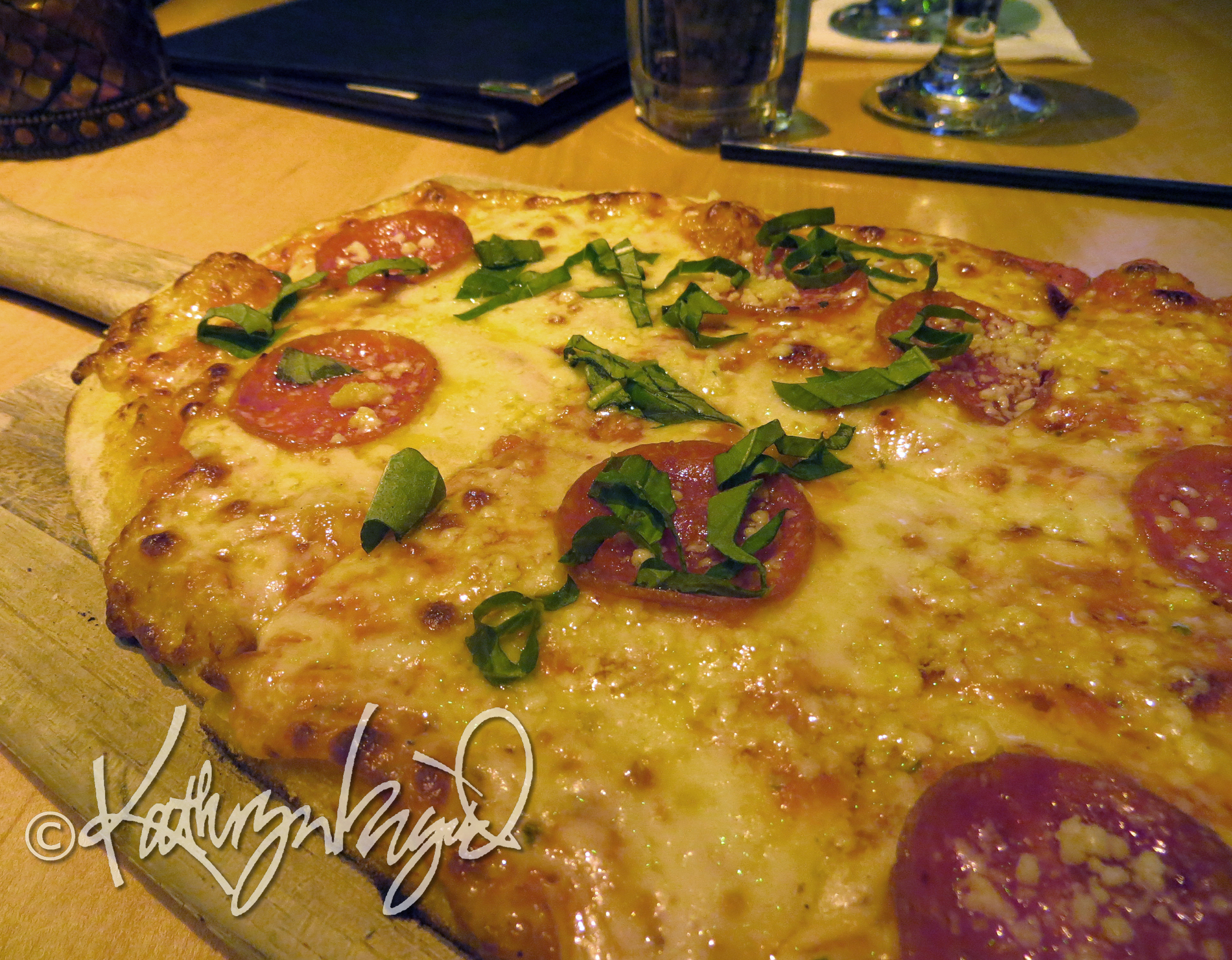
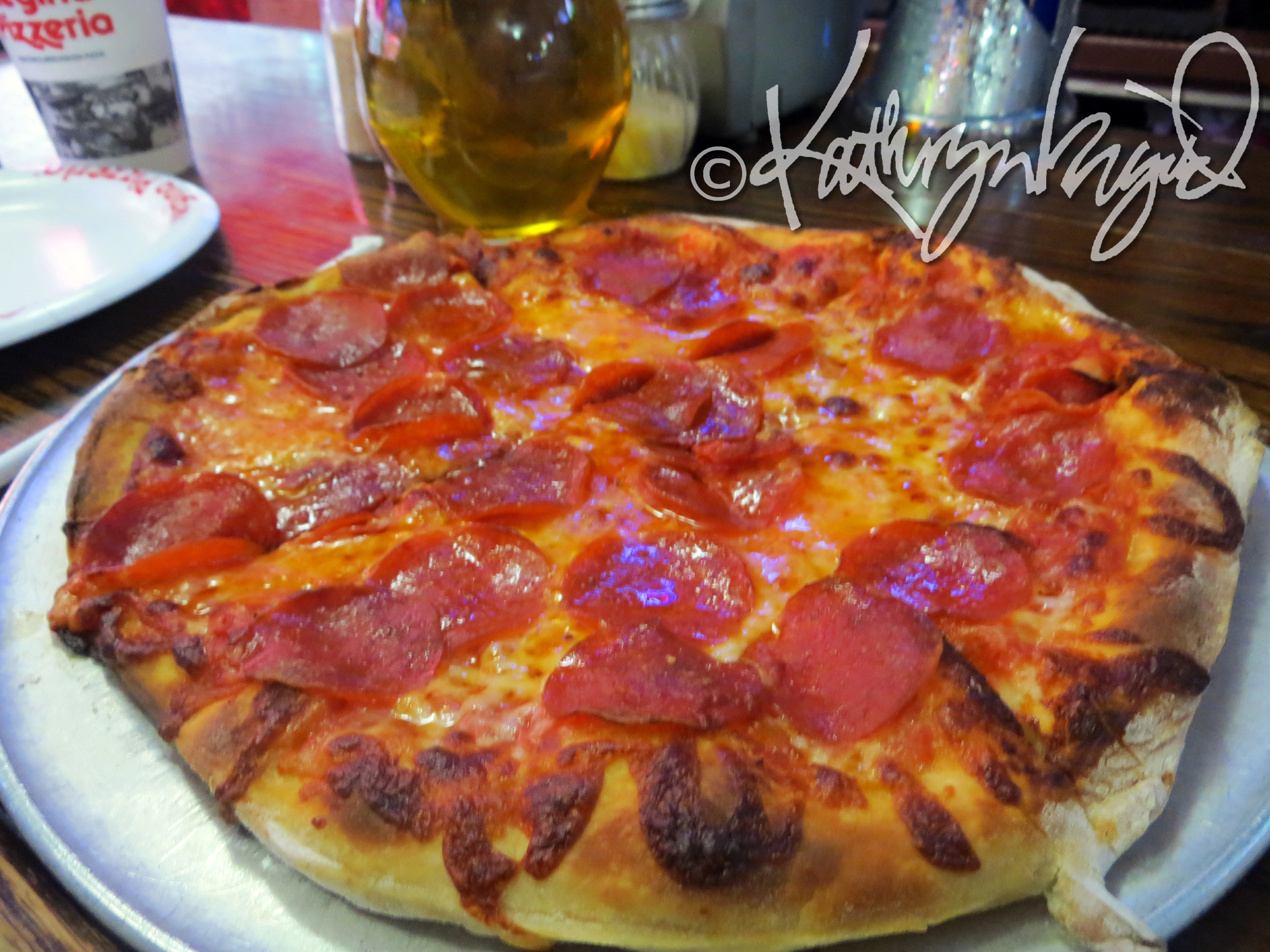
So when the opportunity for a really fine piece of pizza is not just sustenance but a great treat, I’m happy to dig in and eat. Especially if the pizza is one that doesn’t have a bunch of bitter or sour or Weird toppings, but rather the much-loved supreme deliciousness of good pepperoni and cheese and a slick of only a well-balanced ripe tomato sauce, the way my excellent spouse likes it best, so I can share it with him. And if I can wash down my tasty pizza with a good beer, then I will happily raise my glass in memory of Granny, who taught me to appreciate that the old-time stereotypical American image of men enjoying their beer and pizza in estrogen-free splendor was far from exclusive. And in memory of Gramps, whose sole-wage-earner retirement money paid for the beer and pizza Granny the homemaker bought for us while I was out with Gramps’s sons and grandsons, my uncles and cousins, practicing the ‘manly’ arts of working in construction as he had done for years before us. Keeping tradition and breaking with tradition. There’s always room in a good family, or a good stomach, for both.photoAll of this being said, with the help of my perspicacious, pizza-loving spouse and some research he’d read, I’ve recently discovered that avoiding wheat, of all things, seems to greatly reduce the hot flashes that have been the bane of my middle-aged existence since well before I was middle-aged. What to do? Wheat is the basis of the traditional pizza crust. Not to mention a key ingredient in lots of tasty beers. What!!! Is the universe spinning out of control???

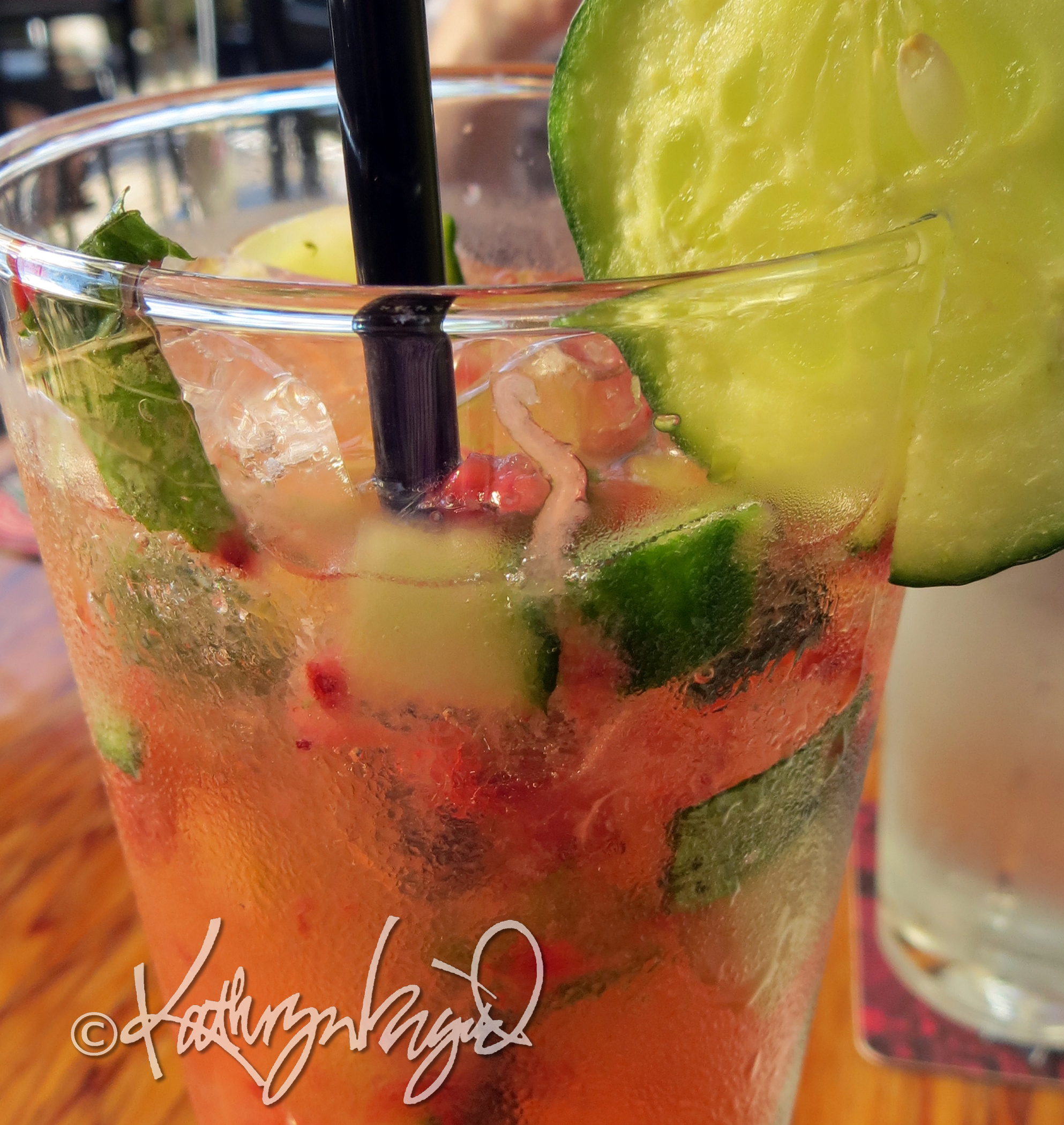
Fear not, my good friends. I am finding that where there’s a hankering, there’s a way. Besides the existence of a number of flour mixes and recipes for them that substitute quite neatly and directly–and generally must more tastefully than in gluten-free days of yore–for wheat flour, I am also learning that there is an ever-expanding universe of alternatives for those who are forbidden wheat, whether by choice as in my case or perforce as in the lives and kitchens of celiacs, allergy sufferers and others who must avoid the offending grain. Stay tuned for the experiments that are sure to follow: rice and potato and nut crusts, vegetable stand-ins and stunt doubles, and more. Meanwhile, I will not shy away from a cold beer, just check to be sure that it’s a wheat-free variety. And of course there’s always a nice cold cider or lemonade or iced tea, or perhaps a fresh and icy strawberry-cucumber mojito, as they also make quite the dandy accompaniments to a slice of pizza, gluten-free or not, don’t you know. I’m quite certain Granny would approve.photo

Hither and Yon

photoTravel calls. It almost always does. I am grateful that travel doesn’t always require a lot of concrete resources. Because when travel demands that I join hands and run away with her, I may not have instant access to the time, money and practical resources needed for physically hitting the trail.

That’s when I travel Inward. While I love traveling in fabulous cities and foreign countries, unknown rural roads and famous tourist sites, I also delight in traveling the interior world. I make inner places both based on those lovely locales I’ve visited in real life or know of through others and on ones wholly invented by my strange little imagination, and they’re populated with all sorts of people and creatures, real or magical or, better yet, a nice mix of the two, doing whatever the denizens of such places should or can do. Anything can happen, and in the inner world I can be the one deciding what that Anything should be, playing puppet-master and ringmaster as I see fit, and returning home to my conscious and ordinary world of day-to-day life when it’s time to do so.

And when traveling Inward is not enough or the moment of wealth arrives when I can afford traveling Outward again, that’s what I like to do. So much unexplored territory remains for me to learn, experience and enjoy. To assimilate as fuel for further inner invention! So many friends and towns and countries I long to revisit. Beauty and mystery and joy and adventure that removes me from my ordinariness. That, whether my journey goes inward or outward, is a grand and miraculous thing.

May we all travel well, wherever our travels take us.photo

Squirrelly Behavior

photoSquirrelly, Now and Formerly

Pipkin was a rascal lad who disobeyed his mom and dad

Pestered his teachers, pinched the girls

Among the young chipmunks and squirrels

And threw hard acorns from the trees at passing mice and birds and bees

He chewed on rafters, jambs and screens

Teased babies, oldsters, in-betweens

Stole in through windows left ajar—

Alas! Could not outrun a car.photo

Strange Birds & Iconoclasts

Nothing particularly wrong with being a strange bird.

Strangeness may be my only truly notable characteristic. I may not be particularly memorable to most people, what with being a mere mortal and all. Superpowers, I’ve none. Standout knowledge or skill or charisma? Nope. But being just a teensy bit weird, yeah, I’m all over that.

So I like to make art sometimes that is as pointlessly silly and eccentrically absurd as I am. I just feel I’m in a larger company of fringe characters than ever. And that, after all, is very probably exactly where I belong. I kind of like it on my perch. From here, the view is quite quirky and therefore strangely appealing. Come on over if and when you like, all you other odd birds out there.

digital illustrationRoom for Everyone

My friends, you are welcome to sit in my house,

admiring my other friends, family, spouse,

each one of us charming, delightful and sweet

as any convention of people you’ll meet,

as brainy and clever and heartwarming, too,

as anyone can be, and that includes you;

come in and enjoy the great company,

come in and be welcome, as welcome can be,

but please keep in mind, while you lounge in this spot:

compatible, yes, but the same we are not!digital illustration

Hot Flash Fiction 8: Out of His Family Tree

Beau Bretagne has a twelve-gauge shotgun on the porch and has a ladder-back chair with one short leg, a chair in which he leans against a big old sycamore tree; he has fourteen perfectly good teeth and a wonderful, spotless complete set of the Great Books, and he has read the complete bindings of them more than once. He has the gift of playing the squeezebox in the Gilded Crescent’s Big Dog Zydeco Band so beautifully that dancers have passed out as often from dancing all night as from the vast quantities of moonshine they are drinking at the same time. Beau gets a lot of pleasure out of all this wealth, but most impressively, he has the envy of the entire county ever since he had the brainstorm to name his baby boy Xerxes Junior Bretagne so that he truly has something that no one else in that whole county has. Unless you count Beau’s two cousins Billy-john and Bart, whose sons also share this magnificent combination of names (modified for the Bretagne family’s convenience as XJ2 and XJ3), but since Beau doesn’t count these, why should you?digital illustration from antique photographs