I Love You Like Crazy

Acrylic mural: Tongue-in-Cheek, after Élisabeth Vigée-Lebrun It’s probably inaccurate in more than just the politically correct sense to say that I love my husband like crazy, because it would imply that my affections are only similar to complete madness, and we all know I’m much closer than that in reality. While I flatter myself that I maintain a reasonably plausible façade of normalcy, everybody knows that I’m pretty nutty about my spouse. And those who know him don’t blame me.

He really is a lovable guy.

But aside from the stuff that is evident to the general public, that part about him being a thoughtful colleague, a committed and skilled teacher, a nuanced and inspired conductor of singers and instrumentalists, and all that other excellent and admirable kind of thing, he is smart and curious and kind as a person. I know that when we are together, I matter as much to him as he does to me; that he is a safe retreat from both the minor perturbations of the day and the greater dangers of the wide world when I am in need. And I have in him the great friend with whom I would rather while away the hours either in intensive work or fully at play than with anyone else on earth.

Most of all, I know he not only understands my particular brand of craziness but shares in it as well. Each day, each year, is a surprise package of a kind, and every one of them is somehow richer than all of the foregoing ones as more than the sum of their many parts. Love and admiration and respect and support are all well and good, but if they don’t have the kind of holy hilarity that life with my partner has, they can never be enough.

With that, I wish my beloved the happiest of birthdays, and many more of them yet to come, each in succession with new and astonishing delights.

Be that Light

Photo montage + text: Mirror for Contemplating Possibility

Photo + text: Toward Light

Photo + text: Solrosbarna

Photo montage + text: Solrosbarna 2: Greatest Gift

Things to Remember

Apparently I am sucked into the Throwback Thursday vortex, for amid my housework wanderings I stumbled across some dish-drying towels that brought a flood of memories over me. The first thing that came to mind was curiosity about whether there are many others who grew up using tea-towels like these made of flour sacking material and hand-embroidered, often with a small posy or aphorism in the corner, and usually by Mom or some older relative, at least until we ourselves were conscripted for the task.

My mother enjoyed embroidery as a relaxation mode as well as art form, and the last batch of dish towels that I know of her having made were a series of line drawings of local native flora, based (with the author’s permission) on a book of lovely little watercolors of the same plants and flowers. I chose one representing a favorite alpine blossom, even though the creamy white blooms were guaranteed to fade quickly against the pale fabric, and the outline of them remains faintly visible even after many years of hard use. That’s a perfect representation, in its way, of how my memory works. I began to reminisce, seeing this embroidery, on the alpine plants that have always signaled peace and freedom to me as I day-hiked on the flanks of Mt. Rainier. So I meandered over to search online for native alpine plants of the northwest, and as soon as I began looking at the images I was struck with an infusion of the very scent of those hikes, a spicy, earthy, fresh and herbal blend of tree resins—cedar, pine, alpine fir—and sun-baked earth, lightly perfumed flowers, crushed needles and fallen leaves underfoot, the brisk dash of elevated air. What a lot of fine things to be contained, in addition to the treasury of love and family history, within my mama’s embroidered dish drying cloth.Photo: Mama's Embroidery

You might think I’d’ve inherited an embroidery gene, because in addition to my mom’s fine handiwork, I grew up seeing and using Grandma’s embroidered towels and pillowcases and enjoyed them, too. I did not, and since I had these two sources readily available, I didn’t mourn the gap in my skill set. I could always go to one or the other of them and find some new kitchen linens in a time of need.

My father’s mother never got so inventive as to design her own embroideries based on book illustrations like Mom’s were, but Grandma chose for her projects the resource of hand-me-down and found patterns, most of them quite out of date already (hence the ease of her collecting them), and almost all of them much quirkier and tackier than her normally refined taste would have allowed. These were, however, mainly destined to be given to charity or sold for the proceeds that would go to the charity in their stead, so she had no attachment or agenda for showing them at home. I, on the other hand, bought a few not only out of any little do-gooder intentions but because the sheer silliness of some of the designs so delighted me.

This one, for example, that was my inspiration for joining now in the Throwback Thursday brigade, was highly amusing to me in its ridiculously fantastic subject, its period style, and its girly goofiness. I couldn’t resist it. I found no other Days of the Week as companions, so I can only imagine what happened on those days, but it was enough to find this towel that could simultaneously remind me of my grandmother and my youth and make me laugh, all while getting my dishes dried.Photo: Throwback Thursday

Fashions change, and with them, the decor and even tools that fill our lives and homes. Yesterday’s dish towels are probably more often machine-made of some high-tech sort of microfiber or super-absorbent bamboo fiber blend with an artful printed-on design in the proper Pantone colors of the year. But do they do a more artful job, as well, of wiping dishes dry after washing? Can they strain soup broth into crystal clarity? Do they make perfect wraps for ice packs when a sore neck or bruised arm is in want of one? No better than the old standbys of my youth, I imagine. Old as I am, I come from good stock that valued something a bit quaint and very handmade, and if it managed to accomplish the task and carry memories for decades at the same time, why, I suspect I’ll do well to try to be a human imitation of it myself.

Desire! & Creature Comforts

I got to cuddle a couple of babies lately. I’m a sucker for cute babies and even when they’re a little weepy or unhappy, I’m generally glad to get to play grandma for a little while in exchange for the warmth of a wriggly tiny person’s presence in my arms. I didn’t have either the instinct or the timing to be a mother myself, but I’ve been gifted with siblings, in-laws, and friends whose babies have been the delight of my Auntie and pseudo-Granny life. In the last couple of weeks, I got to hold and cherish one of my great-nieces for the first time. What a joy!

Of course, I admit I can’t help but feel a teensy bit of envy when I hold a sweet, curled up baby, whether she’s awake or asleep. The brief part of life when you’re still consistently the most adorable person in the room, even when you’ve just spewed copious quantities of used milk on everyone in the vicinity, is surpassed only by the preceding months of cushy luxury spent doing the backstroke in the protective amniotic pool, and I think it would be lovely if I could just get hooked up to that kind of spa service on a longer-term basis.Drawing + text: Umbilical

Discretionary Fun

Digital illustration/drawings: Mood & 'TudeI get the impression that some people treat non-work times as the only times when they’re allowed to be happy. I do understand the need for income that can drive one to spend time in a job that doesn’t fulfill any other need or desire in life, and many of those are in the least-compensated positions at low-paying employers’ as it is. Been there, done that.

But I can say, too, that the greatest misery in my work life was attitudinal, and the more I did to discover and avoid the things that made me unhappy in my work, the less miserable I was. The more I sought to learn what I enjoyed in work and chose ways to magnify that, the closer I got to contentment both at and out of the workplace.

I grew more cognizant, at the same time, of not wanting to waste precious time on work that challenged my inner playfulness or threatened my general sense of joy and purpose. I was given a great gift in being able recognize the longing and accept and pursue it by choosing a much lower-paying job (on paper, at least) with a great happiness-quotient. I’ve seen, over the years, that many of us are easily misled when we try to calculate what we think we need for our daily expenses, and how much it costs us to earn that. Yes, we get those paychecks, but if the job requires, say, clothes that we wouldn’t wear other than at work, child care, transportation, professional training and memberships, and that sort of thing, how much pay on an annual or monthly or hourly basis does it really cost to go beyond paying for those, at least far enough to keep a roof overhead and food on the table as well?

Nobody knows this awful kind of math better than the working poor. I’ve been in that category more than once in my life, but have always had safeguards others lacked—like friends or relatives from whom I could rent living space more cheaply than I could even a minuscule, run-down apartment in a scary part of town—so I also know that I am luckier than most. Now, when I am married to a person who is not only able to make enough income to support both of us but is willing to do so, I am among the most privileged and fortunate of creatures, and I know that, too.

But one of the best things I learned along the way when I was living on a very slender, sometimes sporadic, income, remains valuable to this day: if I spend so much time and energy on just ‘getting by’ in life and don’t put forth equal effort to enjoy, live, and love my life along the way, all of the pennies I earn are of little value at all. And while I can’t always afford the most thrilling and glamorous ways of keeping myself amused, especially when I do need to be working at any task or job, I had better find the simpler and cheaper ways and the most reliable ones to fill my life with happiness and contentment, I know by now that surrounding myself with people I love, admire, enjoy and respect is the very best solution. And if my job doesn’t allow for that kind of happiness and contentment, then it is costing me more than it pays, in the end.

The Only Magical World

Digital illustration from a photo: Mythic MirrorThere’s only one plane of existence that is guaranteed to seem perfect and right to you at all times, and that’s the one in your dreaming heart. But the place in the real world that will come closest to that kind of mythic perfection is the one where you can dwell in the center of real, constant and generous love. On the third of August, every year of my life, I get to celebrate such a love because it’s the anniversary of my parents’ marriage.

Their love for each other has withstood many tests and trials over time, but because it was genuine and down-to-earth love from the beginning, the tests and trials have tended to be more externally made and less harsh, perhaps, than they might otherwise have been. And in its best and least challenged days, it shines the brighter because it feeds and is fed by a larger love—for life, for those articles of faith and those people they hold dear—and I, as one of their offspring, get to share in that care and affection, friendship, respect and kind generosity.

This is the sort of beauty and distinction that transcends fairytale happiness and is, instead, steady and sure. Better than supposed Magic and miracles, it is so dependable that even when the sun isn’t shining quite right or the cogs of the world aren’t turning exactly as one might wish they would, it’s possible and natural to have assurance that what needs to be will return; goodness will prevail, and we will all get back to the constant and comforting business of loving and being loved by one another. It’s a potent blend of companionship and  concern and hope that aren’t dependent on spells and manipulations but reside in the everyday promise, and every third of August I get to celebrate it anew because my parents taught me what this kind of love can be.

Happy anniversary, Mom and Dad.

Unbalanced

Love always makes us a little nutty, and that’s not a complaint.

Digital Illustration: A Little Off Kilter

After all, it’s the only explanation for how I’ve managed to be so loved all of my life!Digital Illustration from a Photo: Longing Ladies

One could do a whole lot worse than beginning and ending with love.

My One and Only

Despite its title, this post isn’t about my marvelous spouse. But it could be. After all, like the actual topic of the day, marrying him is one of the most meaningful, fun and satisfying achievements in my life, and an act I intend to perform exactly one time ever.

But don’t we all have those? There are certain life experiences that we are so glad happened or are so pleased we did, yet there’s no intention whatsoever of our repeating the episode. Whether it, like my marriage, simply cannot be replicated in all of its fabulous fantastic-ositude-inous-ness, or it’s too expensive or difficult or ephemeral to do more than once in a lifetime, there are just things that will only occur once in our lives.

Making a stone sculpture is one such thing, for me. It was a required project somewhere along the course of my art studies, and I am glad it was required, because I doubt I’d ever have attempted it if the materials hadn’t been put right into my hands, the techniques taught to me on the spot, and the work necessary for me to fulfill the requirements of the class. I’m old enough by now to have figured out that there are a whole lot of activities and things in life I’d never have dared try, let alone figured out how happy I was to pursue them, if I hadn’t had to do them. Stone sculpting is one of those things that fell into the been-there-done-that category, finally, but besides having a decent little piece of art to show for it I am glad there was that one chance in the beginning.

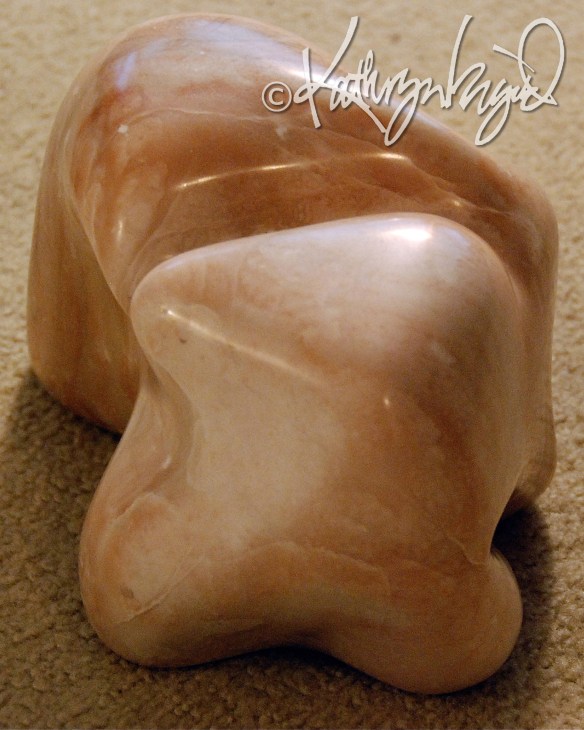
Photo: Alabaster Sculpture

My very own [Untitled] alabaster sculpture, the one and only. Approximately 7.5″ (19 cm) H x 8″ (20.5 cm) W x 11″ (28 cm) W.

Luck and happenstance, of course, have their own parts to play in the determination of whether any new experience becomes a one-off or a lifelong passion. Or, like my marriage, a one-time event that turns into a lifelong passion.

In the case of the rock sculpting, there were a few particulars that [ahem] shaped my attitude about the experience. One was that when the pile of alabaster hunks appeared on the table in front of my sculpture class, I chose a piece, lone among the heap as far as I remember, that had no major, unavoidable fissures in it. This allowed me to make a piece that was not a lot smaller than the original stone without having large parts of it crack and fall off. And my bit of alabaster had some nice coloration, attractive pale veining, and a natural overall shape that guided my sculpting choices. So all I did was refine the existing form and exaggerated it, and that led to the abstraction I made in the end. I just aimed for a sort of rounded Henry Moore-ish sculptural curvaceousness to showcase the silky, milky beauty of the alabaster as best I could. It was a slow and fussy process to chisel out an alabaster sculpture, and it made me ever so much more appreciative of and awestruck regarding the accomplishments of all real stone sculptors throughout the ages. Also, glad not to put my perpetual laziness into extended servitude to stone carving.

So, yeah. I made an alabaster sculpture, and I kind of like the result. And I’m happy that I did it, that I had the experience and learned a deeper appreciation of that art form. And yes, I am also pleased that I don’t ever have to make another alabaster sculpture, with the possible exception of the if-and-when instance of my deciding someday to have another go at it. Meanwhile, I have a decent memento of the experience. And if I get tired of it as a decorative object, it’s big and heavy enough to make a decent doorstop. If not beauty, then utility: that’s kind of how those once-or-more decisions can go.

Sometimes It’s Hard to Tell Who’s Giving the Gift and Who’s the Recipient

I have been taught that it’s polite to accept generosity with good grace: say Thank You, show proper appreciation, and humbly know that even when you think you don’t need or want the gift, it is your turn to show kindness by recognizing its significance to the giver. That doesn’t mean I’m terribly shy about ‘re-gifting,’ or passing the gifts along to someone I think will better appreciate and use them, eventually. It also doesn’t guarantee that I’m entirely alert to when I’m being presented with something valuable and meaningful. Even when I’m fully aware of my undeserving, I’m not exactly a genius at generosity myself, let alone fully attuned to how much I am given and how often.

Take the times when I am being thanked with gifts for doing things that I should have done as a matter of course, and often have done very grudgingly at that. I have always been a poor excuse for a visitor, supporter and caregiver, being intimidated and squeamish and easily unnerved by others’ needs and ailments and trials. I was terrified of visiting my own grandparents when they were old and shut-in, unable to be the people I had known in their healthier and more mobile and cogent days, and could rarely face the strangers that they had become, let alone the alien and frightened person I was myself in their presence.

Long before those times, even, I was both younger and less experienced or brave, if you can imagine anything yet more craven. My parents had always taught me by example that care and compassion, generosity and hospitality and respect, all of these were essential life skills and characteristics that should be nurtured and cultivated through consistent use. And I never got good at any of that.

Once, when Dad was making a hospital call on a parishioner who was dying of cancer, it happened to be when Mom and I needed to be along with him for something later in the day and it wasn’t convenient for anyone to be shuttling back and forth multiple times, so Mom and I rode along. Somewhere on the trip I realized or was persuaded that I should join both of them in visiting this man who was a stranger to me, rather than sitting and waiting in the car on a cold, damp day in the first week of December. I’m quite certain that I was both reluctant and frightened to make this visit, parental support notwithstanding. I’d never seen a person so near to death, and his being unknown to me did nothing to ease my fears; if anything, my perpetual social anxiety probably spiked to all-time highs at the thought of meeting someone new just when he was about to die. I’m quite sure that I wasn’t mature enough to recognize that this was a clear instance of the occasion being ‘about’ him, and not about me at all.

I remember rather little of the actual visit, only little bits. I had met this man’s wife once or twice, so I suppose we exchanged some small talk about that acquaintance. He asked me about my interest in art and shared that, while he’d had some entirely different sort of day job, he’d always had a creative urge and had made many small stained glass pieces as a fond hobby, something I gathered he sold to make a little pocket-money at times. His inquiry about what was happening in my own life just about then eventually revealed that the anniversary of my birth was approaching just as the end of his life was to come.

He was a pale, yellowish creature after cancer had defeated most of his bodily systems and all of his treatments, bloated but in an empty way; an airy husk of the man that had been, now nearly ready to blow away. His hospital room smelled just like hospital rooms have always smelled, overlaid with the added imaginary pall of looming mortality. I wasn’t a baby—I understood well enough that his sort of death wasn’t contagious—but I couldn’t help itching to escape all the same.

When this pallid wraith offered me his dry, cool hand I took it in mine and held it for a while as he and my parents continued to talk softly about more needful things. I did my best to give the appearance of better bravery than I had, if not compassion, and still he showed me more sympathy than I expect I did him. He thanked us all quietly for the visit as we left, and I was too immersed in trying to console myself over the sadness and discomfort of it all to realize that it was he who had done the kindness.

I heard in just a few days of his death and thought with some melancholy of how sorrowful it must have been for him to face it, and for his loved ones to cope with its eventual, if expected, arrival. Only a couple of days later, I thought of him again.

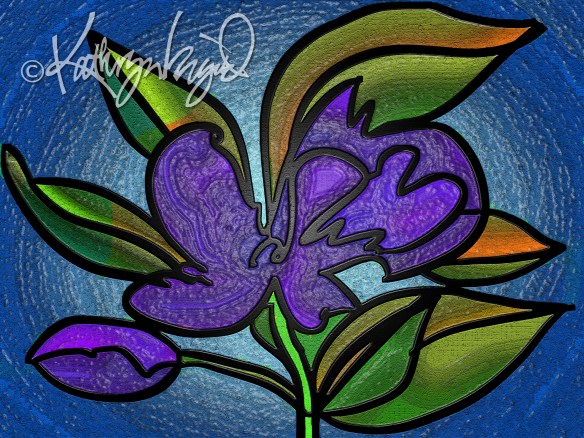
It was my birthday, and among the presents I received was one small package that was not from a family member. My parents told me that my acquaintance had asked his family to see that I be given this gift as a token of his gratitude for my visit. It was a table-top stained glass flower he had crafted sometime back when he still had the strength and skill to make such things. The little blue flower bowed gently on its wire stem, and I was abashed and moved by it.

This was a delicate token of real grace. It made a fine representation of that goodness, its glass petals and leaves letting light filter through, its slender stem so fine, yet resilient enough to spring back upward when pressed. It was a flower that stubbornly refused to wilt, even when it was a post-mortem gift from a virtual stranger. I don’t know, after all of these years, precisely what happened to it or when and where it disappeared, but I kept it for a very long time indeed and found in its simplicity a constant reminder that the little things even a reluctant and weak person might do in the name of duty or expedience or, however hesitantly and ineptly, for kindness’ sake, might in the end have some power. That this power is not our own matters less than that it can change the course of the moment, or sometimes, perhaps, even make a difference in matters of life and death.Digital illustration: Stained Glass Flower
For Love of Singing

Digital illustration from photos:  I Sing for JoyI Sing for Love

I sing for love of singing, For music, sweet and strong

That carries me from joy to joy, Amending every wrong—

To hear clear voices ringing Across the dawn of day

Makes purest gold, without alloy, My every waking way—

As day approaches evening, A lullaby, at last,

Gives night delight, believing As I do that in the vast—

Infinite—constellation Of voices in the night,

I will find deep communion With the song that sets me right—

I sing for love of singing, For in the choir’s heart

Is all the song of blessing That I longed for from the start.