Friendly Dragons

photo montageLight Armor

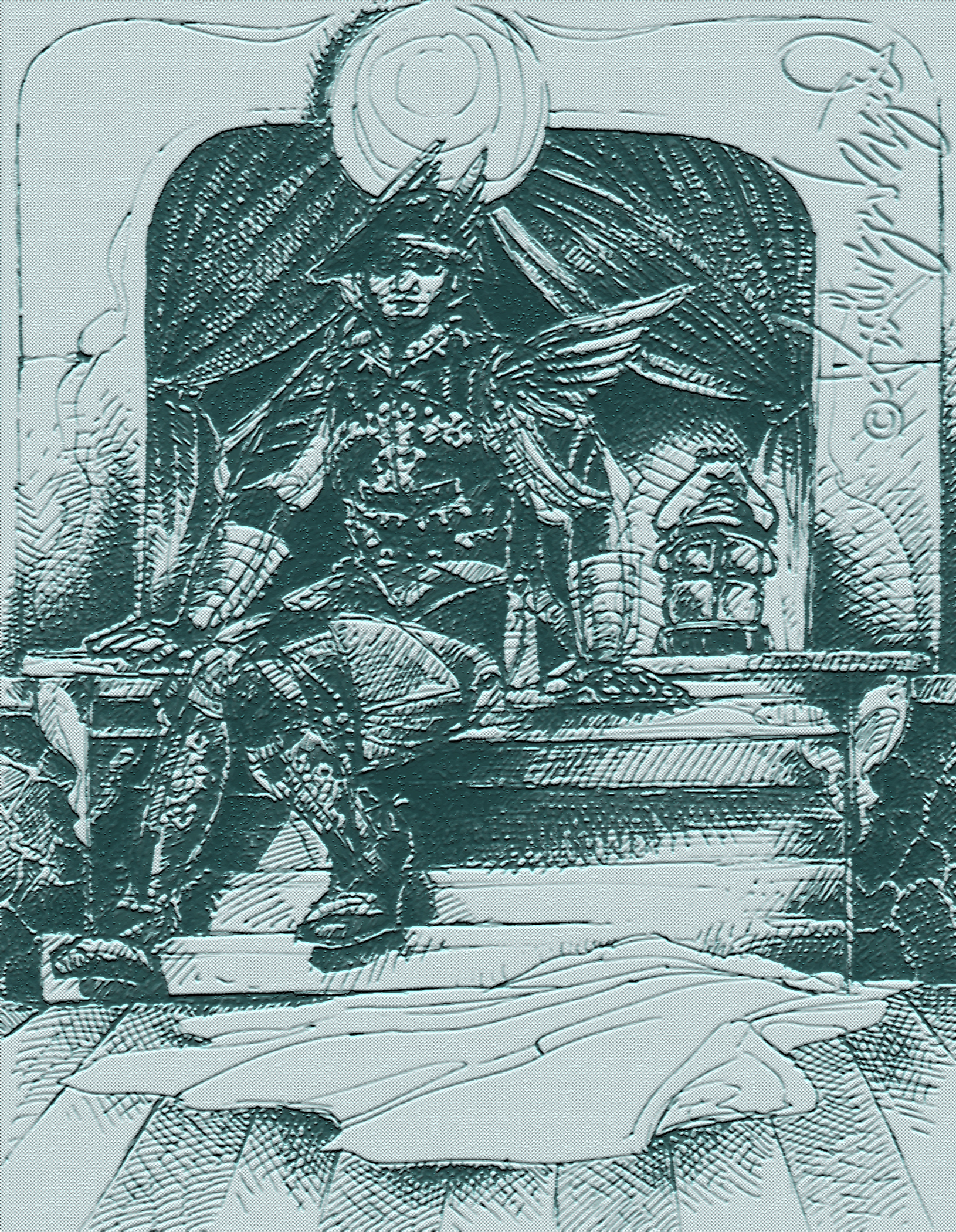
Not everything that’s fierce is cause for fear,

for strength in a good cause is great indeed,

but not intended to make others bleed;

rather, to shield the weak and persevere

Against all odds, to seek the distant grail,

to lead the way when battle’s all around,

and when it’s won, to hold the conquered ground,

protecting treasures fragile, sweet and pale;

For guardian angels, pioneering, brave

adventurers and stalwart friends in stress,

must keep their fiercest watch and always dress

full-armored, so prepared to shield and save

Us humbler beings and what we hold dear;

Not everything that’s fierce is cause for fear!

digital illustration from a P&I drawing

See? I told you they show up unexpectedly; just after I gave you this messenger in another post, I got the idea for today’s sonnet.

For Ourrrrrrr Boisterous Friends

In honor of International Talk Like a Pirate Day, I humbly make my contribution:

digital illustration

How d’ye like the swash o’ my buckle?

All Hands on Deck

(and If You Ain’t Got Both of Yourn, Git Along Up There Anyhow!)

Methinks the parley perilous with pirates gaudy, garrulous,

spectacularly scare-ulous, with too much time to spare;

That’s when the day gets dicier, the swordplay sharply spicier,

and nastily not-nicier linguistics fill the air,

For pirates, though a jolly sort, think keelhauling the keenest sport,

‘n’ walkin’ the plank, starboard or port, a fine means to such ends;

So watch your tongue (and your nose ‘n’ ears) when a peg-legged, cutlassed cur appears

and he with his Hook-fist henchmen nears, for they are risk-fraught friends

Who’ll trim the hedges about your garden without so much as a beg-yer-pardon,

then trim you to size without regardin’ your nat’ral breadth or height;

So parley with care, and watch your purses, as well as the strength of your pirate curses,

or fall beyond reach of the leech‘s nurses ere day drops into night.

All this aside, and despite the urge a pirate may feel as a dramaturg,

he might invite you to join the surge toward a pleasanter thing to do:

Join with his crew, ye smirkin’ smarty, drink and be merry and join the party,

and dance and laugh like a loon most hearty, and talk like a pirate too!digital illustration

If the Muse Should Come to Visit

Our summer road trip afforded me a few good opportunities for one of my favorite activities: listening during great music rehearsals while drawing and writing. Part of me is fully engaged in the music-making, wanting not to miss a single note or nuance even when it’s truly a working bash through sort of session for the musicians. I learn so much about the pieces in hand, their histories, contexts, technical challenges and all that sort of thing as well as what to expect and what might happen in performance that I always enjoy concerts more deeply after hearing them being developed for the performances. At the same time, if the work in hand is sans text or in a language so unknown to me that I can’t get wrapped up in that aspect beyond whether the ensembles’ vowels and consonants, attacks and diminuendos and cutoffs are, well, ensemble, then I can focus my language centers on writing, sometimes blog post essays and sometimes poetry.

When the text is too enthralling or at least too present in my attentions, I can still indulge in drawing. Either way, it’s not so much dividing my attention as letting one kind of artistry inspire and guide another one. One enriches the other. Especially when the music rolling around me is as rich as, say, that being prepared for performances at the Vancouver Early Music Festival in August. I only wish that the products of my sessions were always as inspired as the music undergirding their inception. But my only chance of getting any better is to keep practicing, isn’t it. And I’m lucky that I like the process more and more as I go along, and yes, the better the music is, the more I enjoy my learning curve. That’s inspiring enough.graphite drawing

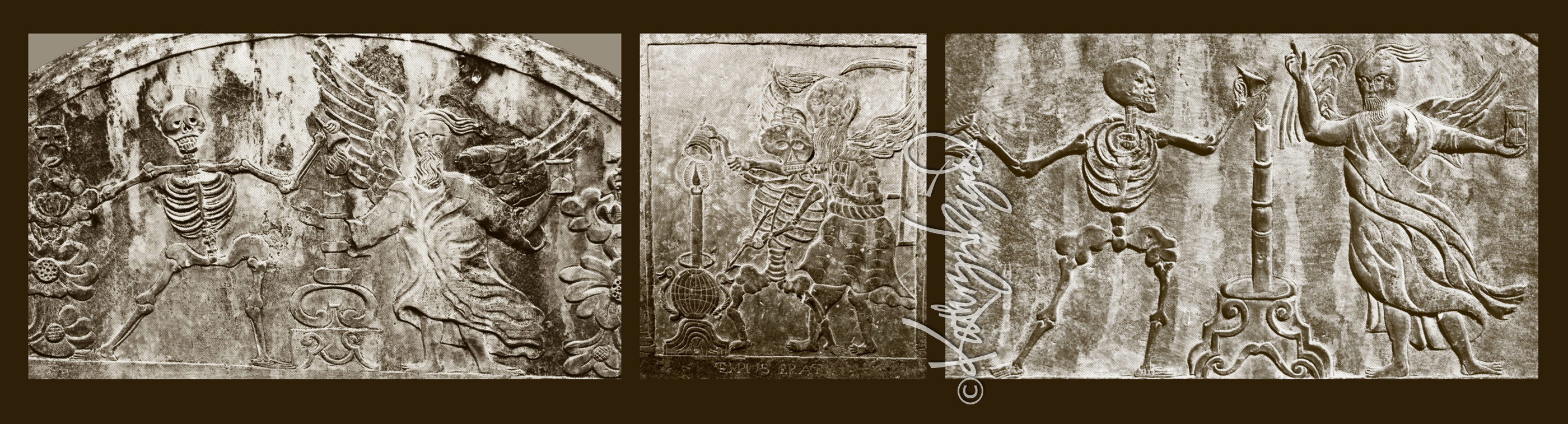
Another Totentanz

digital illustrationTo Rest in Peace

Alas! for shadows carve my collarbones

and misery is lapping at my heels;

Death’s machinations turn, wheels within wheels,

and grind me for its grist between cold stones–

And yet, as dust-dry as I turn, breath blooms

persistently, a torture to my soul

when I had rather be devoured whole

and go on into Peace’s empty rooms–

Still, here I stay, lie atomized, forlorn,

forgotten on the fringes of what life

and loves I knew once, when my days were rife

with possibility as a new morn–

Let me die now, not live without a chance

of altering this endless Totentanz.

Lest you think me suffering myself, or pessimistic, I assure you I am alive and well. It’s just that I have seen many others struggle with prolonged and pitiful end-of-life dramas and was reminded this June when I saw the beautiful antique gravestones in Boston of how different things are now, when we have such nearly unbelievable powers to keep ourselves alive for tremendously long lives but have lost touch with when it’s acceptable or even desirable not to do so. If our skills for ensuring or encouraging genuine quality of life are far outstripped by our skills for lengthening it, what does that say about us? Generations removed from our forebears, whether in Boston or elsewhere, who knew much more primitive medicine, greater physical dangers, irreparable injuries and the concomitant shorter lifespans we have apparently long since forgotten, do we know how to accept death as a natural end to life and treat dying as a passage to be eased to the fullest extent instead of forbidden?

Time Circles Back

digital image from a photoIf Memory Serves

If memory serves

It serves us right

To swerve first left

And then to right

To right the ship

And shift our weight

See changes flip

Both small and great

As fools it’s true

But happy ones

And lighted through

By moons and suns

As endless time

Follows its curves

To roll away

If memory servesdigital illustration from a photo

I’ll Tell You a Little Secret

You shouldn’t be surprised, if you’ve been hanging about this place at all, to learn that I’m very fond of living in my imagination, and that as Ruler of it I am happy to say that reality is highly overrated and being a distinctive (or weird) creature surrounded by distinctive (or weird) happenings and insights is a far superior sort of happiness.graphite drawingWeasels Ahoy

There once was a stoat in a velvet coat

Sailed off in a sterling silver boat–

Yet here’s a clue: I don’t know about you,

But I think some things are too good to be true,

And just as a logical soul should think,

That shiny boat was bound to sink–

At least in a Normal world it would,

Yet some things are simply too true to be good,

So I live in a world that I much prefer,

Where stoats wear velvet right over their fur

And captain ships of a platinum hue;

I think it beats logic by far, don’t you?

The End of Us is Not the End of All Things

photoHer Bones are Glass

Her bones are glass; the diamonds in her eyes

Now shining dust, yet still and otherwise,

Though time says that she must, she still decries

The need, opposes it by effort, will

And awful grief and rage at what would kill

Her body, spirit, mind and heart, until

She mounts the ridges of that final hill,

‘Til battle’s over and the victory won;

So while she harries them, Age sets her sun

A-fade, Time lets her hourglass empty run,

Approach the space where sleep and she are one;

The sands thin silently, passing to less-

Than-empty, right to utter nothingness,

In view but fading, to her pale distress,

Her winding-sheet already worn for dress,

‘Til battle’s over and the victory won;

Comfort she needs, yet I can offer none

‘Til battle’s over and her victory won.photo

It’s All Rehearsal, Really

Blog.08-30-2013.all-rehearsalWe may look like we’re all geared up and doing important stuff, but mostly, we spend all of our lives practicing, learning and getting ready for one thing or another. Some of those things happen in due course and many more of them either never quite come to fruition, or far more often, change along the way and we end up following along and seeing where it all takes us. All of this is quite normal and perfectly valid.

As a privileged observer and listener in many musical rehearsals long after the years when I was an active amateur participant, I can tell you that I think these more explicit practice sessions can have much the same sorts of both trajectories and outcomes. What anyone not privy to the backstage view of any sort of practice may easily forget, even if they once knew it, is that whether the moment is strictly obligatory, is amateur in the finer sense, or is wholly professional, it can have the same range of characteristics, studious, soulful, playful, predictable, heartrending or hilarious–or some grand combination of them all.

The experience of listening in on the preparations for musical performances is distinct from the performances themselves in a multitude of ways, but perhaps the most striking to a non-participant is arriving at a high-level rehearsal and seeing all and sundry set up camp for it in their work clothes. The star soloist is wearing old jeans. The conductor, who no matter how rigorously the singers and players enact their parts will likely move around and sweat the most, is wearing shorts and a short-sleeved, thin shirt. The players have open cases near their chairs with spare instrument pieces and alternate score parts strewn across them, and the singers, no matter what the temperature, are wearing neck scarves and lugging big containers of fluids to protect their own precious instruments. The rehearsal accompanist at the beat-up old piano is wearing glasses both on the bridge of the nose and the crown of the head, one for the easier to read individual parts and one for the microscopically reduced full score. All of this in a sort of ordered chaos the shows they are all there to Do Things. It’s work. It’s fun. It’s messy, like life.

Our Big Summer Road Trip, a driving circuit of over 6000 miles this July and August, was a multipurpose travel package designed to accomplish a number of ends, not least of them to attend and study and enjoy music-related adventures with friends, colleagues and other musicians and music lovers in several disparate events. First, we went to the Oregon Bach Festival to see the newly anointed Artistic Director make his debut interview marking the occasion, and more importantly to see maestro Helmuth Rilling conduct his grand finale performance as AD in this season when he officially passed the baton to his successor after 44 outstanding years at the Festival’s helm. The Festival is a fine one, Rilling a justly revered conductor and teacher, and many of the singers and players who participate, along with many regular OBF attendees, are longtime friends and colleagues, so it’s always a joy and privilege to go to the Festival ourselves, but particularly meaningful to see Rilling lead the B Minor Mass on his way to Conductor Emeritus status, since my husband Richard had the good fortune to sing the same piece under Rilling during the maestro’s second year at OBF. A great deal of water has gone under the bridge, and though a lot has changed in that flow of time, many things remain the same. Rehearsals and performances, practice and action go on as ever.

I had been reminded of all of this, of course, by the opportunity to attend the Boston Early Music Festival and see my spouse conduct and his Collegium Singers and the university’s Baroque Orchestra in June, along with admiring all of the other marvelous artists and events at BEMF. So many wonderful concerts and recitals; so much hard and happy work to prepare them! And how quickly June disappears into the mists of memory as the summer rolls forward. Thus, a long road trip seemingly becomes an amazingly fresh outing to experience more variations on this theme.

The second of the trio of musical events we attended on the road trip was the regional gathering of choral conductors in our former home area, a great opportunity to renew ties with longtime fellow conductors, teachers and friends over grilled wild salmon and to revisit musical literature options, audition processes, mull over the usual academic topics, share hints about favorite new compositions and gossip about who is the up-and-coming hottest new choir or conductor in anyone’s neighborhood. Driving up to the chapel that serves as the main conference space, whom should we see sitting visiting on the porch but a man who was the excellent recording engineer serving in that artistic task for many of my husband’s choirs’ recordings over the years, and with him, the teacher-conductor-mentor who led Richard to music as a vocation and profession in the first place and so became not only his ‘choral father’ but a lifelong dear friend. To follow this greeting with collegial renewal among many other fellow musical artists, from colleagues and collaborators to singers and students, composers and coordinators of conferences and musical programs at all levels, and then to have dinner a week later with both of those two first friends we’d spotted, was rich beyond words.

Third on our list and rounding out the road trip with our stop in Vancouver, BC, was the Vancouver Early Music Festival. A perfect bookend to starting the trip with OBF in Eugene, VEMF attendance had much the same purpose for us as the Oregon visit: see and hear good friends and other artists at work, and attend the events honoring the longtime AD’s retirement. While Jose Verstappen has served a mere 34 years in Vancouver, he has had as much impact of his own on the Festival there as Rilling has in Oregon, just a very different sort. Jose is a modest and self-effacing man, but as warm and as hardworking and dedicated, and certainly as hard for donors and supporters to say No to, as Rilling, and so both have created environments of commitment and excellence that will thrive long after both have abdicated their thrones. Matthew Halls, Rilling’s successor, and Matthew White, Verstappen’s, are both bright, gifted and able men and I expect to enjoy attending both festivals with as much outstanding artistry on display as ever in years to come.

While in Vancouver, besides the great fun of attending Verstappen’s farewell party, seeing many dear friends, meeting Bruce Dickey–the leading light of cornettists nowadays, he will be playing in the production of the Monteverdi Vespers Richard’s conducting in October–and hearing some terrific music of various kinds in concert, the highlight was sitting in during rehearsals for Händel’s ‘Israel in Egypt’. It was there that I was most struck by this lovely interweaving of labor and lightness that can happen when the people at practice are fully engaged in their work and love what they do. The piece itself is a marvel, full of potent and piquant and even picaresque melodies and moments, and those singing and playing it made the most of these riches. When Tyler Duncan and Sumner Thompson started singing the bass duet ‘The Lord is a Man of War‘, not only was the music and text mesmerizing (never mind my personal feelings about the story’s theology) but their obvious pleasure in exploring the expressive potential in the piece together with the players and conductor (the impressively sensitive and dramatic Alexander Weimann) moved me to pay special attention to this juxtaposition of the remarkable and the workaday, the plain and the powerful. So to all of you out there who sing, play, work, rehearse, prepare and perform, and especially to the players, singers, composers, conductors, administrators and Artistic Directors encountered on this summer tour of ours, I dedicate this poem.digital illustrationNumber Thirty-Eight

Strike, then carry on, and so the sound

Belies in beauty such a martial start,

When ragtag troops in everyday are found

To sing and play at battle from the heart–

Who seemed so simply destined for the soil

As laborers in neither art nor war

But some plebeian, plodding sort of toil,

Then strike, and decimate what came before–

Show the illusion is not acted out

Through violence or merely artifice,

But rather, note by note dispelling doubt

That mystery’s all quite undone by this–

Where love and war are mingled in their way

By songs more eloquent than words can say.

Shiny Objects & Flying Illusions

Beetling Brow

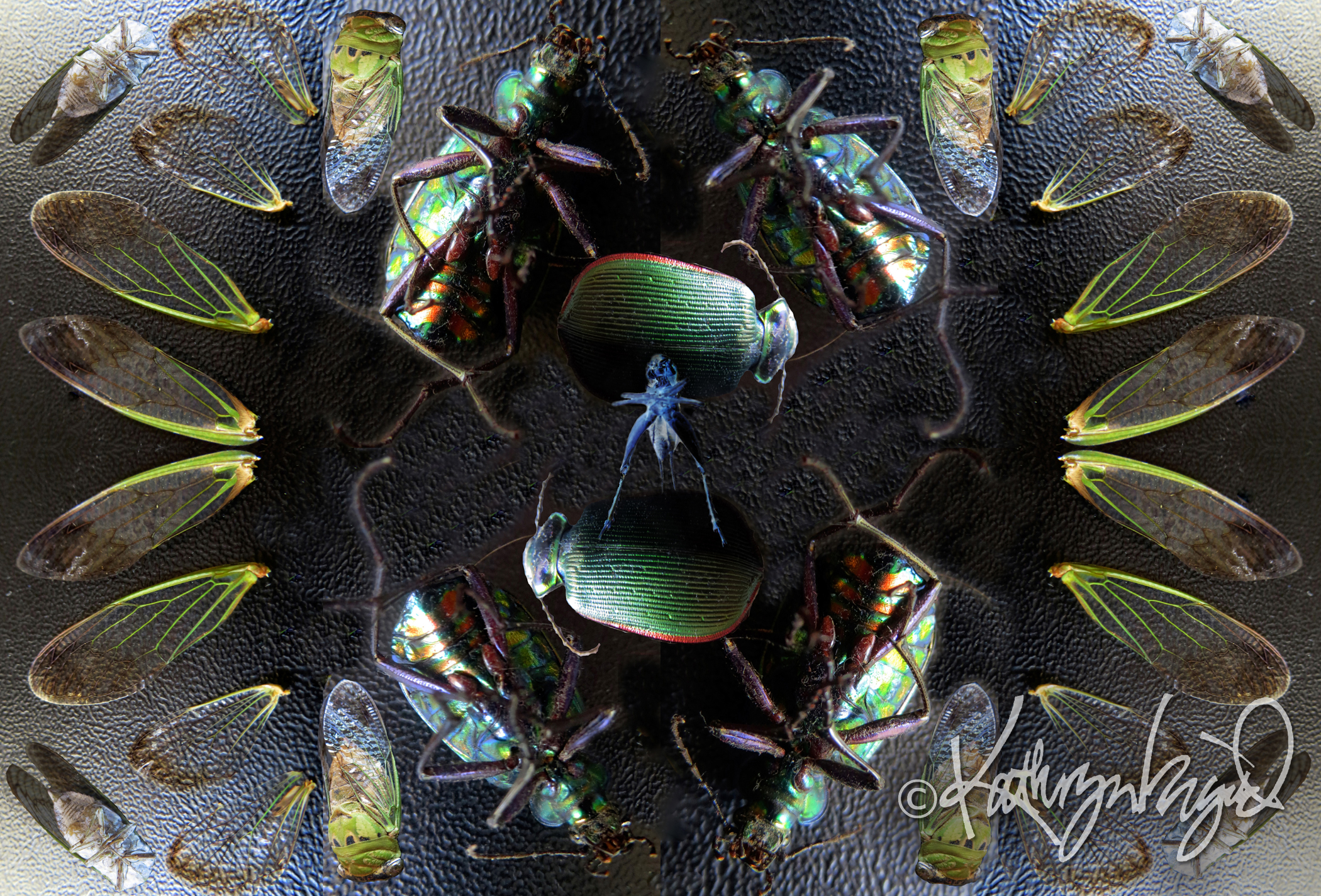
Inside my skull’s a fizzing insectarium

of mystic, magic, merry little things

so wildly pretty that my brain can’t carry ’em

without the power of all their tiny wings,

Abuzz with sparkling brilliance and their fleeting,

so speedy that they’ve utterly forgot

regard for gravity or need for beating,

become instead bright vestiges of thought.

Now, you may think I’m just a bugged-out entity

with not a thought for anything of sense,

but every person has his own bugs, hasn’t he,

and with their glittering gleam, the joy’s immense;

I never really cared that much for images

or what all others thought my problem was,

but just embraced my inner insects’ scrimmages,

and love the shiny ways they make me buzz.digital collage

Sonnet for Sisters

restored antique photoMy Sisters’ Names

Three sisters, three have I, each one a star

to light the night or day with brilliance new,

a spark these shining few, though rare, bring to

the darkest, deepest places where they are–

Fair Wisdom bears a gleaming cup, as thirst

for knowledge waits in ev’ry darkened realm

to sip the learning springing from her helm,

sweet Wisdom bringing in this treasure first–

The next is gracious Kindness, in whose charms

of sympathy and care is safety found

when she with gentle strength wraps all around,

encompassing the world within her arms–

The third with equal radiance inclines

to lighten hearts as much as sun can do;

Laughter‘s her name, and like the other two,

her sparkling wit enhances how she shines–

All three, my sisters light the corners of

The universe: their other name is Love.digital artwork from an antique photo