If Words are Food for Thought, Writers should Always Play with Their Food

Writing, like most other creative problem-solving processes, can sometimes best coalesce into sense out of utter nonsense. Untrammeled play is often the precursor to productive work, and if it remains unproductive, there will be less cursing afterward anyway. If you know what I mean, and since you’re hanging around here I can only assume that you, too, understand the importance of letting your silly side out for regular exercise.

So today, no more from me than a hearty helping of hooey. How shall I refine the ridiculous on this occasion? Perhaps not at all. Maybe I’ll just throw it on the table and let you decide what’s worth a nibble or a nosh, for once. Play on, pals.

Noises On

Bye bike bicycle
Far farce farcical
Pop plop Popsicle
Drip drop dropsical
Miracle spherical
Fanatical dramatical
Hysterical historical
Oracle Coracle Rhetorical
Trickle mickle pickle tickle fickle nickel prickle
Hackle spackle cackle grackle tackle
Chuck chuckle chuckling Buck buckle buckling Suck suckle suckling

Duck…Duckle? Duckling…

Oh, F…I mean, Yuck.

Definitive Thoughts

Aberration [/ˌæb.’bɛər.ˈreɪ.ʃ(ə)n/ noun]: the odd ursine meal.

Harbinger [/ˈhɑːr.bɪndʒ-ɜːr/ noun]: one who chortles incontinently.

Jasmine Tea [/’dʒæz.men.ˌtiː/ noun]: Thelonious and Tatum play golf.

Protuberance [/prə.ˈtuː.bər.əns/ noun]: in favor of liquid-cleaning one’s brass instrument.

Rapscallion [/ræp.ˈskæl.i.ən/ noun]: green onion that induces stream-of-consciousness chanting.

Raisin Bread [/ˈreɪ.z.ˌɪnˈbred/ noun]: what’s the matter with cousinbrother Raymond.

Saline [/ˈseɪ.lɪŋ/ verb]: what square-riggers do over the bounding main.

Scalawag [/ˈskæl.ɪ.wæɡ/ noun]: opera house humorist.

Digital illo: Psychedelic Food for ThoughtWhat, you wanted sense? Why’d you come here, then?

On a Windy Day of Blue

Digital illo from photos: Ripples

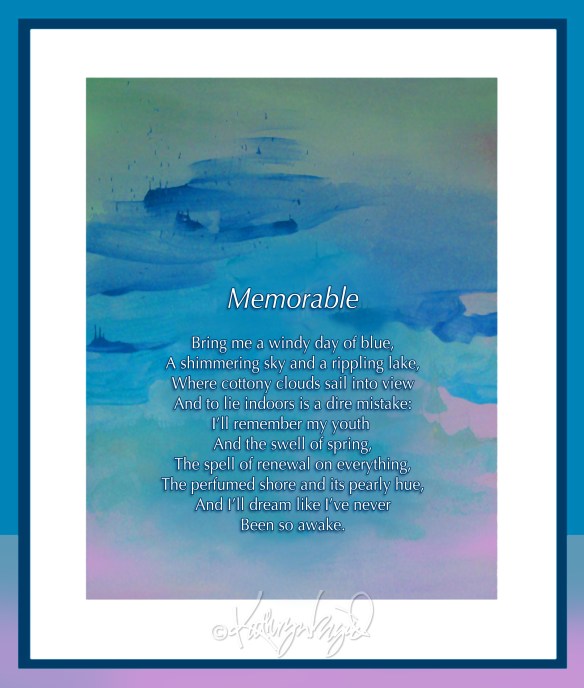
Digital illo + text: Memorable

Transitory or Transitional

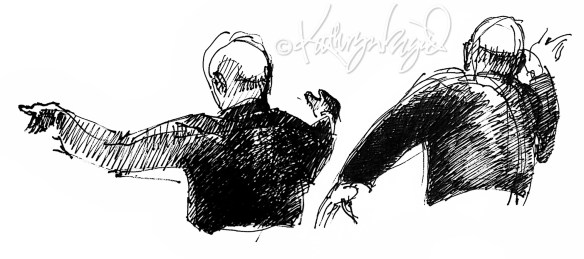
Pen & ink drawing: Transitory or TransitionalMy spouse, in his combined capacities as a natural-born teacher and a lifelong curious learner himself, is constantly reading, studying, talking shop with others both in and out of his field of music, and cogitating inwardly and through his writing about ways to grow and improve. I am neither a born teacher nor as dedicated and skillful a learner as he is, but I have, I think, grown a fair amount in my appreciation of what quantities and depth of effort it takes to improve oneself, let alone help others to improve themselves, in any chosen course of study. One of the things that intrigues me is that, as in so many areas of life’s experiences, the macro and the micro aspects of learning and, in turn, teaching, always ebb and flow: it takes a multitude of tiny pieces of knowledge and/or effort to make any significant larger ones, and the large ones must generally be reduced to smaller and more manageable parts in order to be changed, eliminated, or simply learned, as well.

In a day’s rehearsal for an upcoming concert, it’s marvelous to see and hear what occurs as a major composition is broken down into its component parts and those parts studied and practiced and rehearsed in detail, bit by bit, but also to realize that the individual parts have no beauty or meaning unless also studied in the context of the whole. Fixing one small phrase or chord at a time can be a portion of the improvement process, but if that’s all that happens, then the performance will never have any cohesion or sense of drama but will forever remain a collation of essentially separate and unrelated atoms that happened to be sounded in the same room on the same night. Playing or singing through transitions—the places where one phrase or larger idea in a composition ends and the next begins—is a way in which my conductor husband helps his choirs, orchestras, and other performers to experience and express the whole of the story more convincingly themselves, and thus bring an audience into the flow of the work as well.

Music is a wonderful vehicle for individual experience of the aesthetic, emotional, artistic, and ephemeral aspects of existence, and as such is a grand gift. But when it becomes a communal, communicative experience rather than only an isolated solo, it has incredible power for building relationships between people, ideas, cultures, lives. When it is a bit of a song, hummed or played on the street, in the car, at work in the kitchen, it can cheer or soothe, feed or please; when it is a performance of a major musical work in concert, in a musical or opera, an oratorio or a middle school end-of-year concert that has many participants and has been labored over with passion by all of them through a string of intense rehearsals, its power is magnified and resonates for a long, long time to come. It’s as though the practice of singing or playing through the transitions from one passage to another of that single composition has expanded into life, letting the dissonances and harmonies, the threads of meaning and the ecstatic shimmer of aural beauty, all remain in the air and in our spirits long after the last notes have gone silent, carrying us through the transition from art into life with renewed depth and purpose.

Art in the Middle of Dying

Digital illo + text: Angels DescendingThere’s little in the world that gives more meaningful respite from earthly trials than art. Those sorrows and struggles that range from the brutality of human weakness and evil to the most monstrous of natural disasters have no true cure, no end. Safe to assume that they have existed since long before recorded history, and will outlast the lives of any of us now present. But art—a painting, a dance, a song, a story—in its turn outlasts, too, the horrors and madness of the darkest time. What exists in the background, dwells in the underground, during suffering and oppression, so strong that it cannot be extinguished, and both records the terrible event and defies it? Art.

If we learn anything from our history, it should include the knowledge that any threat to eliminate or suppress art by force or merely by neglect and dissolution is a time when we should most avidly practice our defiance of oblivion. When it is bleakest, we should dance most wildly and gracefully; when dark, sing boldly and sweetly; when empty, we should fill the void with thought and challenge it with beauty. The blank Nothing may not mock us into meek obsolescence if we refuse to silence our passion and surrender our dreams.

Something about the Wide Open Spaces

Image

Watercolor + text: Prairie Romance

Solo after Dark

If you’ve ever heard Miles Davis play, this needs no explanation. If you haven’t ever heard his music, whether you were lucky enough to catch it live or, like me, have only known it through recordings, it’s time you listened. Get a recording, turn it on, and turn off the lights or just close your eyes. And listen. Because.

Digital illo + text: I can Hear It from Miles Away

My Portfolio

I’ll leave it to others, preferably sometime after I’m dead and even less likely to be concerned about it that I am now, to determine whether I’m a real artist or writer. No doubt there are, and will be, many who are dubious that I am a real person, for that matter. But it’s of little consequence, as long as I believe I exist. There’s room enough in my delusion for a number of delightful companions, and as long as I am happy in my imaginary world, all is well. But I will stake a small claim that, whether as a real artist or writer or a mere fantasist, I’ve been making art and writing stuff for as long as I can remember.
Photo: Portfolio 1

I think it unlikely that much of either kind of output will ever be considered especially valuable by others. I don’t flatter myself so far as to think that a large quantity of my work in visual or verbal invention is more than a passing amusement even to me, so there’s no reason to believe that the rest of the viewing and reading world will be so moved by my thrilling creations as to consider it important. And I don’t worry about that.

After all, I am as ephemeral as all persons of the human persuasion are, and thus unlikely to be troubled by anything lasting after I’m dead. I’m not one to concern myself with my epitaph (although I’ve written dozens of silly couplets and quatrains that would more than suffice in summing me up for a headstone, so that’s taken care of already if it worries you) or my legacy. The latter, I hope, will be to not have left too much of a mark on the world when I’m gone, but rather have trod on it fairly lightly, as these things go.

But because I am alive in an era when a veteran introvert like me can now also easily ‘go public’ without the great anxiety-production that comes from real world interaction with other humanoids, and in order to keep myself motivated to enjoy my practice of art and writing as much and as long as I can, why then: I am; therefore, I blog. Inevitably, others will feel it incumbent upon them to critique. Thankfully, the most succinct and practical form of critique in the digital age is first, to ignore, and then, Delete. So if anyone finds my work offensive or ugly, or just plain tedious and tiresome, their best defense of their tender eyebulbs and precious time is to run away from my website and never darken its portals again. I take the grand liberty of assuming that anyone who comes here does so unforced, and is free to go galumphing off in a cloud of huffiness when and if that suits them, and has therefore no cause to chastise me with wasting their life-energy here.

Photo: Portfolio 2

Meanwhile, having this platform for self-training and/or self-amusement, I go on producing new posts, new drawings and photos and poems and fictions and musings and digital collages daily and to my heart’s content.

But I consider that my portfolio is more than just a blog. It’s more than all of the art and writing and publications and stashed-away unshared works of my lifetime thus far and to the end of my days, whenever that will be. My true portfolio is all of the inspirations and ideas and inventions from the alpha to the omega of my lifespan, plus every experience and dream, study and accident, fear and hope and longing that led to those works of my brain and hands. And most of all, it is the collected community of friends, teachers, icons, playmates, correspondents, counselors, and loved ones who have moved, and continue to move, me to pour out this satchel of tricks and treats by which I will leave what little mark I do make upon the universe before I go.

Marble Bust of a Young Child

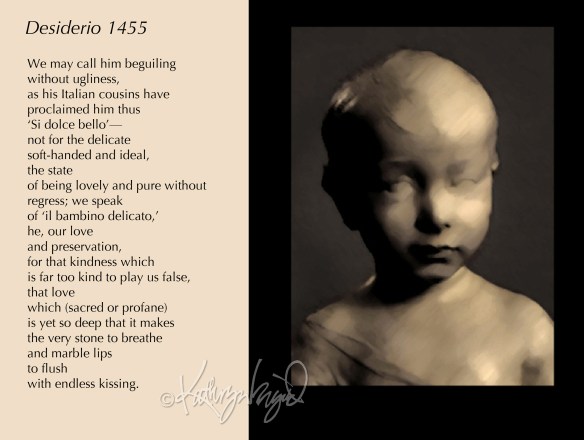
Some artworks defy the passing of long ages not only as physical objects but also as ideas and images that transcend trends and tastes. One that captured my imagination long ago and has never grown dull or fallen from my affections is a carved stone portrait of a child, created in the fifteenth century by a sculptor mellifluously named Desiderio da Settignano (de Bartolomeo di Francesco detto Ferro). My computer wishes that I would change the unknown word “Desiderio” to “Desire,” and indeed, it is as though the artist had infused the marble of his sculpture with such mystical attraction, a heightened, time-proof version of the natural affection for a child’s inner beauty that can surpass the strength of his individual name or origins or place in time.

In recognition of both that species-perpetuating endearment and the accomplishment of the artist in capturing it, I wrote a pair of dedicated meditations.Digital illustration + text: A Delicate Incandescence

Digital illustration + text: Desiderio 1455

Don’t Fear the Beard

Long, long before beards were either returned to fashionability or considered the topic for memes and manias of any modern sort, there were many cycles of similarly obsessive and extensive motivations for—and against—facial hair. Formidable schoolmistresses, pretend feminine mates for closeted men, and prickly maiden aunts notwithstanding, the majority of these trends applied generally only the male of the human hominids. It’s amazing, no matter what era one would choose to examine in this regard (excepting, perhaps, the days before shaving was discovered), how much political, religious, tactical, emotional, social, and spiritual power facial hair—its shape and size and location—has, for good or ill.
Mixed media artwork: Bearded Brahms

I’m not necessarily fixed in one camp or another about beards, mustaches, or sideburns. Since they have no moral value in my life, my critique of facial hair has to do with strictly logistical matters, like how much of a day is devoted to grooming and admiring one’s own set of whiskers, or possibly to hygienic matters, like how much of a person’s lunch enters into and remains attached to the hair, regardless of where on the head it is located. And I’m definitely prejudiced with regard to matters of my personal taste, if pressed to choose. Unless I know of or can guess at some imperative guiding a man’s choice in the whether, why, and how, like his subscribing to a religious orthodoxy that dictates it, I am inclined to regard facial hair as a fashion statement, and therefore to be liked or disliked on the basis of whether it seems to me to suit the fellow’s appearance.

Johannes Brahms’s luxuriant beard would undoubtedly look odd, if not weirdly wrong, to me on some younger celebrities of the present time, just as Jamie Foxx’s sleekly tailored goatee would hardly have suited a big, wild-haired guy like Herr Brahms, even if it’d been fashionable in his day. I am attracted mostly to people who look thoughtfully and well put-together, from their hairstyles to their dress and deportment, but perhaps even more so to people who look like their ‘look’ really suits them. So while I was not, shall we say, a huge fan of my late great-aunt’s bristling brows or prominent mustache, which though they were not as impressive as, say, Mark Twain’s, did remind me of him at times, I knew that not only did I actually admire those accoutrements on said author, but accepted that, given her life and unselfconsciously plain attitudes, they pretty much suited Tante Anna as well.

Still, I am biased by physiological expectations enough to prefer heavier facial hair to be located on male specimens, and even then, generally to have a certain sense of purpose and care attached to them. My spouse sported a cleanly shaped mustache and goatee when we were first together and for some years thereafter, and since it didn’t in any way affect his handsomeness, let alone his kissing skills, I had no objection either to the days of his sporting that look or to the time when he shaved not only those off but his entire head of hair as well. It turned out, in his case, that his facial hair was already so light-colored that in fact very few people noticed when he shaved it all off, and if they saw any effect they were inclined to comment that he seemed to look younger to them lately, for some reason. Which says to me that if it took any greater effort to maintain the grooming of the facial hair than it did to shave it off daily, he was better served by saving the time and labor. It also happened that I found him just as attractive, if not even more so, when he went for the all-shaven look, so there’s that.

But I didn’t entirely share my little sisters’ horror of beards to the degree that when Dad showed up sporting one after a canoeing trip with colleagues in our youth, one ran crying from the room and wouldn’t come back to greet the returning pater, and the other gravely announced that if Dad died before he shaved the offending item off his face, she wouldn’t attend his funeral. He was amused, but in a very short time reappeared with the beard gone. I think he kept the mustache for some time without incurring such severe filial censure, but most of the rest of his life he’s remained a clean-shaven man. As for others, I can take or leave the beards. I’m not insistent on them being worn, or even necessarily tidily trimmed, as long as they seem right on their respective faces. And I’m not convinced that the wearing of them is necessary, either, for the winning of sporting events, luring of mates, intimidation of un-bearded persons, or any other purpose except perhaps keeping an otherwise not fur-bearing creature from freezing in lieu of borrowing another creature’s pelt in the Arctic. But that’s another day’s post entirely, I suspect.
Metallic Melange

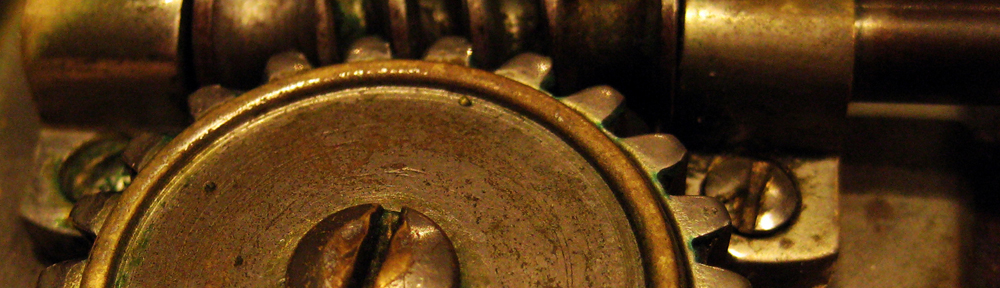
As a shiny-object addict, I inevitably crave making artworks with shiny parts from time to time. It’s one of the reasons I started making found-object sculptures so many years ago: a way to make use of my stash of sparkly, quirky, and metallic Junk bits that I still spy and pick up on my walks out of that compulsion. No surprise that I would, in turn, be cheered by others’ fascination with the multitudinous curios and clockworks so embedded in the likes of Steampunk and Sci-Fi, Industrial interior styling, Grunge and Goth, and Cabinet of Curiosities interests.
Mixed media artwork: A Sort of a Wreath

So here’s one of my latest concoctions, a wall sculpture that plays on all of those themes. It means nothing at all, or perhaps, everything, depending upon your preferences and whimsies. I like to think of it as evoking a variety of hints and hyperbole, of the histories, mysteries, and fantastical foolishness that both underly and defy nature and invention. In that sense, I suppose it might be considered a reasonable facsimile of the contents of my cranium. All of you amateur psychiatrists out there, have at it. If you dare.