Early Music for Breakfast

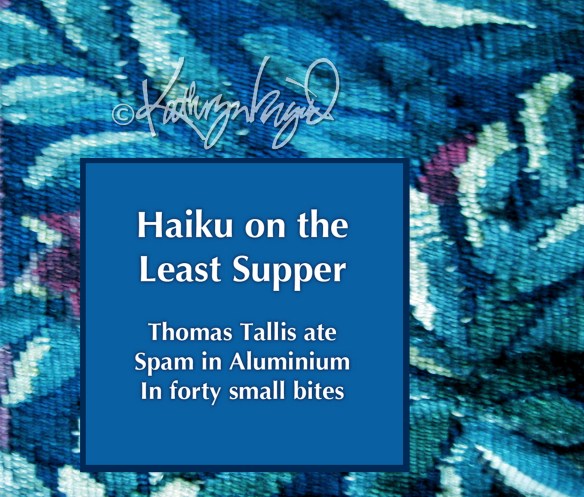
Digital illustration + text: Haiku on the Least Supper

If you haven’t already crossed paths with Thomas Tallis‘s landmark Renaissance motet Spem in alium, I highly recommend it. It’s a truly astounding piece of European music history, representing the confluence of the political and artistic competition for primacy in that time period; it’s believed to have been composed as England’s answer to Italy’s Alessandro Striggio‘s own, earlier 40-part motet, or possibly to Striggio’s 40-60 voice mass. I’m no musician, but I’ve learned, mostly through witnessing a few performances of the Tallis by different groups led by my husband and his colleagues, just what a feat this piece really represents.

While the creation of Striggio’s works for 40 and more independent voices is amazing in its own right, the 40-part motet he wrote specified that the voices be doubled instrumentally. That is impressive enough. For my fellow non-musicians, think of it this way: a typical piece of music for a mixed choir requires singers to perform different notes and lines of music, often at the same time, so that what is heard is not one single series of notes, one after the other the way we sing by ourselves, but layers of notes that become deeper and more distinctive expressions of the words being sung. Instrumental doubling means that some or all of the vocal parts are supported by one or more instruments “singing” the same notes at the same time. This can intensify the effect of that singer or section’s line, and it can sometimes also help a less skilled singer or choir stay on target with the line.

In any event, the more typical choral works tend to have soprano, alto, tenor and bass voice parts, or singing lines, (or some combination of those) and generally, not more than eight or perhaps twelve different lines intermingling at once. Anything more than that means that every singer in a moderate-sized choir is responsible for knowing and performing his or her own notes, on pitch, at the right moments, and with exactly the right loud-soft dynamics and flow at every point throughout the piece. Being in a choir is a thrill; being in a good choir is a real intellectual and artistic and even physical challenge.

What makes the Tallis Spem so incredible is that it comprises not only forty individual, fully independent singers’ voices all singing their own distinct parts of the song, but indeed, doing so entirely unaccompanied. Every one of the singers has to be spot-on at all times without the support of either a fellow singer or any kind of instrumental doubling. If one singer goes off the rails, there’s the possibility that others will be thrown off of their pitch, timing, or even their place in the whole work. It could well lead to a musical train wreck. Think you’d be intimidated by doing this? I think any sane person should be!

But it’s powerful stuff, when it’s well done. I’ve had the privilege of hearing this feat beautifully accomplished by singers surrounding me in a cavernous cathedral space, and by singers standing onstage in a modern performance hall with a carefully engineered acoustic. I’ve experienced it in art galleries where Janet Cardiff‘s intriguing installation of forty high fidelity speakers on stands are placed in a circle in the otherwise rather bare room, each playing in synchrony the recording of one of the singers in a performance of the Tallis, so that one can stand outside the circle or in the center of it surrounded by the speakers, or can move to stand at one individual speaker at a time, getting entirely different effects depending upon which part of the score is being performed and where one stands in relation to the speaker playing that part.

No matter how it’s done, once you’ve gotten a little of the idea how this piece of music intertwines voices that seem at first to be operating without a clear relationship but then, more and more, to be converging into a meditative, chant-like, layered song, it is quite mesmerizing. There are some recordings and performances out there on CD, iTunes, and YouTube worth a listen, and if you get the chance to visit the Cardiff installation, called simply Forty-Part Motet, do it. Best of all, of course, is if some fine choir nearby offers a live performance that you can attend. It’s rather haunting and ethereal, and made all the more impressive by the knowledge of its complex origins.

Meanwhile, I have given you this bite-sized humorous meditation on the work. A haiku seemed the ideal vehicle for acting as either commentary on or antidote to a choral masterpiece so complicated and virtuosic. And I sort of wonder if, in the process of composing this grand work, Mr. Tallis had any chance to stop for rest or was so deep in concentration that he barely had time to do the Renaissance equivalent of opening a tin of luncheon meat and dining directly from it, pen and parchment in one hand and dripping Spam juice on the other. Thankfully, it doesn’t appear that this effort of his was entirely detrimental, let alone leading to his personal version of the Last Supper, since he went on to compose other fine works up until nearer his death some fifteen years later.

Foodie Tuesday: Ploughman’s Lunch & Cavegirl Quiche

photo

Ploughman’s-in-a-bowl.

I want to eat joyfully and intently and live a long, healthy life, then die and get recycled.

You know that although I respect veganism and the very solid reasons millions of people have for choosing not to eat animals and animal products, I am, like some other animals, an omnivore myself. Like these brother animals, I am okay with eating my fellow creatures. Hopefully people who respect animals’ right to be carnivores can respect a human’s wish to be a carnivorous animal as well. Yes, I want animals to be treated with great care and respect while they live, and yet I know that they’ll die; I expect no less on either count for myself. I would love to know that when I die it would be permitted, instead of my personal-leftovers having to be buried in a state-sanctioned impermeable box to take up prime real estate in perpetuity, for the aforementioned detritus to be left in the woods for some nice creatures to eat up, and what remains to fade into the grand recycling unit of the forest. Short of that, I have arranged with my loved ones to cremate what-was-me [after any possible organ farming is accomplished] and put my ashes into garden-feeding, where at least I will fertilize feed for ruminants and so serve as a smaller part in earth’s renewal. That’s what I think we’re all designed to do. Carbon to carbon. So whether I get eaten or make a less obvious contribution as a small pH balancing agent in the dirt, I plan to return the gifts that others, animal and plant alike, have given me in my life. This is not particularly meant to be a political or religious statement on my part, as I apply it only to myself, and I don’t begrudge anyone’s disagreement with it, it’s just a worldview that seems pragmatic to me. I am not saying this to court condemnation or controversy (you know I despise them) but simply to be honest with myself as much as with you.

So my protein preferences arrive as fatty and delicious nuts, eggs, seafood and, indeed, meats. I tend to be very old-fashioned in that way, following the path of my workman ancestors, and even their ancestors back in the hunter-gatherer days. I am enormously (no pun intended) grateful for the gifts of the earth that keep me not only alive but healthy and even well fed, and I don’t want to squander or be thoughtless about such magnanimity. Hence my determination to eat more deliberately and moderately as I grow older, and also my penchant for being ever more inventive in refusing to waste the goodness of any part of my personal food cycle. The recent posts about rescuing broth-making remnants are a tiny testament to this commitment. I’m a junk food junkie like everybody else, loving stuff that’s far from good for me, but I’m gradually learning to lean a bit further toward the less trashy ways to enjoy those elements that are the true reasons I like junk, not the addictive formats in which they’re presented to us by commercial producers and retailers so that we’ll just treat them–and our bodies–like garbage by over-consuming them thoughtlessly.

I want to eat joyfully and intently and live a long, healthy life, then die and get recycled.

A couple of the variant meals I based on my recent beef ginger mousse making fed both my frugal and my treat-hungry sides. Having the pre-made avocado mash around amped up both aspects as well, and the addition along the way of some other easy-to-keep ingredients made it all pretty much homemade fast food without the related regret.

photo

Another day, another ploughman’s.

Ploughman’s lunch, that great English enthusiasm for serving and eating what’s essentially deconstructed sandwiches–bread, cheese, chutney, pickled goodies, and so forth–are pretty common around our house. The differences in our tastes, multiplied by the number of friends sharing the meal, makes it easier to stick to assemble-it-yourself service for so many things that the logic of the operation is obvious. Since I’m generally weaning myself from wheat, that makes a hands-on, fork-in version of the Ploughman’s even more useful. Beef mousse and avocado mash make this easy. Hard boiled eggs are a grand addition, but a quick scramble or fry is fine as well. Chutney or jam alongside? Oh, yeah. Pickles of any sort are a plus. Add the crunchy pleasures (and instant utensils) of carrots, snap peas, celery, apples, jicama, radishes or any number of other good crudites and you’ve got all you can handle, short of a cold cider, iced tea, beer or lemonade. Filling, varied and delicious.

photo

Ploughman’s redux: beef mousse with pureed fresh tomatoes and mint, olives, pickled green beans, roast chicken, snow peas and apple.

For a cave-dweller-pleasing rearrangement of the same essential ingredients, I stacked it all up and sliced it into a semblance of a pie, first as a single layer and then as a double-decker version. Rather than baking it all up as an actual crustless quiche or omelet, which should be simple and tasty with the addition of some beaten eggs (and if I had some on hand, a bit of shredded cheese), I ate it cold and was not sorry to have the quicker version either. This one, given my previous pseudo-recipes on the topic, can be pretty easily illustrated in assembly by pictures only. What you choose to do with it is up to you! As long as you don’t disappoint me by wasting it. [Winking broadly.]

photo montage

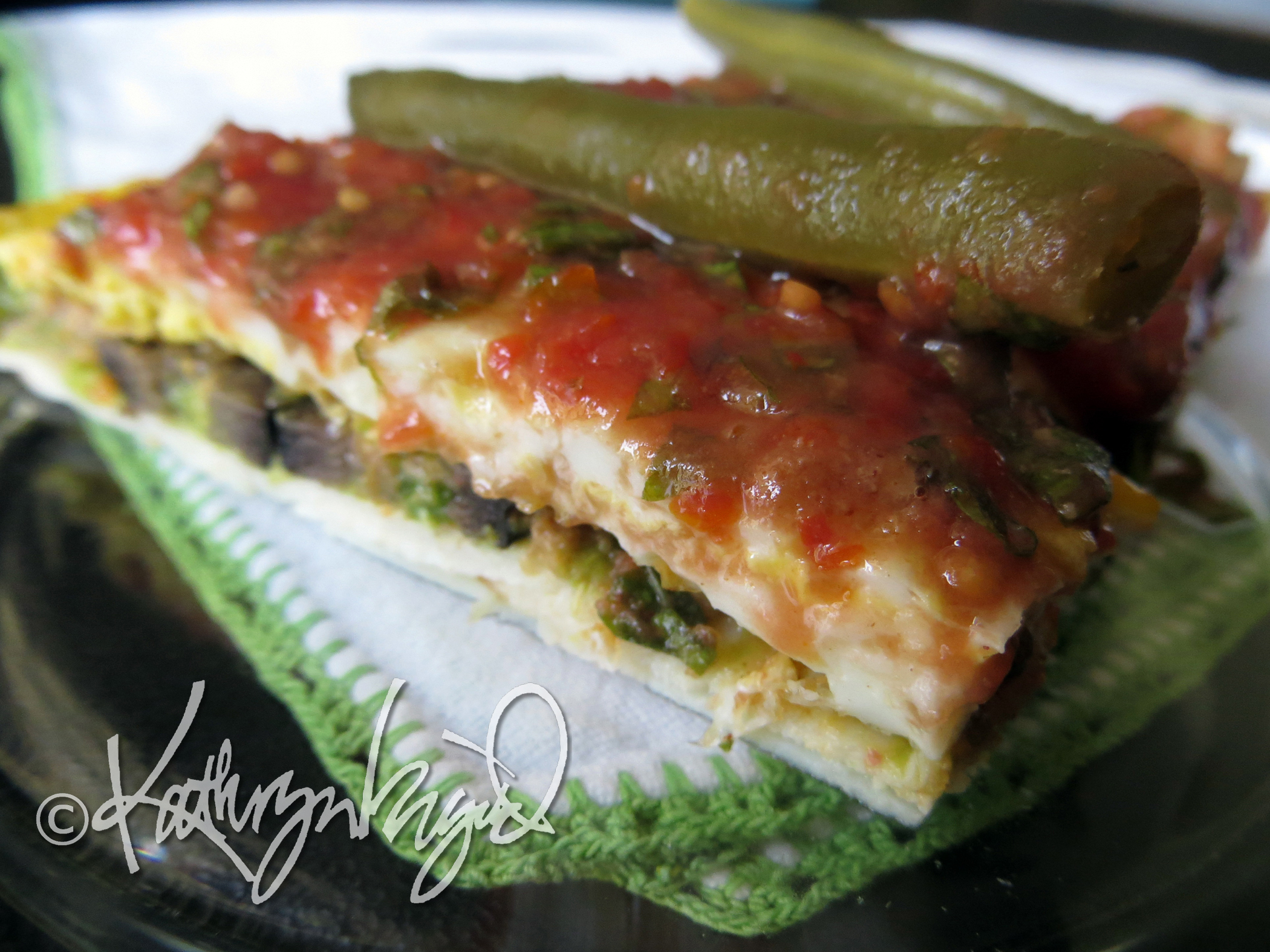
The Cavegirl Quiche Assembly Line: sliced chicken or smoked turkey; mashed lemony avocado; sliced olives; pate or beef mousse; fried or scrambled eggs; tomato-mint puree; pickled green beans.

photo

A wedge of cavegirl quiche. Enough to take the edge off a day’s hunting and gathering.

photo

The double-decker version of cavegirl lunch: how to get ready for yet further mastodon chasing and saber-tooth battling.

Un-Appetizers

You may not be the least bit surprised to hear that I was recently duped by a fast food commercial (yes, I do eat Junk Foods of many kinds) into thinking that a special treat of theirs was going to be worth trying. Not only was it worlds from what was portrayed (as the old Norwegian-joke goes: ‘What was wrong with it??? The food was terrible! And the portions were so small!’), it was accompanied by a zippy little packet from the counter container marked Honey, which on closer inspection turned out to be not honey but ‘Honey Sauce’–a packet I was too fearful to open after reading the long ingredient list wherein honey fell fourth to three of the other four sweeteners, barely before water and a list of preservatives impossible to spell.

I was tempted to go directly home and swill real, pure, local, raw Texas honey straight from the bottle, but I resisted. Needless to say, the packet of Mystery ‘sauce’ (I still find it kind of amazing that it’s even legal to call it that, let alone Honey Sauce) went instantly to the circular file, followed in short shrift by the remains of the appalling main dish, and I went off to cleanse my palate at home. You’d think I’d be smarter by now. Sigh.digital artworkFasting Food

Silly me! I thought Fast Food

meant eating something raw and crude,

Something exotic and delicious,

not appallingly pernicious,

But cooked and primped and sauced to serve

as amuse-bouche, starter, hors-d’oeuvre,

Not some spectacular, emetic

parody of dietetic

And comestible delights—

it seems to me, Fast Food, by rights,

Should be what shows up close to hand

in finished form and on demand,

Unsullied by the attitude

of what we often call Fast Food.