




Just having a little fun with digital drawing tools again. It’s nice to have art toys, isn’t it. I know that my latest little dragon friend wouldn’t have been hatched, let alone gone through his spotty youth and prime and grown into a fully fledged friendly monster, if I hadn’t had access to such enjoyable and versatile playthings. Little Alvin here is happy to meet all of you.

Alvin the Artful
From the day that he was born, he has been drawn to things
That make him want to skip and jump and stretch his wavy wings;
His destiny is in the works and he’s a tool of fate
Designed to entertain, amuse, and if it’s not too late,
To educate his artist friend in how to make him change
From skinny little squiggle lines to something rich and strange,
And older dragon, more mature, more layered, nuanced, wild,
And her, the artist, to more skilled—but happy as a child.

For people like me who aren’t naturally brave, just getting up in the morning and leaving the house has its challenges and scary elements. I’m not talking about agoraphobia or even my formerly much higher state of perpetual anxiety, but rather the knowledge that on any ordinary day unexpectedly bad things can happen at any random moment. I know, too, that fabulous and gloriously good things can occur without any apparent reason or preface. And among the many, many things I worry about, even if I don’t outright fear them, are the unknown and loss of an undoubtedly false sense of control.
So when I get the courage to pop out of my cozy little life nest, that place wherever I feel safest and most comfortable and contented, I can have moments of feeling like some little hatchling hopping out off the ledge for the first time, not entirely sure whether my wings work yet or not, let alone whether I will know what to do with them when the time comes. Walking the last mile or so to my doctor’s appointment the other day and seeing a handsome trio of vultures lounging overhead on the telephone poles, I was inclined to make a quick inward note that I hoped the three amigos relaxing up there weren’t also considering me a potentially delicious traveling snack. My hike was, after all, only for a conversational and informational visit to the doctor, so I hoped I wasn’t looking invitingly unwell to their shiny little eyebulbs.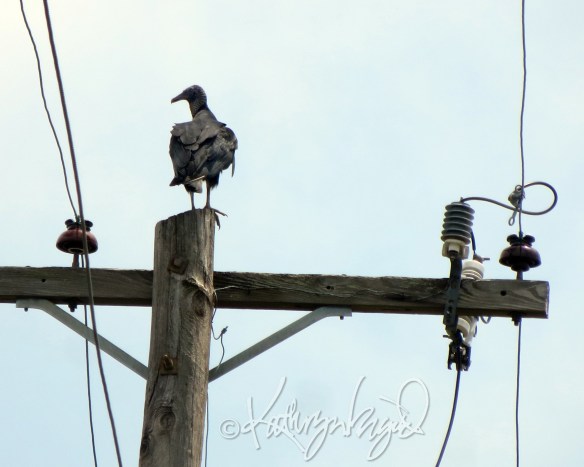
Heading along the highway today and seeing, conversely, the half-flattened remains of some other poor vulture where it had unexpectedly been taught its expiration date by a passing vehicle, I thought the reverse: I wish I could undo your doom, once-graceful bird. The truth is somewhere in between for me, on an average day. Whether I am predator or prey, the day will do with me—and the birds soaring around me—as it wishes. Whether any of us leaving our perches will soar or crash isn’t entirely a matter of choice and will, nor is it wholly chance, but most likely it is someplace in between on an ordinary day. I am so glad that the forces governing us all aren’t utterly capricious but are generally more benign and kindly. Even toward those of us destined to be either road kill or the ones dining on it.
Any homeowner or even mildly obsessed apartment-dweller who likes customizing his or her nest, office, cubicle, or living space knows that there are numerous ‘projects’ that are never officially finished. Most DIY projects of any sort, in fact, are only satisfying right about the time they’re in their last stages of preparation and very, very newly finished. Then we’re on to the next change or update we’ve been itching to see transform our spaces. For me, the Next Big Thing is perpetual: I never quite settle down and stop having new ideas and fantasies. My now-spousal partner knew even before my dad jokingly warned him when we sprang the (not especially surprising) news of our intent to marry that it was not merely in jest Dad told him to expect to come home virtually any day of the week and find the furniture moved all over the place, half the house painted, or the chairs reupholstered. Thank goodness he’s a very flexible, tolerant guy…of course, he wouldn’t be with me in the first place if that weren’t true.
Nowadays I’m lazier and less willing to spend much money on concrete Stuff if I can save it instead for our various retirement plots and plans or spend on current doings. But the urge never dies; there’s always some little tweak or To Do lurking in the back corners of my brain’s attic. The one thing I’ve learned to appreciate better about the process is the slowness of it all that used to irk me immensely. Over the intervening time between idea and execution, the possibility of improving both process and product grows, and in many instances, the availability of a better set of materials and solutions arrives as well. Though I had in mind a nifty reboot of the existing dining room fixture that was, sadly, thwarted by the outdated wiring’s channels being too narrow for me to fit the necessary updated wiring through them, my time pulling apart and cleaning and fiddling with the entire fixture in an unsuccessful attempt to bypass the problem was long enough for a more suitable modern fixture to at last appear on the market at a price I was willing to pay.
Likewise, the wildflower and sapling “nursery” meadow I made out of half our backyard a couple of years ago has taken that long to begin coming to recognizable fruition as such a space instead of merely a raggedy weed patch. The time spent waiting for the (semi-dead, weak little one-dollar end of season) plants I picked up here and there to take root enough to survive longer term, let alone bloom, was well worth it, since those were not seasons of rich encouragement. This year’s mild winter and spring and its extraordinarily generous rainfall are providing a much friendlier environment for the plants now old and established enough for bloom to make their first appearances. So, though you can’t see it behind the blast of rose blooms in the last photo, there have been much more encouraging bursts of growth on a number of patches of chrysanthemums, Echinacea leaves, and myriad wild cousins, with some Salvia and Cynoglossom amabile (Chinese forget-me-not) throwing bright blue sparkles into the mix of pink primroses and green leafy things even before others come into bud.
Kind of the way that one new idea breaks in upon the muddle of all the old ones stirring in the brain while they wait to be put in order for becoming DIY projects and household fixes.
 If you’ve never experienced the almost ferally visceral adventure of hearing a performance where the formally clad male chorus belts out the lyrics of each work, each man in perfect time with what would ordinarily be his voice part (first tenor, bass, baritone, etc), but screaming so loudly that there’s no discernible key singly or altogether—then you’ve never heard the Finnish performers known as Mieskuroro Huutajat (Screaming or Shouting Men). In their performances, even the most famous and familiar songs are deep mysteries to be unmasked gradually by focused—if slightly frightened—listeners. If you haven’t had the Shouting Men experience, however, you might still have had such a hair-raising listening adventure in a supposed concert or rehearsal. Many an ordinary choir has its moments of being involved in an almost unbearable shout-fest.
Sitting in the back of a hard-surfaced rehearsal space packed with a mass choir in prep for the famously big and bombastic Beethoven Nine‘s ‘Freude, schöner Götterfunken,’ with a chorus of big-voiced collegians full of energy and enthusiasm, no less, could conceivably deafen you. Or drive you mad. ‘Ode to Joy‘ becomes almost insufferably opposite to joyful, the choral equivalent of being carpet-bombed, if the singers haven’t already been subject to a goodly quantity of training prior to your visit.
The recent evening where the latter experience reminded me of the aural dangers with which such rehearsals can be fraught was, thankfully, not that group’s first foray into the depths of the piece. They had worked past the awkward or tuneless point of flogging notes and were more focused on nuances of the sound in various parts of the composition where phrasing and textual emphasis begin to be more significant than learning individual notes or when strictly turning the volume ‘up to eleven‘ is the goal. Now it was time to be subtler, to learn why Ludwig van Beethoven or the text’s poet Friedrich Schiller might have chosen a particular word, or what singers in the rehearsal might need to be prepared for when they were handed off in a week or two to the symphony conductor who would lead the public performances. And, of course, it was time to be untying some more of the knots in the choir’s German pronunciation.
Getting the sounds of the language right and even, sometimes, appropriate to a period in history when the language was significantly different from the present version, if that’s when the composition was written, always makes as much improvement in the overall sound of a piece as getting the notes right. Most composers’ works are heavily flavored as much by the natural vowel and consonant sounds and rhythms of their textual languages as by their personal compositional styles and languages. If you’re singing in German but your first language is English or Korean or Spanish or Chinese, as is the case with most of these students, that can take some serious learning and practice.
On the night in question, the big Beethoven rehearsal was followed in less than a half hour by a full concert performance of another massive German choral classic, the Johannes Brahms ‘Ein deutsches Requiem.’ This piece was performed by the most advanced and experienced of the university’s choirs, with even bigger voices among them, in the main concert hall of the campus. That group was, of course, at the end of its whole rehearsal period of work on the Brahms, and was in concert dress and on stage in the far finer and more refined acoustics of the performance space. Attending audience members would hardly think about it, most of them not having just sat in the foregoing rehearsal, but despite the potentially deeper well of experience among the singers, their later stage of preparation, the improved acoustic, and the attentive state of the choristers that arises in performance mode, the problems and possibilities remained pretty much the same. If the German pronunciation was any less accurate, the pitches any less solid and informed, the changes in meter and volume any less clear, precise, subtle, and graceful, there could still be the risk of concert attendees being deafened or merely battered about the head by the cacophony. You might not always think of concert attendance (especially outside of death-metal arena performances) as being dangerous, but there it is.
As a favorite opera educator was fond of saying, practice and preparation could mean the difference between Bel canto (beautiful singing) and Can Belto (a humorous American coinage meaning, roughly, I Can Shout). The zone between these two can be remarkably small when the music is as grand-scale, powerful, and emotionally charged as Beethoven and Brahms’s superb works. No matter which the piece, far better that both performers and audience leave feeling joyful than near to needing their own requiems sung. Yelling “songs” can be an interesting stunt (and one I have experienced in a small and resonant space with that chorus of Finnish gentlemen blaring away at me), and it’s often a state that must be visited sometime during the preparation of a major choral work, too. But unless the goal is actually having listeners’ heads explode, it’s ever so much better that everyone does his and her preparation diligently until the big sounds, even in rehearsal, are not constantly terrifying but in fact mostly soul-stirring. Nice when we can save the shouting for a good standing ovation’s “Bravissimi!” at the end of the concert.
In fond memory of our dear James Dale Holloway, who was known to exhort his singers to “never sing louder than Lovely!”
Midhun Antony claims anybody can dance. I have always thought of myself as living proof that even if every single other living creature on the planet can do it, there’s still One Who Can’t. It’s not a point of pride with me; just what I think of as an uninspiring factoid.
But he’s right. It’s unfair, despite my belief I’m being honest in claiming to be a fairly awful dancer, to say that I can’t. Even if my goal is to impress anyone, rather than merely to enjoy the activity for itself, or to express joy—surely among the highest and best reasons to dance, really—can I truthfully claim that a bad dancer is no dancer? How many times have I enjoyed, along with my much-better-dancing friends, the vision of an uninhibited exhibition of movement-to-music by a truly unskilled practitioner? The littlest of children, even those not yet able to stand without support, dance and fearlessly. That is the point! It’s not about skill and coordination or style points, or ballroom etiquette, the vast majority of the time; it’s about happiness and commitment.
A little bonus exercise is not to be sniffed at, either, I should be the first to confess.
If I’m truly so self-absorbed as to think that my dancing should be of any interest to anyone in the room but me or—given the right circumstances—any other person I am dancing to please, at the very least I should keep in mind that letting down my guard so others can have a good healthy laugh at my expense would be a tremendous gift. Some of the best moments ever recorded on film are not only those shared by the Nicholas Brothers or Rogers and Astaire, Alvin Ailey or Mikhail Baryshnikov or Judith Jamison, but also the high and low comedic gifts of attempted dance we also remember with intense fondness. Elaine Benes, I salute you! Chris Farley and Patrick Swayze, I curtsey in awe. I fall down while curtseying, of course, but I do admire your work. In fact, I’ll hazard a little wiggle of sheer glee right now, just because you all make me so happy.
 Ever wonder where little children get their surprisingly sophisticated or apropos neologisms from when they pop up with those odd comments seemingly out of the blue? I know I do. I’ve spent enough time pondering the verbal magicks of the offspring sprung from sisters, friends, and relatives, to think that there is something more than mere chance at work some of the time…but, what? Sheer serendipity seems inadequate to explain how logical or fitting or uniquely unlike what one ought to expect from these kids such prodigious pronouncements can be. From what ineffable sources does infant etymology spring?
There’s one goofy expression long used in my family that makes a fine example, I think; I hadn’t even thought about the oddity of the word and concept in ever so long, but when it came to mind as suited to an occasion arising just the other day, I pondered yet again how such things can arise. The story behind the word/idea is that my youngest uncle, at the time still sleeping in a crib but definitely speaking—as the youngest of six children in a not-very-wealthy household, I can imagine this was a useful space-saving device as much as anything else—was heard to be stirring one morning but hadn’t clambered out of the crib. So his mama, my grandmother, made her way in to see whether her boy was actually up and about or had merely made a sound in his sleep.
It seems he was in an intermediate state, still not fully ready to get up and attack the day, but not deep in dreams anymore either. When asked what he was doing, his response was that he was “just Swissin’.” That seemed to require a bit of clarification. “What?” His response: “I’m not asleep and I’m not awake; I’m just Swissin’.” For the longest time, I thought of this invention as being the equivalent of behaving like the Swiss—existing at neither extreme but in a neutral space between the two. But later, it seemed to me that if he’d had the slightest contact with a real Swiss person, he could well have had a different reason for coining the word. In German, the similar-sounding word “zwischen” means “between,” and what could possibly be a better way to describe the state in which one is neither waking nor sleeping, but in that suspended animation reaching from one state toward the other?
The problem with this delightful theory’s seeming perfection is that if that little boy who became my uncle was hearing anything other than English spoken around him in his American home, it was most likely Norwegian spoken between his parents or other older relatives and friends, given their roots. So how did he invent and name that neat little idea of his? I can’t begin to fathom. But after having made that unexpected connection myself, long after the fact, I relish all the more our continued family use of the word Swissin’, and I thoroughly enjoy knowing that it is even better suited to the status of being neither-here-nor-there than any other single word I can recall. Is it the work of a brilliant linguist or the most excellent of accidents in speech? Neither; it’s just Swissin’.
 Jittery Janus
A slight, but real, absurdity is troubling my mind:
If something is in back of me, it’s fronting my behind—
Or is it backing up my front? It’s weakening my pride
That heads or tails I can’t make out, so coin flips must decide
Whether what’s aft is yet before, ahead or what’s astern,
Or I’m too turned around and backward-brained to ever learn
If what’s before my very eyes affronts my front or back;
Please, someone, sort it, or I think I’ll have a heart attack,
For hid behind this placid front, behind the back of me,
Yet also forward of my back, where, sadly, I can’t see,
This sad conundrum irritates and pesters me, alack,
For I’ve no way to know what’s going on behind my back.
 Art-Colored Glasses