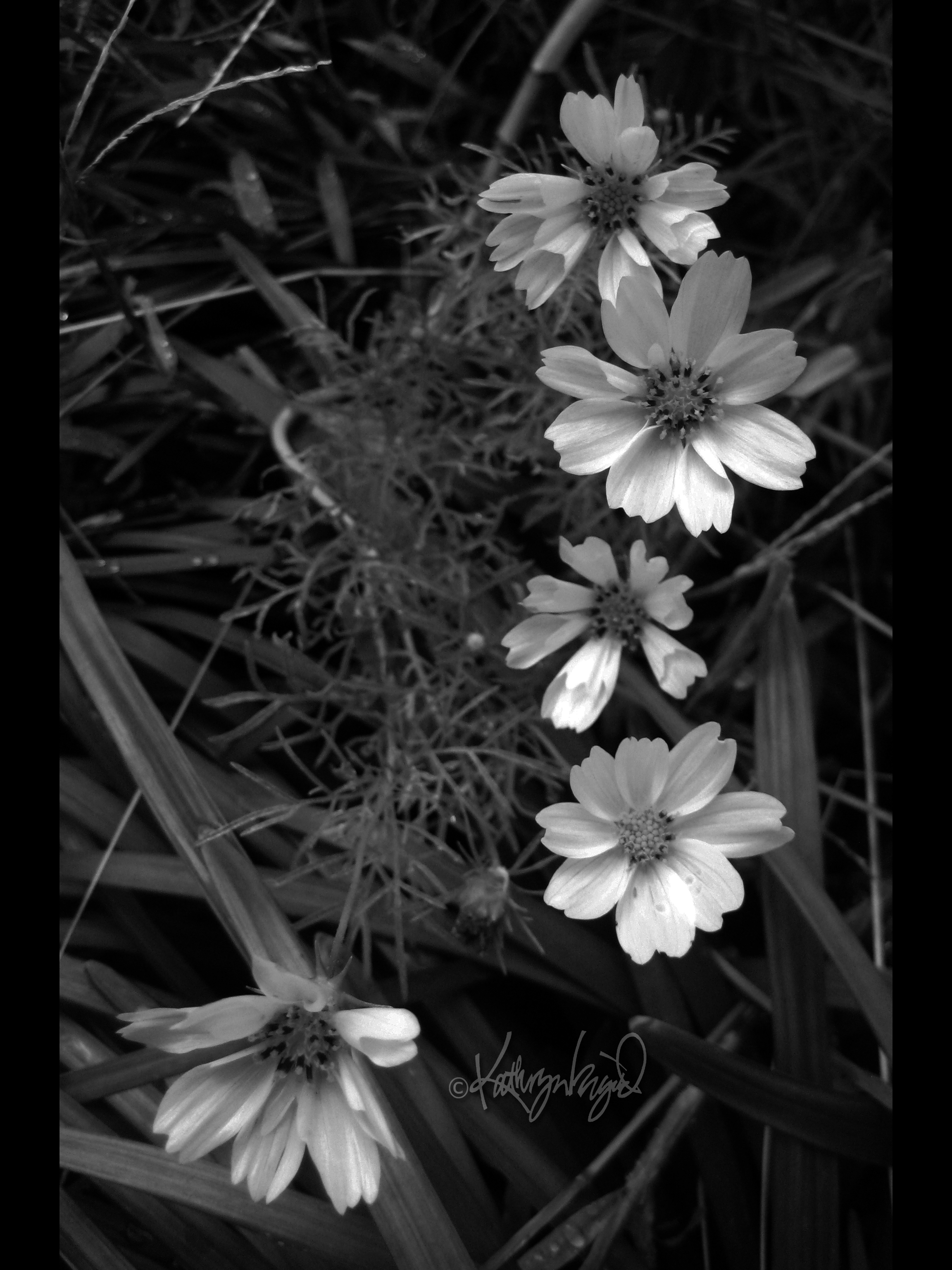
Building Dreams

Dollhouses were for other girls. I preferred to design my fantasy floor plans and build them out of cardboard and found objects in the built-in bookshelves in the upstairs bedroom. I built them for dolls if those happened to be handy, but since I wasn’t ever a huge fan of dolls except as handy models for my model homes or as fashion models for my clothing and costume designs, my time and energy were more happily spent on the architectural fantasies and the drawings that led to them.

There was never any hope of building the real-world, full-scale versions of any of these, since I started as a young squirt whose whole bankroll comprised a few allowance installments, then grew up (a little) into an arty type, yet another iteration of the sort never meant to have large hunks of cash lying around. I never stopped loving buildings and the magnificent, marvelous pleasures of dreaming up all of the different ways to make interior and exterior spaces work beautifully for all of the different people and purposes I imagine in them. As I grew, my methods leaned less toward bookshelf usurpation and more toward drawings and particularly, toward inner design: one of the ways to soothe myself to sleep when my brain is too hyper for relaxation is to choose a specific kind of building, close my eyes, and try to work out every tiny detail of it in my mind. Eventually, that usually leads to the perfect combination of dozing off and waking up with some new inspirations, often enough ones that can be applied to other things than mere mental building construction.

Just because I’m realist enough to know how unlikely it is that I’ll ever afford to build a dream house in reality doesn’t mean that there’s nothing purposeful in my fantasizing. I’ve invented all sorts of dandy details that would make the constructions more ecologically sound, longer lasting, easier to change and update over time, simpler to construct, more affordable, energy-efficient, attractive in a number of styles, and flexible for multiple users’ needs. All in my head, with the exception of a few on paper and a few in the old bookshelves in Mt. Prospect.

Anybody who has a pile of money just sitting around all unloved and unused and wants to contribute to the construction of my living-&-arts community complex should feel free to give me a jingle. Barring that, I will happily continue sharpening my mental prowess as a developer of mental real estate. Come on inside, if you can figure out how to join me here.photo

Saving My Reverence

photoI sat by the river. We were visiting town for a conference, and my spouse was going to some sessions I didn’t choose to attend. The weather was very warm, an overcast early spring day with a mild-mannered breeze, and being indoors in even a perfectly nice hotel room is a waste on such a day, so I walked down to a spot nearby and sat by the river.

As daily life passes in its ordinary ways, I so rarely pause and think deeply about what’s happening in my orbit. It’s so very easy to forget to look around to stop and let go of all forms of busyness and buzz, and simply Be. To sit by a river for an hour doing nothing can become everything.

In that hour I was silenced, stilled. I felt a deep repose settle in me, a sense of quiet peace that I hadn’t realized had been absent, banished to memory by the constant chasing and chatter of ordinary things for so long. Even the soft conversation of passersby and the rush of traffic on the road so few paces away were hushed to a sussurant tide washing the shores of my peripheral perception. Closed in an invisible veil of calm, I felt my reverence for simply being alive well up, awaken in me, renew.

The light scent of cut grass overlaid the ambient dust of a dry week; the crunch of passing footsteps was so soft that even the river’s low whisper beyond could be heard, punctuated by the distant fluting of some bird tucked under the trusses of a bridge. The hazy overcast hid the face of the sun, but its warmth suffused my skin until I thought I, too, might radiate light and heat. My usual inner litany of things demanding my efforts and attentions slowed, and slowed again, until my state of rest was such that I let go of nearly everything, even that sense so common in those rare moments of pause, that I should sleep. This was the rare kind of rest in which I would far rather be awake.

Action and angst and haste and harriedness always return soon enough. But in a moment of genuine and grateful repose, I found refreshment that can underlay it all and remind me to embrace all that is peaceful and contented within. If I am wise, it’s to this power I will assent to bend.digitally painted photo

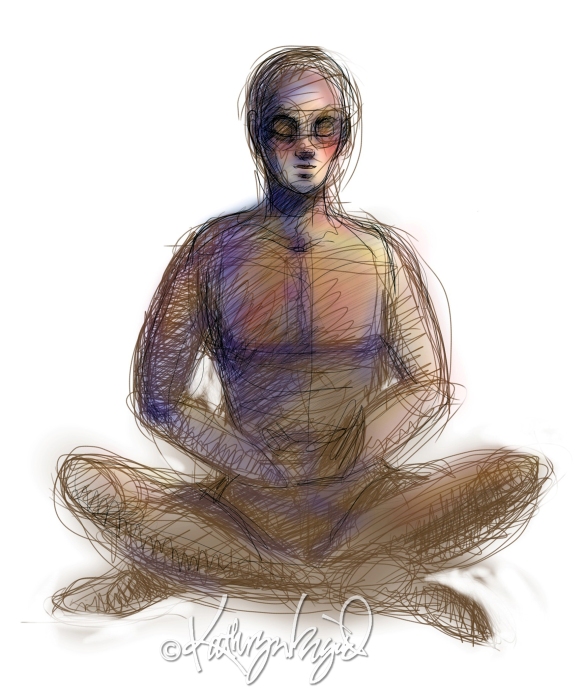
Meditation Medication

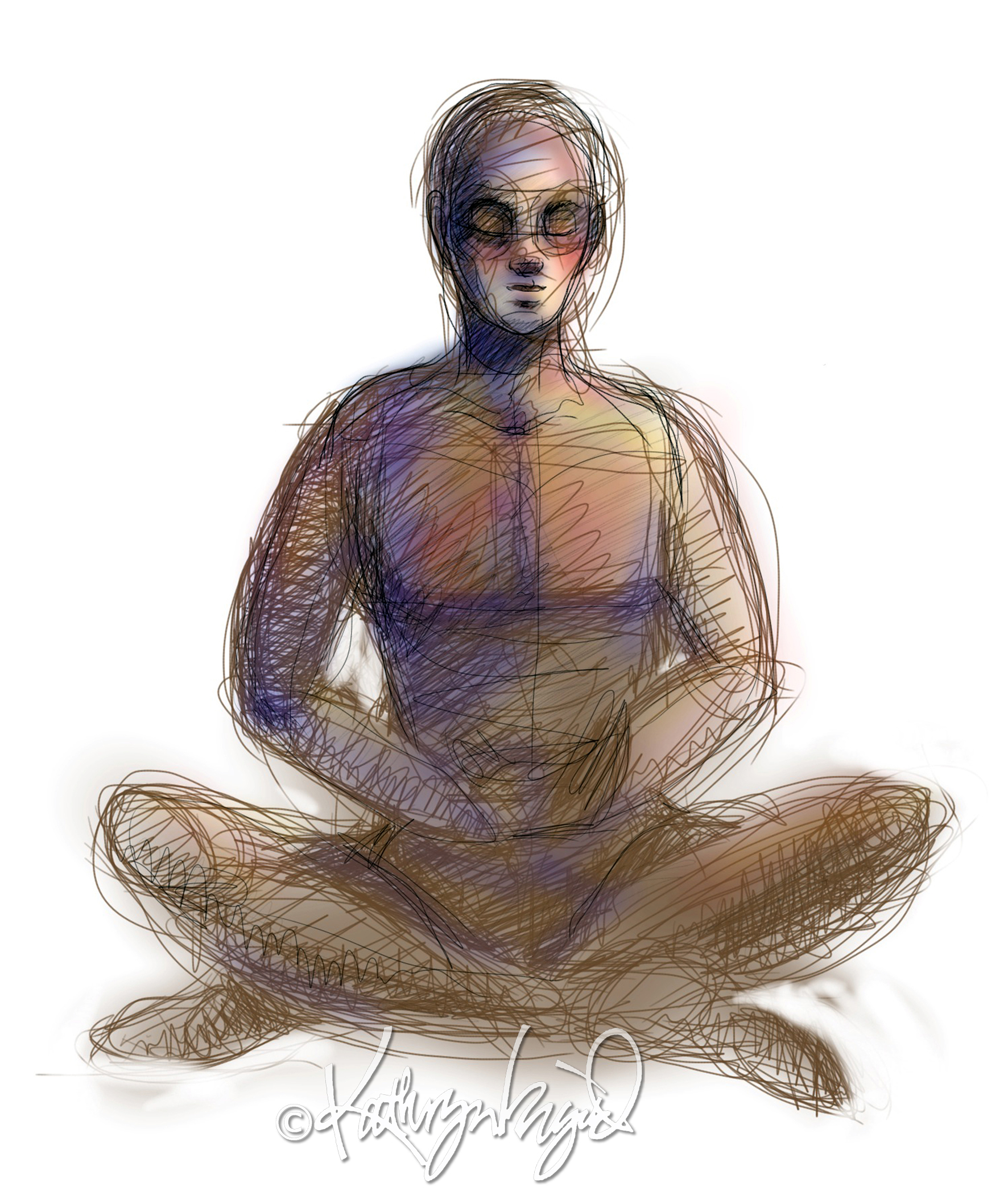
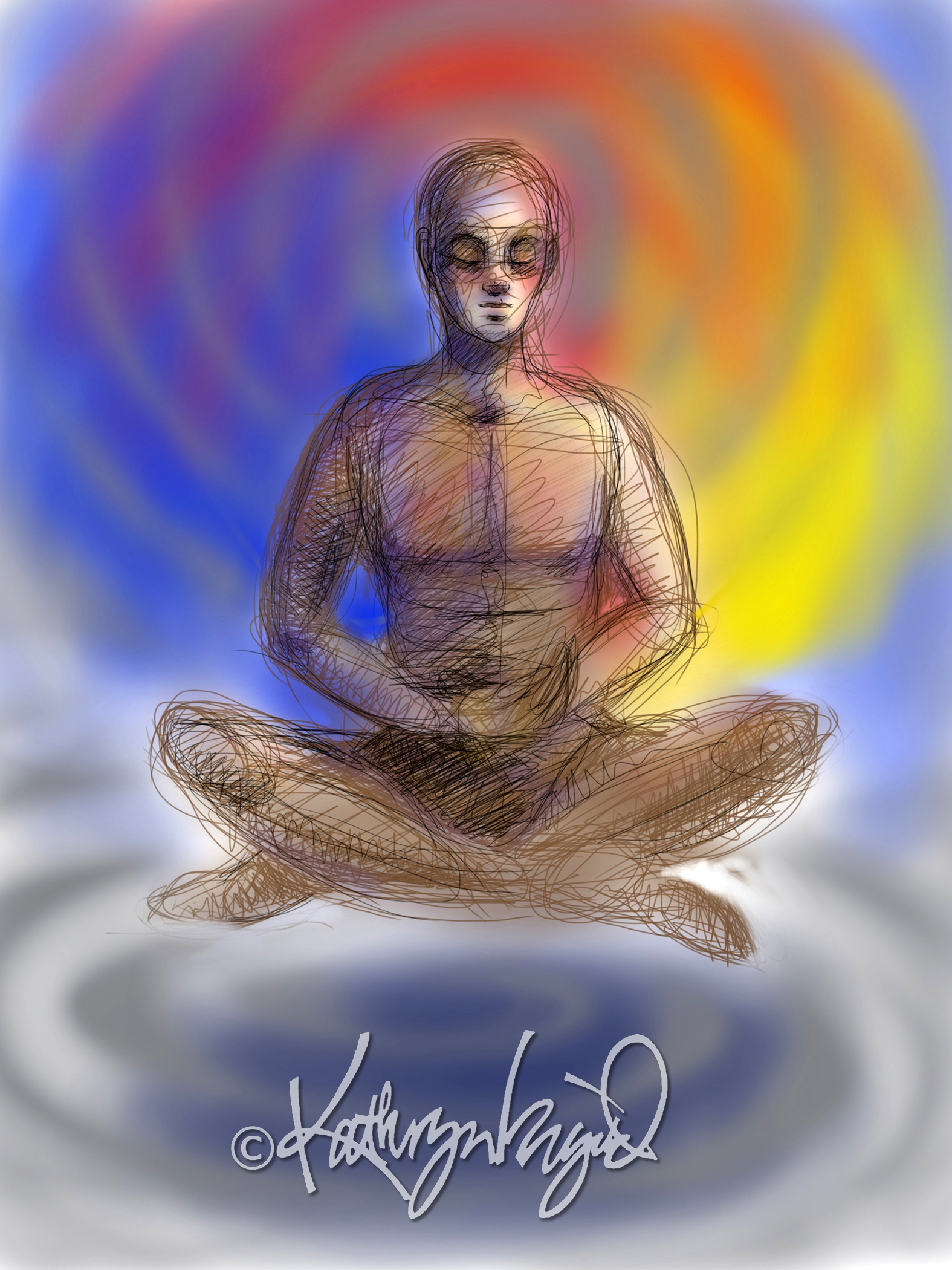
digital illustrationHealth is a wildly, weirdly, wonderfully complicated state. Both physical and mental health are astoundingly omnidirectional networks of intersecting matrices and random points; genetics, environmental influences, accidents, allergies and so much more come together and continue to change over the life of any one person. Furthermore, these meet in an intersection of the two networks (mental and physical) in every single person, that it’s nothing short of miraculous that any of us human conglomerations actually survive and have relatively good health.

It’s completely unsurprising, then, when something or other does break down or fail to be really perfect when it comes to health matters. Thank goodness there are more and more answers and helps for us when it comes to such moments of concern. But for every solution, there are shortcomings and side effects, and we still have to make choices and experiment, test and try and hope.

I’m one of those relatively rare creatures blessed with generally outstanding and reliable good health. I’ve never had a broken bone; I’ve had all of three stitches in my whole life, and I’ve never worn a cast or a brace unless you count the kinds I could buy in a neighborhood pharmacy for an achy hyper-extended knee or a fiddly fingertip whose little cut made a mockery of my hale-and-heartiness when I was whimpering over the pain every time I’d bump it. My various moles, cysts, and bumps have all thus far been benign and manageable. Even those more significant elements that might affect my function and longevity are so far pretty reasonable to deal with and don’t require enormous amounts of care just yet.

The essential tremor, noticeable since I was about ten or twelve, has never gotten so obtrusive that I have had to do anything for or about it. The mitral valve prolapse (heart murmur) is so mild that it went unnoticed until I had a regular physical exam from a person who, as pure chance had it, was conducting a study of that specific condition and so was attuned to its unlikely presence. Very minor hypothyroidism like mine is easily kept at bay with very little medicine (mostly pretty common ones at that) or monitoring. I am especially grateful that thus far there is no indication that the Parkinson’s Disease that poses as the only true black sheep of my family has not to date taken up residence in my body.

This is not to say that I have no inkling of any of the irksome and unpleasant effects of imperfect health. I’ve come to recognize the recurrent, and in some cases, chronic, annoyances and inconveniences that come with allergies. While mine have remained moderate and turn out to be treatable if not controllable, I figured out after getting some help that they had had a far greater control over my daily life and well-being before that time than I had realized. And as I’ve said here before, I have had my adventures with Spasmodic Dysphonia, clinical depression, and anxiety; these had larger influences on me and, therefore, those around me, by a magnitude of difference.

What arises every time I contemplate these things, all of which are in my own life more survivable and treatable than I know that they can be for others, is the notion that as a typically complicated human health exemplar, I still have to work continuously to discern what combination of the tangible and medical kinds of interventions and treatments with those more intangible approaches of meditation, activity, and trust—call it faith, hope, prayer, optimism, or attitude adjustment, it’s all fodder for feeling, and possibly, getting, better—will suffice to keep any of my anomalous conditions in check.

Thus far, the answer for me has been a shifting combination of the tangible and the intangible; I think that’s how it works for most people. My personal recipe for success is neither absolute nor permanent, any more than my personal state of being is fixed or unchangeable. Health, both physical and mental, changes rather constantly over a life span, and the longer one lives the more cycles and spikes of change are likely to occur during the stretch. What, then, can I do?

Keep trying. What combination of body-chemistry-altering substances serves my needs at the moment? They might well be outright commercially made and sold and officially, doctor- or nurse-administered drugs, but they can also easily be homeopathic or folk cures, foods or herbs or numerous other things that I’ve discovered through trial and error suit my physical and mental well-being. The same can be true of physical therapy: it might be specific exercises recommended to me by my doctor or other trusted medical and health experts, or as is often the case, it can be a set, series or group of activities that simply make me feel closer to my optimal conditioning. Nowadays, as always, I find myself using quite the mixture of these helpers to suit my specific needs and wishes for better health and happiness. For me, that means a full combination of what could be loosely classified as medication and meditation.

I can’t begin to tell you how that works or is explained scientifically. Some of it I’d bet good money can’t be clarified in scientific terms. But experientially, that I can tell you: I feel pretty good. I get the occasional sneezes or headaches, and there are times when it irritates me, yes, that my vocal cords are recalcitrant and unreliable. I’d definitely prefer if the shadow of Parkinson’s hied itself off my family’s shoulders, most especially Mom’s, and would never try to sneak up on me later despite any efforts on my part to ward it off if possible. But let’s be honest. Right now I feel pretty good, and that makes me happy. Whatever I’m doing or not doing, taking or not taking, it seems to be working.digital illustration
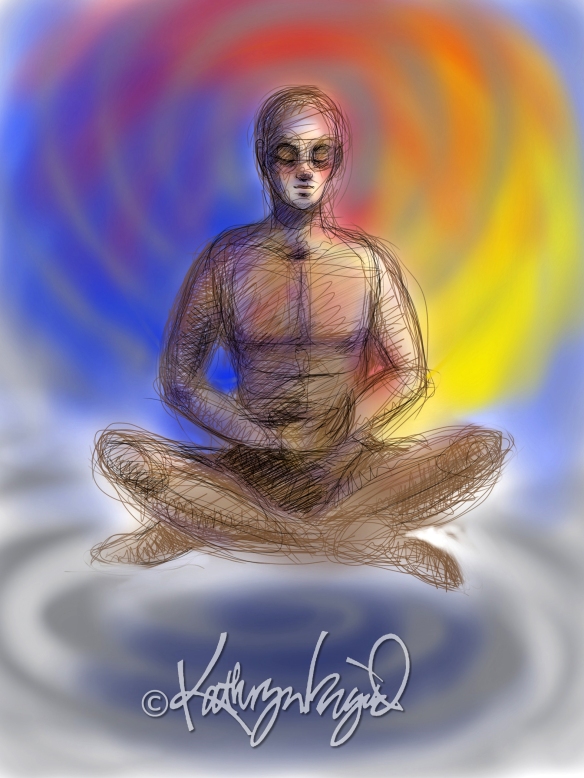
It’s Still Life

Little is as desirable in day-to-day life as peace and quiet. Rest, respite, calm–I crave them. There’s so much invitation and welcome in the sweet marvels of time off, time out and down time that I never feel I have too much of, well, not-too-much.

But busyness is ever so much more common in our everyday existence in this century, certainly in this household. It’s no still life, to be sure; any silence found in this way of living is more of the deafening sort. But yes, it’s still life.

So I have to manufacture or steal my moments of rest and relaxation. Isn’t that how most of us end up finding our tiny increments of space and time and sanity anyway? I have to learn how to tune out the white noise, hide from the constant demands and burrow into hidden corners when and wherever I can, to choose deliberately to decompress and unwind. If I don’t make room for my own peace of mind, who’s going to give it to me? The world may rattle on around me at a furious and eardrum-shattering rate and all I know may change in the ten minutes I’ve stolen to renew myself, but I will return to those realities soon enough, and hadn’t I better do so in a fortified state than otherwise?

Better to sit down and tell myself soothing tales undergirded with lullabies, to draw myself a little old-fashioned still life arrangement in the calm unruffled grey of graphite, and breathe deeply without regard for the bustle and bash of the universe, if only for a moment or two.graphite drawing

The Garden Rejoices

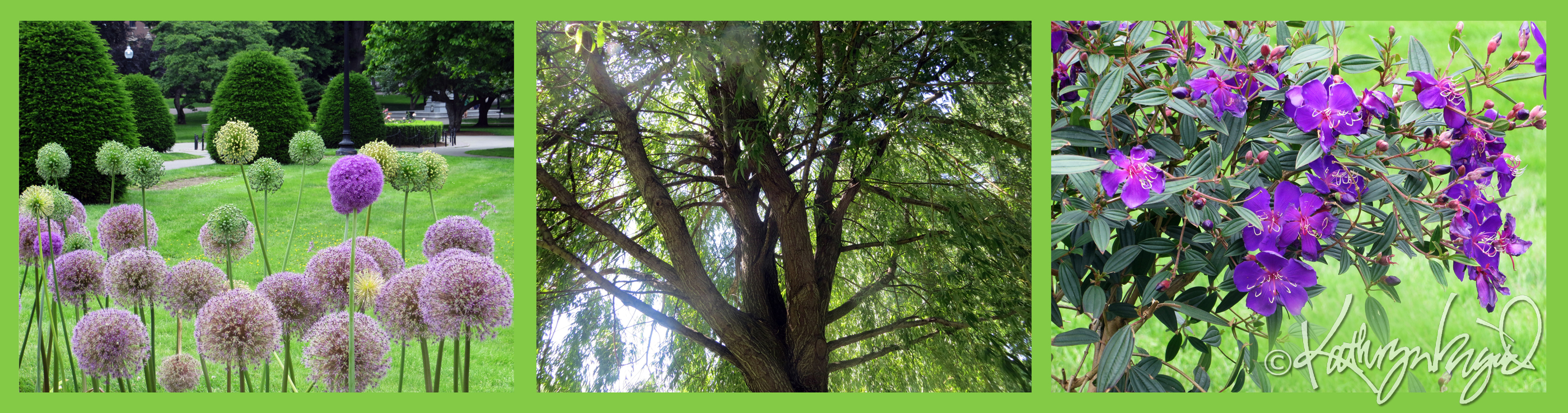
photo montageRespite is the thing we all crave at times. Too much of a good thing is still, when all’s said and done, too much. Having spent the majority of my life in climes of plentiful cloud and rain, I was quite pleased to experience the practically perpetual sunshine of north Texas, but learned that with it can come garden-blighting and spirit-dampening heat and even drought, so when it rains, as much as it might make a few things more inconvenient or messy, it can also make my heart glad.

And the way that the leaves plump up, flowers loosen and uncurl their fists and stalks and stems stretch instantly taller toward the sky, it’s also easy to see that the garden rejoices. It’s as though all of nature around me is sighing and relaxing every tensed-up, coiled tight thing with grateful relief.

A moment of quiet in the heart of a rushed day or a busy week is rain for my spirits as well. Whatever the cause of the busyness, however pleasurable the things that do clamor for my attentions, I find that a brief pause to lower the speed of thought, to quiet the relentless insistence of life’s siren calls and cool the heat of its demands–this one small thing–has wonderful power to relieve and renew me, too.

This is how I remember the kindness of the rain in the midst of unyielding heat, the shelter of low clouds that break the relentless glaring sun. And I look for my tiny bits of solace in a meditative mode, feeding my roots and encouraging me to let go, expand, release the tensions I am in and carry on, better able again to bloom and grow.

Keeping Watch

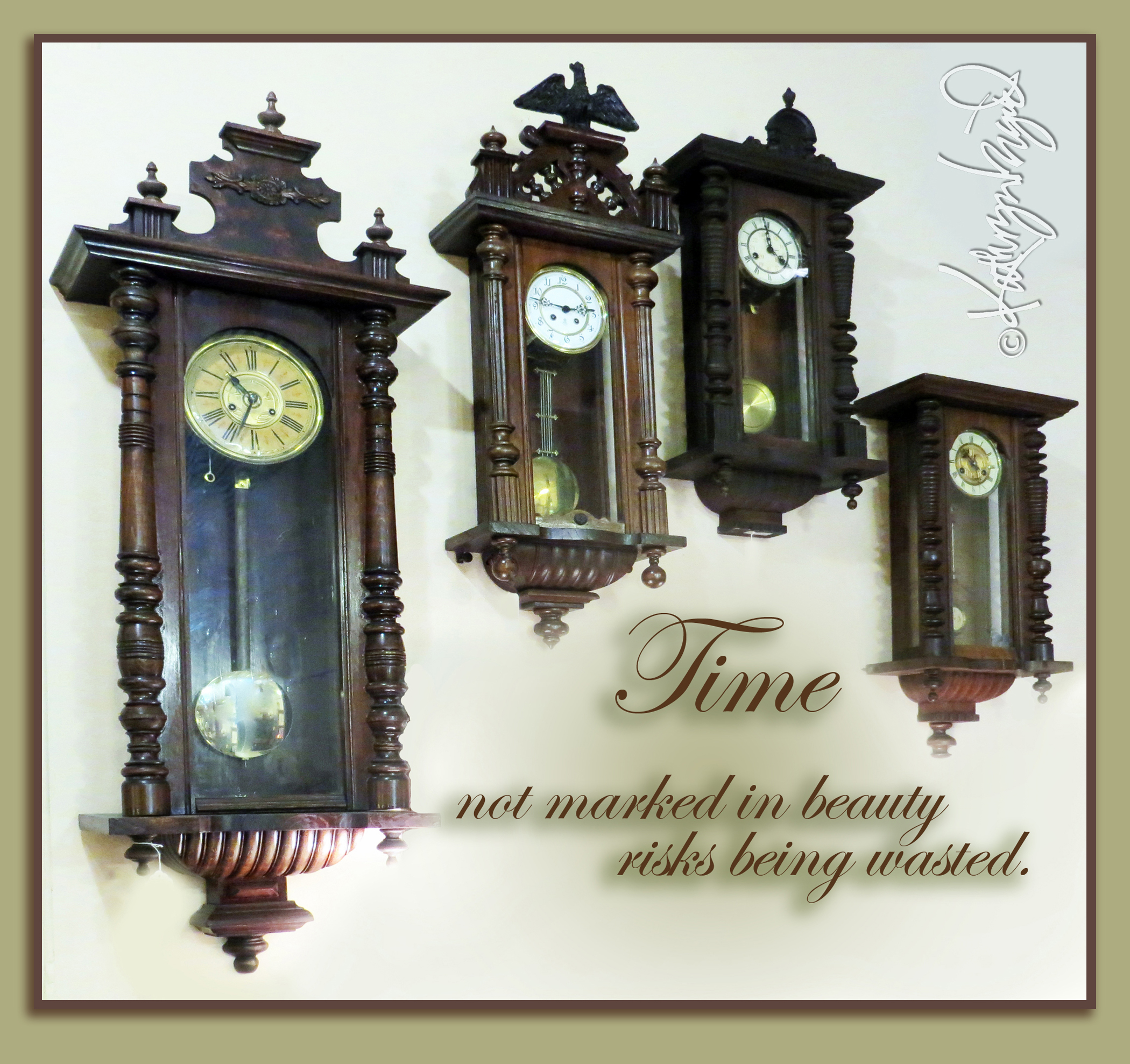
Now that everyone seems to have the technology to make cheap watches (which I must designate in my heart mere instruments for marking time, not timepieces), I get to wondering whether the beauty of true clockworks will always be preserved or will only serve as curiosities and fodder for art. That precision we take so nonchalantly to be ours is a museum of measurement and the poetry of a mechanism we should keenly regret to lose if we value something more than the rigid math of time, the seamless meeting of Doing and Deadline.

digital illustration from a photo

Meditations

digital collageStillness at the Edges
I
We stood along the shore at break of day,
The water lapping gently at our heels,
And heard the distant crying of the seals
At gulls for stealing all their fish away–

The dawn was chill and misty, palely blue,
Our hearts in morning shadow just as cold,
And bone and sinew feeling early old
As soul and body waiting day will do–

The sea was restless, slowing at the last
To push up foam as streaky as the clouds
And gather shells and pebbles in those shrouds
Around our feet, we statues standing fast–

All this, because our spirits captive are
Until revived by sun, our morning star.
digital collageII
So lifeless, silent, still and cold are we
When gold has yet to tinge the morning sky,
So empty is the world but for the cry
The seals and gulls raise up in minor key–

So heartless is the morning chill ashore
We stand like stone and cannot take a breath
Until the sun releases us from death
And brings the flame of sentience once more–

At last the light of day draws us to wake,
And we’ll bestir ourselves to act and thrive,
Rejoicing to discover we’re alive
Until the world’s foundations start to shake–

We know the night will come again, and fast,
And so must live each day as if our last.digital collage

Drawing on Your Beginner’s Luck

The nice blogger from Zara–A Writing Story stopped by recently and her post said she is working at starting to draw. I’m delighted to have another person join the ranks of happy visual artists via drawing–a collection of skills that come in quite handy (no pun intended, especially since there are artists who use their mouths or their feet to make artworks) for far more than strictly a pleasurable activity or visual entertainment. Drawing, a foundational skill in all sorts of visual art, is also a means of communication that differs from and can work in wonderful tandem with writing, singing, signing, and any number of other ways of personal interaction and transmission of information. In addition to the practical application of the end product of the process, the practice of drawing itself has great power as a mnemonic device, a tool for problem-solving, and the training of the brain in such useful skills as eye-hand coordination and (as I know from experience) the correlated motor control of working through tremors to achieve refined movements.

But beyond that, as I said to my blogger colleague, the act of drawing has elements of physical pleasure in the mere action of arm and hand and body that can be worth the pursuit, not to mention the mental and/or emotional pleasures possible. The act of drawing as a form of meditation, even without regard to any possible ‘product’, is quite desirable on its own.

As I said to my correspondent, she needn’t be intimidated in the least even if she’s a rank beginner: By even making the effort to learn, you’re worlds ahead of lots of others! A book I often referenced when teaching my beginner students in college was Betty Edwards’ classic Drawing on the Right Side of the Brain–it has exercises that aren’t too hard even for someone who’s never attempted to draw before, and because her focus is on how the brain works in visual activity, she offers insights into the process and possibilities that few others do. There are, of course, innumerable excellent how-to books for those who want to draw, many of them favorites of mine as well, but because of Dr. Edwards’ [then] ground-breaking work in recognizing the character of right-vs-left brain function and how it played out in drawing, I always found her work particularly helpful.

Because drawing can engage so many diverse cognitive processes like this, it can be complicated and overwhelming to know just where to start learning how to draw. As I remarked in my note to my fellow blogger, All of that aside, simply making marks on a surface is the beginning of drawing. Sometimes the least intimidating way to begin is to take a piece of paper, make some totally random marks on it, and then see where that takes you. Even if all it does is make you comfortable making the arm movements for a start, that’s helpful. If, as with most people, you look at it and think ‘that looks like . . . ‘ or ‘that doesn’t look quite right . . . ‘–well, then, you’re already making editorial decisions that can help you move toward drawing the way you want to draw.

The bottom line, if you will, for me is that I feel more alert, more attuned to potential solutions when everyday problems arise, and generally just plain happier when I draw. It’s not because every drawing turns into something fabulous–far from it–but because the process of drawing opens up my brain and spirits in useful and unexpected ways. Many times, my drawing produces nothing more than scratches that are shorthand for bigger and more complex and, I hope, better things to come. But the exercise itself is valuable to me, and a glance back through my sketches can often kick-start me into drawing a work that is more successful than the twenty previous ones.

line drawing

Exploring pattern in a sketch.

line drawing

Playing around with volume.

line drawing

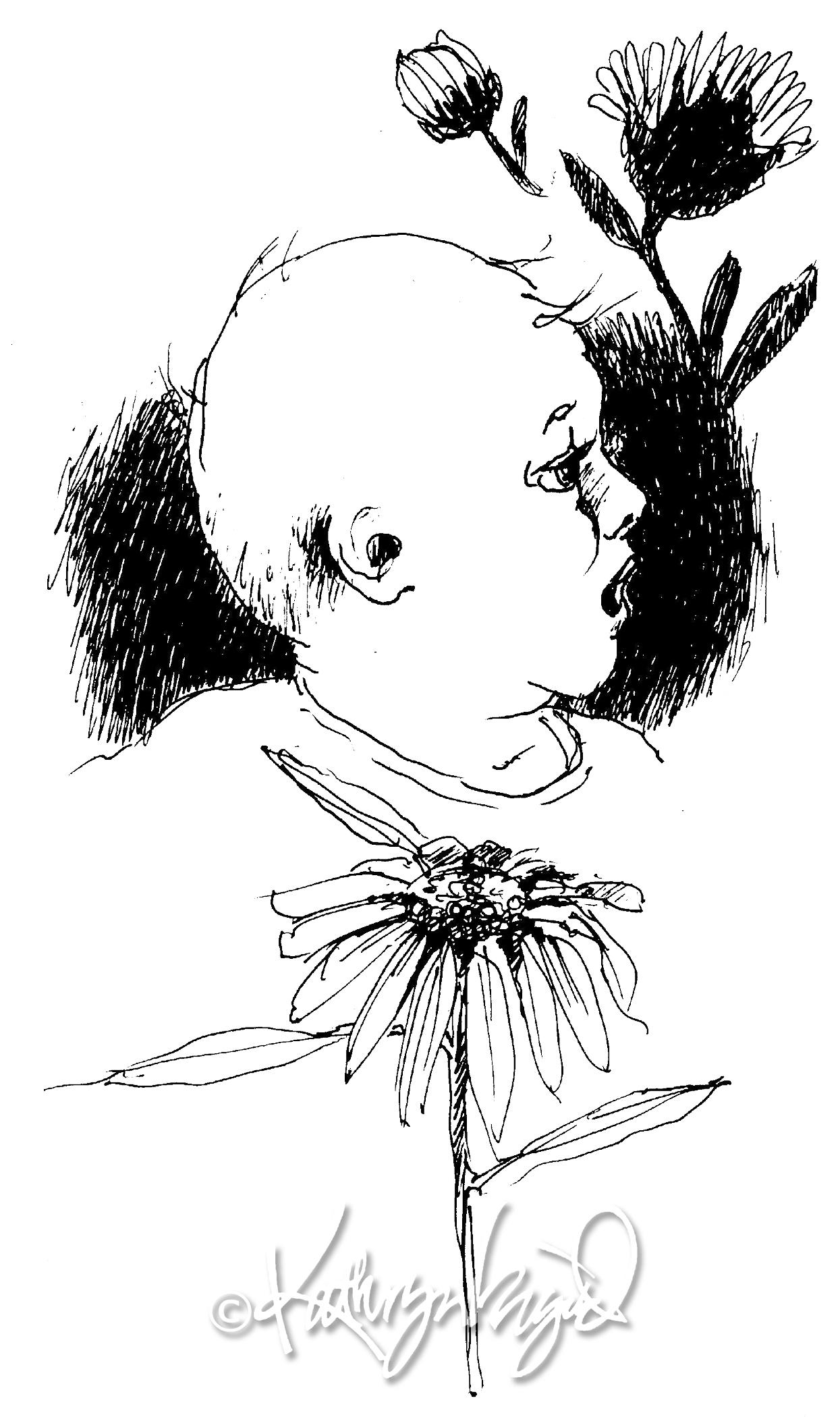
Faces and flowers show up often in my sketchbooks.

line drawing

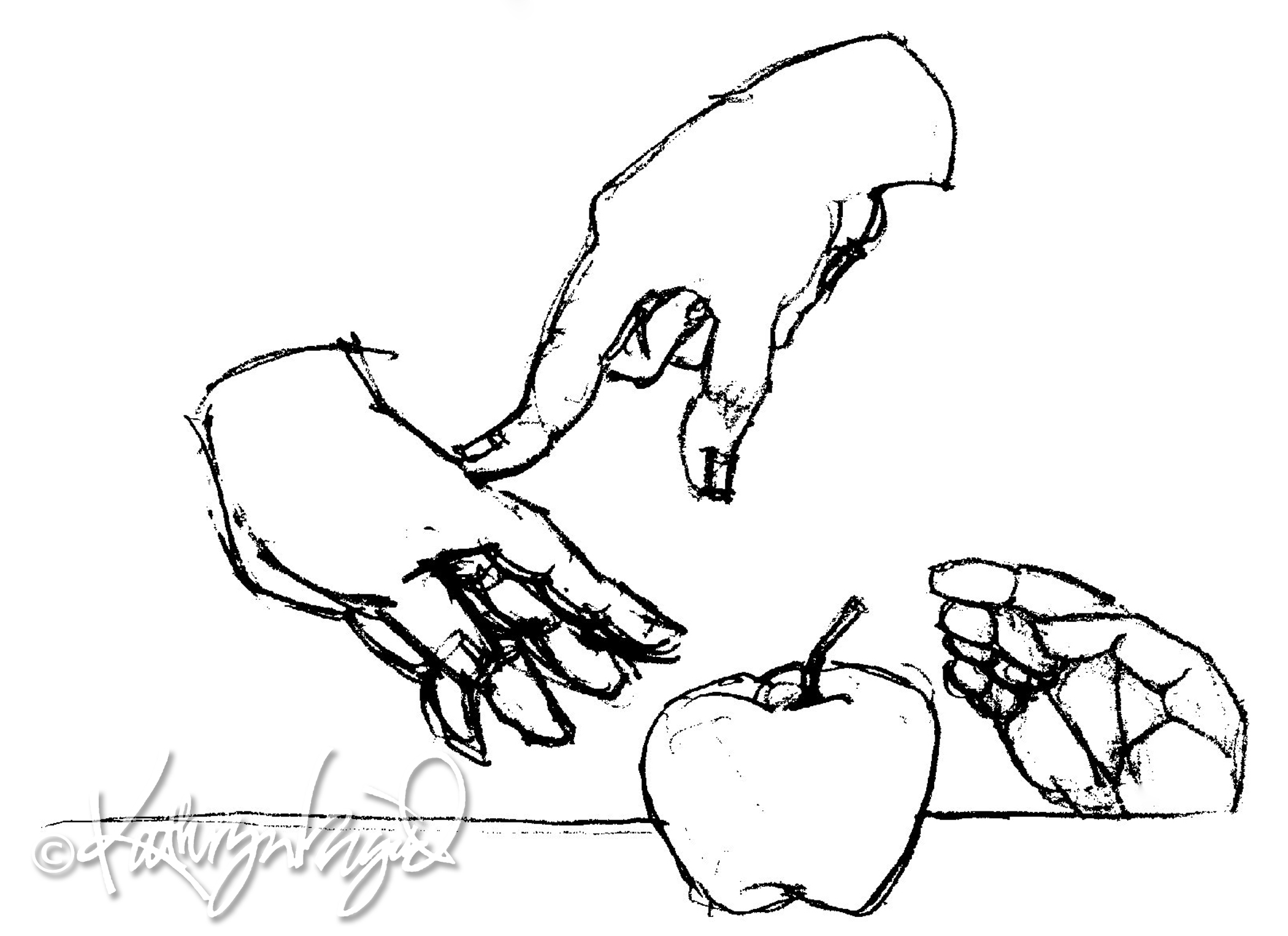
Hands can be pesky subjects, so I play with sketches of them frequently too.

line drawing

Any little vignette that pops into my mind is worth scribbling at least a few times.

Ultimately, whether I’m in gear for serious drawing or just fiddling with a pen or pencil to pass the time, it’s good practice and feels worthwhile. If nothing else happens, at least I have given my brain some thinking-room between the lines and I might figure out what to make for supper, how to cut through the piece of metal that is in the way of my completing a repair in the garage, or who knows–I might even remember where I set down that book I was reading days ago before it ‘disappeared’. It’s doubtful I’ll come up with any Nobel Prize-worthy inspirations while drawing, but then again, if I don’t draw, I’ll never find out!

The Sound of Inner Peace


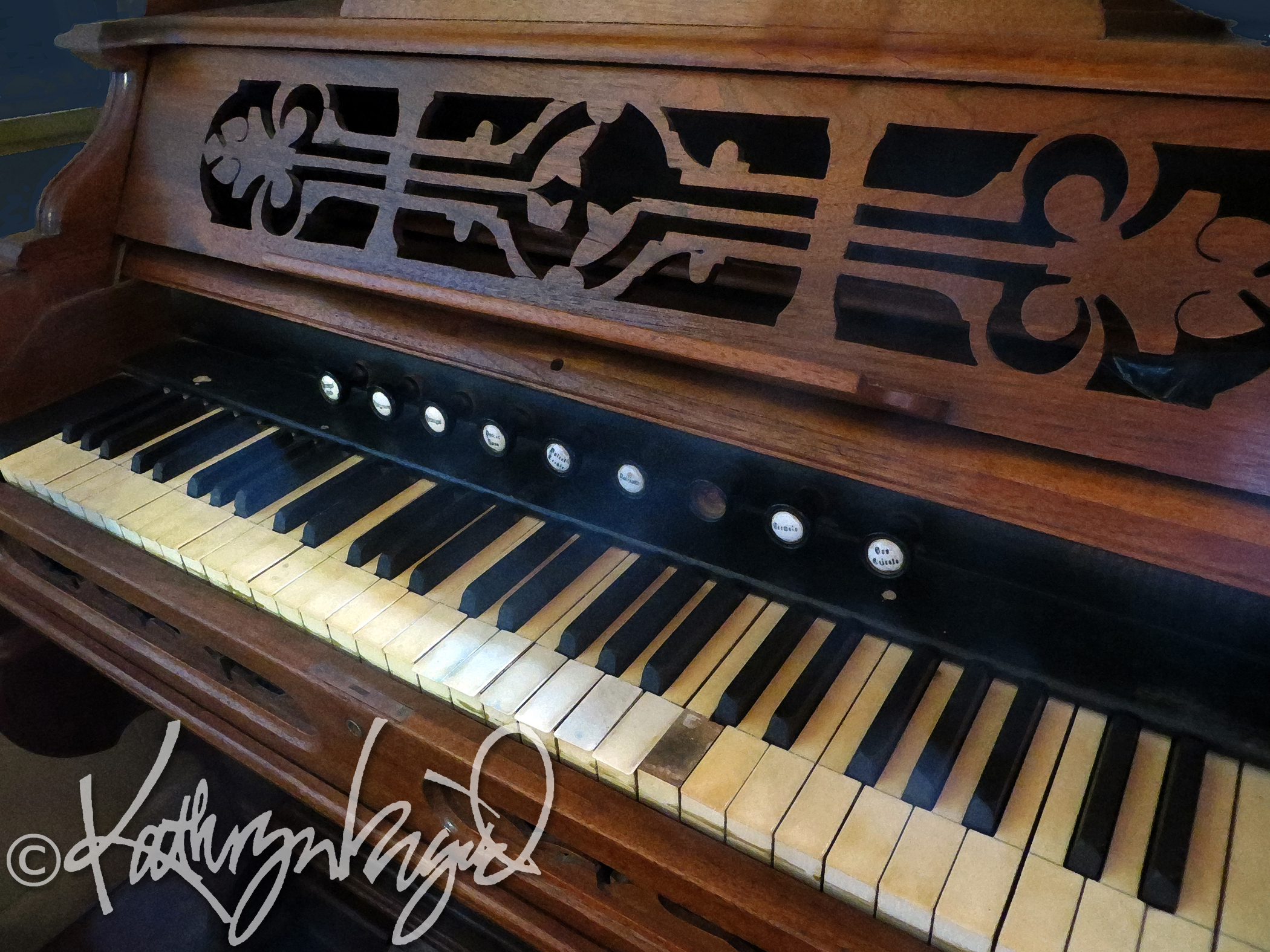
photoSilence is both elusive and therefore, golden in this life. Even when we can escape the ambient clamor of our everyday existence it’s rather rare to achieve the sort of true silence that’s found in deep contemplation, deeper meditation or deepest sleep. Our own brains make an immense quantity of distracting and sometimes just plain disconcerting noise so much of the time that it’s rather remarkable we even know what silence is or can be.photoIt’s almost ironic, then, that what makes inner calm and silence possible for me is often music. The way that music can clear my mind of mess and detritus, allow me to empty myself of unproductive or unpleasant things and focus on things of grace and beauty until my mind opens up so wide that it can embrace genuine calm, peace, contentment and meaningful introspection, achieve a kind of silence that transcends nothingness and surpasses quietude. Music makes me whole.photo

Peaceful Shadowland

Fall and Winter have a stealthy benefit that’s often overlooked. They lend themselves, more than the ebullience and exuberance of Spring and Summer, to a sort of calming melancholia, to meditation and contemplative times. In Autumn and wintertime, the chaos of the world can be lessened and untangled without the palisade thrown up by the warmer seasons interfering with the endeavor.photo

In part, it’s simply that we are increasingly encouraged by colder and often less amenable weather to stay indoors. Indoors, where the hearth beckons, where our books lie in wait, where our writing tools stay safe from the tempests outside. Indoors, where it’s easy to keep a cup of tea or coffee or cocoa hot and handy while we spend the hours tending to those tasks of repair and renovation that have lain unnoticed when the longer days of sunlight kept pulling us away. The birds flit south and abandon their choir-lofts around the house and the other creatures begin to line their dens and curl up under porches with greater urgency, leaving the airwaves to the less inviting, darker sounds of passing traffic on wet pavement and wind whistling down the fence lines, sounds that urge us to follow our instincts and the local wildlife to seek shelter and keep quiet while the forbidding cold and darkness of the ‘off seasons’ roar through town.

photo

But there’s another great appeal to Fall and Winter, another aspect that captures the gentler and more introspective angles of the imagination, and that is the way that these seasons strip away their frills and wash out any fripperies that might distract us from the most basic parts of our existence. It’s the way this time of year seems to contract not just the length of its daylight hours so that we see things dimly, palely and in lengthening shade and shadows, but even the spectrum of visible color, which becomes thin and subdued in the leanness of winter light. The water recedes from the fruits and flowers and stems of summer’s abundance and leaves them slightly parched and leads them to bend and fall. The slightest breeze, now colder, finds us clutching at our lapels and jamming our raw hands as far into pockets as they can go.photo

In this beautiful world, with the color rapidly draining out of memory, the stillness of hiding and hibernation weighing us into lassitudinous introversion, and the brisk chill of frost settling around our ears and shoulders like lead, we can at last let go of the impetus to run and shout and do, if only for the joy of rediscovering what waits in the seasons of shadow. We can see the world in a sort of refined simplicity if we let ourselves. We can take these moments of clean-slate clarity to listen to our innermost selves for a bit and sort out what does and doesn’t really matter in the grand scheme of our lives. And we can go to sleep knowing that when the glad excesses of Spring and Summer return we will see them through new and more appreciative eyes and perhaps, yes just maybe, even find that in the midst of all that bloom and warmth and celebration we may long for the stringent joys of Fall and Winter once again.