For Love of Singing

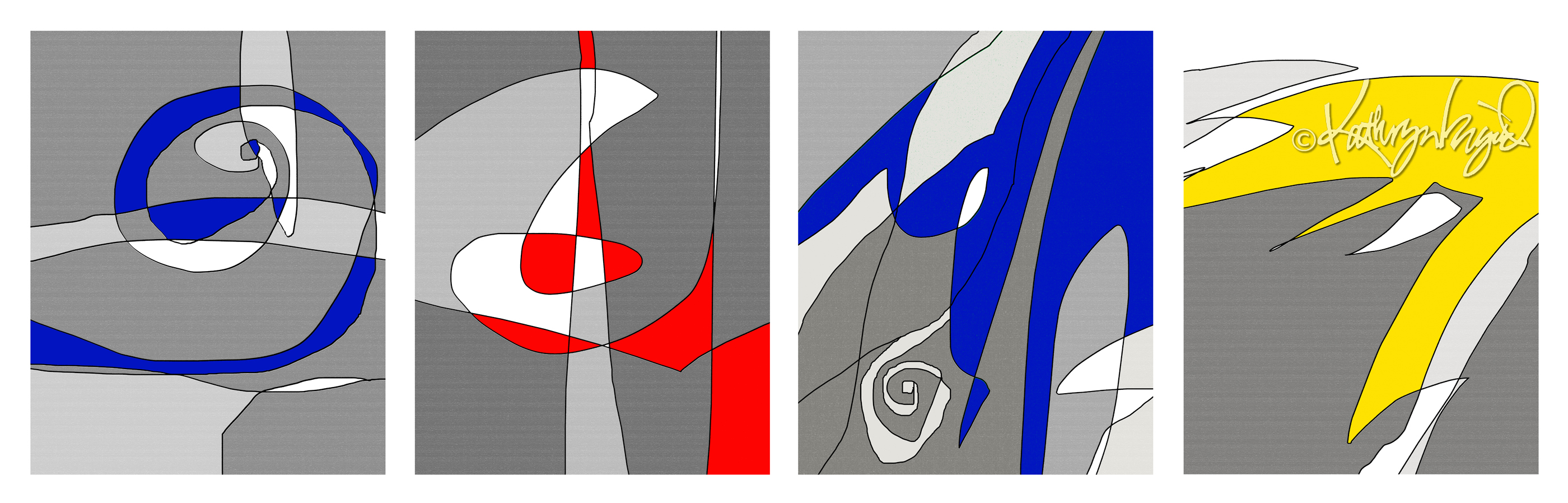
Digital illustration from photos:  I Sing for JoyI Sing for Love

I sing for love of singing, For music, sweet and strong

That carries me from joy to joy, Amending every wrong—

To hear clear voices ringing Across the dawn of day

Makes purest gold, without alloy, My every waking way—

As day approaches evening, A lullaby, at last,

Gives night delight, believing As I do that in the vast—

Infinite—constellation Of voices in the night,

I will find deep communion With the song that sets me right—

I sing for love of singing, For in the choir’s heart

Is all the song of blessing That I longed for from the start.

If My Song could Last Forever

Photo: Well Seasoned 1Hours into Seasons

There’s a sweetness in the morning when the sun has yet to rise

And the blooms lie, still unopened, under sleeping butterflies;

When the stars still wink and glimmer, while the frogs yet softly sing—

There’s a sweetness in the morning that is like the breath of Spring.Photo: Well Seasoned 2

There’s a graciousness at midday when, amid the racing streams,

All arise and put in motion yesterday’s profoundest dreams;

When the past its chains has loosened on the race of all alive,

That in joyful forward motion we, like Summer, grow and thrive.Photo: Well Seasoned 3

There’s a calm amid the evening when the birds come to the trees’

Respite from the day of flying, echoed by our evening ease;

When the cares of noon have lessened as the dusk swept into place—

There’s a calm amid the evening, peaceful as the Autumn’s grace.Photo: Well Seasoned 4

There’s a beauty to the nighttime, glorious and peaceful bliss,

Treasured for the kind renewal of the souls that rest in this

Cradling darkness and this languor, in this place of mending rest

That, like Winter’s dormant healing, lets us wake refreshed and blessed.Photo: Well Seasoned 5

I would take these hours’ presents as my guide through seasons long,

Through a lifelong path that’s pleasant as a choir’s finest song;

I would be a seasoned traveler, happy above everything,

If my song could last forever,

Summer, Autumn, Winter, Spring.Photo: Well Seasoned 6

An Extremely High Note

I’m like that guy who can very nearly hit his high B-flat.digital illustration

I’m reasonably useful in my little bitty part of the world, but my imperfections are both ever-present and well known to me. I have learned, long since, that as in real (physical/aural) life, in the metaphorical sense I am far better used as a chorister than as a soloist. My ego is neither too big nor too fragile for me to know that I make much better Filler in either setting than I do star material. Anybody with any sense knows that it takes a whole bunch of us to sing backup for the marquee artists, to act as support staff and cheering section and general-dogsbodies for the persons who are better designed for leadership roles. There are rare occasions when I’m the most experienced or skilled in the necessary ways for the task at hand, but as that’s mostly by default and by dint of the odds, I take no cue that it should become the norm.

I’d much rather stick contentedly to my supporting roles, humming along quietly as best I can, and perform no unintentional solos. If I ever get up that high B-flat, I’ll let you know; until then, I’d appreciate if those of you with the proper pipes carry on, and you can count on me for that low undercurrent of pretty-fair tones to fill in around your excellence. I’m excellent enough at my own, non-flashy, kind of stuff.

Sweets for the Sweet (& All Others, Too)

digital illustration

Remember this…

Long-Awaited Benison

The sweetest sound the human ear has heard
Was not a waterfall or splashing brook
To thirsty thoughts; nor thirsty mind, a book
Read out; nor singer’s voice, nor whistling bird

In spring’s cool song; it wasn’t kittens’ purr
Or baby’s comfortably cooing charms
When resting safely in his mother’s arms
—Though it might then seem wildly sweet to her

It wasn’t the “I love you” of romance,
Nor was the sweetest sound of clinking gold,
—Though to its owner, that cannot grow old—
But rather, barring mystic happenstance,

The miracle of sound most truly sweet
Was Mama’s voice announcing, “Come and eat!”

Flantasia

graphite drawingThe Warbling Flantical

Upon a promontory sat the Flantical, in coat and hat,

In curled toupee and beaded gloves (the sort his sort of person loves),

And sang a tune so bold and sweet, a choir gathered at his feet

And joined their voices, fine and strong, to this his pure and sacred song,

Admiring both his vocal fire and handsome mien in that attire,

And so anon, the Flantical and choir closed their canticle

And all dispersed, but all retained the melody that still remained

In head and heart; that is the story born upon that promontory,

And each Flantical now loves to sing it, wearing beaded gloves.digital illustration

A Musical Tradition

The office where my esteemed spouse performs many of the studies and administrative duties comprising his workload outside of the conducting element at the church where he’s now interim chancel choir director hasn’t got a lot of stuff in it other than a big desk, a small piano and a couple of bookshelves. Most of the books that had filled the shelves went away with their owner, the previous director; a few that go with the office itself remain on the shelves, and all by themselves they tell quite a story. That’s the way of books in general, isn’t it.

It’s all the more so in this instance, by virtue of the books’ being vintage hymnals. The history of the United Methodist Church at large is in their pages. The history of this specific congregation within the UMC is there, too. And there’s a great deal of Protestant church history, Wesleyan history, English and American folk music and even larger and older parts of the musical tradition. All right there in the pages of some rather small, rather worn books that just happen to be full of hymns.

There are libraries; there are Protestant theological resources; there are music collections; there are history books. All of them are in this one room, in a handful of little old books. And that, in itself, is the nature and long-lived tradition of printed music in general. So much has been passed down in the oral traditions of so many cultures and religions and peoples, but there’s an enormous amount that lives on and grows and inspires because of those amazing repositories that exist in the written music that survives everyday use, one generation after another. I only hope that all such traditions can be preserved and enjoyed far beyond our lifetimes, whether in temples or towns, religions or regions, families or foundations, schools or individual choirs. Beyond inspiration or even enjoyment, these are great containers of food for thought.digital collage

Under the Arches

I walk into the room after the rehearsal has begun, and the men are working on a slow passage of Handel. Choirs I and II sing the same tenor, baritone and bass parts at this part of the piece, and they have unified their pitch and the round warmth of their Latin vowels so that despite having only ten of them singing a relatively soft phrase, the sonority is beautifully intense and sweeps me into the room on an almost ecstatic wave.photoI sit and finally have a look around. The doctoral student assistant is conducting, and one of the voices raised is my husband’s, from where he’s joined Choir II. I close my eyes for just a moment to listen to the lilt and roll of the men’s voices.

When the women rejoin and the full ensemble begins to move forward, picking up speed and volume as the text becomes more buoyant, I feel myself lifted further on the waves, transported far from this concrete box of a room and its cold fluorescent lights.photoSuddenly I am under the morning light pouring through a cathedral’s oculus, gazing up into the curves of the arched nave and dome. I am pacing sedately through the arcade of a cloister, the afternoon sun warming my heels as it peers into the intervals between the pillars. I am in the garden, watching the sun set on the curled canes of the roses climbing there,the bows of the water leaping in the fountain, the draped arms of the willow as it leans out to embrace the day’s last rays of light.

This is the sweetness of music, and in this wash of light and dark, cool and warmth, joy and meditation I can gladly lie for a thousand years.photo

Angels of Mercy

graphite line drawingThere are a lot of distinguishing features that we associate with Goodness, in the general sense of that construct. There are the usual ethical and even moral qualities we impute to a person or action or event in our humanist or religious ways: honesty, justice, kindness, compassion, hospitality, wisdom, patience and other such characteristics are almost universally recognized as positive and admirable. And while we can sometimes recognize these things in our fellow mortals, many of us find it easier to represent them in our minds’ eyes as some kind of super-beings that transcend human limitations, because it’s hard to imagine much of this happening or being sustainable in the hands or lives of mere people.

So we have our superheroes and our faeries, our special agents and goddesses, avatars and angels. But we’re still either too limited in our mental vocabularies or perhaps simply a little bit too insecure and egocentric to imagine or depict much that is Good without giving it a recognizable hint or ten of humanness. We make our gods in our own image, unable to picture them as truly different enough from ourselves to be genuinely Other and unique. We need to feel a concrete connection if we’re to make any sense of our own ideals.

And there’s nothing wrong with that, to my mind. How can I talk about the sweetness of a ripe pear with someone who has no sense of smell or taste? What it feels like to stand mid-stream in an icy creek with someone who has no legs or is a lifelong quadriplegic? How could I hope to discuss a complex topic with a deaf person from another country? We have to have some little commonalities, at least ones that we perceive as such, for us to have any kind of relationship, including the philosophical or emotional or spiritual.

So we, thankfully, have our Helpers, our unseen supporters and caretakers and watchers and guides, and we give them features that help us to understand and trust them. The other day when I was drawing I was thinking of a friend who, as I write this, is undergoing cancer treatment. Many friends and relatives and acquaintances have done so in times past, and many will yet again, and I think of them in their times of need and send, in my own way, my love and hope and concern, but most of them cannot use anything tangible that I have to offer. I think for cancer patients, my versions of angels would most certainly be beautifully smooth-headed creatures.

I am no surgeon, healer, scientist, caregiver or therapist of any sort. If you live close enough you might get some homemade chicken soup from me, or an armful of flowers from my home meadow, or a little note, but I have no cure to offer, have not even enough encouraging wisdom of my own to get you through the day better. What I do have is my own vision of what I would hope to have at my bedside or hovering around me as I tread any dangerous paths, a sort of gracious, singing, laughing and–when I need a modest and quiet companion who understands the sorrow of it all–gently embracing angel of mercy. And my particular versions of such beings work in force, and also make house calls, so I will gladly send regiments of them in all their shining, vaguely human, terribly purposeful Goodness to watch over all.digital illustration

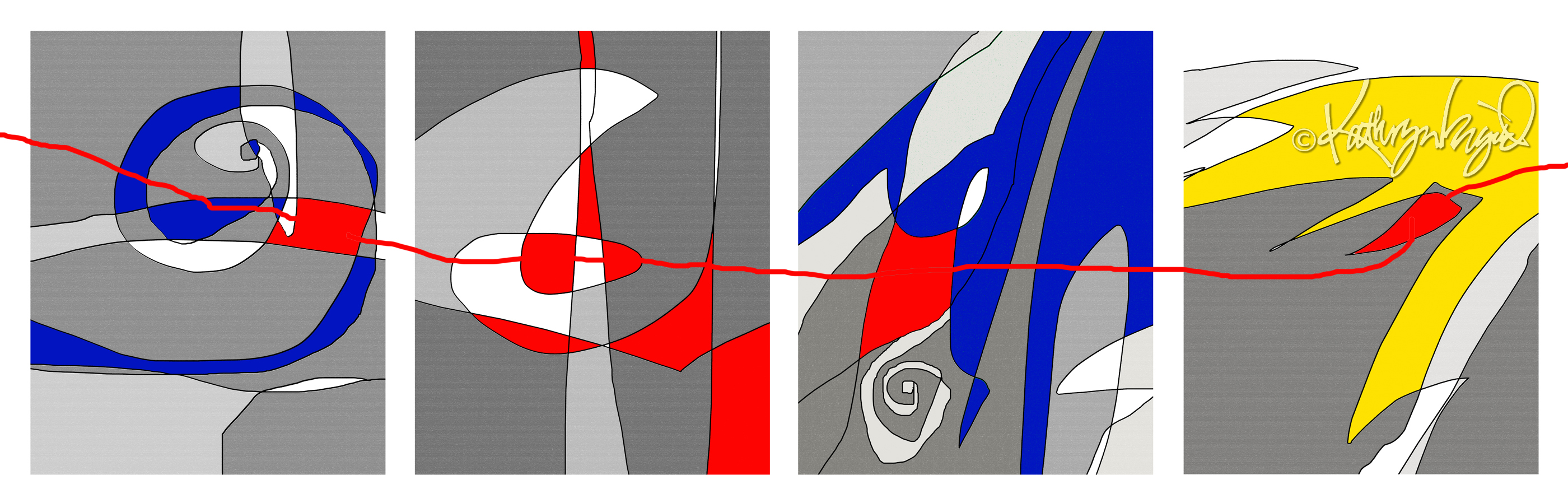
Röda tråden (The Red Thread)

Röda tråden is the Swedish phrase for connectivity. I learned it from my husband, who in turn learned it during his dissertation studies on modern Swedish choral history, and in a way it’s the perfect encapsulation of what his research revealed: that the astonishingly deep and broad influence of such a small country, in such a short time, on such a large field as Western choir singing and music came about primarily because of the remarkable and unique confluence and joining together of a huge number of events, people, ideas and resources in that little land at the end of the Second World War. As unimaginably terrible as war is on any scale, it’s all the more a testament to connectedness that at the end of one of the largest we’ve known, such good and meaningful and positive elements were all drawn into one significant, beautiful growth spurt in the art of singing together.digital illustrationAs a miniature of String Theory in the arts, this surge of the choral art in Sweden is notable (no musical pun intended) not only because it posits a reasonably substantial explanation for the larger choral sector’s modern expansive development amid the general devastation and struggle following the end of WWII, but also because in doing so it illustrates wonderfully how the intertwining of all sorts of seemingly disparate elements such as safe havens from political unrest and postwar reevaluation of norms, personal and professional relationships and experimentation with new media could come into contact and interact to create a new mode of thinking, acting, composing, teaching and singing. In turn, this is a striking model of how people from distinct cultures, educational backgrounds, economic resources and political systems and of widely varying personalities, unified by the one tiny thread of choral music, could be pulled together into a complicated system that, though still colorfully messy and imperfect, led to a potent common end that has had lasting and marvelous influence for long and fruitful decades since.

I am, of course, grateful on a personal level because this Swedish postwar influence on Western choral culture has not only enriched my husband’s professional and artistic endeavors–not to mention was the basis for his award-winning doctoral dissertation that in turn opened a lot of friendly doors to us both in Sweden–but because it produced so much spectacular music and inspiration for so much more.

digital illustration

Röda Tråden is the Swedish version of the idea that–indeed literally–fascinates so many of us: the connecting thread–that which binds one thing to another. I can think of nothing greater than to spend life seeking the Red Thread that shows us our commonalities and binds all people together as well.

Further, though, I am grateful that such an otherwise inexplicable event as the ‘Swedish Choral Miracle‘ seems to me ample proof that all things and people really are connected. And that through recognizing and making good use of those connections, however, odd or tenuous they may appear, there is hope for new and better songs to be sung everywhere.

If I needed further proof of this, last night’s concert gave it amply. My spouse conducted the combined forces of the Chancel Choir of the church where he’s currently interim choirmaster plus their excellent hired pro orchestra in performing Haydn and Dvorak’s two settings of the Te Deum text as the concert opening and closing, respectively, bookending the extraordinarily lovely and moving Missa Brevis of Kodaly. I came in to sit for the concert among strangers and acquaintances from the church and discovered a friend from another parish sitting across the aisle from me, then learned from one of the choir administrators that a friend of hers in attendance turned out to be a long-ago colleague of my husband’s from another state, and finally went up to greet my guy after the concert and found him speaking with a group of ladies in the front row, one of whom was the wife of a former US president. What brought all of us divergent people together in this moment? Music. Beautiful singing and playing. Chance, kismet, divine intervention. Call it what you will, the slender but unbreakable thread that connects us all drew us into one place for a time of basking in the inscrutably beautiful harmony that is beyond craft, beyond art. That is a concert without peer.

Love, or Something, Conquers All

Is there something else you want to tell me, sir? You say you are a musician, yet I distinctly recall that on evenings around the campfire you’ve always strummed off-key and your songs are always unrecognizable to your fellow players. You tell me that you are a skilled horseman, but I have known you to fall off every mount you ever met and the way you’re always sneezing makes me pretty sure you’re more a specimen of the allergic type than a cowboy of any real sort. As for your claims of being a king of the romantics, they strike me as far more hopeful than strictly factual, considering that you cannot read, write or dance, never remember to comb your hair or wash your face, and are cowed into stammering and foot-shuffling when actually in the presence of anyone even slightly ladylike.

Forgive me, then, if I tend to take your claims with a certain jaded skepticism. I am fairly certain I do not want to listen to you bash away on your two-stringed guitar, to watch you topple out of the saddle the instant your horse makes a move, or to wait for you to wrestle up the courage to make small talk while I dream of my escape from your company. And if you should persist in attempting to convince me that you are the master of the Wild West, I shall be reduced to the expedient of dispatching you with a hefty branch of mesquite laid across your noggin, stuffing you into a handy gunny sack and slinging you over the back of a mule headed toward some terribly remote corner of the prairie.

Other than that, though, I suppose I don’t mind your company. A girl can’t be too choosy out here on the frontier if someone offers her his family fortune and she has her eye on a particular set of acres for ranching. Business is business, after all.digital illustrationOn Closer Examination

A fella whose flaws were prolific

And both manners and taste quite horrific

Filled my soul with alarm

But still had one great charm–

His inheritance, to be specific.