PostModern Coloring Book

Now that I’ve had my iPad and its various drawing and art apps for about six months, you might hope, if not expect, that I would have gained a certain amount of fluency in the medium. You would, of course, be disappointed in that. I’m still as ignorant a neophyte as ever. But I’m having a good time, and that makes plodding along at my own minimal speed worth my while, all the same. I suppose it could be compared to the childhood love of scribbling and crayons and such excellent things that leads to our continuing to practice for extensive periods over our early years despite being unlikely to become little masters of art for a much longer time yet.
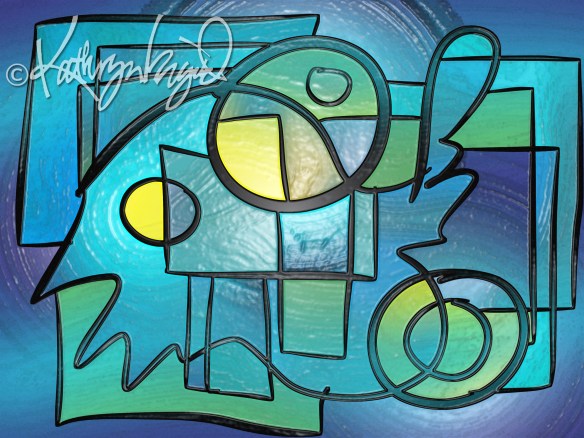
Digital illustration: Modernist Coloring Book

It would be more meaningful to me, I imagine, and to those who know me, if I could extend that youthful courtesy not only to playing with my latest techno-tools for art making but also to other areas of my life’s education, the many in which I have far less patience with learning as slowly as I do and therefore generally end up quitting or making virtually no progress for eons. Imagine if I loved studying personal finance as much as I like scribbling: I might be rolling in wealth by now instead of still struggling to count change when I buy a few groceries. If I had learned to enjoy practicing exercise—any form of exercise at all—I could have been fit and fabulous and looking at living enough more decades that I could learn a vast quantity of other fantastic and exciting things.

But alas, none of that is my nature or my passion. Plodding along and just playing with those things that amaze and amuse me, that’s my style. I may get up a short burst of energy or speed and manage to improve at one thing or another in my repertoire occasionally, but if you’re looking for snappy progress, cast your eyes in any other direction and you’ll have a better chance of seeing something new and inspiring happen. I’ll be right here in my little corner, scrawling with a stylus like a crazed second-grader mauling her coloring book and cackling with delight over the slightest mark that pleases me. Just think how well I make the rest of you look good!

Foodie Tuesday: Dad Goes Grocery Shopping, Too

Photo montage: Grocery BonanzaNot everybody grows up with a dad who likes grocery shopping, but I got lucky. My father was the son of a grocery man and had his first real job working for the same grocery business as Grandpa did, so it was not entirely unusual that Dad would be the one who took us kids grocery shopping when it was time to stock up again. Even summer vacations followed a little in Grandpa’s tradition; instead of the stereotypical roadside tourist attractions, he was wont to stop at any grocer’s the family passed on their travels, wanting to see what ‘the competition’ was doing and reveling in the interesting inspirations he might find along the way. My dad, too, had enough of the bug from watching his father in action that when we did go to the grocery store, it wasn’t one of those stomp-through-at-top-speed reluctant shopper experiences that so many have with their parents, notoriously fathers most of all.

We meandered up and down every aisle, having a happy, leisurely look through everything on display, and more often than not, we came home with something new or unusual or just plain frivolous. Much to the delight of Dad’s junior shopping contingent, of course!

Mom was a good grocery shopper and fed us well, and taught us the kitchen skills to use the stuff we were buying, but Dad got to play the primary role of finding the unusual fun in visiting the store. Between the two, then, they gave us kids not merely those practical survival and sustenance skills we needed but a sense of pleasure in exploring what food does beyond keeping us alive and healthy. Thanks to their teamwork, it became a focus for community, artistic invention, entertainment, and exploration, and this all made it easier to expand those ideas far beyond our home walls.

That my parents’ ideas about division of labor and gender roles was generally more practical and individualized than American, middle class, mid-twentieth-century standardized was a boon to us as we grew in many other parts of our lives. It was Mom who taught me by example to do the fix-it stuff for general home maintenance, having been brought up in a carpenter’s household herself, and both parents took part in helping us with homework, counseling us, playing with us, and much more. Dad was a neatnik by inclination as much as Mom was a careful homemaker, so there wasn’t much obvious differentiation when it came to keeping the house up and running on a simple organizational basis.

But that’s all peripheral to my thesis, which is that I was fortunate to have two parents, not just one, who took an interest in the choosing and assembling of what we ate. Dad never demonstrated a huge urge to Make things with recipes, so sandwiches and cereals and the occasional barbecue tending was his main realm of preparation, but he did those with aplomb and enthusiasm and played sous chef many a time. Mom was the chief in the kitchen. Having two skilled shoppers in the house, though, that was, and still is, inspiring, and I am the better and happier for it. If your household consists of more than your lone self, or you share meals and their preparation even occasionally with younger people, I hope you’ll consider creating such an atmosphere of joy and adventure in the process as well!

I Did It Myself…*to* Myself

Do It Yourself (DIY) projects, when well executed and realized, are impressive and admirable. They double one’s pleasure in the end product by being not only beautiful and useful as desired but also the satisfying result of her own skilled labors. Personal investment increase value exponentially.

I can claim a few DIY accomplishments on my resume, happily, despite my ordinary limitations of resource, monetary or of expertise or ability for the project in hand. But having mentioned hands, I must also confess to having a DITY (Do It TO Yourself) record as well. On the occasion of the hand-made hand injury, I was fortunate that my second of inattention resulted in no worse mishap than a tiny nip on my finger.

Being an artist, I did however do this with a certain degree of style: when I stuck my finger with a single tooth of my nice, sharp little hand saw (too aptly named, perhaps?), I did manage to insert the steel into the only small spot on my hand that already had a visible scar. Puncture becomes punctuation, so to speak.

As always, the tiniest wound is magnified by other pains, not least of them the injury to ego and dignity when on the instant of infliction I succumb to a combination of reactions that to the uninjured could only have a sort of serio-comic ridiculousness perfect for cutting me down to size. The unpleasantness of having made an unwanted incision in my personage is compounded by the leap back that threatens to throw me over a chair and onto my tailbone; the pinching clamp of fingers on the cut to stanch the bleeding hurts almost more  than the initial stab; the yell of pain that, in my nephew’s youthful terminology ‘scares my ears’ is also loud enough for the neighbors to hear and enjoy. On top of all this is the diminution of my sanguine pride, reminding me that my handy skills are sorely limited no matter what I tell myself.

Does this prevent my attempting further DIY projects? Hardly! Being by nature a timid and lazy and not-so-brilliant craftsman hasn’t made me give up but instead tends to make me plan and work things out fairly exhaustively before I begin, and to assume that I’ll make mistakes or need help before I finish. It all slows me down, to be sure—and that’s not a bad thing, mind you. Any DIY work is bound to be only as polished as patience and occasionally remedial work can make it.

When I speed up too much, I get sloppy and unfocused; I make silly mistakes like sticking my finger on a saw tooth/a saw tooth into my finger. Luckily for me, I didn’t have a power saw going there, so all I lost was a few minutes, my composure, and a few red cells rather than a digit. In return, I got a good reminder to sharpen my attention, to use tools with greater care, and to call in expert help when needed.

After all, I’d far rather sacrifice some dollars and a touch of my DIY pride than an appendage. This is how I’ve survived to my advanced age without losing any body parts or breaking any bones. I have recovered numerous times from being an (or falling on my) ass. Self image is ever so much more resilient than such things. Arguably, a little too much so in my case, or I wouldn’t tend to get into these fixes at all.

Of course, getting into a fix is something I can easily do all by myself. For that task, I do have all of the necessary experience and expertise.Digital Illustration: In Which I am a Silly Ass

About Average

Digital illustration from photos: Handy, or a Handful?

Am I handy, or just a handful?

I’ve always thought of myself, without any implied value judgement, as an average person. But given my conviction that each of us is as distinctive as the proverbial snowflake, being average does not imply sameness in every way or with every one. After all, I have my distinctions, as anyone who knows me in the least can tell.

Still, in my particular milieu, those paths I’ve trod in my life’s journey as well as the matrix of my personal genetics and environmental influences, I have never tended to stand out from the crowd much. Some of that could clearly have been thanks to my preference for being a wallflower and remaining as invisible as I could manage during all of the years of my intense anxiety and self-doubt. But I really did blend in more than not, even when I felt like an emotional outsider. I’ve generally been just about smack in the middle of the majority wherever I’ve found myself in life.

Few are the superficial and visible things by which I can or could be easily singled out from a crowd. I am of approximately average height and weight, not particularly short or tall, thin or fat. I wear what I’m told are the average sizes in clothing—mostly Mediums, if not numerically average in a more specific way—and the most common size of women’s  shoes, those also in the medium width. I have brown hair; I have all of the standard, requisite limbs and appendages and other body bits in the ordinary places one would expect to find them, and a relatively symmetrical frame. I am neither notably hideous by popular standards nor a stellar beauty.

My education extended to college and a master’s degree, something not everyone has the wealth or privilege to experience, and I got pretty good grades all through, but again, nothing to put me on the map or anyone’s Specialness radar. My personal life, my daily activities, my work life: these are all unmarred by major peculiarities or notable oddments that would make me memorable to anyone who wasn’t already paying attention to me. What does all this mean? Is it unusual that I’m, uh, not unusual?

Nope. I think what it means is that each of us, unique in some ways, is utterly average in others. The world isn’t actually divided neatly into things, let alone people, able to be classified as belonging in a certain percentile as Normal or Average, above or below it, and remain in that category in all ways, for all time. Every one of us people, places, things, animals, vegetables and minerals seems to have a complex, and ever-changing, collation of classifications, each of our characteristics being at its own level, some of which levels vary over time and—

Oh, never mind. This could devolve into such a death-spiral of convoluted thinking that I might just explode into some sort of extraordinariness, if I’m not careful.

[Muffled, slightly crazed laughter]

I am a Three-Year-Old

Digital illustration: Coloring Book/Stained GlassHave I matured as much in three years of daily blogging as a toddler does in her first three years of life? Highly unlikely. I was, after all, already a half century old and probably set in many of my ways to a degree that could forestall any large amount of progress toward real change, or at least drag it by the ankles dramatically.

Chances are, I haven’t made a huge number of changes as a person in general during the last three years. But I can lay claim to some growth, after all.

Moving to the wholly new world of life here in Texas in 2009 certainly necessitated some change. My aging corpus may not have made the transition perfectly: being over-endowed with the internal furnace function of middle-aged hormonal fun isn’t entirely compatible with the outdoor temperature norms here, and like many transplanted citizens I’ve done some battle with the local slate of allergens new to my system.

On the positive side, what I’ve found as a blogger echoes the best of what I found in migrating from my longtime home in the Pacific Northwest to the new-to-me frontier of North Texas, an entirely different sort of northern-ness. Entering new territories, both the real and the online ones, presented the possibility of encountering insurmountable tasks and challenges, or worse yet, unfriendly natives. Of course, my being still in Texas after five years and still blogging after three tells you that none of those fears proved true. Quite the reverse, in fact, considering that I’ve had some lovely experiences in both worlds during my brief tenure here, and I’ve garnered a whole cadre of wonderful friends in both, as well.

In short, I would amend my initial statement so far as to say that anything leading to such an exponential increase in the size and variety and quality of my circle of compatriots seems to me the very best kind of growth possible. Happy blogiversary to me this week—and more importantly, from me to all of you, who have made the journey so worthwhile and still so inviting. Who knows where the next three years may take us all!

Did that Sound Insincere?

My family thrives on sarcasm, satire, and silliness, with a tiny dash of the snarky for good measure. It’s in the genetic pattern, and I can’t remember a time or age when we weren’t all generally a bunch of smarty-pants, irreverent goofs around home. I can’t even remember the first time that I began to realize that not everybody speaks that language. Some people think it too flippant (or possibly, blasphemous, at times), and some simply and plainly see the entire world in a very literal light. I can certainly understand how, to them, my family’s way of communicating would be mystifying and, very probably, make us seem really dimwitted or alien, or both. I don’t mind. It’s most likely true, about me, anyway.

Digital illustration: Did that Sound Insincere to You?

There are times, however, when I have well and truly put my foot in it. And I wish that I either could have read the situation better or had simply paid better attention. Sometimes it’s not nice to be flippant or jokey or snarky, or even to say the direct opposite of what I mean merely to lighten the mood or put someone at ease. Such stuff can go very wrong in an instant if I fail to notice that the party on the receiving end doesn’t converse in that language, or doesn’t appreciate what I think of as its lightheartedness.

But to be honest, most of the time I just think it’s their loss.

With one particular exception: I do feel especially ridiculous when I’ve been consistently playful and perhaps outlandish in my communications with a person and I want to get serious for a moment, especially when I want to say something complimentary. Did it now sound like I was insulting my friend because I was uncharacteristically nice and kindly? If I think it humorous to be droll and dry and sarcastic, maybe I’ve gotten too far from being nice! What’s a poor fool to do? Most likely, fall back on my old ways and hope for the best. At least I’ve done marvelously well in my life at surrounding myself with people who are almost superhuman in interpreting my chatter with generous and accepting ears and open minds, so I haven’t yet been banished from polite society despite my shortcomings.

And if you’re one of the many who have thus given me a pass, I thank you deeply. No, I really, really do mean that!

We were So Civilized

Digital collage: We were So CivilizedNo matter where I am on the Fourth of July I am likely to think about the country in which I was born and have lived all of my life thus far: the United States of America. The Fourth is the official birthday of the nation, though many of the current states joined the union long, long after that July in 1776 when it was established by its founders. Like so many nations around the world, this country and its history are a tremendously complicated and varied patchwork of fact and fiction, hope and fear, two steps forward and one step back. Over and over and over again.

Imagine this: a pack of refugees from religious persecution left their homeland and sailed into the unknown across an ocean of which they also knew very little except that their passage across it was dangerous and miserable and killed plenty of them before they hit the new shore. When they landed, to their surprise there were already plenty of other people living on that new turf, and did that stop the interlopers from moving in, too? Of course not. I don’t expect it ever occurred to them, to be honest, that there wasn’t room for everybody or that if they took a ton of the resources around them that might just mean there were fewer for the previous residents of the land, folk who had, indeed, already long established a very different relationship with the continent.

That the illnesses and diseases the newcomers brought with them from Home would endanger and kill many of their new unwitting and unwilling neighbors could never have entered these interlopers’ minds, when they were so preoccupied with not only their current survival but their escape from the hardships and sorrows back in their own homeland. That they themselves would suffer privation, fear, danger, loneliness, and the loss of their lifetime homes, belongings, families and friends across the vast ocean they had crossed was a stark enough reality that perhaps they willed themselves not to think too hard about all that they faced next also affecting the long-tenured native peoples across whose lands they moved like human bulldozers.

The establishment of this new home was far from smooth and easy too, as anyone could probably guess, though I wonder if any of them really considered that the goal as much as simple escape from what they’d known before. Still, none of those inhabitants of North America—invaders or original denizens—could possibly imagine at the time, I suspect, quite how vast the whole continent was and what that meant in terms of creating new colonies within it, let alone new nations. In the years that followed, the westward migration confirmed the existence of innumerable tribes and clans of people not before known to the new arrivals, but also of wild creatures unimagined, of terrain unlike any they had dreamed possible, of climates that had been the stuff of legend until then.

In those many decades of carving out new paths and territories, it was inevitable that, just as it had been with the foregoing generations of various indigenous peoples, there would be struggles over who had access to what, who could live where, and who belonged together with or as far as possible away from whom. No surprise that this led not only to separated towns and enclaves and ethnic, religious, political or philosophical communities but also, in turn, to a wild array of accents and ideas that might as well have been different languages and different species altogether.

Amazing that all of this could remotely possibly coalesce into what is known as the United States of America. Today’s states are still so diverse, even sometimes from county to county or one side of the railroad tracks to another, that it’s nearly laughable to call them United. We fight like pesky siblings with each other all the time; it’s a miracle, in my book, that the so-called Civil War, one of the most uncivilized events in the country’s history, hasn’t simply continued from its beginning to the present day. It does, perhaps, at subtler levels. Just because the invasion of the continent by a bunch of frightened Pilgrims who only thought themselves seeking freedom from tyranny didn’t destroy the whole land and kill every one of them off outright, and because the various internal skirmishes that led to, but were far from limited to, the Civil War didn’t complete that annihilation doesn’t mean we’re not still perfectly capable of incredible incivility at every turn. We try, we fail.

On the Fourth of July, I think of how astounding and—generally—good it is that this messy nation has managed to survive this long without self-destructing. But I can’t help also thinking this of most of the rest of the world. Humans just plain are messy. We form and break alliances; we argue over being Right instead of being compassionate or practical, let alone pursuing justice. We blunder around, hog resources, ascribe privileges and powers to ourselves and our chosen comrades that we willfully deny others, or just pretend the others don’t exist, and thanks to our weirdly, wonderfully diverse array of accents, when we do get around to discussing the least of these things, even those who ostensibly share a language can’t understand each other half of the time anyhow.

Just possibly, our life form may have been civilized at a few choice moments. There is plenty of potential in this odd species of ours, I like to think. Even we Americans aren’t entirely irredeemable; we keep bothering and beating up on each other like so many brothers and sisters, and yet most of us still manage eventually to just agree to disagree and, in moments of precious lucidity, even to see each other’s point of view and operate in an environment of respect and hope. As rotten as we can be to each other, we care enough to wrestle it out and try to find ways to go forward. Together, even. If that isn’t a family worth saving, I guess I don’t know what one is. Happy birthday, USA. Go forth and get a little more civilized, if you can.
Spaceships, Time Machines, Bicycles

Photo: One for the RoadWhen I think about it, I’m amazed at how many modes of transport exist. Contrary to the fantasies popular in the middle of the past century, we’re not all traveling in levitating cars and being atomized and reassembled on opposite sides of the world. But it’s still fiction-worthy stuff that emerges when I realize we’re within reach of fully self-driven cars and can already travel at light speed, drive under the sea, and fly to the moon and, yes—more importantly—back again.

Fiction, however, has always outstripped real-world progress, as well it should. If we don’t imagine it first, how can we build it? If we didn’t travel thus in dreams, what chance would there be of our ever doing so in life?

I have invented an item or two in my time, but my ingenious machinations have never yet been realized in concrete form, at least those unrelated to my art. Still, I hold dear the idea that ideation is the necessary precedent of exciting discoveries and meaningful inventions. As silly as they may seem, then, I’m unlikely to quit developing my odd creations of the imaginary sort.

Who knows what journeys might someday spring from them?Digital illustration from photos: Time Machines

Portals

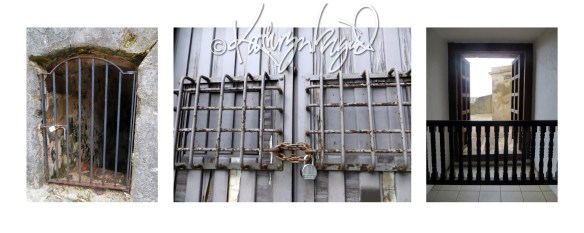
Photo montage: Portals 1Every doorway, every window, every gate is a portal to adventure. It may well be that those  portals are locked when I approach. More often than not, I find that it’s I who locked them up, who put impediments in my own way. That is the price of fear, of laziness, and of self-doubt. What holds me back or shuts me out is rarely an insurmountable obstacle; it’s me, often and only me. If I want to grow and change, learn and progress, it’s up to me to find the openings I most want to explore, and challenge the barriers with all my might. If I can’t find the key, I should make one. And frankly, if I can’t do that, I should probably make some adventures of my own and not bother waiting for the right portal to appear. Knock, knock! Life calling!Photo montage: Portals 2

No Surprises Here

Digital Illustration from a Photo: Baby Carriage

Kids have an amazingly flexible sense of time. The week at the lake, playing with cousins, is so shockingly short that the suggestion of leaving there provokes crying fits of desperate sorrow over its unbearable brevity. The twenty-minute regular doctor’s appointment, with a quick squeeze from the blood pressure cuff and a thermometer swiftly passed across a healthy forehead, well that might as well have taken ten years, because the same child is now certain she’ll die in a matter of seconds from the prolonged trauma of it all.

But to be fair, isn’t this exactly the way we see time as supposed adults, too? I may not want anyone to catch me whimpering over the end of a holiday or the beginning of a doctor visit, but generally, I’m not less inclined to feel that way than I ever was in youth. The real difference, for adults, is that we have the perspective and experience to recognize the true brevity of our lives within the broad arc of time. We have, if anything, a deeper desire to cling to and attenuate all of the good moments and avoid the bad. It’s not childishness for a kid to abhor pain and sorrow and crave ease and pleasures, it’s an innate wisdom that tells us the clock is ticking.

I won’t tell you to stop wasting your precious time reading my blog posts, no, I am far from that angelic and selfless. But I hope that time thus spent is indeed a refreshment and pleasure, however small. And that, in the larger scheme, it serves to remind both you and me, if gently, to value our limited time of life enough to choose those things that reduce the ills of life and expand upon the joys—for self, for others—forever. Or as close to it as we can manage to stretch.Digital Illustration from a Photo: Carousel and Other Horses