Sometimes It’s Hard to Tell Who’s Giving the Gift and Who’s the Recipient

I have been taught that it’s polite to accept generosity with good grace: say Thank You, show proper appreciation, and humbly know that even when you think you don’t need or want the gift, it is your turn to show kindness by recognizing its significance to the giver. That doesn’t mean I’m terribly shy about ‘re-gifting,’ or passing the gifts along to someone I think will better appreciate and use them, eventually. It also doesn’t guarantee that I’m entirely alert to when I’m being presented with something valuable and meaningful. Even when I’m fully aware of my undeserving, I’m not exactly a genius at generosity myself, let alone fully attuned to how much I am given and how often.

Take the times when I am being thanked with gifts for doing things that I should have done as a matter of course, and often have done very grudgingly at that. I have always been a poor excuse for a visitor, supporter and caregiver, being intimidated and squeamish and easily unnerved by others’ needs and ailments and trials. I was terrified of visiting my own grandparents when they were old and shut-in, unable to be the people I had known in their healthier and more mobile and cogent days, and could rarely face the strangers that they had become, let alone the alien and frightened person I was myself in their presence.

Long before those times, even, I was both younger and less experienced or brave, if you can imagine anything yet more craven. My parents had always taught me by example that care and compassion, generosity and hospitality and respect, all of these were essential life skills and characteristics that should be nurtured and cultivated through consistent use. And I never got good at any of that.

Once, when Dad was making a hospital call on a parishioner who was dying of cancer, it happened to be when Mom and I needed to be along with him for something later in the day and it wasn’t convenient for anyone to be shuttling back and forth multiple times, so Mom and I rode along. Somewhere on the trip I realized or was persuaded that I should join both of them in visiting this man who was a stranger to me, rather than sitting and waiting in the car on a cold, damp day in the first week of December. I’m quite certain that I was both reluctant and frightened to make this visit, parental support notwithstanding. I’d never seen a person so near to death, and his being unknown to me did nothing to ease my fears; if anything, my perpetual social anxiety probably spiked to all-time highs at the thought of meeting someone new just when he was about to die. I’m quite sure that I wasn’t mature enough to recognize that this was a clear instance of the occasion being ‘about’ him, and not about me at all.

I remember rather little of the actual visit, only little bits. I had met this man’s wife once or twice, so I suppose we exchanged some small talk about that acquaintance. He asked me about my interest in art and shared that, while he’d had some entirely different sort of day job, he’d always had a creative urge and had made many small stained glass pieces as a fond hobby, something I gathered he sold to make a little pocket-money at times. His inquiry about what was happening in my own life just about then eventually revealed that the anniversary of my birth was approaching just as the end of his life was to come.

He was a pale, yellowish creature after cancer had defeated most of his bodily systems and all of his treatments, bloated but in an empty way; an airy husk of the man that had been, now nearly ready to blow away. His hospital room smelled just like hospital rooms have always smelled, overlaid with the added imaginary pall of looming mortality. I wasn’t a baby—I understood well enough that his sort of death wasn’t contagious—but I couldn’t help itching to escape all the same.

When this pallid wraith offered me his dry, cool hand I took it in mine and held it for a while as he and my parents continued to talk softly about more needful things. I did my best to give the appearance of better bravery than I had, if not compassion, and still he showed me more sympathy than I expect I did him. He thanked us all quietly for the visit as we left, and I was too immersed in trying to console myself over the sadness and discomfort of it all to realize that it was he who had done the kindness.

I heard in just a few days of his death and thought with some melancholy of how sorrowful it must have been for him to face it, and for his loved ones to cope with its eventual, if expected, arrival. Only a couple of days later, I thought of him again.

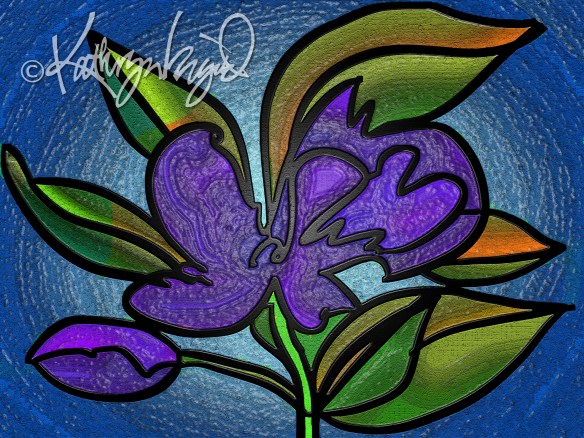
It was my birthday, and among the presents I received was one small package that was not from a family member. My parents told me that my acquaintance had asked his family to see that I be given this gift as a token of his gratitude for my visit. It was a table-top stained glass flower he had crafted sometime back when he still had the strength and skill to make such things. The little blue flower bowed gently on its wire stem, and I was abashed and moved by it.

This was a delicate token of real grace. It made a fine representation of that goodness, its glass petals and leaves letting light filter through, its slender stem so fine, yet resilient enough to spring back upward when pressed. It was a flower that stubbornly refused to wilt, even when it was a post-mortem gift from a virtual stranger. I don’t know, after all of these years, precisely what happened to it or when and where it disappeared, but I kept it for a very long time indeed and found in its simplicity a constant reminder that the little things even a reluctant and weak person might do in the name of duty or expedience or, however hesitantly and ineptly, for kindness’ sake, might in the end have some power. That this power is not our own matters less than that it can change the course of the moment, or sometimes, perhaps, even make a difference in matters of life and death.Digital illustration: Stained Glass Flower
Foodie Tuesday: A Toast to Skagen

I have not yet been to Skagen, that Danish destiny so alluring to international tourists, fishermen and art lovers, but I have long since had an imaginary affair of the heart with it, thanks to the popular Swedish concoction known as Toast Skagen. It’s quite a simple thing, really, just toast points with a light shrimp salad on them, but when the shrimp are just-jumped-out-of-the-sea fresh and sweet and the preparation of them done with a delicate hand, it’s just about as good as seafood can get. So between visits to Sweden, I pine for the treat. It’s not that I couldn’t make my own facsimile of that assemblage, for even in the heart of north Texas there are places where one can lay hands on pretty good shrimp (at a price), but since the presence of briny air and piercingly radiant northern light and the lilt of Swedish conversation all around are also key ingredients regardless of their absence from the written instructions one might find for the preparation of it, Toast Skagen is still best savored in Scandinavia, and worth the protracted longings between visits.

That is why, if it appears on an even moderately trustworthy menu in Stockholm and its environs, I am likely to order Toast Skagen without even giving much of the rest of the menu a fair study. On the visit that just ended a few days ago, I did just that. Several times. And I was not disappointed—unless you count each time I ate the last bite.

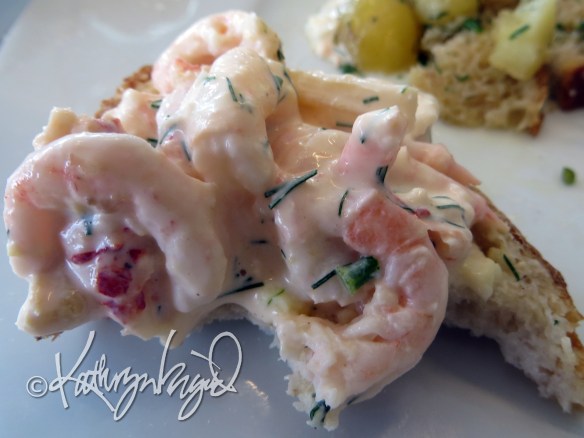
The simplicity of the combination is key, because it must showcase the freshness of the shrimp, but there is room for subtle difference just as there is in any classic food recipe or combination that has survived the twin tests of time and chefs’ egos. The best preparation of Toast Skagen begins with fresh, perfectly cooked cold shrimp, is seasoned with nothing more noticeable than fresh lemon juice and fresh dill, lest the delicate salty sweetness of the shrimp be overpowered, and is bound with mayonnaise and served with or on bread. That’s about it. The subtleties come in with the proportions in the combination, the type of bread or toast, the presentation, and a few possible additional flavors and garnishes that won’t attempt to compete with the simple perfection of the concept.Photo: Toast Skagen 1

On this visit, I managed to taste three slightly different, all delicious, versions within the bounds of our ten days. I’m sure I’d have done more, but I did have to leave room for other favorites, and despite having eaten extensively and often, I did have to accept the finitude of hours in the day. Even though with midsummer daylight, those were admittedly impressive. The version of my shrimp-laden toasty dream that I’d been contemplating for the longest before our recent trip was had on our last day in Stockholm, for we had plenty of other places to go and people to see before then, but we did finally go to Sturehof, a venerable restaurant in a swanky but not stuffy neighborhood only a hop, skip and short T-bana (subway) ride from where we stayed. At Sturehof, I was greeted by lightly toasted points of white bread and a copious hillock of shrimp shaped with the help of a very light coating of mayonnaise. A toss of snipped dill, a mild dash of perhaps Dijon mustard to undergird the squeeze of lemon I’d give it, and a spoonful of Kalix Löjrom (caviar) to give a little snappy texture and sea flavor boosting, and it was a filling but refreshing luncheon to give our last day of play in Sweden a far less melancholy tinge.Photo: Toast Skagen 2

The second version of Toast Skagen was almost an afterthought in the middle of our visit, but far from negligible in the eating. My husband and I went with a dear friend to visit the fantastic Artipelag, part seaside park, part eco-tourist experiment, part art museum and all Swedish brainchild of the inventor of the BabyBjörn line of child care products. Unlike many museum cafes, this place’s eateries are worthy of a visit entirely unrelated to the call to check out all of the other wonders of Artipelag. We didn’t even bother to go up and dine in the restaurant upstairs after having a quick look at the buffet in the less fussy main level. It was an extravaganza of delicious and beautifully prepared traditional Swedish foods and their contemporary companions, and reasonably priced for such a grand meal at that. Among the attractions for me was an early spotting of other visitors parading their plates to the table with enticing spoonfuls of Toast Skagen in their midst, but when I arrived to select my foods at the board, the Skagen bowls were empty. Empty! Thank goodness I noticed that the staff continued to keep most of the dishes there overflowing with fresh batches of food, so I pulled up my fainting spirit and managed to down great quantities of other delectables before going back to find the missing delight replenished.

It was worth the wait, which, given the quantity and quality of everything else I’d been eating quite happily in the meantime, was no small feat. This version of Toast Skagen was either the plainest or the most complex of all, depending upon how one chose to dish it, dress it up, and/or accompany it when choosing from the fabulous array of salmon with baby peas, lovely cool salads, savory sausages, buttery tiny roasted potatoes, and so much more. I opted to keep it somewhat unfussy since it was really the dessert after I’d consumed so much other tasty food. There was splendid chewy, crusty peasant bread to be freshly sliced by my own hand from a warm loaf, so it seemed the obvious thing to merely take a slice or two, give it a slick of good cold butter, because to ignore good cold Swedish butter is very nearly a cardinal sin, and put a fat spoonful of shrimp on top. This variation had the mayonnaise and dill and very little else, but because the shrimp and bread and butter were so fresh and delicious, it was as close to perfect as need be.Photo: Toast Skagen 3

The first, and not least, helping of this craved creation that I had on the journey was on a tour boat that we took with other great local friends, while cruising leisurely through the archipelago‘s canals to have a short walking tour in Sandhamn before boarding for a leisurely dinner cruise back to town. The dinner onboard was a very pleasant, well-prepared selection of Swedish favorites, like the Artipelag buffet, but at this sit-down meal one had the choice of two fixed menus, with or without drinks and dessert, and ours had an option for my object of Swedish shellfish lust on it, so that was a foregone conclusion. This was the prettiest plating of the three, and had a couple of good signature tweaks worth mentioning. Besides the creamy, dill-speckled shrimp salad and a scoop of Löjrom for that snappy seaside pizzazz, there was a small stroke of Balsamic reduction brushed onto the plate and its piquancy gave a sweeter buzz to the usual lemon spritz, the latter still perfect in its way. And the garnishing lettuce and cucumber on the plate were so bracingly fresh that I only barely resisted turning Toast Skagen into Vietnamese-style salad rolls for the occasion. I munched the greens as a mini side salad, instead. Great textural contrast in one uncomplicated gesture.

Now, should you think I was so obsessed with this specific dish and with All Things Swedish All of the Time, I can assure you that my euphoric revisitation of beloved Stockholm and environs was filled with beloved friends, too, and yes, lots and lots of non-shrimp-toast-related food. More on that later. For now, be content that you know a plain yet elegant dish worthy of single-minded pursuit, and go forth in search of it yourself.

Changing Directions

Digital illustration: Changing Directions

Do I move at the whim of the slightest breeze? Often enough, I suppose. But what really changes my direction in life? Chance? Passion? Accident? Will?

I’d say it’s been one or another of all of those at various times, and perhaps occasionally a combination of elements. What I would say most definitely and commonly is that I have rarely known very far in advance what direction my life would be taking, let alone exactly when. Living with uncertainty is at the heart of the human condition. We can’t know (nor would I wish to know) much of what lies ahead for us. Being an artist, and married to an artist, I have made some choices that guaranteed perhaps an even deeper and more frequent susceptibility to wondering what comes next. While both of us have taught at times, an occupation that has a degree of predictability and dependability absent in most other employment that involves our artistic skills and training, it never prevented the question from arising in other ways.

For me, as a longtime adjunct at the university, it meant that though I’d been there for nearly seventeen years (most of those, full-time) before I stopped teaching, I never had a contract in hand for more than a year at a time, nor was my class load or schedule in any way predestined; I taught what I was asked to teach, when I was asked to teach it. For my spouse, a tenured full professor and director of his division, he still had questions about how he might change and grow as a teacher, never mind whether to apply for or take any of the other positions on offer at other places from time to time.

We are, I think, pretty much the ordinary pair when it comes to that sort of thing. Even now, after many years of doing particular kinds of work at specific places and getting plenty of satisfaction from those various tasks, it doesn’t in any way stop us from asking, What next? Will we continue on the present path exactly as we are just now? Do we opt to  make any kinds of transitions, either changing the way we do what we do or the venue for doing it, or does something entirely new entice and draw our interest? If it does, is it attainable? Is there some utterly unimagined thing lurking just around an unsuspected corner, waiting to draw us in?

At times, it can make me feel as though I can never quite catch my breath or my balance. I tire of asking myself all of these whys, hows and what-ifs, yet I can’t resist scratching at the questions the minute I thought I’d put them to rest for a while. Even when I’m most happy and fulfilled and contented, I always wonder what lies ahead.

And that, of course, is the very heart of that human condition. We know that change is inevitable. We know that some of it will be by our choice, and much of it will be thrust upon us or sneak up subtly and surprise us all the same. And we know that, in some ways, the only guarantee we have is that we will all die wondering. It’s what we do, and it’s who we are.

I’m in the Gifted Program

Photo: Sunset in SilverdaleWhen I think of all the wildly wonderful things I’ve had the privilege of experiencing in my life, I’m more than a little cowed by it all. How does someone with a pedigree made primarily of jolly and kindly, if intelligent, ordinary folk get to rub shoulders and shake hands with nobility, both real and hereditary? The only blue in my family’s bloodstream is that of unusually unmixed Norwegian-ness for Americans, and the only green in its coffers was always the modest, hard-earned kind.

But here I am, flitting around just as if I belonged, in a great company of educated, artistic, skillful, cosmopolitan people and living like nobility myself. It certainly doesn’t derive from any actual grandness on my part any more than from goodness. I simply think myself the living illustration of undeserved largesse and unmerited grace. I might be especially skilled, at least, at being the receptacle for those who pour out all those gifts, and I am not one to deny them the pleasure, either.

[If you happen to be looking for another outlet for your excess generosity, here I am!]

In fairness, I sincerely hope I can learn to be nearly so generous, in turn, as others have always been to me. I know there are plenty of folk with far smaller resources than mine who’ll gladly have even a thousandth of the joy that’s mine, and I’ve also learned along the way that those who have been so outrageously kind to me seem always able to increase their own happiness in the transaction. Giving as gift: now, that’s the way to go.

Foodie Tuesday: Dad Goes Grocery Shopping, Too

Photo montage: Grocery BonanzaNot everybody grows up with a dad who likes grocery shopping, but I got lucky. My father was the son of a grocery man and had his first real job working for the same grocery business as Grandpa did, so it was not entirely unusual that Dad would be the one who took us kids grocery shopping when it was time to stock up again. Even summer vacations followed a little in Grandpa’s tradition; instead of the stereotypical roadside tourist attractions, he was wont to stop at any grocer’s the family passed on their travels, wanting to see what ‘the competition’ was doing and reveling in the interesting inspirations he might find along the way. My dad, too, had enough of the bug from watching his father in action that when we did go to the grocery store, it wasn’t one of those stomp-through-at-top-speed reluctant shopper experiences that so many have with their parents, notoriously fathers most of all.

We meandered up and down every aisle, having a happy, leisurely look through everything on display, and more often than not, we came home with something new or unusual or just plain frivolous. Much to the delight of Dad’s junior shopping contingent, of course!

Mom was a good grocery shopper and fed us well, and taught us the kitchen skills to use the stuff we were buying, but Dad got to play the primary role of finding the unusual fun in visiting the store. Between the two, then, they gave us kids not merely those practical survival and sustenance skills we needed but a sense of pleasure in exploring what food does beyond keeping us alive and healthy. Thanks to their teamwork, it became a focus for community, artistic invention, entertainment, and exploration, and this all made it easier to expand those ideas far beyond our home walls.

That my parents’ ideas about division of labor and gender roles was generally more practical and individualized than American, middle class, mid-twentieth-century standardized was a boon to us as we grew in many other parts of our lives. It was Mom who taught me by example to do the fix-it stuff for general home maintenance, having been brought up in a carpenter’s household herself, and both parents took part in helping us with homework, counseling us, playing with us, and much more. Dad was a neatnik by inclination as much as Mom was a careful homemaker, so there wasn’t much obvious differentiation when it came to keeping the house up and running on a simple organizational basis.

But that’s all peripheral to my thesis, which is that I was fortunate to have two parents, not just one, who took an interest in the choosing and assembling of what we ate. Dad never demonstrated a huge urge to Make things with recipes, so sandwiches and cereals and the occasional barbecue tending was his main realm of preparation, but he did those with aplomb and enthusiasm and played sous chef many a time. Mom was the chief in the kitchen. Having two skilled shoppers in the house, though, that was, and still is, inspiring, and I am the better and happier for it. If your household consists of more than your lone self, or you share meals and their preparation even occasionally with younger people, I hope you’ll consider creating such an atmosphere of joy and adventure in the process as well!

About Average

Digital illustration from photos: Handy, or a Handful?

Am I handy, or just a handful?

I’ve always thought of myself, without any implied value judgement, as an average person. But given my conviction that each of us is as distinctive as the proverbial snowflake, being average does not imply sameness in every way or with every one. After all, I have my distinctions, as anyone who knows me in the least can tell.

Still, in my particular milieu, those paths I’ve trod in my life’s journey as well as the matrix of my personal genetics and environmental influences, I have never tended to stand out from the crowd much. Some of that could clearly have been thanks to my preference for being a wallflower and remaining as invisible as I could manage during all of the years of my intense anxiety and self-doubt. But I really did blend in more than not, even when I felt like an emotional outsider. I’ve generally been just about smack in the middle of the majority wherever I’ve found myself in life.

Few are the superficial and visible things by which I can or could be easily singled out from a crowd. I am of approximately average height and weight, not particularly short or tall, thin or fat. I wear what I’m told are the average sizes in clothing—mostly Mediums, if not numerically average in a more specific way—and the most common size of women’s  shoes, those also in the medium width. I have brown hair; I have all of the standard, requisite limbs and appendages and other body bits in the ordinary places one would expect to find them, and a relatively symmetrical frame. I am neither notably hideous by popular standards nor a stellar beauty.

My education extended to college and a master’s degree, something not everyone has the wealth or privilege to experience, and I got pretty good grades all through, but again, nothing to put me on the map or anyone’s Specialness radar. My personal life, my daily activities, my work life: these are all unmarred by major peculiarities or notable oddments that would make me memorable to anyone who wasn’t already paying attention to me. What does all this mean? Is it unusual that I’m, uh, not unusual?

Nope. I think what it means is that each of us, unique in some ways, is utterly average in others. The world isn’t actually divided neatly into things, let alone people, able to be classified as belonging in a certain percentile as Normal or Average, above or below it, and remain in that category in all ways, for all time. Every one of us people, places, things, animals, vegetables and minerals seems to have a complex, and ever-changing, collation of classifications, each of our characteristics being at its own level, some of which levels vary over time and—

Oh, never mind. This could devolve into such a death-spiral of convoluted thinking that I might just explode into some sort of extraordinariness, if I’m not careful.

[Muffled, slightly crazed laughter]

My Misfit Brain

Digital illustration: My Brain is an Alien

Unknown's avatarA Holistic Journey

One sunny afternoon I went to a family and friends’ celebration, and I wanted the earth to swallow me whole. I’d that very week been diagnosed with clinical depression and anxiety; nobody there knew. Those at the gathering were celebrating religious and political beliefs that were virtually opposite to my markedly less conservative views. I was invited as a relative, and never knew if they really thought I shared their views or if it just didn’t matter. There was a lot of Bible reading, text interpreted to support favorite right-wing politicians. Many emotional speeches on the rightness and beauty of the group’s beliefs also implied that divergent views were stupid, evil or both. I wished I could disappear.

Mental health problems are inconvenient, messy, embarrassing. Incompatible philosophies and tastes, maybe even political or religious views, are sometimes socially acceptable as matters of personal leanings. But being exceedingly depressed or anxious?…

View original post 325 more words

Did that Sound Insincere?

My family thrives on sarcasm, satire, and silliness, with a tiny dash of the snarky for good measure. It’s in the genetic pattern, and I can’t remember a time or age when we weren’t all generally a bunch of smarty-pants, irreverent goofs around home. I can’t even remember the first time that I began to realize that not everybody speaks that language. Some people think it too flippant (or possibly, blasphemous, at times), and some simply and plainly see the entire world in a very literal light. I can certainly understand how, to them, my family’s way of communicating would be mystifying and, very probably, make us seem really dimwitted or alien, or both. I don’t mind. It’s most likely true, about me, anyway.

Digital illustration: Did that Sound Insincere to You?

There are times, however, when I have well and truly put my foot in it. And I wish that I either could have read the situation better or had simply paid better attention. Sometimes it’s not nice to be flippant or jokey or snarky, or even to say the direct opposite of what I mean merely to lighten the mood or put someone at ease. Such stuff can go very wrong in an instant if I fail to notice that the party on the receiving end doesn’t converse in that language, or doesn’t appreciate what I think of as its lightheartedness.

But to be honest, most of the time I just think it’s their loss.

With one particular exception: I do feel especially ridiculous when I’ve been consistently playful and perhaps outlandish in my communications with a person and I want to get serious for a moment, especially when I want to say something complimentary. Did it now sound like I was insulting my friend because I was uncharacteristically nice and kindly? If I think it humorous to be droll and dry and sarcastic, maybe I’ve gotten too far from being nice! What’s a poor fool to do? Most likely, fall back on my old ways and hope for the best. At least I’ve done marvelously well in my life at surrounding myself with people who are almost superhuman in interpreting my chatter with generous and accepting ears and open minds, so I haven’t yet been banished from polite society despite my shortcomings.

And if you’re one of the many who have thus given me a pass, I thank you deeply. No, I really, really do mean that!

Unexpected

To my beloved husband with great love and affection on our eighteenth anniversary: you continue to surprise me, all of these years after your initial unexpected appearance as the love of my life!

Digital illustration from a photo: The Base of the WallSnowing Amethysts

At evening, summertime holds breathless sway

When even crickets wait before they’ll sing,

And birds to roost go silent; everything

Takes pause because the lengthy heat of day

Has drawn a shawl of stillness down to lawn

And flowerbed and hedges, ’til a breath—

So shallow it could scarcely ward off death—

Is difficult to breathe ’til the break’s gone,

Until the night resumes its stealthy crawl,

Exhaling with a stirring wind that flies

Up, stirring blossoms upward to the skies,

Their petals dropping, ash-like, down the wall,

Crape-myrtle petals drifting down below

In waves of amethyst, a summer snow.Digital illustration from a photo: Amethyst Snow

We were So Civilized

Digital collage: We were So CivilizedNo matter where I am on the Fourth of July I am likely to think about the country in which I was born and have lived all of my life thus far: the United States of America. The Fourth is the official birthday of the nation, though many of the current states joined the union long, long after that July in 1776 when it was established by its founders. Like so many nations around the world, this country and its history are a tremendously complicated and varied patchwork of fact and fiction, hope and fear, two steps forward and one step back. Over and over and over again.

Imagine this: a pack of refugees from religious persecution left their homeland and sailed into the unknown across an ocean of which they also knew very little except that their passage across it was dangerous and miserable and killed plenty of them before they hit the new shore. When they landed, to their surprise there were already plenty of other people living on that new turf, and did that stop the interlopers from moving in, too? Of course not. I don’t expect it ever occurred to them, to be honest, that there wasn’t room for everybody or that if they took a ton of the resources around them that might just mean there were fewer for the previous residents of the land, folk who had, indeed, already long established a very different relationship with the continent.

That the illnesses and diseases the newcomers brought with them from Home would endanger and kill many of their new unwitting and unwilling neighbors could never have entered these interlopers’ minds, when they were so preoccupied with not only their current survival but their escape from the hardships and sorrows back in their own homeland. That they themselves would suffer privation, fear, danger, loneliness, and the loss of their lifetime homes, belongings, families and friends across the vast ocean they had crossed was a stark enough reality that perhaps they willed themselves not to think too hard about all that they faced next also affecting the long-tenured native peoples across whose lands they moved like human bulldozers.

The establishment of this new home was far from smooth and easy too, as anyone could probably guess, though I wonder if any of them really considered that the goal as much as simple escape from what they’d known before. Still, none of those inhabitants of North America—invaders or original denizens—could possibly imagine at the time, I suspect, quite how vast the whole continent was and what that meant in terms of creating new colonies within it, let alone new nations. In the years that followed, the westward migration confirmed the existence of innumerable tribes and clans of people not before known to the new arrivals, but also of wild creatures unimagined, of terrain unlike any they had dreamed possible, of climates that had been the stuff of legend until then.

In those many decades of carving out new paths and territories, it was inevitable that, just as it had been with the foregoing generations of various indigenous peoples, there would be struggles over who had access to what, who could live where, and who belonged together with or as far as possible away from whom. No surprise that this led not only to separated towns and enclaves and ethnic, religious, political or philosophical communities but also, in turn, to a wild array of accents and ideas that might as well have been different languages and different species altogether.

Amazing that all of this could remotely possibly coalesce into what is known as the United States of America. Today’s states are still so diverse, even sometimes from county to county or one side of the railroad tracks to another, that it’s nearly laughable to call them United. We fight like pesky siblings with each other all the time; it’s a miracle, in my book, that the so-called Civil War, one of the most uncivilized events in the country’s history, hasn’t simply continued from its beginning to the present day. It does, perhaps, at subtler levels. Just because the invasion of the continent by a bunch of frightened Pilgrims who only thought themselves seeking freedom from tyranny didn’t destroy the whole land and kill every one of them off outright, and because the various internal skirmishes that led to, but were far from limited to, the Civil War didn’t complete that annihilation doesn’t mean we’re not still perfectly capable of incredible incivility at every turn. We try, we fail.

On the Fourth of July, I think of how astounding and—generally—good it is that this messy nation has managed to survive this long without self-destructing. But I can’t help also thinking this of most of the rest of the world. Humans just plain are messy. We form and break alliances; we argue over being Right instead of being compassionate or practical, let alone pursuing justice. We blunder around, hog resources, ascribe privileges and powers to ourselves and our chosen comrades that we willfully deny others, or just pretend the others don’t exist, and thanks to our weirdly, wonderfully diverse array of accents, when we do get around to discussing the least of these things, even those who ostensibly share a language can’t understand each other half of the time anyhow.

Just possibly, our life form may have been civilized at a few choice moments. There is plenty of potential in this odd species of ours, I like to think. Even we Americans aren’t entirely irredeemable; we keep bothering and beating up on each other like so many brothers and sisters, and yet most of us still manage eventually to just agree to disagree and, in moments of precious lucidity, even to see each other’s point of view and operate in an environment of respect and hope. As rotten as we can be to each other, we care enough to wrestle it out and try to find ways to go forward. Together, even. If that isn’t a family worth saving, I guess I don’t know what one is. Happy birthday, USA. Go forth and get a little more civilized, if you can.