Foodie Tuesday: Dad Goes Grocery Shopping, Too

Photo montage: Grocery BonanzaNot everybody grows up with a dad who likes grocery shopping, but I got lucky. My father was the son of a grocery man and had his first real job working for the same grocery business as Grandpa did, so it was not entirely unusual that Dad would be the one who took us kids grocery shopping when it was time to stock up again. Even summer vacations followed a little in Grandpa’s tradition; instead of the stereotypical roadside tourist attractions, he was wont to stop at any grocer’s the family passed on their travels, wanting to see what ‘the competition’ was doing and reveling in the interesting inspirations he might find along the way. My dad, too, had enough of the bug from watching his father in action that when we did go to the grocery store, it wasn’t one of those stomp-through-at-top-speed reluctant shopper experiences that so many have with their parents, notoriously fathers most of all.

We meandered up and down every aisle, having a happy, leisurely look through everything on display, and more often than not, we came home with something new or unusual or just plain frivolous. Much to the delight of Dad’s junior shopping contingent, of course!

Mom was a good grocery shopper and fed us well, and taught us the kitchen skills to use the stuff we were buying, but Dad got to play the primary role of finding the unusual fun in visiting the store. Between the two, then, they gave us kids not merely those practical survival and sustenance skills we needed but a sense of pleasure in exploring what food does beyond keeping us alive and healthy. Thanks to their teamwork, it became a focus for community, artistic invention, entertainment, and exploration, and this all made it easier to expand those ideas far beyond our home walls.

That my parents’ ideas about division of labor and gender roles was generally more practical and individualized than American, middle class, mid-twentieth-century standardized was a boon to us as we grew in many other parts of our lives. It was Mom who taught me by example to do the fix-it stuff for general home maintenance, having been brought up in a carpenter’s household herself, and both parents took part in helping us with homework, counseling us, playing with us, and much more. Dad was a neatnik by inclination as much as Mom was a careful homemaker, so there wasn’t much obvious differentiation when it came to keeping the house up and running on a simple organizational basis.

But that’s all peripheral to my thesis, which is that I was fortunate to have two parents, not just one, who took an interest in the choosing and assembling of what we ate. Dad never demonstrated a huge urge to Make things with recipes, so sandwiches and cereals and the occasional barbecue tending was his main realm of preparation, but he did those with aplomb and enthusiasm and played sous chef many a time. Mom was the chief in the kitchen. Having two skilled shoppers in the house, though, that was, and still is, inspiring, and I am the better and happier for it. If your household consists of more than your lone self, or you share meals and their preparation even occasionally with younger people, I hope you’ll consider creating such an atmosphere of joy and adventure in the process as well!

I Did It Myself…*to* Myself

Do It Yourself (DIY) projects, when well executed and realized, are impressive and admirable. They double one’s pleasure in the end product by being not only beautiful and useful as desired but also the satisfying result of her own skilled labors. Personal investment increase value exponentially.

I can claim a few DIY accomplishments on my resume, happily, despite my ordinary limitations of resource, monetary or of expertise or ability for the project in hand. But having mentioned hands, I must also confess to having a DITY (Do It TO Yourself) record as well. On the occasion of the hand-made hand injury, I was fortunate that my second of inattention resulted in no worse mishap than a tiny nip on my finger.

Being an artist, I did however do this with a certain degree of style: when I stuck my finger with a single tooth of my nice, sharp little hand saw (too aptly named, perhaps?), I did manage to insert the steel into the only small spot on my hand that already had a visible scar. Puncture becomes punctuation, so to speak.

As always, the tiniest wound is magnified by other pains, not least of them the injury to ego and dignity when on the instant of infliction I succumb to a combination of reactions that to the uninjured could only have a sort of serio-comic ridiculousness perfect for cutting me down to size. The unpleasantness of having made an unwanted incision in my personage is compounded by the leap back that threatens to throw me over a chair and onto my tailbone; the pinching clamp of fingers on the cut to stanch the bleeding hurts almost more  than the initial stab; the yell of pain that, in my nephew’s youthful terminology ‘scares my ears’ is also loud enough for the neighbors to hear and enjoy. On top of all this is the diminution of my sanguine pride, reminding me that my handy skills are sorely limited no matter what I tell myself.

Does this prevent my attempting further DIY projects? Hardly! Being by nature a timid and lazy and not-so-brilliant craftsman hasn’t made me give up but instead tends to make me plan and work things out fairly exhaustively before I begin, and to assume that I’ll make mistakes or need help before I finish. It all slows me down, to be sure—and that’s not a bad thing, mind you. Any DIY work is bound to be only as polished as patience and occasionally remedial work can make it.

When I speed up too much, I get sloppy and unfocused; I make silly mistakes like sticking my finger on a saw tooth/a saw tooth into my finger. Luckily for me, I didn’t have a power saw going there, so all I lost was a few minutes, my composure, and a few red cells rather than a digit. In return, I got a good reminder to sharpen my attention, to use tools with greater care, and to call in expert help when needed.

After all, I’d far rather sacrifice some dollars and a touch of my DIY pride than an appendage. This is how I’ve survived to my advanced age without losing any body parts or breaking any bones. I have recovered numerous times from being an (or falling on my) ass. Self image is ever so much more resilient than such things. Arguably, a little too much so in my case, or I wouldn’t tend to get into these fixes at all.

Of course, getting into a fix is something I can easily do all by myself. For that task, I do have all of the necessary experience and expertise.Digital Illustration: In Which I am a Silly Ass

Blowing through the Wild Grasses

Weed or wildflower? Messy or naturalized? Everyone has an opinion, and they often differ distinctly on the same little plant or plot. Part of the pleasure of good company will always be in its variety and the interest that it brings to life. Gardening tastes are very much in that vein.

Digital illustration: Wild Grasses

As a sometime gardener, however amateur, I can think of few styles of landscaping that I don’t find appealing and attractive in their own ways. I admire the near-perfection of elaborate, formal palace gardens and magnificent, fountain-filled parks with their follies and allees. I am fond of a rustic campfire-side bramble patch, punctuated by straggly hydrangeas run wild, down by the lakeside. There is both soul refreshment and eye appeal for me in a delicate Zen garden with bonsai, laceleaf maples and a barely rippling koi pond.

When it comes to my own gardens, I tend to walk just a little farther on the wild side. I hate to fiddle and fuss at length with the hard labor of a garden. I greatly prefer the genteel pleasures of the design of the garden, and perhaps the occasional artistic pruning to shape a rhododendron or sapling tree. But I’m not so wild about back-breaking rock picking and digging; I moved from incredibly rich but equally rocky volcanic glacial till of western Washington to the cement-like red clay of Texas, both places where putting a one-gallon root ball into the ground requires a pickaxe.

My first garden was an exploration of the beauties of cottage style gardening. Washington, temperate and moist, was ideal for a grand assortment of bulbs, flowering shrubs and cutting flowers, so I had profuse blooms and constant green with little effort. The traditional cottage style allowed me to squeeze a massive amount of lively growth into a normal city house lot, and the more I wedged into the ground, the less room there was for volunteer and invasive plants. Weeds had a tough go of it there, so it wasn’t especially hard to keep ahead of them.

There are plants I don’t invite to my parties. Much as I enjoy and admire most, I’m no friend of those pest plants that choke out others, cause massive allergies, or stab at me with cruel thorns, or those that threaten entire ecosystems, mine or others’. Good riddance to misplaced English Ivy, kudzu, poison oak and wild blackberry canes. Conversely, one of my particular favorite garden options is to find ways to encourage native plants to thrive. The more a plant is suited and accustomed to its environs, the more it will grow and be healthy and attractive and weed-proof.

Texas has reinforced that love in my aggressively. It’s a harsher climate than the Pacific Northwest’s in which I now garden, so what I plant and tend must needs be up to surviving and flourishing in those more demanding circumstances—or die. Even desert plants don’t necessarily have what it takes, since north Texas can still get true freezes in winter, and occasional snow, hail and ice. This last winter, a relatively mild one, still killed off a lot of specimen agaves and prickly pears and even cut some mighty oaks down to size.

I’m finding that the area’s status as an extension of the country’s central prairies may be the key to what will survive and grow here long term. When anything will grow, that is. I’m tending to my little wildflower meadow out back, to see if I can’t reintroduce something a little more self-sustaining than those long cultivated but seldom successful hard turf lawns that were popular in our area and surrounded our house when we bought it. Even better than the wildflowers, I’m finding, will be the ‘amber waves of grain’ I seeded in  among the wildflowers, the native prairie grasses.

Prairie grasses have some of the deepest, toughest and most tenacious root systems of any type of plants, and along with the leaves that sway in every breeze, often creating symphonies of susurration, they go to seed in many attractive ways. So I really am enjoying ‘sowing my wild oats.’ And Little Bluestem, Fountain Grass, Weeping Lovegrass, and many more. My backyard creatures will enjoy them, and their varicolored, many-textured attractions will beat any struggling, forced lawn that ever tried to eke out a living where its native cousins once roamed free.

Bring It On

There’s that old saying about how ‘it never rains but it pours,’ and while I often think it’s true that troubles and trials seem to come in number rather than singly, I also tend to think that’s the sense we get because everything subsequent event’s difficulty is magnified by the one that preceded it. And of course, in a more literal sense, since moving to Texas five years ago during a period of general drought in the region, I would be inclined to say that it seldom rains enough here, let alone pours. Much as I might find minor inconveniences and even annoyances brought on by a rainy day, the more so if it’s stormy, I am glad enough of the needed moisture that I don’t hang onto any grudges against nature’s outpourings. Even on that persistently blinding, bleary day of storms when I took my turn driving toward home at the end of last year’s summer road trip I was more grateful than hateful regarding the dousing we received, and that’s going some for a nervous driver like me.Photo: Rain Storm on the Road

I am reminded these days, though, of the original frustrated character of the proverb and am working not to get sucked down into such a mode myself. There have been little hints from my mind and body that perhaps the decade-plus of grand good health and wellness I’ve enjoyed upon being treated for and generally freed from depression and anxiety and the nasty physiological symptoms thereof may be, like the moon in a spooky campfire tale, on the wane. I’ve avoided thinking about it much not only because it’s an unpleasant prospect in itself but also for superstitious fear that just contemplating such a thing makes it more possibly true. And at first, it was just those little, nagging bits of something that I couldn’t quite define as backsliding: a hint more tension when riding in the car, a touch more touchy about unimportant problems in the day-to-day, a stomach-ache when I get worried about a deadline….

But when we were at the airport the other day, waiting to board a perfectly ordinary flight to go to the familiarity of our own home after ending a week of (for me) unfamiliar and exciting travel that should have been the tough part of the equation if there were any, I had the horrible experience of an emotional meltdown in a panic attack. It’s been so many years since I had one that I almost didn’t realize what was happening and thought I had simply gotten a sudden illness of a more ordinary kind, and that would be irritating enough in its own way, but when I did connect the dots and know that I was losing all sense of control and well-being, the drop down that well was swift and obliterating. I am relieved that it was a relatively short-lived event, and I doubt many around me knew anything untoward was happening, but inside, I was a morass of terror, unable even to speak in quiet gratitude to my spouse for his patience. In the end, I got on the plane and, once there, cocooned with my scarf and went to sleep as quickly as I could, and that was that.

The speed and intensity of the attack, however, were enough to convince me that it’s now time to see the doctor and discuss what to do before I fall as far, and for as long, as I had in the past. I have no use for being that powerless and miserable shadow of myself ever again. I hate feeling almost perpetually nauseated, often breathless or dizzy, ice-cold and then broiling hot and then ice-cold again. I loathe feeling like I will burst into absolutely unwarranted uncontrollable crying at any moment. I abhor feeling like a useless baby. I despise feeling so sick and enervated and exhausted that I can barely lift my arms, no, can hardly croak out a word without wanting to keel over. I reject that version of me!

During our lovely week in Puerto Rico, it rained one day in the intense and intimidating and glorious way that a tropical shower can do. It was pouring thoroughly enough that we waited until the hardest pounding let up a little, popped open our umbrellas, and headed out knowing we’d get good and wet. I was glad of wearing both quick-drying summery clothes and open, flow-through sandals, because even with our umbrellas in full bloom and the rain somewhat lessened, within about two blocks’ walk we were seeing rivers race down the street and right on up over our feet. By the time we stopped in a coffee shop not so many minutes later, we were pretty damp all over and soaked up over the ankles. It was warm weather, and the rain dried very quickly indeed, and of course we long for that sort of bounty for our Texas landscape, so we rather enjoyed the novelty of it all. But I’ll admit that even knowing that the rain’s a tiny price to pay for the generous greenery of the tropics, I was delighted to see the sun again as soon as it arrived.Photo: Rainfall in San Juan

I can’t say what is the benefit of going through the floods of depression and anxiety. I can only hope that at least it teaches me to be more mindful of the many blessings I do have and to fight my way back up and out toward them as quickly as I possibly can. Perhaps, if I’m lucky, I will also be more sensitive to others’ struggles when I have been reminded how hard it is to keep perspective when one’s own brain and body absolutely refuse to bow or to cooperate with the tiniest and simplest, most logical of requests. All I can say for certain is that I am not planning to lie back and take it. You’re gonna rain on me, eh? Bring it on. Getting out my umbrella, yes. Digging up every resource I can find or imagine, done and done. Climbing up the side of the well with my own fingernails if I have to, rather than falling farther into it, see ya on the other side, pal. Bring it on.

Attention to Detail in All Things

digital illustrationI’m far from being the world’s best gardener. I may have the perfect skill set as a lazy dilettante, loving the design process and having a tremendous appreciation for all of the non-laborious joys of a garden, whether it’s well tended or not. A bark-boring beetle or a sculptural skeletonized leaf can be as beautiful as any spectacular, pristine lily or a lilac’s heady bloom. A moss-choked stone path is as glorious as a graceful fountain encircled by perfect tea roses and rosemary. And I have had quite the aversion to trench digging, rock picking and weeding ever since I was old enough to be conscripted by my parents for the purpose.

But I also know that if a garden is to have any hope of continuity and flourishing in flower, it needs occasional attention to such details, at the least, from Nature’s seemingly random hand. The gusts and waterings, composting and tillage performed by her weather and her handyman crew of creatures all do their parts in keeping the landscape in beautiful form. Even better chance of thriving if I do my part, too, having noticed what details might better prosper under my attentions, however slight they might be.

I was reminded of it recently as I watched a family make their valiant attempt at getting a group portrait. Flanked by grandparents, the parents stood holding their two little boys: Dad, in back, held the eight month old and Mom, ahead, wrangled the three-year-old. No one seemed able to get the normally placid toddler in front to hold still for even one quick photo, or to understand why he was so unusually squirmy, until someone finally noticed what I could see better from my side angle: that the baby was cheerily leaning forward at intervals and yanking his big brother’s hair. Detail noticed, problem solved. Had that adorable little scalawag been able to keep up the practice, I have little doubt there would’ve been need, eventually, for an expulsion from that particular little Eden.

I, meanwhile, must try to keep after my own gardens, the real and the metaphorical, and make sure the little buzzing creatures and weeds don’t get too far out of hand.digital illustration

Building Dreams

Dollhouses were for other girls. I preferred to design my fantasy floor plans and build them out of cardboard and found objects in the built-in bookshelves in the upstairs bedroom. I built them for dolls if those happened to be handy, but since I wasn’t ever a huge fan of dolls except as handy models for my model homes or as fashion models for my clothing and costume designs, my time and energy were more happily spent on the architectural fantasies and the drawings that led to them.

There was never any hope of building the real-world, full-scale versions of any of these, since I started as a young squirt whose whole bankroll comprised a few allowance installments, then grew up (a little) into an arty type, yet another iteration of the sort never meant to have large hunks of cash lying around. I never stopped loving buildings and the magnificent, marvelous pleasures of dreaming up all of the different ways to make interior and exterior spaces work beautifully for all of the different people and purposes I imagine in them. As I grew, my methods leaned less toward bookshelf usurpation and more toward drawings and particularly, toward inner design: one of the ways to soothe myself to sleep when my brain is too hyper for relaxation is to choose a specific kind of building, close my eyes, and try to work out every tiny detail of it in my mind. Eventually, that usually leads to the perfect combination of dozing off and waking up with some new inspirations, often enough ones that can be applied to other things than mere mental building construction.

Just because I’m realist enough to know how unlikely it is that I’ll ever afford to build a dream house in reality doesn’t mean that there’s nothing purposeful in my fantasizing. I’ve invented all sorts of dandy details that would make the constructions more ecologically sound, longer lasting, easier to change and update over time, simpler to construct, more affordable, energy-efficient, attractive in a number of styles, and flexible for multiple users’ needs. All in my head, with the exception of a few on paper and a few in the old bookshelves in Mt. Prospect.

Anybody who has a pile of money just sitting around all unloved and unused and wants to contribute to the construction of my living-&-arts community complex should feel free to give me a jingle. Barring that, I will happily continue sharpening my mental prowess as a developer of mental real estate. Come on inside, if you can figure out how to join me here.photo

Foodie Tuesday: Drink & Shrink

photoWould that I could tell you that today’s post title implies I’ve discovered a miracle diet that allows me to become slinky and svelte by doing nothing but sipping cocktails, yet alas, this most sadly is not so. In fact, it’s a very safe bet that numerous cocktails are, like certain bras, nothing more than alluring cups full of doom, being bad for both health and sanity if sampled in inappropriate quantities and circumstances. But to steer closer to my actual point, I must confess that despite my many food-and-drink-related loves and obsessions, I do get quite hungry and thirsty for a healthier change on occasion.

Like now. I seem to have been on a bender lately, eating too often, too much, and too badly in general, and my body is complaining. It’s not that I have grown morbidly obese, thanks more to good genes and good luck than good behavior, but I have grown a whole lot closer to outgrowing my attire and decidedly closer, as well, to just not feeling so great. It makes me squirm when I think of how unfit I will be in short shrift if I don’t just stop being such a spoiled child around food. And I have it on good authority that being horribly unfit is not the way to insure a longer, healthier life.

Drat.

photo

At least I know that I can still have delicious food, but even if it’s better for me, eating too many helpings of ‘Waldorf’ slaw (sweet cabbage-yogurt salad with chopped apples) is just as dangerous to my eating habits as too many helpings of pretty much anything.

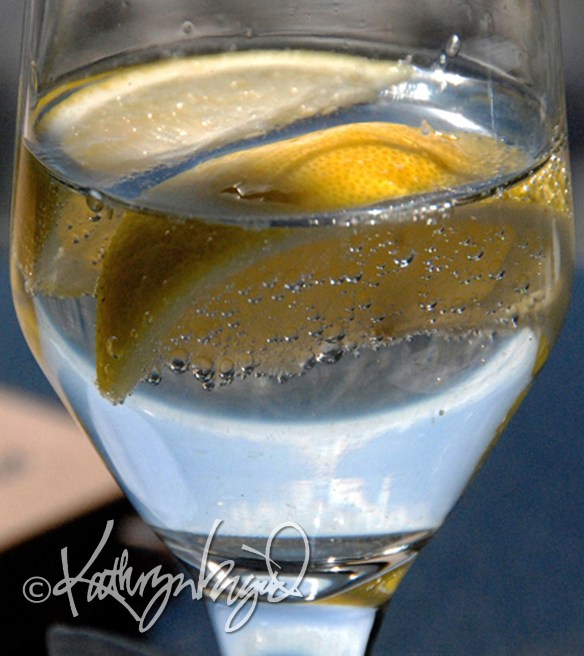
I must throw a bracing dash of cold water on my enthusiasm for overindulgence and get myself closer to optimal comfort. I don’t care if that makes me model-thin or gives me fab abs or any of that superficially pleasing stuff or not; what I want is to feel my best and have a good shot at the whole ‘live long and prosper’ proposition. I know from experience that among other benefits of returning to a more thoughtful eating agenda, my appreciation of all that I do eat and drink increases greatly, to the point where a simple slice of citrus and a glass of pure, clean water is a pleasing sensory experience as well as thirst-quenching, and a complete meal becomes a feast. So much more satisfying in the long run.

And I do want a good long run of it, after all.photo

Yet More Advice-to-Self

text

text

digitally doctored photo

All Gardens should be Herb Gardens

photoI am prejudiced. It seems logical to me that any garden grown for beauty should be grown for utility as well, and any garden grown for use ought to be pretty to look at and full of great sensory experiences well before it gets put to work. Why shouldn’t gloriously pretty edible and functional plants be shown off in all parts of the landscape, and why shouldn’t we take better advantage of what we have growing around us anyway?photo
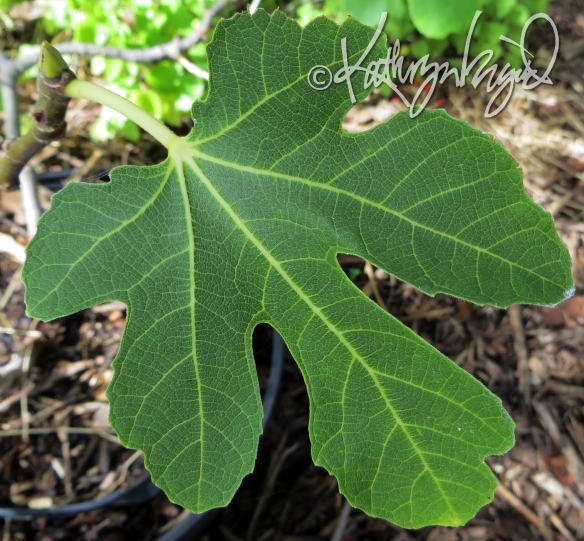
Thankfully, these biases of mine are becoming more widely put into practice all the time. While kitchen gardens have a grand tradition of being ornamental and landscape design has long had its elements of utility inserted, those approaches have tended to be rather exceptional than the norm. So I’m thrilled to see such a proliferation, a flowering, if you will, of the whole concept that these belong as integrated into a delightful whole.photo
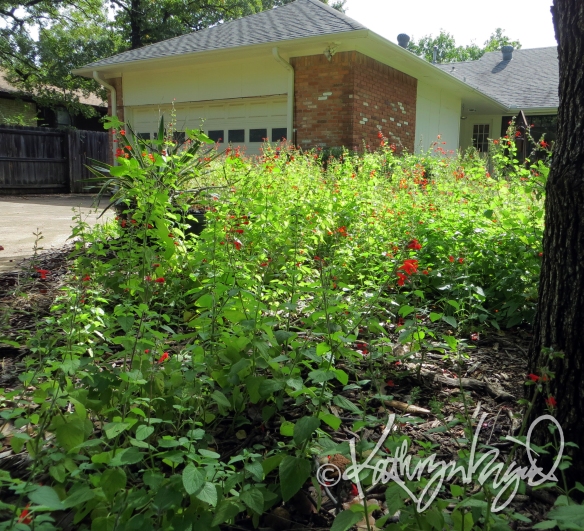
My friend Christopher’s interest in starting the garden personalization of his next home with herbal inclusions and infusions (not to mention his appreciation of adventuring in the kitchen) got me thinking about my own past and present herbal operations. What do I consider a good framework for inserting my own preferences, herbally speaking, into the garden nowadays? And what, in turn, is actually happening in that way here? Not surprisingly at all, this thinking turned into a lengthy exercise in list-making. Herewith, my mental inventory of herbal ideas. Foremost among them: that I plant every and anything in my garden where I think it will thrive best, then opt for where it will provide the most splash and panache in complement with the nearby plants, and finally, tuck in some elements of surprise wherever I think they can inspire even the casual visitor to the place. Herbs, fruit, vegetables, common or exotic. So long as I’m not trying to subvert the laws of nature too far, let alone encourage an invasive alien species anywhere, it’s all fun.

For the moment, though, I’m focused mainly on herbs and a few similar animal (human or otherwise) friendly options.photo montage

Easiest to keep as perennials or self-sowing annuals are some of the best kitchen basic herbs and also some of the prettiest flowering or border texture plants, so they’re what I’d call genuine bargains in the herb dept:

Parsley (curled and flat-leaf); both can get pretty large over time, but are also pretty easy to cut back if necessary. Be prepared for gigantism, since parsley can easily top two meters in height when it’s stretched out in bloom.
Chives (common and so-called Garlic Chives); both give that nice light oniony flavor, and of course the ‘garlic’ variety has a hint of garlic in it as well. The purple pompom-like head of the common chive is attractive in the garden or as garnish and also edible, but I’m especially fond of garlic chives as a garden plant–they don’t look at all like the common chive, having a flattened stem and clusters of tiny white lily-like flowers in place of the purple variety’s.
Rosemary comes in a wide variety of shapes, sizes and leaf lengths, most tasting similar. It’s a woody, shrubby plant in general, but some are upright, some trailing. The blooms vary: white, pink, lavender, purple, even quite blue, depending on the variety. Pretty and fragrant even while still in the yard, and bees and butterflies tend to like it too.
Thyme also comes in a ton of forms. Its types vary slightly in the pink-to-violet bloom range (quite tiny flowers) and quite a bit in the leaf type: white- or yellow-edged green, solid green, silvery; some, like Lemon Thyme, have mildly differing flavors as well, and some, like Woolly Thyme, are more strictly ornamental. Me, I’m quite happy with common thyme (Thymus vulgaris); it’s really quite easy to grow, even as a sort of ground-cover plant in borders, easy to control, has those cute little blooms, and is a very versatile herb for cookery. My favorite with chicken.
Sage is pretty easygoing, too, and also has numerous colors. I like growing the purple-leaf and variegated yellow- or lime-and-green varieties for what they bring to the flowerbeds. They can get big and leggy and woody, so sometimes sage plants require some good pruning, but it’s not hard to do with them, and sage is so lovely with poultry and winter vegetables, not to mention that their fried leaves are fabulous with lots of dishes!photo montage
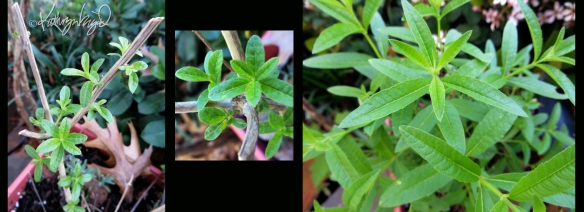
Some of the less common ones I love are well worth mentioning, too:

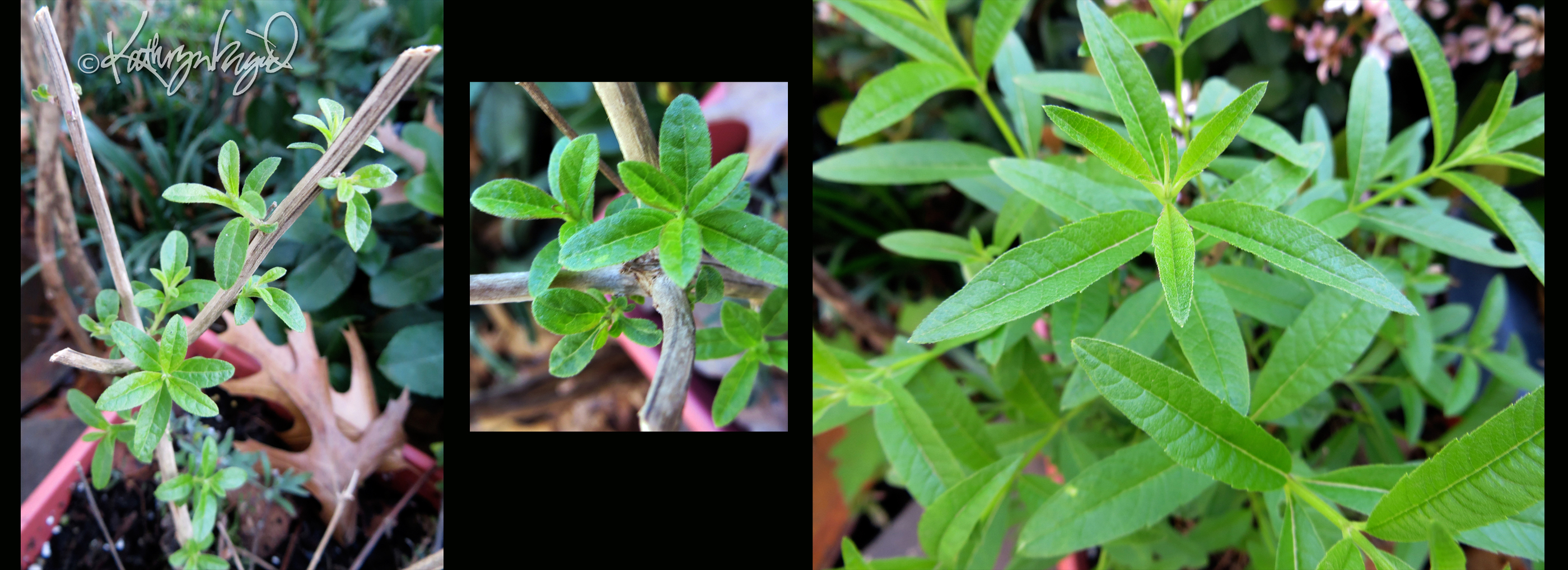
Lemon Verbena is better started from a live plant than seed and is fragile. I suspect it could work as a kitchen-window dweller for longer life, though I’ve not tried it indoors. I got lucky with it wintering over last year! As I said, great to add to tea (hot or iced), and would be dandy in anything where you want a less astringent lemony, kind of perfumy, flavor. There’s a lemon verbena ice cream recipe on epicurious.com that is sheer HEAVEN.
Borage is an annual, but I got lucky last year and it self-sowed from the previous season. It’s a kind of straggly and tall plant and has hairy, even lightly spiny, leaves and stems, but the hairs actually look kind of pretty in daylight, adding a lacy aura to the plant, and they don’t outright hurt when you touch them at all. Both leaves and flowers have a lightly cucumber-like flavor that’s nice in salads or cold drinks (chop the leaves finely or smash ’em to keep the fuzziness from being an off-putting texture in food), and the blooms are gorgeous, starry, true-blue dainties.

&    Sweet Bay, if you have the room for an actual tree, is a pretty one and exudes a faint resinous perfume on a windy day as well as providing bay leaves for all sorts of cookery. In a former home I had a 4 foot tall lollipop shaped semi-bonsai one I grew in a big galvanized tub and wish I could’ve taken it with me.
&    Saffron is both useful and a glorious choice for the garden, being the dried stigmas of a very pretty kind of crocus. These bulbs don’t naturalize readily like some crocus, but are of course worth the effort and expense if you can get them.
&    Sorrel‘s bright acidity makes it a welcome herb with which to spike a salad, my favorite use for it. The zippy sourness comes from oxalic acid, so it’s not something you want to eat by the bale, but it’s not so potent you can’t safely make soup or just eat it raw in small amounts. The flower stalk is slightly weedily aggressive, and the leaves are very popular with munching insects, but since it’s not a virulent spreader the flowering isn’t hard to nip, literally, in the bud, and those insects are often butterflies and moths, so I’m happy to share with them.

Some herbs are big on flavor but not worth trying to grow in the wrong climate or simply too short-lived for my lazy wishes:

&    Cilantro: I love it, but it bolts (goes to seed) so fast that unless I grew a huge patch of it for one-time harvest and freezing or kept planting it repeatedly through the season, it’d be sprouted and dead in no time, so I’m happy to pay farmers to grow it for me.
&    Kaffir lime leaves and lemongrass and ginger (okay, that’s a rhizome, not an herb) are exceedingly delish in all kinds of Asian foods but require more tropical conditions than I’ve lived in for their happiness!photo montage

Some annual herbs are worth the effort, even if they don’t tend to self-sow:

&    Basil is one that I have been known to plant in a couple of varieties a season for different purposes: the purple leafed types are pretty as well as decent tasting; Thai Basil gives a specific and welcome familiar spice to Thai and Vietnamese cookery; Sweet Basil is the most versatile flavor king among them. They all have nice blooms, though not showy; if you let them bloom, though, they tend to wind down as their work is done, so you want to keep beheading at least some if you plan to keep using it through the whole growing season. Then basil tends to keep proliferating. Cruelty pays! 😉
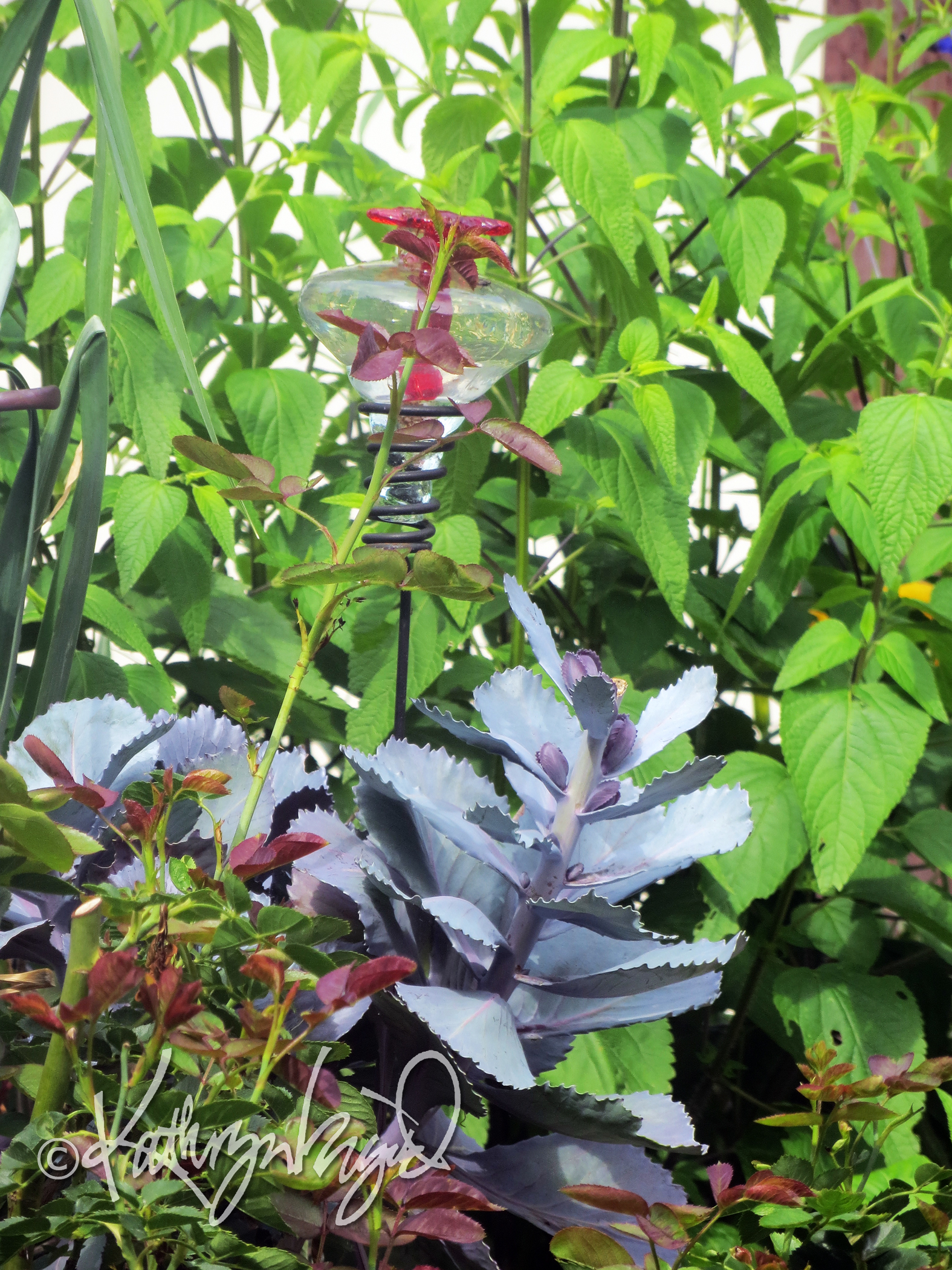
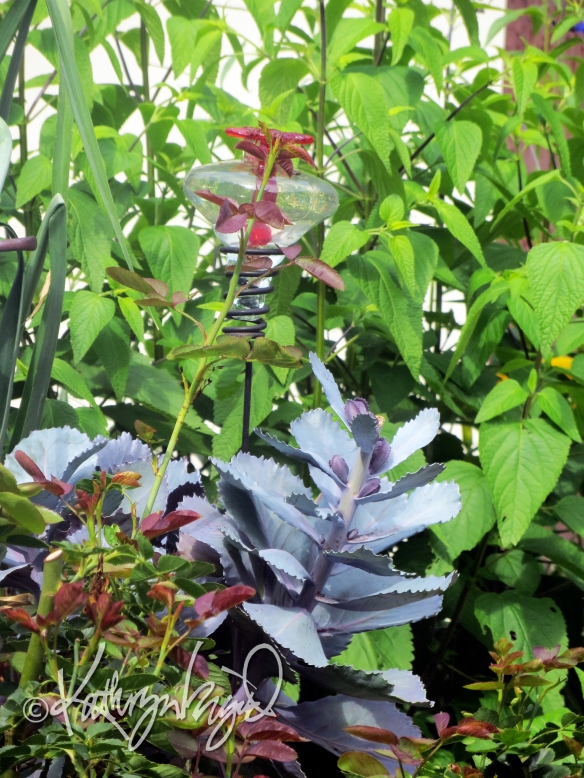
&    Lettuces are of course lovely, but cabbages too are often forgotten as ornamentals, but as you know, I like planting them for their leaf color and texture, can cut occasional leaves for food or garnish, and when I leave the rest to do so, they bloom in very hummingbird-friendly ways and are a fun novelty in the flowerbed as well. Another lettuce cousin I like a lot is chard (silverbeet), whose leaves are tasty spinach imitators (raw or cooked) and whose varieties include some with great colorful stems that make them look like rhubarb or Pop Art versions of it in yellow and orange. Mine wintered over this year in the front flowerbed, surprisingly. Radicchio is a great member of this whole group, too: edible and showy burgundy colored leaves, and if you let some or all of them go to flower, they’re tall blue daisy-like things. Quite delightful.
&    Shiso, or Perilla, is a less commonly used leafy herb in the US, but the popular Japanese treat comes in a number of often quite attractive leaf shapes, textures and colors. I grew a gorgeous one some years ago that had a slight scallop on the leaf edges, a gracefully veined texture, glorious purple and green-black hues, and a spectacular metallic sheen. I confess I didn’t use it much for food because I couldn’t bear to snip it.
&    Garlic and Onions, on the other hand, have distinctive and fun flora, and can survive longer term if you don’t choose to dig all of them up to eat.

Some herbs are potentially invasive pests but I still like them for their beauty and/or culinary gifts, so I’m willing to keep massacring them occasionally to keep them in check:

&    Oregano spreads fairly easily but is a pretty bloomer as well as a tasty leafy herb, and not awful to control.
&    Mint is a genuine monster that wants to take over the world, especially my favorite commonly named ‘apple mint’ (huh??? I’ve never figured out what’s apple-y about it) that’s so incredibly versatile, but I try to plant it in places where it can spread without turning into square-stemmed kudzu. There are a number of interesting and fun varieties of mint ‘flavors’ available, but I stick with my old reliable despite the allure of Chocolate Mint, Orange Mint, and even true Peppermint and Spearmint, since one aggressive invader variety is enough for me. Wintergreen is a beautiful plant but, besides not being a mint variety at all, is pretty hard to find. It’s a broad-leafed evergreen with small white flowers and big pinky-red berries, and the crushed leaf is wonderfully fragrant, but it’s not commonly found, isn’t a snap to prepare for edible uses like most of these others, and has a picky attitude in climate and growth requirements. Still, I did grow it once in Washington because of its peculiar attractions. Maybe I feel an affinity with it by virtue of my husband’s having chosen me for my peculiar attractions. Ha.
&    Dill is sometimes known as Dill Weed for good reason, as it can run rampant in friendly climates and it’s a large, blowsy plant despite its delicate thread-like leaves. But its starburst flora and subsequent seed heads are pretty among the leafy lace, and it’s so danged delicious in so many meals that even if your climate is conducive to such running amok it’s worth the trouble. Besides, in that case you can at least put in some of the dwarfish kinds of dill. Pretty unbeatable with fish, and indispensable in deli pickling!
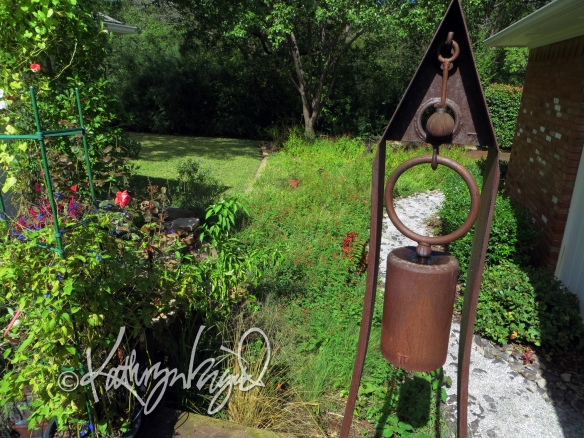
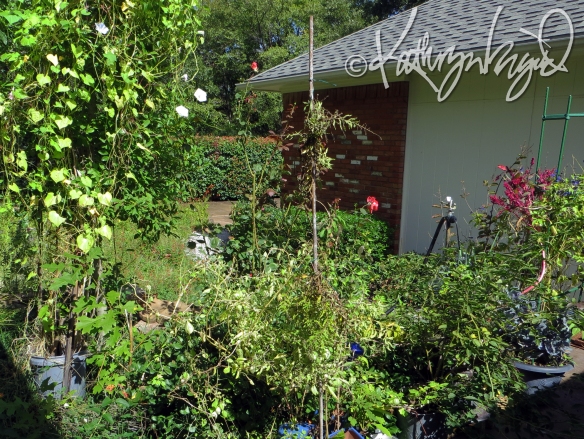
&    Fennel is similarly a member of the uncontrollable-toddler plant type, moving aimlessly but at speed all over the garden and being a big showoff of a thing, but even if you’re a little hesitant about the licorice-y hints it gives food, it too has a nicely delicate look for such a tall plant, and you can bring some nice color into the beds by planting bronze fennel. Just chop it ruthlessly when it wants to flower to keep it in check. I’ve never tried growing bulb fennel myself since as rarely as I use it, it’s easier to buy it and give the garden space to something else.photoClearly, I could wander on like this for ages. My experimental wildflower mini-meadow out back has behaved modestly well in its first half-season last year and appears to be letting a few sprouts emerge for a good beginning again now. I will go out in the next few days and give it a thorough haircut with the weed-cutter so that it has its own mulch through the remaining unreliable chills of late winter and early spring, and have been feeding it a kind of pre-compost over the winter by tossing the chopped and blended remains of the kitchen’s dregs in and letting them freeze and decay gradually as they would have in a regular garden, and will add to that with some other treats as the patch begins to revive. I am very curious to see what of the multitudinous kinds of seed I’ve planted out there now makes an appearance and what will take hold for the long term, as much of what I put in was intended to be naturalizing perennial feed for the birds and insects as well as soothing wildflower beauty. The bonus, if all goes well, will be lots of herbal fun for my dining companions and me. Only time and Mother Nature will tell.
photo

My Own Inverted Jenny

book cover imageI have a little confession to make. My book-publishing debut has a noticeable flaw. It’s not huge enough that the editorial filters of the publisher, or even my own oft-repeated scrutiny, caught it in the preview and proofing processes, but I noticed it, and I’d like to make it better. See, in the hard-copy and digital proofs that I checked before giving the go-ahead to publish, I didn’t manage to spot how low the contrast was between text and background on one of the two-page layouts, and it’s not nearly legible enough for my taste in the final print, even with my relatively eagle-sharp eyes.

So I’ve made a revised version of that page duo and a couple of other pages that were quite acceptable but I thought deserved a boost of readability as well as long as I was at it, and I have requested that the publisher allow an after-publication change. Those of you who have already purchased and received the book (I’m looking at you: family members; Mira, Diane, Gracie, Christine, etc, and a handful of others that I know of thus far) will probably know which typography I’m describing. It’s readable, but it’s an effort, I admit. Those of you who haven’t bought the book yet, I certainly hope you will do so but maybe, just maybe, I’ll be able to give you an even more polished product if you wait until I give the thumbs-up to a tiny revision in a week or so. Now, at least you know the whole story of my neophyte adventure.

If you’d rather hang on to the original version of the book as it stands anyhow, I promise you that all but the one poem—all 165 or so of the others—are entirely readable as the book stands, and while I can’t in any way promise that this, my first foray into unintentional-humor publication (to be fair, the rest of the book is supposed to be amusing) will be my last, let alone likely to accrue the sort of megabucks value given the famous upside-down airplane stamp of my post title, I do hope that when I croak, you might be able to get a bonus by selling off the short run of mistake-inclusive prints to crazed collectors. So if you paid, say, ten or twelve dollars this week (and I see they’re already reducing the price on Amazon, so bargains can already be had) you may be able to sell the book in a couple of decades for thirty-six cents extra. Talk about a fantastic investment! Don’t say I never gave you anything exciting.

But seriously, I hope that you will think buying a book from me is a reasonable investment not only in my happiness and well-being but in your own good spirits, because that’s what the book was intended for in the first place: playful entertainment for semi-grownups in the form of my whimsical-to-wacky drawings and poems. With your patience and a little perseverance on my part, we ought to be able to conjure up such an interlude together one way or another, no? I thank you for your good humor and support. Have a lovely day, y’all, and I promise I’ll keep you posted on my progress.photoOf course, since I’ve already made the revision of my “oops page” to submit, now I’ll be getting started with the conversion of the (reedited) book file to prepare it for a Kindle edition, and will need to decide which of the many other books I’ve got on various ‘back burners’ will be next on my agenda for what will hopefully be mistake-free from the moment of its publication. That’s the plan, my friends.