PostModern Coloring Book

Now that I’ve had my iPad and its various drawing and art apps for about six months, you might hope, if not expect, that I would have gained a certain amount of fluency in the medium. You would, of course, be disappointed in that. I’m still as ignorant a neophyte as ever. But I’m having a good time, and that makes plodding along at my own minimal speed worth my while, all the same. I suppose it could be compared to the childhood love of scribbling and crayons and such excellent things that leads to our continuing to practice for extensive periods over our early years despite being unlikely to become little masters of art for a much longer time yet.
Digital illustration: Modernist Coloring Book

It would be more meaningful to me, I imagine, and to those who know me, if I could extend that youthful courtesy not only to playing with my latest techno-tools for art making but also to other areas of my life’s education, the many in which I have far less patience with learning as slowly as I do and therefore generally end up quitting or making virtually no progress for eons. Imagine if I loved studying personal finance as much as I like scribbling: I might be rolling in wealth by now instead of still struggling to count change when I buy a few groceries. If I had learned to enjoy practicing exercise—any form of exercise at all—I could have been fit and fabulous and looking at living enough more decades that I could learn a vast quantity of other fantastic and exciting things.

But alas, none of that is my nature or my passion. Plodding along and just playing with those things that amaze and amuse me, that’s my style. I may get up a short burst of energy or speed and manage to improve at one thing or another in my repertoire occasionally, but if you’re looking for snappy progress, cast your eyes in any other direction and you’ll have a better chance of seeing something new and inspiring happen. I’ll be right here in my little corner, scrawling with a stylus like a crazed second-grader mauling her coloring book and cackling with delight over the slightest mark that pleases me. Just think how well I make the rest of you look good!

I Did It Myself…*to* Myself

Do It Yourself (DIY) projects, when well executed and realized, are impressive and admirable. They double one’s pleasure in the end product by being not only beautiful and useful as desired but also the satisfying result of her own skilled labors. Personal investment increase value exponentially.

I can claim a few DIY accomplishments on my resume, happily, despite my ordinary limitations of resource, monetary or of expertise or ability for the project in hand. But having mentioned hands, I must also confess to having a DITY (Do It TO Yourself) record as well. On the occasion of the hand-made hand injury, I was fortunate that my second of inattention resulted in no worse mishap than a tiny nip on my finger.

Being an artist, I did however do this with a certain degree of style: when I stuck my finger with a single tooth of my nice, sharp little hand saw (too aptly named, perhaps?), I did manage to insert the steel into the only small spot on my hand that already had a visible scar. Puncture becomes punctuation, so to speak.

As always, the tiniest wound is magnified by other pains, not least of them the injury to ego and dignity when on the instant of infliction I succumb to a combination of reactions that to the uninjured could only have a sort of serio-comic ridiculousness perfect for cutting me down to size. The unpleasantness of having made an unwanted incision in my personage is compounded by the leap back that threatens to throw me over a chair and onto my tailbone; the pinching clamp of fingers on the cut to stanch the bleeding hurts almost more  than the initial stab; the yell of pain that, in my nephew’s youthful terminology ‘scares my ears’ is also loud enough for the neighbors to hear and enjoy. On top of all this is the diminution of my sanguine pride, reminding me that my handy skills are sorely limited no matter what I tell myself.

Does this prevent my attempting further DIY projects? Hardly! Being by nature a timid and lazy and not-so-brilliant craftsman hasn’t made me give up but instead tends to make me plan and work things out fairly exhaustively before I begin, and to assume that I’ll make mistakes or need help before I finish. It all slows me down, to be sure—and that’s not a bad thing, mind you. Any DIY work is bound to be only as polished as patience and occasionally remedial work can make it.

When I speed up too much, I get sloppy and unfocused; I make silly mistakes like sticking my finger on a saw tooth/a saw tooth into my finger. Luckily for me, I didn’t have a power saw going there, so all I lost was a few minutes, my composure, and a few red cells rather than a digit. In return, I got a good reminder to sharpen my attention, to use tools with greater care, and to call in expert help when needed.

After all, I’d far rather sacrifice some dollars and a touch of my DIY pride than an appendage. This is how I’ve survived to my advanced age without losing any body parts or breaking any bones. I have recovered numerous times from being an (or falling on my) ass. Self image is ever so much more resilient than such things. Arguably, a little too much so in my case, or I wouldn’t tend to get into these fixes at all.

Of course, getting into a fix is something I can easily do all by myself. For that task, I do have all of the necessary experience and expertise.Digital Illustration: In Which I am a Silly Ass

A Whispering Medium

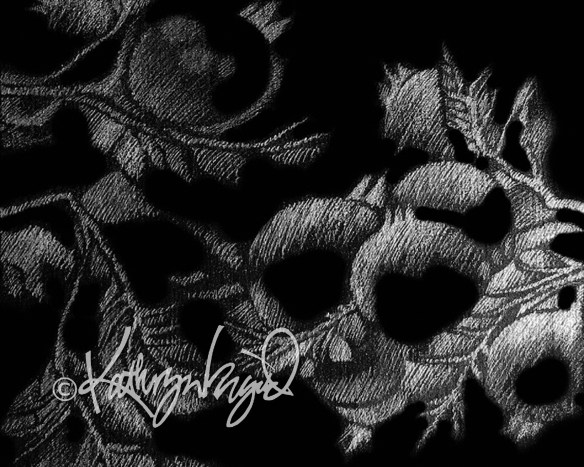
Silverpoint is relatively rarely seen nowadays, but it remains a delicate medium for drawing. Putting a point of real silver onto gessoed paper allows the same kind of fine detail and fragility to be expressed that are characteristic of harder graphite pencils’ work. The effect is of pale and careful imagery, a wisp of smoke, a mist, a whisper.Drawing: Silverpoint Apples

There’s an appealing air of the arcane to a medium that’s old and seldom used nowadays, and silverpoint qualifies on both counts. It’s also effective, as I found in my little experiments, on a black background to create gently ghostly drawings, but as ghosts seem wont to do, has a tendency to disappear at the slightest whiff of air, since oxidation darkens silver and it becomes less and less visible against the dark ground. Of course, that very ephemeral quality might be a further attraction, an encouragement to see the medium as a passing fancy best appreciated ‘fresh’ and gone in the blink of an eye.

Drawing: Silverpoint Blueberries

This is, after all, an age in which change comes at an ever-increasing speed and in growing quantities, and we become accustomed to nearly everything having the shelf life of a mayfly at best. We adapt, we move on. Yet we crave the sense of permanence and connection, so here I am marking in graphite over the top of the silverpoint as it fades, or scanning the images to enhance the contrast while it can still be seen. And while I still love the sense of tactile attachment and involvement that writing longhand, pencil on paper, gives me even when I’m up to my elbows in graphite dust, not to mention hoping that the neural connections such physical action reinforces better than keyboard manipulations will stay with me longer somehow, what do I do with my writings? Transcribe the scribbles to the electronic medium by sitting at my keyboard afterward anyway.

So passes our world; we labor with new tools to speed things up, revisit and relish the old methodology and tools to slow down and remember, and then run back to catch up with the new again. We, too, are ephemeral as faint images, as ghosts, and we feel our mortality even as we strive to make our marks on the world while passing through it. Our tiny voices and messages may be lost in the ether forever, and that, almost at the instant of their making, but the urge to tell our tales remains. Our little silver trails will fade, but we will have moved on elsewhere as well.

Ridin’ the Fences

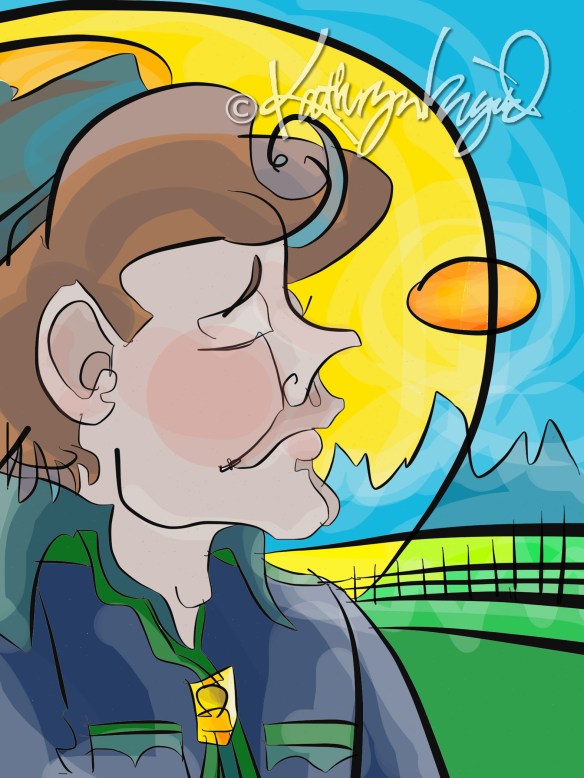
I’ve lived in Texas for five years now. Safe to say, no native of the state would remotely consider me a Texan, though. Being a true Texan, I think, is not so much a matter of hometowns and habits as it is something that exists in the ethereal zone where there is an overlap between a spiritual state and an art form.

I don’t begrudge this; I merely stand in awe of it. It’s as intense and intrinsic a form of identity, I gather, as any birthright. I also believe that regardless of where on earth you had your nativity, you either are or aren’t born to be a Texan. Some people born in the state of Texas can take it or leave it, some just need and can’t wait to leave it, period, and can’t take it at all. And as the slogan here goes, there are non-natives who swear that ‘I was born in X, but I got to Texas as fast as I could.’
Digital illustration: Ridin' the FencesKind of the way of all callings, I suppose. Some have a clear sense of destiny or vocation, and some don’t. Some adore what that purpose promises them, some are indifferent, and some will go to the ends of the earth and beyond, if necessary, to escape it as if it were Toxic Doom, Incorporated. We all have our ways of ridin’ the fences.

So if I can’t be a real-live ranch hand no matter how that suits my romantic image of what it ought to mean to be a Texan, at least I’ve found my ways to make living in Texas suit me just fine, for as long as I desire to live here or the Real Texans don’t hogtie me and ship me out of the state in a rickety hay-wagon with a busted axle.

Blowing through the Wild Grasses

Weed or wildflower? Messy or naturalized? Everyone has an opinion, and they often differ distinctly on the same little plant or plot. Part of the pleasure of good company will always be in its variety and the interest that it brings to life. Gardening tastes are very much in that vein.

Digital illustration: Wild Grasses

As a sometime gardener, however amateur, I can think of few styles of landscaping that I don’t find appealing and attractive in their own ways. I admire the near-perfection of elaborate, formal palace gardens and magnificent, fountain-filled parks with their follies and allees. I am fond of a rustic campfire-side bramble patch, punctuated by straggly hydrangeas run wild, down by the lakeside. There is both soul refreshment and eye appeal for me in a delicate Zen garden with bonsai, laceleaf maples and a barely rippling koi pond.

When it comes to my own gardens, I tend to walk just a little farther on the wild side. I hate to fiddle and fuss at length with the hard labor of a garden. I greatly prefer the genteel pleasures of the design of the garden, and perhaps the occasional artistic pruning to shape a rhododendron or sapling tree. But I’m not so wild about back-breaking rock picking and digging; I moved from incredibly rich but equally rocky volcanic glacial till of western Washington to the cement-like red clay of Texas, both places where putting a one-gallon root ball into the ground requires a pickaxe.

My first garden was an exploration of the beauties of cottage style gardening. Washington, temperate and moist, was ideal for a grand assortment of bulbs, flowering shrubs and cutting flowers, so I had profuse blooms and constant green with little effort. The traditional cottage style allowed me to squeeze a massive amount of lively growth into a normal city house lot, and the more I wedged into the ground, the less room there was for volunteer and invasive plants. Weeds had a tough go of it there, so it wasn’t especially hard to keep ahead of them.

There are plants I don’t invite to my parties. Much as I enjoy and admire most, I’m no friend of those pest plants that choke out others, cause massive allergies, or stab at me with cruel thorns, or those that threaten entire ecosystems, mine or others’. Good riddance to misplaced English Ivy, kudzu, poison oak and wild blackberry canes. Conversely, one of my particular favorite garden options is to find ways to encourage native plants to thrive. The more a plant is suited and accustomed to its environs, the more it will grow and be healthy and attractive and weed-proof.

Texas has reinforced that love in my aggressively. It’s a harsher climate than the Pacific Northwest’s in which I now garden, so what I plant and tend must needs be up to surviving and flourishing in those more demanding circumstances—or die. Even desert plants don’t necessarily have what it takes, since north Texas can still get true freezes in winter, and occasional snow, hail and ice. This last winter, a relatively mild one, still killed off a lot of specimen agaves and prickly pears and even cut some mighty oaks down to size.

I’m finding that the area’s status as an extension of the country’s central prairies may be the key to what will survive and grow here long term. When anything will grow, that is. I’m tending to my little wildflower meadow out back, to see if I can’t reintroduce something a little more self-sustaining than those long cultivated but seldom successful hard turf lawns that were popular in our area and surrounded our house when we bought it. Even better than the wildflowers, I’m finding, will be the ‘amber waves of grain’ I seeded in  among the wildflowers, the native prairie grasses.

Prairie grasses have some of the deepest, toughest and most tenacious root systems of any type of plants, and along with the leaves that sway in every breeze, often creating symphonies of susurration, they go to seed in many attractive ways. So I really am enjoying ‘sowing my wild oats.’ And Little Bluestem, Fountain Grass, Weeping Lovegrass, and many more. My backyard creatures will enjoy them, and their varicolored, many-textured attractions will beat any struggling, forced lawn that ever tried to eke out a living where its native cousins once roamed free.
Well, Blow Me Down!

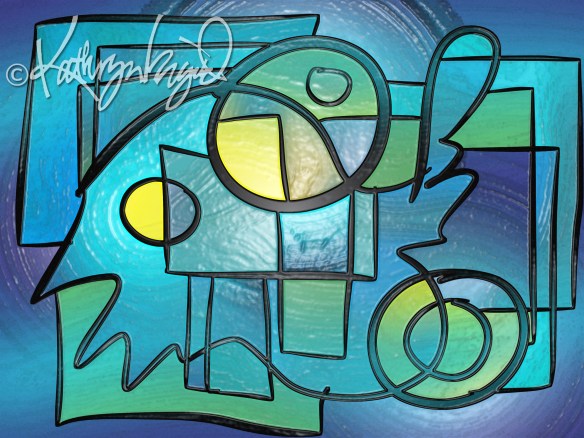
Digital illustration: Blow Me Down!The old expression in my title here—close cousin of ‘you could knock me over with a feather‘—is a colloquialism for great surprise. It’s also, was so many colloquial phrases are, comically colorful and exaggerated. Hyperbole and humor grow out of genuine life experiences and events. They are anchored in recognizably real sensations and situations as much as in silly imagination.

After all, when in shock, don’t I feel my knees suddenly go uncomfortably loose and slack, and go all light-headed as though not only my hat but the whole top of my head might just fly off at the slightest whiff of a breeze?

The appeal of the idiomatic phrase, regional quirks of language, colloquial expressions and other ‘decorative’ forms of description is that they can often communicate far more about the situation than mere facts can do. They share more of our personality and character and our own experience of the moment than the dry recitation of what can be scientifically charted could ever be able to convey. And they amuse and entertain, which gives much more impact to any statement than simple and bald recitation, and what has such verve is more likely to stick in the memory as well.

Also, it’s kind of hard to make a little illustrative sketch that conveys the astonishment with which an unforeseen hat-snatching or similar surprise nearly so well as one that says, Well, Blow Me Down! If you know what I mean.

Keeping My Eyes Open

Let’s not quibble about why I’m here; just show some respect for my dedication. I keep watch, I am the guardian, I stand undaunted at attention. I am a tireless protector. Never mind that I’m protecting what I hope might be my lunch, or at the least, my plaything for the while. I am a cat, and that is what the best of us cats do. It is nature and vocation.Digital illustration: In the Catbird Seat

The mouse living in there, well, he might have a slightly different point of view. But let’s be honest: his place in the natural scheme of things is as a cat’s toy or treat, isn’t it just. So I shall perch here and keep my patience, and never you mind criticizing my ways. That would be too—well, human of you. And you didn’t want to share your house with a mouse, now, did you! Just look away. I’m busy here.

Meeting the New Kid

Did you know that there are creatures you didn’t know you knew? Of course you knew it. After all, there’s the whole race of super-characters, multiple species like the Yeti and the Loch Ness Monster, Dracula and Tinkerbell, Wonder Woman and Wolverine peopling our universe, or at least some parallel ones, so we’re pretty well surrounded by fantastic fellow creatures if we’re willing and able to recognize them.
Digital illustration: Bumblesaurus

I think that perhaps part of the reason I’ve so long loved living so deeply in my imagination is that, having the social anxiety I’ve always dealt with when it comes to human-type people, I find I’m fond of fictional company and its many quirks and quizzical qualities. Not that I would necessarily be more masterful or even less shy in the midst of make-believe characters: I’m perfectly capable of being intimidated by the magnificence of pretend persons or frightened by the nastiness of the wicked ones just as easily as by real folk.

So you’ll forgive me if, despite his appearance of being slow-moving, benign, and perhaps a touch dim-witted yet perfectly friendly, I take my time getting to know the Bumblesaurus. He just wandered into the backyard when I wasn’t looking and made himself at home under a mulberry seedling. Yes, you got that right: he’s four centimeters long. Did I mention that I’m a nervous type? I mean, you only have to be the size of a flea to spread the plague all over Europe and kill off hordes of humans, right? I really do have to remind myself to give everyone, not least of all the Bumblesaurus, the benefit of the doubt. As they probably all do me.

Slow-Moving Cars & Shiny Objects

Distractions abound. One split second of inattention can lead to disaster, whether it’s the roadside wildflowers that make me fail to notice the brake lights ahead of me or the glittery wings of a metallic beetle that keep me from realizing that everybody in my promenading party has walked on ahead without me and I don’t quite know where. Not such great and significant dramas in the grand scheme of things, these, but small indicators to remind me that things could have been so much worse if I hadn’t been so fortunate, and might be yet if I don’t learn from the nudges.Digital illustration: Tripping along the Road

The best fortune in them is, of course, that I’m cautioned before the crack of doom. How much better to be alerted by noticing the swerve I had to make to avoid plowing into the slowed traffic, or by realizing I have to catch up with my strolling companions than that I actually caused a crash or hiked right off the trail into uncharted wilderness alone. A little jolt is an occasion for large thankfulness.Digital illustration: Dyslexic Map

That’s how I travel through life, bumbling along its unmapped corridors with my faulty personal GPS and my avid, easily attracted magpie eye. I bump into life as much as I take a route through it. I’m just relieved to have lived this long without disappearing down any of an infinite number of rabbit holes and being lost forever in the warrens, tripping in them obliviously only because I was too mesmerized by nonessential Other Things along the way.

Cautionary Tale

Years ago our family lived near a wooded area where all of the kids in the neighborhood loved to explore and build forts and play, but the youngest among us wasn’t permitted to go there alone, for obvious reasons. The training was attested to by the little girl from next door who announced quite solemnly to my mom one day that her “mother always told [her] never to go into The Forest.” This little ditty is for Micki.

Don’t Go into the Forest

From long ago, our elders cautioned us

That in the wood there lurked a dreadful beast

Whose fangs were fiercely fine, and for whose feast

A hearty haunch of whole rhinoceros

Was scarce an appetizer, and the main

Entrée, a village full of soldiers, knights

And heroes snapped up, each, in single bites,

Made more delicious by their screams of pain.

Our fear of this stayed abstract, since the hurt

Inflicted, terrible enough, was made

For full-grown animals and men, which stayed

The doom from us—but then we learned dessert

Was Children, and we changed our minds, for good,

About the lure of wand’ring in the wood!Digital illustration: Child, Mother, Monster