A Musical Tradition

The office where my esteemed spouse performs many of the studies and administrative duties comprising his workload outside of the conducting element at the church where he’s now interim chancel choir director hasn’t got a lot of stuff in it other than a big desk, a small piano and a couple of bookshelves. Most of the books that had filled the shelves went away with their owner, the previous director; a few that go with the office itself remain on the shelves, and all by themselves they tell quite a story. That’s the way of books in general, isn’t it.

It’s all the more so in this instance, by virtue of the books’ being vintage hymnals. The history of the United Methodist Church at large is in their pages. The history of this specific congregation within the UMC is there, too. And there’s a great deal of Protestant church history, Wesleyan history, English and American folk music and even larger and older parts of the musical tradition. All right there in the pages of some rather small, rather worn books that just happen to be full of hymns.

There are libraries; there are Protestant theological resources; there are music collections; there are history books. All of them are in this one room, in a handful of little old books. And that, in itself, is the nature and long-lived tradition of printed music in general. So much has been passed down in the oral traditions of so many cultures and religions and peoples, but there’s an enormous amount that lives on and grows and inspires because of those amazing repositories that exist in the written music that survives everyday use, one generation after another. I only hope that all such traditions can be preserved and enjoyed far beyond our lifetimes, whether in temples or towns, religions or regions, families or foundations, schools or individual choirs. Beyond inspiration or even enjoyment, these are great containers of food for thought.digital collage

It’s Still Life

Little is as desirable in day-to-day life as peace and quiet. Rest, respite, calm–I crave them. There’s so much invitation and welcome in the sweet marvels of time off, time out and down time that I never feel I have too much of, well, not-too-much.

But busyness is ever so much more common in our everyday existence in this century, certainly in this household. It’s no still life, to be sure; any silence found in this way of living is more of the deafening sort. But yes, it’s still life.

So I have to manufacture or steal my moments of rest and relaxation. Isn’t that how most of us end up finding our tiny increments of space and time and sanity anyway? I have to learn how to tune out the white noise, hide from the constant demands and burrow into hidden corners when and wherever I can, to choose deliberately to decompress and unwind. If I don’t make room for my own peace of mind, who’s going to give it to me? The world may rattle on around me at a furious and eardrum-shattering rate and all I know may change in the ten minutes I’ve stolen to renew myself, but I will return to those realities soon enough, and hadn’t I better do so in a fortified state than otherwise?

Better to sit down and tell myself soothing tales undergirded with lullabies, to draw myself a little old-fashioned still life arrangement in the calm unruffled grey of graphite, and breathe deeply without regard for the bustle and bash of the universe, if only for a moment or two.graphite drawing

Ironclad Alibis

photoYou may think I am obsessed with rusty stuff, and you may well be right about that. I like all sorts of things that look like they have stories behind them, and it doesn’t matter entirely whether they are animate or inanimate. Odd creatures are surely just as likely to have their tales (or tails) worthy of the attention, but all the more probably going to get my imagination geared up if they are in the context of marvelously creaky and rustic and grubby, grimy, weather-beaten, broken-down, scabrous places and things that in themselves invite all manner of assumptions and guesses and fancies.

photoIf I haven’t mentioned or shown you pictures of such wonderfully decrepit and strange objects and oddments in a while, you can be assured that it’s not for lack of interest or for my not having a multitude of such images, visual and verbal, on file and in process. I do try to vary my posts at least a smidgen [Hi, Smidge!] so as to not put myself into a blog-induced coma, let alone every one of you out there who stumbles into my cave of wonders. Then again, the urge rises and I must let some of my pet images out to play.

photo montageDo I get repetitive and predictable anyway? Why yes, of course I do. I can’t help but ramble down favorite paths just as much as anyone, and even when I do have a modicum of willpower in that regard, you can be certain that I’ll give in to my sensationally short attention span and return my focus to its standard grooves soon enough. Most of us do operate that way. I’m not even particularly apologetic about such crass and lazy behavior, as long as no one’s paying me to share what I put up in my little window here in the ether.

photo montageSo if you think it borders on the criminal, the way I manipulate you into thinking I’m veering off into sincerely new and exotic territory at times or the fact that I have such small and narrow interests and opinions and loves, I wonder at your fortitude (or stupidity) for not just trotting off toward greener pastures, at least less rusted ones. And I’ve admitted to this and many other of my faults, so I don’t really think I owe you any further apology or explanation. What you see here is unshakably the real me. Except when it’s straight-up fiction, because I do have a propensity to lie, too.photo

Urbanity

There is a huge difference between the merely impressive and the expressive when it comes to modern cities. Rotterdam, once one of the glories in the European architectural crown, was bombed to dust in WWII and, given the poverty of post-war resources, was rebuilt in the following decades as a horrifyingly soulless, boxy blot of concrete on the face of the Netherlands. There is no comfort in knowing that the firestorm that destroyed the city was probably not planned as it happened but resulted from a perfect storm of another kind in miscommunications; the horrors of war are a long testimony to the potential for such devastation. In any even, it took Rotterdam ages to be revitalized into the place of energy and beauty that it is today. Why? What made it such a heart-stopping graveyard of a place when it had once been full of life and loveliness, and how could it ever come back to be something gracious and potent again?

There is no obvious single word that can express the massive destructive toll the bombing took on that city; annihilation is perhaps a close approximation, since it’s clear even from faded photos that the thoroughness of the attacks left very little evidence there had ever been a Rotterdam. I find it nearly impossible to imagine even when staring at proof. When my spouse and I visited the city for a conference even less than fifteen years ago it was still a sad shadow of its former glory, still dominated by 1950s-vintage blocks of affordable and utilitarian harshness that made me want to scream when I saw them in juxtaposition to the few tiny remnants of the beautiful architecture that had once filled the place.

The main reason that Rotterdam is beautiful once again, and that many other cities have, and some have never lost, such beauty is simple: architectural thought and distinction. Building what is cheapest and easiest to construct is a poor solution to lack of structure anywhere. Places that have never experienced the ravages of war, urban decay and other forms of damage and neglect in such extremes can retain the beauty and patina of urbane culture in their urban settings far more easily. Take Boston, Massachusetts, a city that has seen its share of ups and downs over time, but as one of the older cities in a young and generally untouched-by-war country, still has many of its older–even oldest–and most prized, elegant, distinctive buildings. Despite the expected problems of social unrest, economic up- and downturns, spots of urban blight and misdirected city planning that Boston has faced like any modern city, the knowledge that the architectural strengths it does have are worthy of protecting and preserving means that it was built as more than mere indoor space in the first place and that the character of the structures has as much value in shaping the city’s identity as do its great denizens.photoIt should be obvious to those of us wishing to see all of the world housed and sheltered in humane and useful structures and towns and cities that simply throwing up whatever is cheapest and most readily available is hardly more useful, in the long term, than just plain, well, throwing up on people. If we want others to live educated, healthy and therefore productive and admirable lives, we can’t stuff them into trash bins of buildings that, even if they don’t collapse under their own flawed ugliness, will never encourage their occupants and users to flourish. If we don’t intend to fill others’ lives with the vomitous garbage we ourselves would reject and flee, we must find ways to make good, practical, appealing design a mandate and not an afterthought or an unaffordable dream.

That approach not only makes living and working in tolerable shelter possible but nurtures the human spirit and pushes us all to better ourselves, our cities and our world. photo

If You can Read This, You’re Already Contaminated

When is an advertisement not an advertisement? A warning not a warning?

When bad signage happens. And oh, boy, does it.

photo

It looks okay from here, but if it’s installed in a corner that cannot be seen from across the sidewalk when approached from the correct direction on a one-way road, it loses something in the translation.

Sometimes it’s the glaringly obvious kind of crumminess that comes from ugly design, inaccurate information, typos, misstatements and inappropriate imagery that destroy the intended impact of signage. Sometimes it’s subtler stuff, though. To install signage in the wrong place–or not in the right place–or backward or upside down or in a hidden spot is not only unproductive, it’s counterproductive. It sends people the wrong direction down one-way streets, makes them turn machines on when they’re supposed to be turned off, and lets them walk past the place they seek six times before realizing that what looks like a reflection in the window is actually the back of the sign.

Sometimes, not maintaining the signs properly leads to, erm, lead poisoning, if the sign cautioning that toxic lead is present is no longer readable until one is actually in the toxic zone. A neon sign in my longtime home of Tacoma was half unlit for months on end, supposedly inviting visitors to come to a cheery little mini-mall near the freeway, but I often wondered how many people who didn’t already know the place were actually enticed by the come-hither sign winking at them, ‘COMA PLACE’. There was a family near another home of mine who liked to let everybody know which was their house, so they put up their name by the mailbox in a beautifully scripted plaque proclaiming their home the location of ‘The Balls of Bothell‘. I’m a little surprised that the city didn’t cite them for indecent exposure.

photo

My guess is, the paint that was added over the old pump [and sign] is lead paint, too.

Funny how much we read into these things. I realize that my eyes aren’t what they used to be, but I hope that anyone wishing to tell me anything in print, whether as sign or label or translated instruction book, would take into consideration that bad signage can make bad things happen to good people. If nothing else, you’ll save one life when I don’t have a pulmonary infarct from laughing too hard at those grocery labels you put in the display uncorrected to sell me ‘Semen Tea’ and ‘Mini Bums’.

The Hooey Decimal System

photoWhen I sort and edit photos, it helps if I can create categories and subcategories that will help me to find and use them after the fact. If an event or occasion is short and simple in the relative sense of such things, the name of the event or occasion itself may suffice as filing ID, but what of things like our summer road trip that encompass 5 weeks, 6000 miles, a dozen states, 2 countries, 3 music conferences, a dozen members of the immediate family, a half-dozen motels and hotels, and ever so much more?

What I tend to do is create an all-encompassing title that all photos will bear, identifying them as part of the larger expedition, and then putting them into files and sub-files that clarify the who-what-when-where-why-&-how of them. This helps me have at least a slight hope of locating any single shot or group of shots from among the multitude that remains even after I’ve culled a multitude more. It also reminds me of what things became, either because of my continuing interest in them or by natural default of recurrence on the way, thematic in the event.

Not surprising, then, that this extended road trip would have obvious and substantial files of many very familiar subjects. To be sure, there are a quantity of such old favorites of mine that any moderately frequent or attentive visitor to this blog could easily guess. Given my blog header, I can start with my fondness for rusty, rustic old things (like me, naturally), mechanical bits and industrial loveliness. There are hints in that image, as well, of my magpie adoration of all things shiny-metal, glass, water, jewels, plastic and any other thing that glints to catch my avid eye.photoMy many obsessions also appear in nature: flora, fauna, sea, sky and stone. If there’s a noticeable cloud formation or special kind of light I am lured to admiration of it. Insects draw me like, well, the proverbial flame-drawn moth. I’m an ignorant admirer of all sorts of vehicles that strike me as different or novel when it comes to my everyday experience, so there are always photos in my stash of cars and trucks, boats and trains, heavy equipment and the slightest, lightest personal transport other than feet. Feet, for that matter, can make perfectly entertaining objects of my camera’s affections, since people in general are also on my list, and character-full feet or quirkily clad ones or ones that by position tell a story ought to make marvelous image sources any time.photoIn the case of human subjects, I do have something of a restrictive love, however. When I know the subjects of my documentation, I’d usually rather be interacting with them, so often, the camera sits idle and forgotten unless I have some sort of mandate to shoot. If I don’t know the people, I am bound by respect for their privacy almost as much as by my shyness not to photograph them at all. So aside from crowd shots and unidentifiably altered distant views, I’m not likely to include too many people in my panoply of for-art photographs.photoWhere people congregate or what people have left behind, that’s all fodder for my imagination, though. I love buildings–the older or odder, the better–and their endless details, and whether they are homes or hospitals, offices or auditoriums, farm sheds or factories, they all have stories to tell. Ultimately, I suppose, that’s the overarching guide to my photographic peregrinations just as much as to my poetry and essays and drawing and every other expressive form of art I attempt: I am trying to discern, guess, or invent the stories behind those things I’ve seen.

There are, you know, endless stories just waiting to be told.photo

Signs & Portents

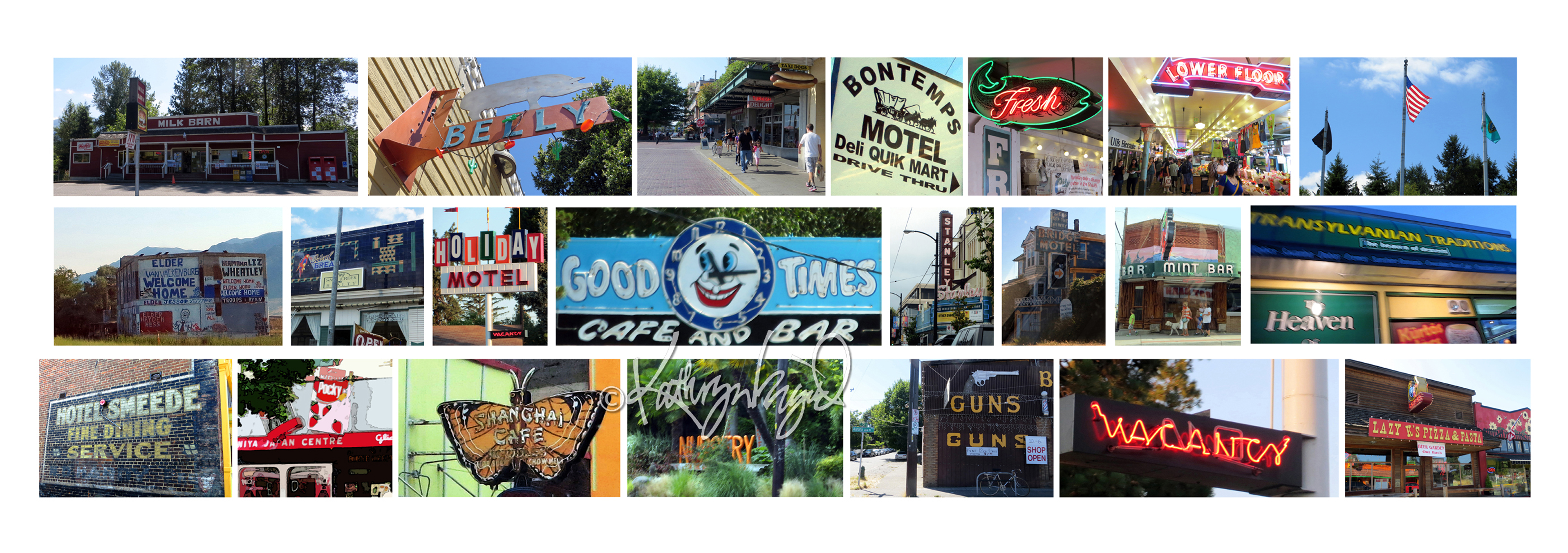
Every trip tends to have its unique interests, but they all share certain qualities, too. One, for me, is the abundance of intriguing, useful, surprising, puzzling, inviting and sometimes downright amazing signs of all sorts that mark the way. Our summer road trip was chock full of them, too; many whizzed by too quickly at highway speed to be commemorated by me with my trusty little camera, but some served well to mark a few of the highlights and oddities of our pilgrimage west and back.

photo montage

Some signs made me wonder if we’d suddenly gone far astray from our intended route, to another state, country or (occasionally) planet. [Remember to click on the images if you want to see them in greater detail.]

photo montage

A few signs were rather provocative, and many simply amused me greatly for one reason or another.

photo montage

Vintage signs often outlive their original purposes by being moved–or read–out of context. Unless, perhaps, the message has a more cosmic meaning…

photo montage

Some of the most welcome signs are those very familiar ones not seen in a very long time. It doesn’t matter so much that I’ve frequented the place or embraced the item as that the sentimental landmark each represents of other persons and places is called to mind.

photo montage

I’m especially fond, though, of those signs that seem to have lives of their own, through age and adventures unknown. I like to imagine what they denote beyond their mere artful decorations and texts.

On this particular escapade of ours, all signs pointed to a grand tour and many colorful memories. And led me, of course, to think ahead to all of the travels and signs yet to come in my life.

A [Mostly] Black & White Photoessay from the Road

digital photo art montage

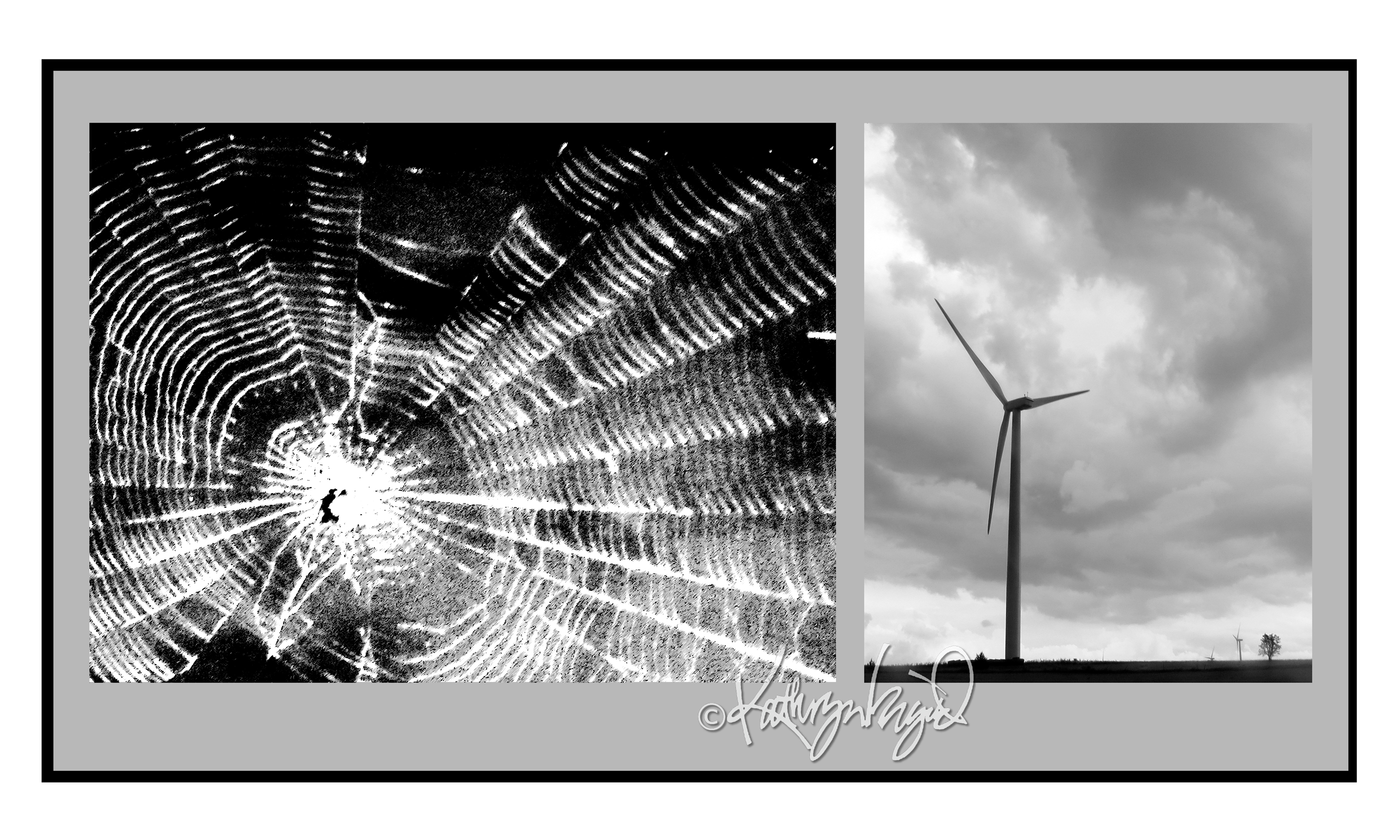
Farm Frames.
I loved the sweet repetition of gorgeous farms of all sorts, in parts of every state.

Some of the images yielded by five weeks and six thousand miles’ worth of rambling cross-country seemed to want expression in my old favorite black and white imagery. And, not coincidentally, this set particularly showcases my obsessions with seeing patterns, repetition and commonalities.

digital photo art montage

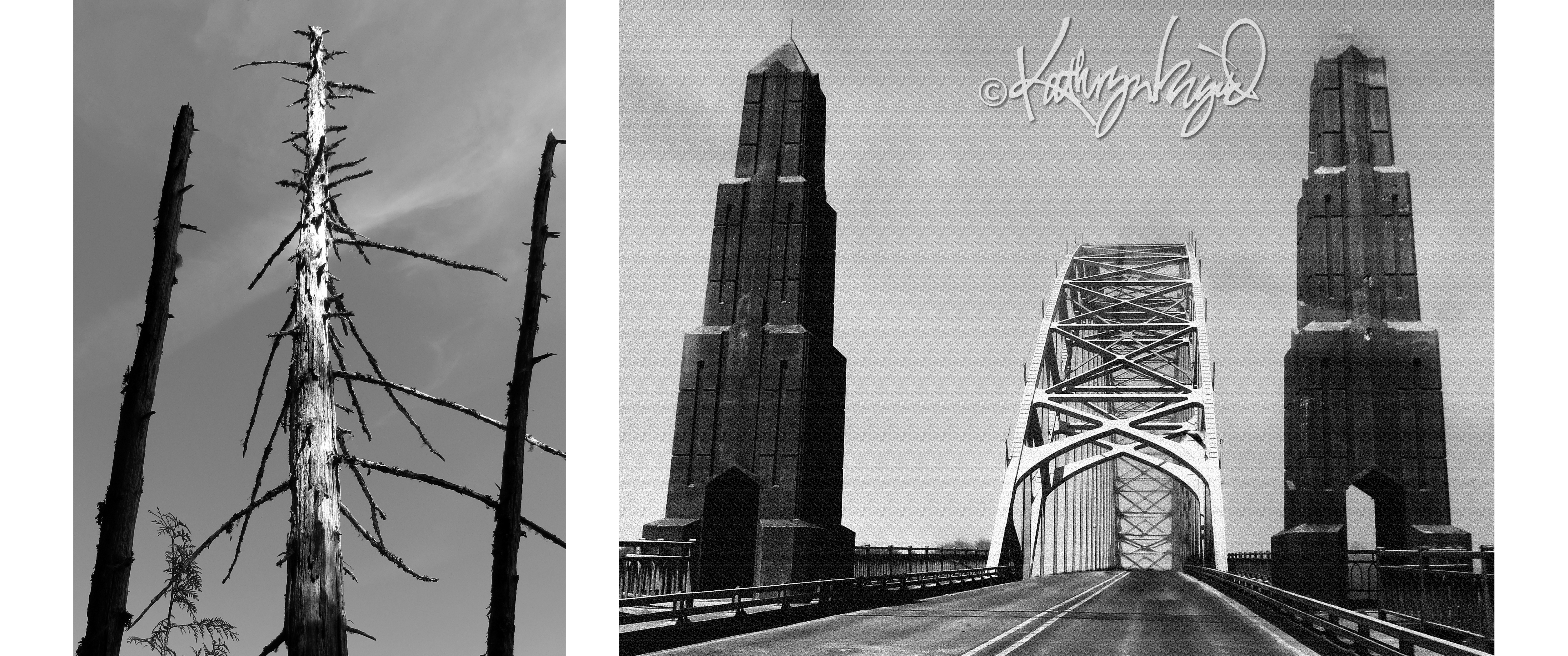
Towers
Monolithic bare trees and sculptural bridges seemingly imitate each other.

digital photo art montage

Twisted Trees
Driftwood. A helical trunk amid Douglas-fir and vine maple companions.

digital photo art montage

AmeriCars the Beautiful
Car culture in the US may have long grown old, but it hasn’t stopped being a classic.

digital photo art montage

Boarded Up
Fruit growers’ packing crates. A burned house.

digital photo art montage

Shake Your Tailfeathers
Hawk? Maybe. Mallard, definitely.

digital photo art montage

Sunday School
The old shed behind the parsonage, the inner workings of a portative organ, and a vintage church.

digital photo art montage

God is in the Details
Small stuff, large impact.

digital photo art montage

Radii
Spokes that speak for themselves.

digital photo art montage

Elephants
An older model pachyderm and an older model Packard? (Nah, I think it was a Rolls.)

digital photo art montage

Strange Geometries
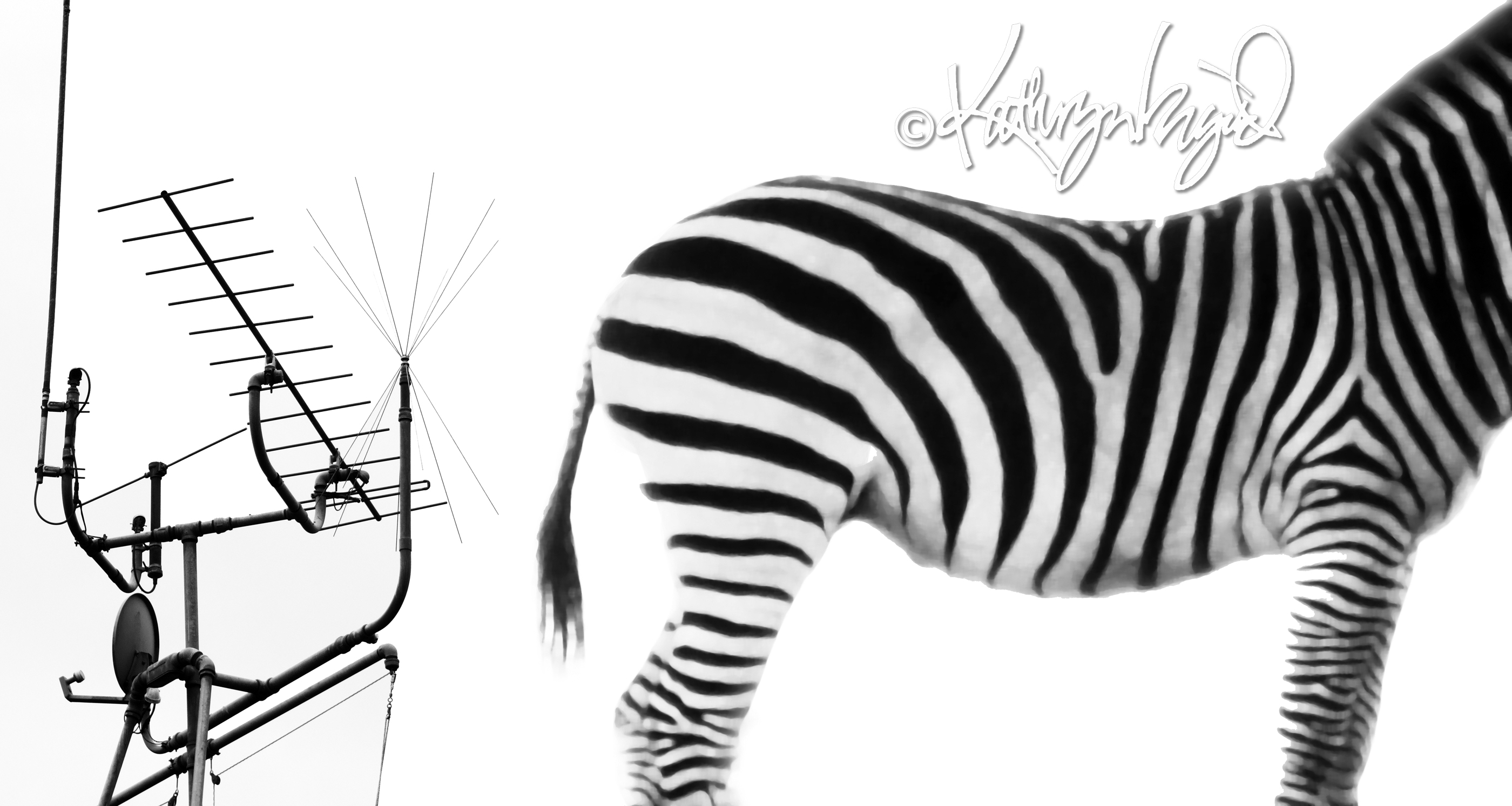
The wonder of a weird homemade aerial and the magic of a zebra.


It’s All Rehearsal, Really

Blog.08-30-2013.all-rehearsalWe may look like we’re all geared up and doing important stuff, but mostly, we spend all of our lives practicing, learning and getting ready for one thing or another. Some of those things happen in due course and many more of them either never quite come to fruition, or far more often, change along the way and we end up following along and seeing where it all takes us. All of this is quite normal and perfectly valid.

As a privileged observer and listener in many musical rehearsals long after the years when I was an active amateur participant, I can tell you that I think these more explicit practice sessions can have much the same sorts of both trajectories and outcomes. What anyone not privy to the backstage view of any sort of practice may easily forget, even if they once knew it, is that whether the moment is strictly obligatory, is amateur in the finer sense, or is wholly professional, it can have the same range of characteristics, studious, soulful, playful, predictable, heartrending or hilarious–or some grand combination of them all.

The experience of listening in on the preparations for musical performances is distinct from the performances themselves in a multitude of ways, but perhaps the most striking to a non-participant is arriving at a high-level rehearsal and seeing all and sundry set up camp for it in their work clothes. The star soloist is wearing old jeans. The conductor, who no matter how rigorously the singers and players enact their parts will likely move around and sweat the most, is wearing shorts and a short-sleeved, thin shirt. The players have open cases near their chairs with spare instrument pieces and alternate score parts strewn across them, and the singers, no matter what the temperature, are wearing neck scarves and lugging big containers of fluids to protect their own precious instruments. The rehearsal accompanist at the beat-up old piano is wearing glasses both on the bridge of the nose and the crown of the head, one for the easier to read individual parts and one for the microscopically reduced full score. All of this in a sort of ordered chaos the shows they are all there to Do Things. It’s work. It’s fun. It’s messy, like life.

Our Big Summer Road Trip, a driving circuit of over 6000 miles this July and August, was a multipurpose travel package designed to accomplish a number of ends, not least of them to attend and study and enjoy music-related adventures with friends, colleagues and other musicians and music lovers in several disparate events. First, we went to the Oregon Bach Festival to see the newly anointed Artistic Director make his debut interview marking the occasion, and more importantly to see maestro Helmuth Rilling conduct his grand finale performance as AD in this season when he officially passed the baton to his successor after 44 outstanding years at the Festival’s helm. The Festival is a fine one, Rilling a justly revered conductor and teacher, and many of the singers and players who participate, along with many regular OBF attendees, are longtime friends and colleagues, so it’s always a joy and privilege to go to the Festival ourselves, but particularly meaningful to see Rilling lead the B Minor Mass on his way to Conductor Emeritus status, since my husband Richard had the good fortune to sing the same piece under Rilling during the maestro’s second year at OBF. A great deal of water has gone under the bridge, and though a lot has changed in that flow of time, many things remain the same. Rehearsals and performances, practice and action go on as ever.

I had been reminded of all of this, of course, by the opportunity to attend the Boston Early Music Festival and see my spouse conduct and his Collegium Singers and the university’s Baroque Orchestra in June, along with admiring all of the other marvelous artists and events at BEMF. So many wonderful concerts and recitals; so much hard and happy work to prepare them! And how quickly June disappears into the mists of memory as the summer rolls forward. Thus, a long road trip seemingly becomes an amazingly fresh outing to experience more variations on this theme.

The second of the trio of musical events we attended on the road trip was the regional gathering of choral conductors in our former home area, a great opportunity to renew ties with longtime fellow conductors, teachers and friends over grilled wild salmon and to revisit musical literature options, audition processes, mull over the usual academic topics, share hints about favorite new compositions and gossip about who is the up-and-coming hottest new choir or conductor in anyone’s neighborhood. Driving up to the chapel that serves as the main conference space, whom should we see sitting visiting on the porch but a man who was the excellent recording engineer serving in that artistic task for many of my husband’s choirs’ recordings over the years, and with him, the teacher-conductor-mentor who led Richard to music as a vocation and profession in the first place and so became not only his ‘choral father’ but a lifelong dear friend. To follow this greeting with collegial renewal among many other fellow musical artists, from colleagues and collaborators to singers and students, composers and coordinators of conferences and musical programs at all levels, and then to have dinner a week later with both of those two first friends we’d spotted, was rich beyond words.

Third on our list and rounding out the road trip with our stop in Vancouver, BC, was the Vancouver Early Music Festival. A perfect bookend to starting the trip with OBF in Eugene, VEMF attendance had much the same purpose for us as the Oregon visit: see and hear good friends and other artists at work, and attend the events honoring the longtime AD’s retirement. While Jose Verstappen has served a mere 34 years in Vancouver, he has had as much impact of his own on the Festival there as Rilling has in Oregon, just a very different sort. Jose is a modest and self-effacing man, but as warm and as hardworking and dedicated, and certainly as hard for donors and supporters to say No to, as Rilling, and so both have created environments of commitment and excellence that will thrive long after both have abdicated their thrones. Matthew Halls, Rilling’s successor, and Matthew White, Verstappen’s, are both bright, gifted and able men and I expect to enjoy attending both festivals with as much outstanding artistry on display as ever in years to come.

While in Vancouver, besides the great fun of attending Verstappen’s farewell party, seeing many dear friends, meeting Bruce Dickey–the leading light of cornettists nowadays, he will be playing in the production of the Monteverdi Vespers Richard’s conducting in October–and hearing some terrific music of various kinds in concert, the highlight was sitting in during rehearsals for Händel’s ‘Israel in Egypt’. It was there that I was most struck by this lovely interweaving of labor and lightness that can happen when the people at practice are fully engaged in their work and love what they do. The piece itself is a marvel, full of potent and piquant and even picaresque melodies and moments, and those singing and playing it made the most of these riches. When Tyler Duncan and Sumner Thompson started singing the bass duet ‘The Lord is a Man of War‘, not only was the music and text mesmerizing (never mind my personal feelings about the story’s theology) but their obvious pleasure in exploring the expressive potential in the piece together with the players and conductor (the impressively sensitive and dramatic Alexander Weimann) moved me to pay special attention to this juxtaposition of the remarkable and the workaday, the plain and the powerful. So to all of you out there who sing, play, work, rehearse, prepare and perform, and especially to the players, singers, composers, conductors, administrators and Artistic Directors encountered on this summer tour of ours, I dedicate this poem.digital illustrationNumber Thirty-Eight

Strike, then carry on, and so the sound

Belies in beauty such a martial start,

When ragtag troops in everyday are found

To sing and play at battle from the heart–

Who seemed so simply destined for the soil

As laborers in neither art nor war

But some plebeian, plodding sort of toil,

Then strike, and decimate what came before–

Show the illusion is not acted out

Through violence or merely artifice,

But rather, note by note dispelling doubt

That mystery’s all quite undone by this–

Where love and war are mingled in their way

By songs more eloquent than words can say.
Love-Birds of a Feather

I’m as much a sucker for a good bird-brained, glutinous, weepy love story as the next guy. But I only like that stuff in fiction, and only in small doses. It’s not enough for me that a love story should have a meet-cute first act and an upbeat dénouement–it’s the stretch between that ought to be uplifting and exciting. Yes, it’s a rather charming sounding concept, at least on paper perhaps, that love would be perfectly lifelong (a lot riding on how long the lives happen to be) and all-encompassing. Yet aside from the exceedingly rare few seemingly flawless pairs for whom there is no apparent need for a world outside of them at all, most of the best relationships I’ve seen or known happen because they comprise two actual individuals, with all of their own unique characteristics, their daily existence intertwining intimately without losing the color and clarity of those individual souls shaped by their distinct thoughts, actions, experiences and inspirations. A true partnership, with all the challenges of give-and-take, beats cloning any day.

That popular book-and-movie of my younger days, Erich Segal‘s ‘Love Story‘, may by now be better remembered for its tagline ‘Love means never having to say you’re sorry‘ than for its actual story of an opposites-attract kind of couple barging and charming their way through thick and thin, plucky and witty and utterly devoted to each other [because of course his haughty family has disowned him for linking up with One of Them, not of Us], until she dies–but very prettily, mind you–of leukemia and her grieving spouse is reunited with his estranged father. The whole story I could take reasonably well, but that one phrase really stuck in my craw, negating all of the negotiations it took to get the fictional couple from their meeting to the bittersweet end of their partnership at her death. Never mind that Segal himself seems to have had a great marriage that defied the glossy sentimentality of such a thing, it always struck me as cheapening the very joy of learning each other’s ways and enriching each other by simply being flawed and odd yet willing to figure out how to fit the two brands of strangeness together well. If I interpret the slogan as regarding regrets rather than apologies, it’s less distasteful to me, though I still think if there’s no risk of hurt, there’s little chance of reward either. The ultimate hurt, in this case, being not death (the old inevitable, despite the dramatic awfulness of its being untimely and painful in this heroine’s case) but the possibility of the relationship failing or being destroyed.

I guess it boils down to this: if a so-called love is so flimsy and flighty it can’t withstand mistakes and the necessary if clumsy duct tape and chewing gum sort of repairs we make on it, how can it be worthy of the name love at all? I much prefer the sort where feathers do get ruffled occasionally but the draw of true companionship and care and hilarity and comfort and adventure all together makes it well worth smoothing them back down.digital illustration from a photoMore than anybody else I know, I have been lucky in love.

I have never suffered through ill-treatment, being dumped or neglected or abused or any of that terrible stuff. I was raised by kind, loving, enjoyable parents–who still seem to think I’m worth keeping around–and have three wonderful sisters who have also kept my coffers filled with affection and excellent companionship. I’ve had a raft of kind friends who have been constant in their warm and encouraging presence throughout my days. Even the teachers, co-workers, postal carriers and shopkeepers peopling my life’s paths have generally been of a goodly sort. Best of all, I am lucky to know just how lucky I have been. And am.

No, that’s not exactly right: the true pinnacle of all this is that I found a best friend I could love, and be loved by, in the truest sense, for the rest of my life. It’s his birthday today, and I can’t help but be reminded how wildly blessed and fortunate I am in having him as my partner and daily companion as well as my great love. Being the best of friends makes all of the rest of it possible, the love and joy and kindness and life challenges faced together. We are birds of a feather, my love and I, and I wish him a long and marvelous series of birthdays yet to come. And a deeply happy one today, to get the rest of them started.

See you back at the ol’ nest by evening, my Sweet.photo montage